On this page
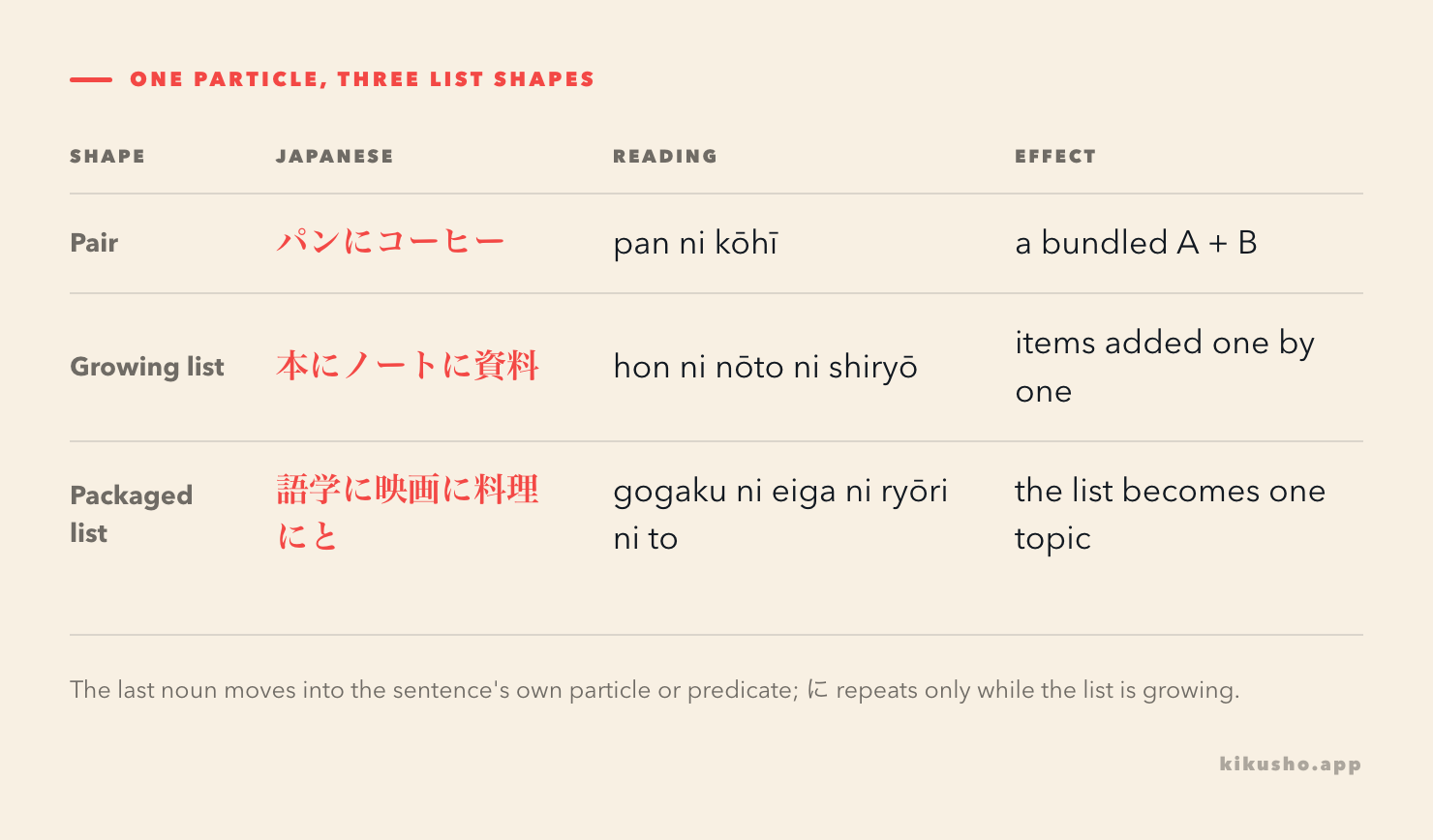
In AにB, に can collect nouns as a pairing or an accumulating list: “A and B,” “A with B,” or “A plus B.” This coordinative に is the reading behind パンにコーヒー and 語学に映画に料理にと, not the beginner に that marks a destination, time or recipient.
今日の朝食は、パンにコーヒーだ。
きょうの ちょうしょくは、パンに コーヒーだ。
Today's breakfast is bread and coffee.
The sentence presents the two nouns as a compact breakfast combination. A neutral パンとコーヒー is also possible, but に gives the pairing an additive, item-by-item feel.
Put に between nouns that belong to the same list
The basic pattern is short. Each noun must play the same role in the larger sentence.
| Form | What it does | Example |
|---|---|---|
| AにB | makes a two-item pairing | パンにコーヒーだ |
| AにBにC | accumulates three items | 本にノートに資料がある |
| AにBにCにと | packages a continuing list before the next statement | 語学に映画に料理にと、趣味が幅広い |
| AにBまで | adds an emphatic last member | 学生に教員に保護者まで集まった |
The final noun does not need another に when the sentence moves directly into its predicate. In 本にノートに資料がある, for example, 資料 takes が. Repetition makes the accumulating rhythm especially clear, but the two-noun form is common in fixed-looking combinations.
夏はTシャツに短パンだ。
なつは ティーシャツに たんパンだ。
In summer, it is a T-shirt and shorts.
普段はスウェットにパーカーという格好が多い。
ふだんは スウェットに パーカーという かっこうが おおい。
I often wear a sweatshirt-and-hoodie combination.
JLPT Sensei's assigned lesson describes this に as “and,” “in addition to” and “the combination of.” The useful constraint is narrower than that translation: the nouns are collected into one list or scene. に is not a general replacement for every English and.
Repetition makes the list feel as if it is still growing
A repeated AにBにC often sounds less like a finished inventory and more like the speaker is adding one visible item after another.
会場には、学生に教員に保護者まで集まった。
かいじょうには、がくせいに きょういんに ほごしゃまで あつまった。
Students, teachers and even parents gathered at the venue.
語学に映画に料理にと、彼女の趣味は幅広い。
ごがくに えいがに りょうりにと、かのじょの しゅみは はばひろい。
Languages, films, cooking: her interests cover a broad range.
The final と in the second sentence closes the quoted-like series so the sentence can comment on it as a whole. It does not turn the earlier に particles into と coordination. The list has already been built item by item; と packages that list before 彼女の趣味は幅広い.
Japanese teacher resource N1et classifies this as the additive use of the coordinative particle に. It also makes an important correction to a common shortcut: these lists are often open, but they do not have to be. If the scene contains only the named members, context can make the list complete.
This is why translating に as “and so on” every time is unreliable. The form supplies accumulation. The situation decides whether anything remains unstated.
と, や and も organize the same nouns differently
With familiar nouns, more than one particle can produce grammatical Japanese. The choice tells the reader how to group them.
| Sentence | How the list is framed |
|---|---|
| 朝食はパンとコーヒーだ。 | a neutral statement of the relevant items |
| 朝食はパンや果物だ。 | representative examples; other items may be included |
| 朝食はパンにコーヒーだ。 | a bundled pairing, with an additive rhythm |
| パンもコーヒーも注文した。 | each item separately shares the predicate 注文した |
と is the safest neutral coordinator when you simply need “A and B.” や deliberately presents examples from a larger class. も adds each item to the same proposition, so it normally marks both nouns in AもBも. The fuller beginner comparison of も, と and や shows their other roles as “also,” “with,” and representative listing.
Coordinating に contributes a different texture. It is comfortable in meals, outfits, belongings, groups of people and other scenes where one item seems to be set beside another. It appears in conversation and description; its N1 study-list label does not make the form inherently formal.
Word order can still matter. Tシャツに短パン follows the familiar movement from top to bottom, and ご飯に味噌汁 names a conventional meal pairing. Reversing such pairs may remain understandable, but it can lose their expected rhythm. A coordinative list is language, not an unordered mathematical set.
A list reading requires both nouns to have the same job
The surface sequence “noun + に + noun” is not enough. Compare these two sentences:
朝食はパンにコーヒーだ。
Breakfast is bread and coffee.
この料理に合う酒は何ですか。
この りょうりに あう さけは なんですか。
What sake goes with this dish?
In the first sentence, パン and コーヒー are both breakfast items. In the second, 料理 and 酒 are not two members of one list. The predicate 合う establishes a relationship: the sake suits the dish. The dish is the counterpart marked by に.
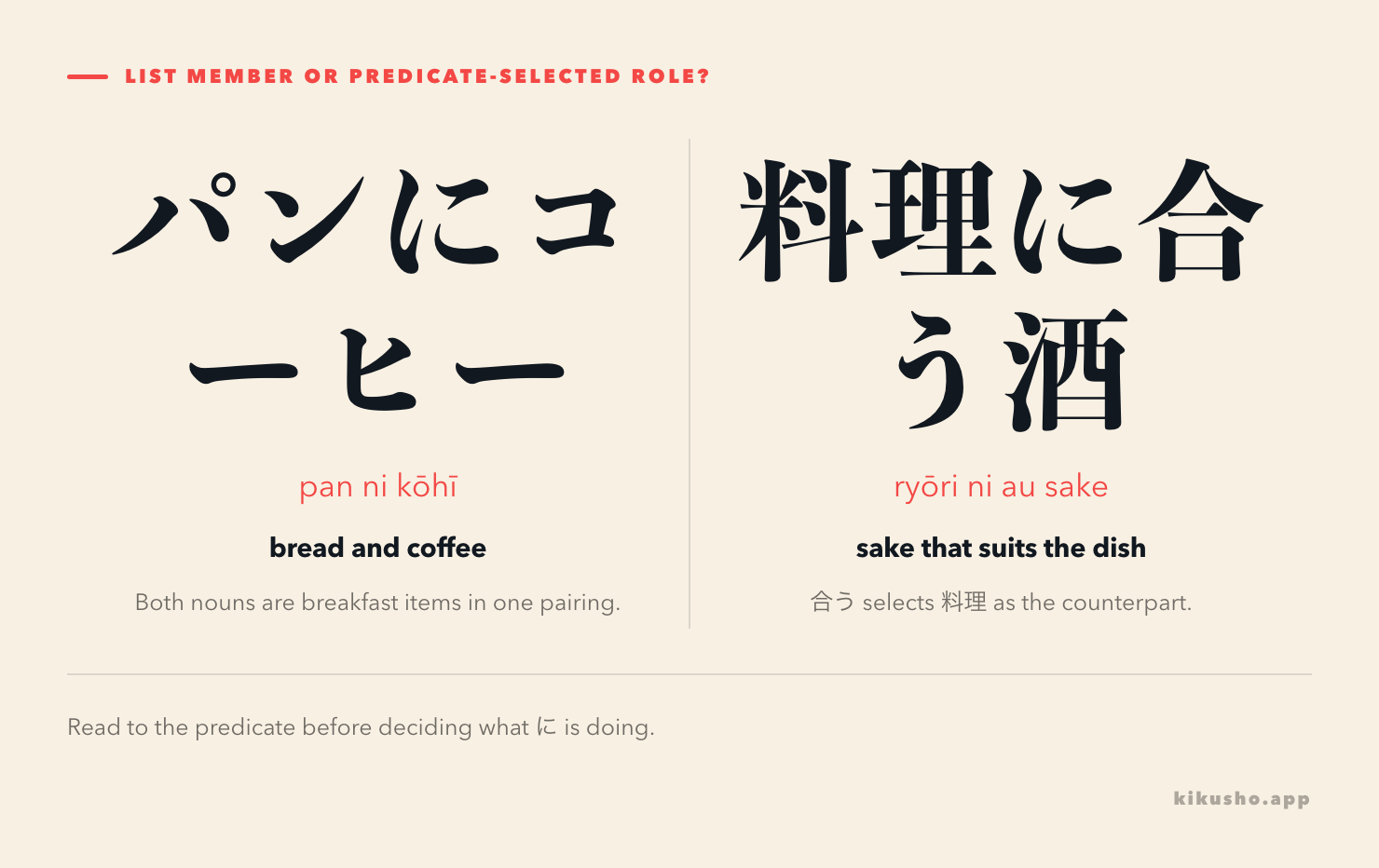
The same test separates ブーツに合わせる: 合わせる selects the boots as the target or counterpart for matching. Treating it as “boots and something” would ignore the verb's grammar.
Ordinary case-particle に remains outside this lesson too:
- 駅に行く marks the destination.
- 七時に始まる marks the time.
- 先生に渡す marks the recipient.
- 週に三回 supplies the unit for a frequency.
Those uses are introduced much earlier. When reading, first find the predicate. If it assigns a role to the noun before に, keep the case-particle analysis. If parallel nouns fill the same slot and accumulate into one scene, the coordinative reading becomes possible.
に加えて states the addition instead of merely listing it
AにB and Aに加えてBも can both bring two items into the sentence, but they are not interchangeable structures.
この仕事には、経験に判断力が必要だ。
この しごとには、けいけんに はんだんりょくが ひつようだ。
This job requires experience and judgment.
この仕事には、経験に加えて、判断力も必要だ。
この しごとには、けいけんに くわえて、はんだんりょくも ひつようだ。
In addition to experience, this job also requires judgment.
The first is a compact coordinated pair. The second explicitly establishes A as the starting point and then adds B; も often marks that added element. It works well in reports and explanations where the logical step matters. The dedicated lesson on に加えて and のみならず covers its noun attachment and the nominalization required after clauses.
That difference also explains why English glosses can mislead. Translating both as “in addition to” does not make their Japanese syntax the same. One particle coordinates list members; the longer expression names the act of adding a further factor.
The N1 label belongs to this narrow use, not to に as a whole
The assigned reference places additive or combinatory に at N1. Other lists place the ordinary case particle at N5 and the frequency pattern 週に三回 around N4. Those labels describe different functions that happen to share the same written particle.
The JLPT does not publish an exhaustive level-by-level grammar syllabus, so “N1” here is a reference-list placement rather than an official guarantee. What makes this lesson advanced is the parsing decision: you already know に, but must recognize when it stops assigning a case role and starts coordinating nouns.
The distinction has also been studied as Japanese grammar rather than only as a test-prep label. The National Institute for Japanese Language and Linguistics indexes a 2016 paper titled “Three usages of the coordinative particle ni in modern Japanese”. Its terminology supports treating this as a genuine coordinative particle while leaving room for more than one discourse effect.
For review, save enough of the sentence to preserve the parse. A card containing only 料理に cannot tell you whether に coordinates a list or marks a role selected by a later predicate. In Kikusho, capturing パンにコーヒーだ or 料理に合う酒 keeps the deciding noun or verb on the same card, so recall tests the relationship rather than the particle in isolation.
Practice: identify the list before choosing the particle
Question 1 · find coordinative に
Which sentence uses に to coordinate nouns?
- A. 七時に会議が始まる。
- B. 朝食はパンにコーヒーだ。
- C. 先生に資料を渡した。
- D. 駅に着いた。
Question 2 · make a bundled pairing
Complete the description so the clothes sound like a compact summer pairing: 夏はTシャツ( )短パンだ。
- A. や
- B. も
- C. に
- D. まで
Question 3 · continue an accumulating list
Complete: 会場には、学生に教員( )保護者まで集まった。
- A. で
- B. に
- C. へ
- D. しか
Question 4 · choose the intended list frame
A speaker wants to mention bread and fruit as examples of what breakfast may include, without claiming that these are the only foods. Which sentence best fits?
- A. 朝食はパンや果物だ。
- B. 朝食はパンに果物だ。
- C. 朝食はパンも果物もだ。
- D. 朝食はパンまで果物だ。
Question 5 · parse に from the predicate
In この料理に合う酒は何ですか, why is に not coordinating 料理 and 酒?
- A. Because only people can be joined with coordinative に.
- B. Because に can never appear before 合う.
- C. Because 合う selects 料理 as the counterpart that the sake suits.
- D. Because 酒 is always marked by が.
Question 6 · state the addition explicitly
Complete the formal explanation: この仕事には、経験( )、判断力も必要だ。
- A. に加えて
- B. にと
- C. や加えて
- D. に合って
Question 7 · build the growing list
Arrange the pieces into a sentence meaning “Languages, films, cooking: her interests cover a broad range.”
料理にと / 彼女の趣味は / 語学に / 幅広い / 映画に
Answers and explanations
Answer 1
B. 朝食はパンにコーヒーだ. パン and コーヒー are parallel breakfast items collected as one pairing. The other sentences use に for a time, recipient or destination.
Answer 2
C. に. Tシャツに短パン gives the outfit an additive, bundled feel. や would present representative examples rather than the requested compact pairing.
Answer 3
B. に. The repeated sequence 学生に教員に保護者まで adds groups one by one; まで gives the last member extra emphasis.
Answer 4
A. 朝食はパンや果物だ. や explicitly presents representative items, so other breakfast foods remain possible. に would highlight the pairing or accumulation, which is not the requested framing.
Answer 5
C. Because 合う selects 料理 as the counterpart that the sake suits. 料理 and 酒 do not fill the same list position. The predicate establishes a relation between them, so this is a case-particle use.
Answer 6
A. に加えて. The expression explicitly adds 判断力 as a further requirement after 経験. も marks the added factor in the second part.
Answer 7
語学に映画に料理にと、彼女の趣味は幅広い。 The repeated に builds the series; final と packages it before the comment about the breadth of her interests.
Let the predicate settle the reading
On an exam page or in a dense paragraph, do not translate に as soon as you see it. Read through to the predicate, check whether the nouns occupy one shared slot, and then decide whether the sentence is building a list or assigning a role. That extra half-second is what separates パンにコーヒー from 料理に合う酒.
Common questions
What does に mean between two nouns?
In the coordinative pattern AにB, に can collect A and B as a pairing or accumulating list: A and B, A with B, or A plus B. The surrounding predicate must support that list reading.
What is the difference between Noun に noun and Noun と noun?
と gives a neutral enumeration of the relevant members. Coordinating に often makes the items feel accumulated or bundled together, especially in familiar pairings and repeated lists.
Does a list with に always leave other items unstated?
No. It often sounds open because the speaker adds items one after another, but context can make the named items the complete list. や is the clearer choice when you specifically mean representative examples.
Is every に between nouns an additive list?
No. In この料理に合う酒, for example, 合う selects the dish as the thing that the sake suits. That に marks a relationship required by the predicate; it does not coordinate 料理 and 酒.