On this page
Aなりに says that an action, judgment or result makes sense within A's ability, circumstances or degree. Aなりの carries the same standard into a following noun: 私なりに考えた is “I thought it through according to my own understanding,” while 私なりの答え is “my own answer, reached from that understanding.”
The construction often admits a limit without dismissing the effort. It can also describe a proportionate result or a concern particular to a role, so “did one's best” is useful in some contexts but cannot serve as its permanent translation.
に modifies what happens; の modifies a noun
The choice between に and の follows their job in the sentence.
| Form | Job | Complete example |
|---|---|---|
| A なりに + verb | describes how or to what degree the action is done | 私なりに調べた |
| A なりに + adjective/predicate | evaluates the resulting state within A's standard | 小さいなりに役に立つ |
| A なりの + noun | makes a noun fit A's standard or circumstances | 私なりの結論 |
専門家ではないが、私なりに資料を調べた。
せんもんかでは ないが、わたしなりに しりょうを しらべた。
I am not a specialist, but I researched the materials as carefully as I could in my own way.
これは、今の私なりの結論です。
これは、いまの わたしなりの けつろんです。
This is the conclusion I have reached at my present level of understanding.
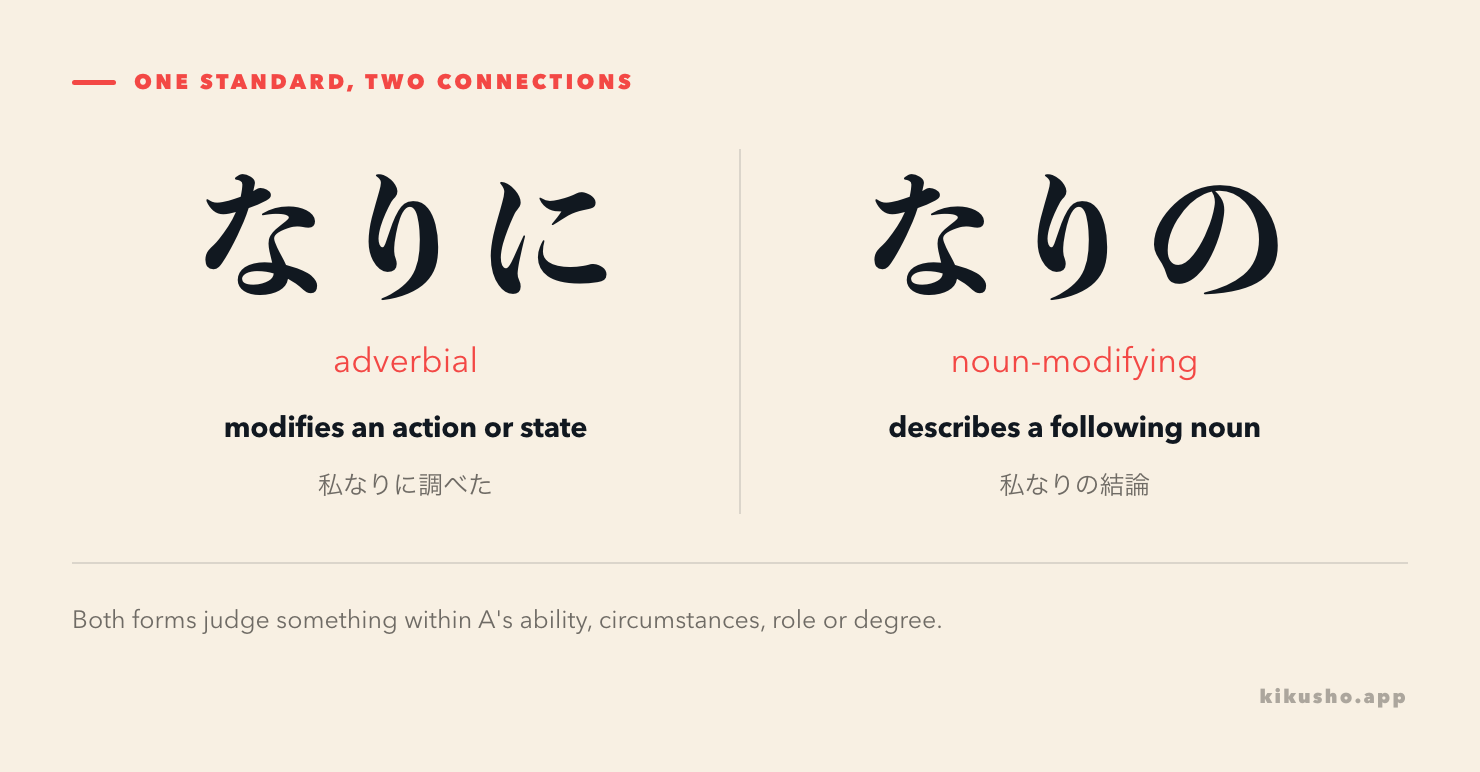
The first sentence does not claim expert quality. It says the research should be judged inside the speaker's present knowledge and effort. The second turns that perspective into a noun phrase. ×私なりに結論 leaves に with no predicate to modify; use 私なりの結論.
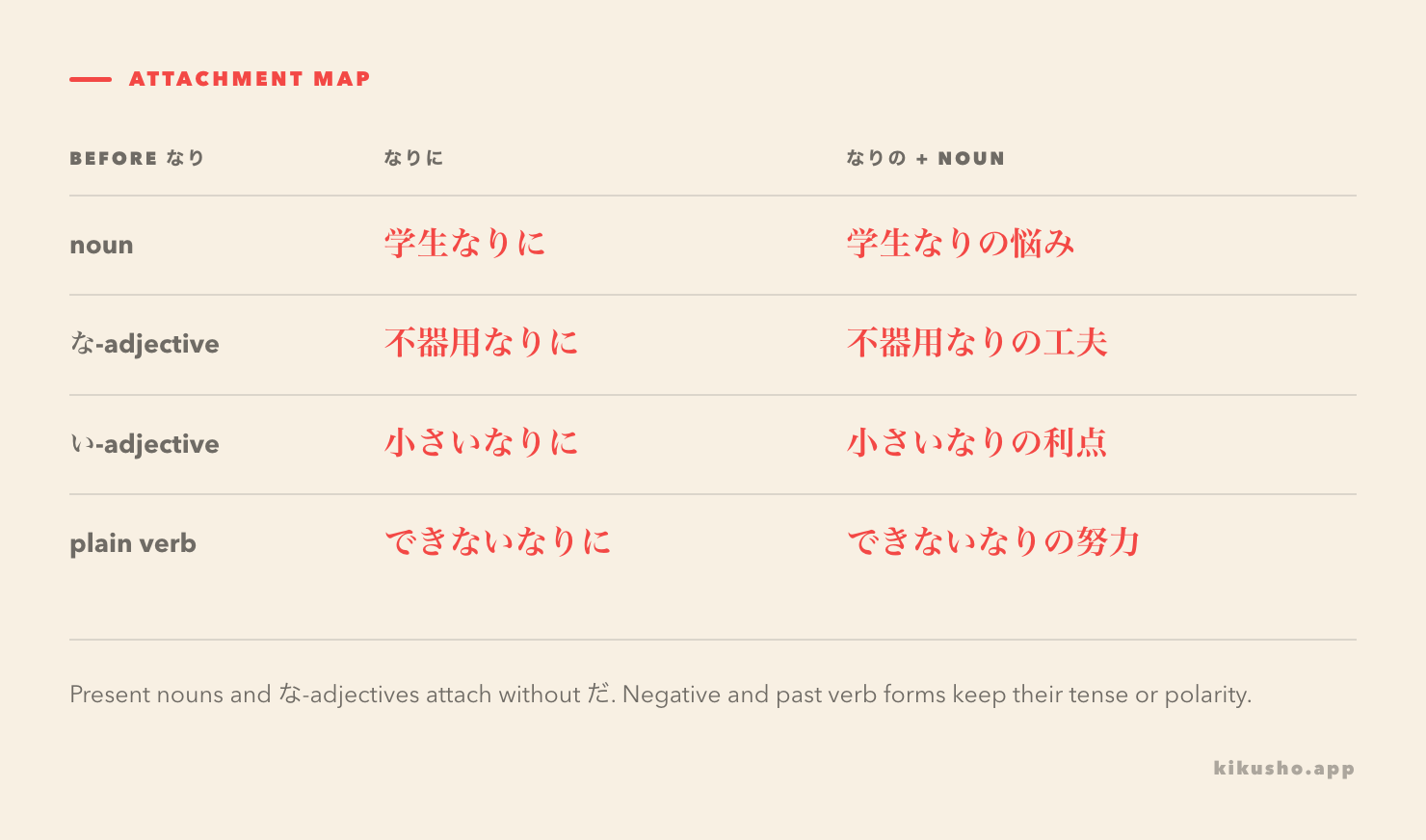
The form attaches to a plain predicate
Nouns attach without だ, and present affirmative な-adjectives use their stem. Verbs and い-adjectives use plain forms, including negative and past forms when the meaning requires them.
| Before なりに/なりの | Form | Example |
|---|---|---|
| noun | N + なりに/なりの | 学生なりに/学生なりの考え |
| な-adjective | stem + なりに/なりの | 不器用なりに/不器用なりの工夫 |
| い-adjective | plain form + なりに/なりの | 小さいなりに/小さいなりの利点 |
| verb | plain form + なりに/なりの | できないなりに/できないなりの努力 |
経験が少ないなりに、準備はしてきた。
けいけんが すくない なりに、じゅんびは してきた。
Although my experience is limited, I have prepared to the extent I can.
うまく説明できないなりに、図を使って伝えようとした。
うまく せつめいできない なりに、ずを つかって つたえようとした。
Even though he could not explain it well, he tried to communicate within his ability by using a diagram.
Do not insert present affirmative だ after a noun: ×学生だなりに. The productive form is 学生なりに. A plain past or negative form is different because it contributes real tense or polarity: 増えたなりに, できないなりに.
The frequent concessive reading recognizes effort inside a limit
Many examples contain an unfavorable or limited A: 下手, 小さい, 経験が少ない, 十分にはできない. The following clause identifies what was nevertheless achieved inside that constraint.
料理は下手なりに、家族のために毎日作っている。
りょうりは へた なりに、かぞくの ために まいにち つくっている。
I am not good at cooking, but I cook for my family every day in the way I can.
This resembles “although I am unskilled,” but なりに adds an internal standard. The speaker is not asking for the cooking to be judged as skilled. The regular effort is meaningful relative to the admitted lack of skill.
That nuance can sound modest when speakers describe themselves:
自分なりに努力したが、目標には届かなかった。
じぶん なりに どりょくしたが、もくひょうには とどかなかった。
I worked toward it as best I could in my own way, but I did not reach the goal.
It can sound patronizing when imposed on someone else. 彼なりに頑張った may generously recognize his effort, or it may imply that his standard was lower than the speaker's. Tone and relationship decide. When direct praise is intended, よく頑張った avoids that downward comparison.
The construction does not always describe weakness
The standard can come from a neutral role or from a changing degree.
学生には学生なりの悩みがある。
がくせいには がくせいなりの なやみが ある。
Students have concerns particular to their own circumstances.
Nothing says that those concerns are inferior. 学生なりの悩み locates them inside student life rather than working life or family life.
収入が増えたら、増えたなりに支出も増えた。
しゅうにゅうが ふえたら、ふえた なりに ししゅつも ふえた。
When income increased, spending rose in proportion to that increase.
The past form 増えた supplies a new degree, and the second change corresponds to it. “In its own way” would be a poor translation here. “Accordingly” or “in proportion” conveys the relationship better.
管理職には、管理職なりの責任がある。
かんりしょくには、かんりしょく なりの せきにんが ある。
Managers have responsibilities appropriate to their position.
This sentence gives the role its own standard. It does not excuse inadequate performance or compare managers with beginners.
自分なりに is not the same as 自分で
自分で identifies the doer or independence of the action. 自分なりに describes the standard, method or interpretation the speaker personally reached.
誰にも頼まず、自分で調べた。
だれにも たよらず、じぶんで しらべた。
I researched it myself without relying on anyone.
先生の説明を聞いて、自分なりに整理した。
せんせいの せつめいを きいて、じぶん なりに せいりした。
After listening to the teacher's explanation, I organized it according to my own understanding.
The second action may still use the teacher's material. Its point is not independence but personal interpretation. That is why 私なりの答え often signals “the answer I arrived at,” with room for another person to reach a different one.
それなりに also appears frequently. It can mean “to a corresponding degree,” “reasonably,” or “in a way suitable to the situation”:
短い時間だったが、それなりに準備はできた。
みじかい じかんだったが、それなりに じゅんびは できた。
The time was short, but we managed a reasonable amount of preparation under the circumstances.
The evaluation is context-dependent. それなりにおいしい may be measured praise: reasonably tasty, though not outstanding. It can also recognize that the result fits the means available. Do not automatically strengthen it to “excellent.”
なりに evaluates a standard; らしい describes a characteristic
These forms overlap around people and roles, but they ask different questions.
子供らしい発想
an idea characteristic of a child
子供なりの発想
an idea formed within a child's knowledge and viewpoint
らしい asks whether the quality feels typical of A. なりの asks what shape is reasonable inside A's position, ability or circumstances. The そう, よう, らしい and みたい lesson covers characteristic らしい alongside its evidence-based use.
The distinction also prevents an unfair paraphrase. 初心者なりの工夫 is not necessarily “a beginnerish trick.” It can be a sensible solution reached with beginner-level tools. 初心者らしい間違い instead classifies the mistake as typical of a beginner.
に応じて describes adjustment, not an internal evaluation
Nに応じて changes one thing according to another stated condition or scale:
人数に応じて、部屋の広さを変える。
Change the room size according to the number of people.
The planner deliberately adjusts room size from the outside. 人数なりに部屋の広さを変える does not express that ordinary rule.
By contrast, なりに treats A itself as the frame within which an action or result is assessed. The に伴って, に応じて and につれて lesson develops deliberate adjustment and correlated change.
Other なり patterns follow different syntax
Do not identify the grammar from なり alone.
| Pattern | Meaning | Example |
|---|---|---|
| Aなりに/AなりのN | within A's standard | 私なりに考える |
| V dictionary + なり | immediately after V | 帰宅するなり寝た |
| AなりBなり | A or B, for example | 電話するなりメールするなりしてください |
The first pattern accepts nouns, adjectives and plain verbs and then uses に or の. Immediate-sequence なり follows a dictionary-form verb, while the choice pattern repeats なり. The や否や, が早いか and なり lesson covers the immediate-sequence use.
N1 is a study placement, not a frequency label
JLPT Sensei, Bunpro and 日本語NET place this use at N1. 絵でわかる日本語 independently supplies the same plain-form attachment and the corresponding-level meaning. Their agreement makes N1 a useful study placement; the exam authority does not issue an exhaustive item-by-item grammar syllabus.
The phrase itself is not confined to formal prose. 自分なりに考えた and それなりにできた occur naturally in conversation. What makes the point difficult is the evaluation it carries: a translation must preserve the internal standard without automatically turning it into praise, excuse or criticism.
For a Kikusho card, keep enough context to recover that standard. 私なりに考えた needs a note such as “according to my present understanding,” while 収入が増えたなりに支出も増えた needs both changes. A card glossed only “in one's own way” will fail when the construction expresses proportional degree.
Practice
Keep track of the standard represented by A in each task. Open the response panel only after completing all seven.
Question 1
Choose the form that modifies the action 調べた.
専門家ではないが、私__資料を調べた。
ア. なりの
イ. なりに
ウ. らしいの
エ. に応じての
Question 2
Choose the form that directly modifies 結論.
これは今の私__結論です。
A. なりに
B. なりで
C. なりの
D. なりだ
Question 3
Which noun attachment is correct?
A. 学生だなりに大変だ
B. 学生ななりに大変だ
C. 学生なりに大変だ
D. 学生のなりに大変だ
Question 4
Choose the sentence that means “I researched it myself,” emphasizing independence rather than personal interpretation.
A. 自分なりに調べた。
B. 自分で調べた。
C. 自分らしい調べた。
D. 自分なりの調べた。
Question 5
Complete the sentence with なりに so that limited experience becomes the standard for the preparation.
経験が少ないが、____準備してきた。
Question 6
Which phrase focuses on a child's viewpoint and level rather than on being characteristically childlike?
A. 子供らしい発想
B. 子供みたいな発想
C. 子供なりの発想
D. 子供のように発想
Question 7
Read the exchange and complete both blanks.
A: 発表の準備はどう?
B: 時間は短かったけれど、私( )準備したよ。完璧ではないけれど、それ( )形にはなったと思う。
Answers and explanations
1.
イ. なりに. 私なりに works adverbially and describes the standard or approach used in 調べた. なりの would require a following noun, such as 私なりの調査.
2.
C. なりの. 結論 is a noun, so 私なりの modifies it. 私なりに must connect to a predicate, as in 私なりに結論を出した.
3.
C. 学生なりに大変だ. A present affirmative noun attaches directly, without だ, な or の. The sentence judges the difficulty within a student's circumstances.
4.
B. 自分で調べた. 自分で identifies the speaker as the independent doer. 自分なりに would focus on researching according to the speaker's own method or understanding.
5.
One natural completion is 経験が少ないなりに: 経験が少ないが、経験が少ないなりに準備してきた。 The repeated clause establishes limited experience as the frame inside which the preparation is evaluated.
6.
C. 子供なりの発想. It locates the idea within a child's knowledge and perspective. 子供らしい発想 instead classifies it as typical or characteristic of a child.
7.
私なりに / それなりに. The first phrase says the speaker prepared according to their own means and judgment. それなりに形になった gives the result a measured evaluation: it took a reasonable form under the circumstances, without claiming perfection.
Common questions
What do なりに and なりの mean?
They judge something within the ability, circumstances, degree or viewpoint represented by A. Aなりに modifies an action or judgment, while Aなりの modifies a following noun.
What is the difference between 自分なりに and 自分で?
自分で says that you do something yourself or independently. 自分なりに means according to your own understanding, method or ability, often acknowledging that another person's standard may be different.
Does なりに always imply that someone did their best?
No. It often gives a modest or concessive evaluation, but it can also describe a result proportionate to a degree or concerns appropriate to a role, as in 収入が増えたなりに支出も増える and 管理職には管理職なりの悩みがある.
How are なりに and らしい different?
Aらしい describes what is typical or characteristic of A. Aなりに evaluates an action or state inside A's own limits or circumstances, and Aなりの makes that standard modify a noun.