On this page
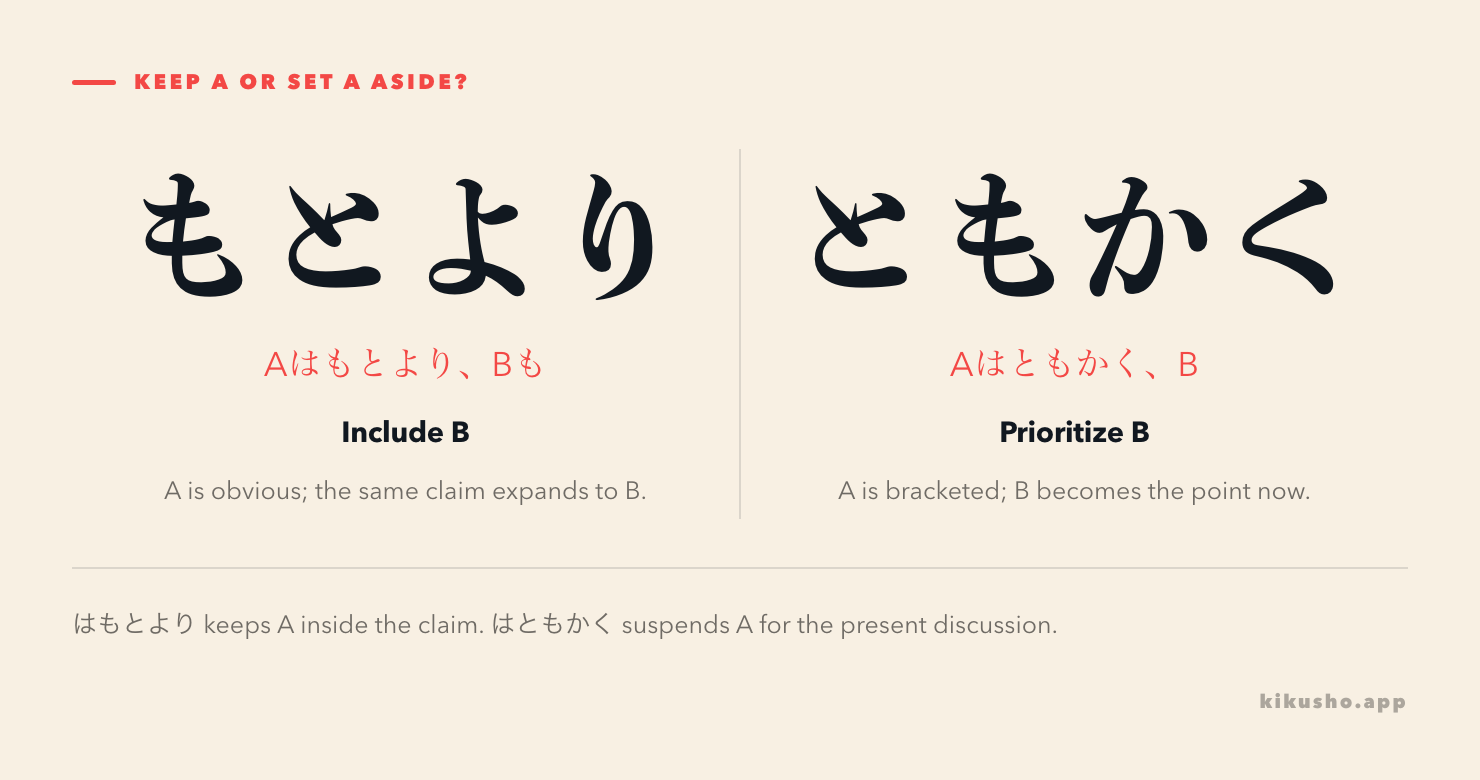
Choose Aはもとより、Bも when A is already taken for granted and you want to add B. Choose Aはともかく、B when you suspend judgment about A and move the listener's attention to B.
Compare デザインはもとより、使いやすさも優れている, where both qualities are praised, with デザインはともかく、使いやすさは優れている, where the speaker avoids evaluating the design and praises usability instead. One expression expands a claim; the other narrows the current discussion.
This lesson covers inventory items g-b0374f20f713, はもとより, and g-f73776ff9bde, はともかく. JLPT Sensei, Bunpro and PassJapanese place these uses at N2. The level is an editorial estimate because the JLPT does not publish an exhaustive grammar list.
The test is whether A stays or leaves
Ask what the speaker does with A.
| Pattern | Treatment of A | Direction of the sentence |
|---|---|---|
| Aはもとより、Bも | keeps A as an obvious baseline | includes B in the same claim |
| Aはともかく、B | puts A aside for this discussion | prioritizes a judgment about B |
この施設は会員はもとより、一般の人も利用できる。
この しせつは かいいんは もとより、いっぱんの ひとも りようできる。
This facility is available not only to members but also to the general public.
Members are the expected users. The sentence extends access to the public without weakening the claim about members.
料金はともかく、場所はとても便利だ。
りょうきんは ともかく、ばしょは とても べんりだ。
Setting the price aside, the location is very convenient.
The speaker does not say whether the price is good or bad. Price is temporarily bracketed so the convenient location can become the main point.
はもとより extends an obvious baseline
The basic shape is noun + はもとより, followed by another item under the same predicate. The added item commonly carries も, まで or さえ.
この映画は若者はもとより、年配の人にも人気がある。
この えいがは わかものは もとより、ねんぱいの ひとにも にんきが ある。
This film is popular not only with young people but also with older people.
Young viewers are treated as the expected case. Older viewers widen the range.
この製品は国内はもとより、海外でも高く評価されている。
この せいひんは こくないは もとより、かいがいでも たかく ひょうかされている。
This product is highly regarded not only domestically but overseas as well.
The second marker need not be plain も. In 海外でも, the も combines with the location particle で.
The pattern can appear in a negative sentence as well:
彼は漢字はもとより、ひらがなもまだ読めない。
かれは かんじは もとより、ひらがなも まだ よめない。
He cannot yet read hiragana, let alone kanji.
Here kanji is the more demanding baseline assumed to be out of reach. The surprising addition is that even hiragana is unavailable. English often reverses the order around “let alone,” so follow the Japanese markers rather than copying the English sequence.
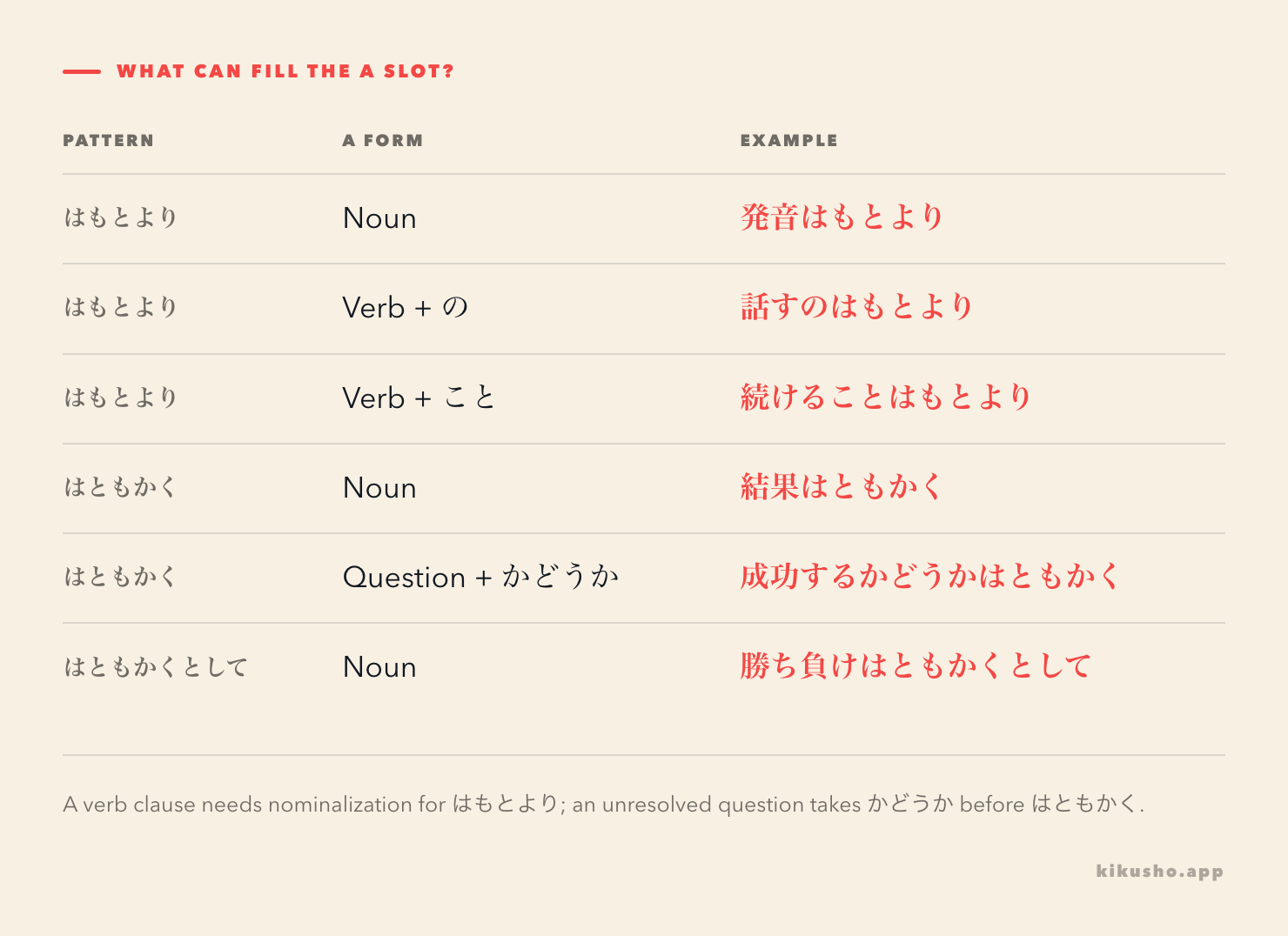
A verb clause needs a nominalizer before はもとより
To use an action or proposition as A, turn it into a noun phrase with の or こと.
| A | Attachment | Example beginning |
|---|---|---|
| noun | N + はもとより | 発音はもとより |
| action | V plain + の + はもとより | 読むのはもとより |
| proposition | V plain + こと + はもとより | 続けることはもとより |
この仕事では日本語を話すのはもとより、正確に書く力も必要だ。
この しごとでは にほんごを はなすのは もとより、せいかくに かく ちからも ひつようだ。
In this job, not only speaking Japanese but also the ability to write accurately is necessary.
話す cannot attach directly as 話すはもとより in this pattern. The nominalizer gives は a noun phrase to mark.
はもとより is the formal neighbour of はもちろん
はもちろん performs the same basic inclusion move and is common in conversation. はもとより sounds more formal and often appears in written descriptions, public statements and presentations.
この店は平日はもちろん、週末も開いている。
この みせは へいじつは もちろん、しゅうまつも あいている。
This shop is open not only on weekdays but also on weekends.
当館は平日はもとより、週末も開館しております。
とうかんは へいじつは もとより、しゅうまつも かいかんして おります。
This museum is open on weekdays and, of course, on weekends as well.
The second sentence combines はもとより with the formal language of an institutional notice. Using it in an ordinary chat is possible, but it can sound deliberately elevated.
Do not confuse the full pattern with adverbial もとより, meaning “from the beginning” or “of course”: 私はもとより賛成だった, “I was in favor from the start.” There is no A-to-B inclusion in that sentence.
はともかく suspends one issue and prioritizes another
Attach はともかく directly to a noun. はともかくとして is a longer variant that makes the act of setting A aside more explicit and can sound slightly more deliberate.
結果はともかく、最後まで努力したことに意味がある。
けっかは ともかく、さいごまで どりょくしたことに いみが ある。
Regardless of the result for now, there is value in having worked hard to the end.
勝ち負けはともかくとして、安全に試合を終えることが第一だ。
かちまけは ともかくとして、あんぜんに しあいを おえることが だいいちだ。
Setting victory and defeat aside, the first priority is finishing the match safely.
The second clause should supply the reason for bracketing A: it states the point, criterion or priority the speaker considers more relevant now.
Use かどうか when A is an unresolved question
A whole yes-or-no issue commonly takes plain clause + かどうかはともかく.
採用されるかどうかはともかく、応募してみよう。
さいようされるか どうかは ともかく、おうぼしてみよう。
Whether or not I will be hired aside, I will apply.
計画が成功するかどうかはともかく、まず問題点を整理しよう。
けいかくが せいこうするか どうかは ともかく、まず もんだいてんを せいりしよう。
Leaving aside whether the plan will succeed, let us first organize the problems.
The speaker is not answering the embedded question. The sentence postpones that answer in order to take a different action.
Bracketing A can sound like judging it
Grammatically, はともかく suspends judgment. In conversation, listeners may infer that A is weak, inconvenient or less important because the speaker refuses to praise it.
味はともかく、量は多い。
あじは ともかく、りょうは おおい。
The taste aside, the portions are large.
This does not literally say that the food tastes bad. Still, if taste were excellent, the speaker would probably mention it. The omission invites a negative inference.
That makes the choice of A important. 命はともかく、お金が大切だ sounds as if life can be put aside while money matters. The grammar is well formed, but the priority is disturbing. Use はともかく only when setting A aside is reasonable in the situation.
The にしても and は別として lesson covers a close neighbor. は別として explicitly separates A from the present evaluation; はともかく often sounds more conversational and more directly shifts attention to B. They overlap, so context and register matter more than a rigid one-word translation.
Similar additions do not all carry the same assumption
Several patterns translate as “not only A but also B.” Their view of A differs.
| Pattern | What it says about A |
|---|---|
| AはもとよりBも | A is already obvious; extend the claim to B |
| AだけでなくBも | neutral addition of B |
| AのみならずBも | formal addition, without requiring A to be obvious |
| AばかりかBも | B goes beyond what A led you to expect |
The のみならず and に加えて lesson develops neutral and formal accumulation. The ばかり and ばかりか lesson is for additions that carry stronger emphasis. Choose はもとより when the baseline status of A is part of the message.
Practice
1. Choose the inclusive extension
この施設は会員__、一般の人も利用できる。
ア. はともかく
イ. はもとより
ウ. かどうかはともかく
2. Choose the suspended issue
料金__、場所はとても便利だ。
ア. はもとより
イ. はともかく
ウ. もとよりも
3. Complete the clause attachment
この仕事では日本語を話す__、正確に書く力も必要だ。
ア. はもとより
イ. のはもとより
ウ. かどうかはともかく
4. Build the inclusion sentence
Put the four pieces in order.
ア. 海外でも イ. 国内はもとより ウ. 評価されている エ. この製品は
5. Choose the unresolved question
__、まず応募してみよう。
ア. 採用はもとより
イ. 採用されるかどうかはともかく
ウ. 採用されてもとより
6. Identify the implied evaluation
味はともかく、量は多い directly states which fact?
ア. The food tastes bad.
イ. The portions are large.
ウ. Taste and quantity are both excellent.
7. Follow the meeting discussion
担当者:「企画の名前はまだ決まっていません。」
責任者:「名前__、まず目的と対象者を明確にしましょう。」
ア. はもとより
イ. はともかく
ウ. のはもとより
Track whether the first topic stays inside the claim or yields the floor to the second before revealing the solutions.
Answers and explanations
イ. はもとより. Members are the expected users, and access is extended to the general public. The added group carries も.
イ. はともかく. The speaker postpones judgment about the price and emphasizes the convenient location.
イ. のはもとより. The verb clause 日本語を話す must be nominalized before はもとより can mark it as A.
エ → イ → ア → ウ: この製品は国内はもとより、海外でも評価されている。 Domestic recognition is the baseline, and the claim expands overseas.
イ. 採用されるかどうかはともかく. The hiring outcome remains unresolved while applying becomes the immediate action.
イ. The portions are large. The sentence brackets taste and directly asserts only quantity. A listener may infer a problem with the taste, but that inference is not the literal statement.
イ. はともかく. The name is set aside because the purpose and audience are the present priorities.
Common questions
What is the difference between はもとより and はともかく?
AはもとよりBも keeps A as an obvious starting point and extends the same claim to B. AはともかくB brackets A for now and makes B the issue the speaker wants to emphasize.
What comes after はもとより?
The added element often carries も, まで or さえ: 国内はもとより、海外でも. A noun attaches directly, while a verb clause is normally nominalized with の or こと before はもとより.
Can はともかく attach to a whole clause?
Yes. A question is commonly packaged with かどうか, as in 合格できるかどうかは ともかく. A noun attaches directly, as in 結果はともかく.
Is はもとより formal Japanese?
The inclusion pattern is formal and especially common in careful writing, announcements and presentations. はもちろん is usually the more natural choice in casual conversation.