On this page
や否や, が早いか and dictionary-form verb + なり connect an event with something happening immediately afterwards, often so quickly that the boundary feels almost simultaneous. や否や and が早いか are characteristic written narration; temporal なり commonly presents a person's abrupt reaction, and the three can overlap.
This N1 grammar comparison teaches が早いか(がはやいか), なり and や否や(やいなや) in that temporal sense. Bunpro places all three at N1, while Iku's page places the same や否や construction at N2. These are teaching estimates: the JLPT does not publish exhaustive grammar lists.
The attachment test comes first
Check the verb immediately before the connector. Then ask whether the sentence reports an abrupt sequence or addresses someone with a request or plan. An English “as soon as” does not decide the Japanese construction by itself.
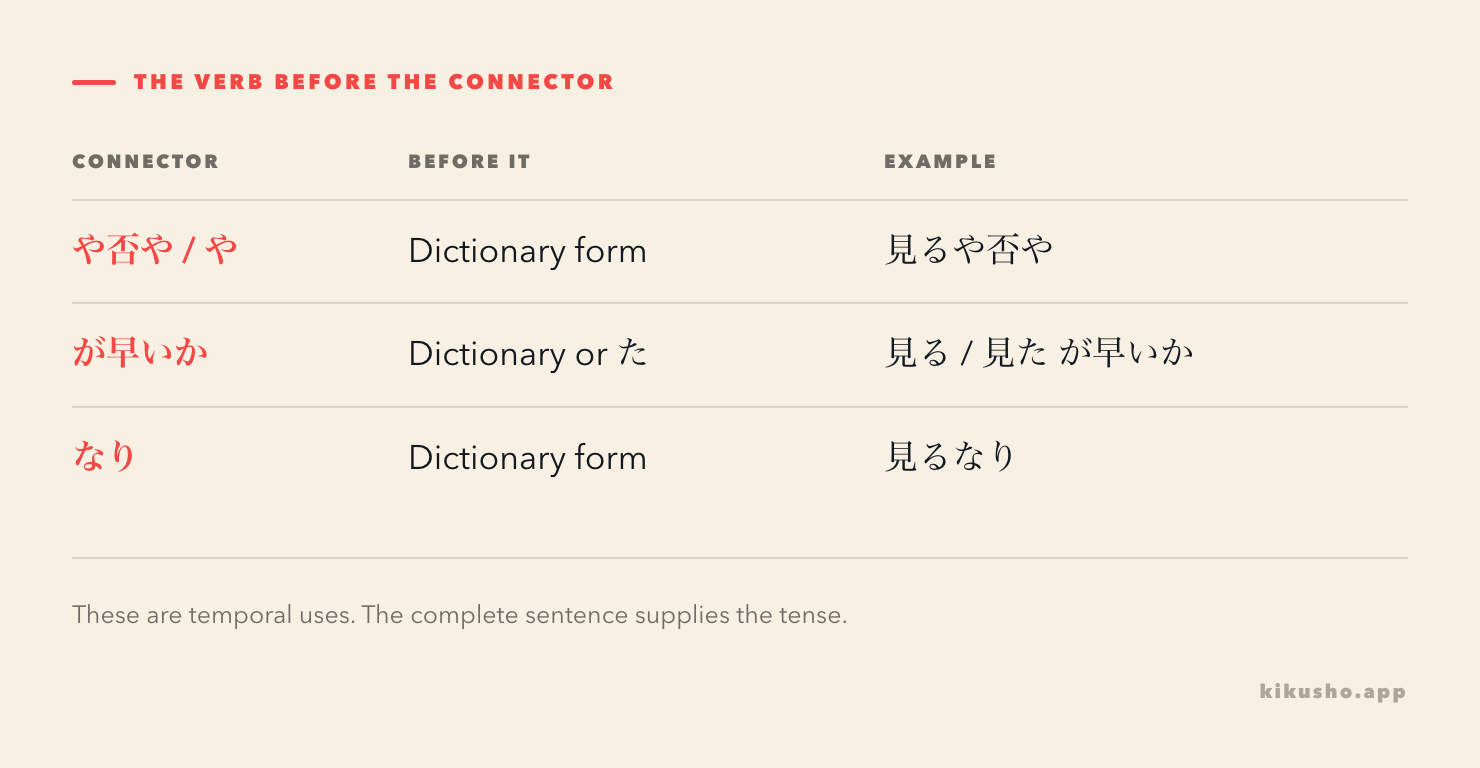
| Construction | Verb before it | Reading | Core scene |
|---|---|---|---|
| V + や否や, also V + や | Dictionary form | やいなや / や | One event immediately triggers or is followed by another |
| V + が早いか | Dictionary form or た-form | がはやいか | A vivid, very rapid succession |
| V + なり | Dictionary form | なり | An abrupt sequel, commonly someone's reaction |
The verb form inside the first clause need not carry the tense of the whole sentence. 聞くが早いか can introduce a report ending in 走った. For a refresher on 聞いた, use the plain past-form lesson.
や否や: one event on the heels of another
Attach や否や directly to dictionary form. The first event supplies the point at which the second begins:
扉が開くや否や、冷たい風が部屋に流れ込んだ。
とびらがあくやいなや、つめたいかぜがへやにながれこんだ。
As soon as the door opened, cold air poured into the room.
The door opening and the wind entering have different subjects. The wind is not choosing to act. This is still an immediate sequence.
Short や can do the same job: 扉が開くや、冷たい風が部屋に流れ込んだ. Read it as a connector after the verb, rather than the noun-listing や you may already know. Mainichi Nonbiri gives both temporal forms.
Choose a recognizable event boundary. A long activity can supply one through its completion: 読み終わるや否や, “immediately upon finishing reading.” The construction makes that endpoint immediate; it does not say the entire reading took an instant.
が早いか: speed, with two verb forms
が早いか makes the response feel almost too quick to separate from its trigger:
係員は警報を聞くが早いか、非常口へ走った。
かかりいんはけいほうをきくがはやいか、ひじょうぐちへはしった。
The attendant heard the alarm and immediately ran to the emergency exit.
聞いたが早いか is also possible. Both Bunpro's attachment table and Mainichi Nonbiri's explanation include dictionary form and た-form. Do not transfer a dictionary-form-only rule from や否や to が早いか.
A deliberate action such as running gives a clear prototype. That does not make “the second event must be voluntary” a safe universal restriction: Mainichi Nonbiri explicitly discusses involuntary reactions too. Nor does “deliberate” mean “a future promise.” Here 走った describes what the attendant did in a reported scene.
なり: an abrupt reaction
For temporal なり, start with dictionary form and a clear reaction:
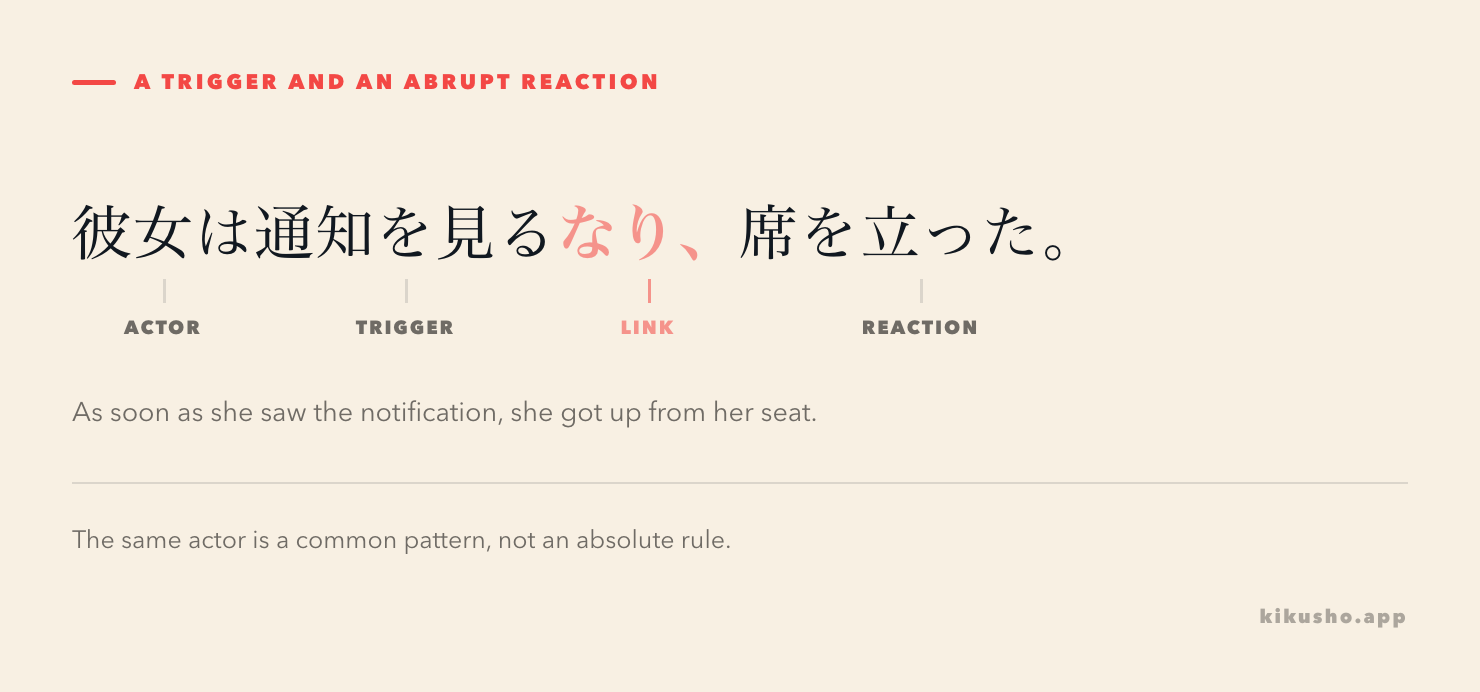
彼女は通知を見るなり、席を立った。
かのじょはつうちをみるなり、せきをたった。
As soon as she saw the notification, she got up from her seat.
The same person sees and gets up. This is a useful pattern for producing a sentence, especially when the sequel is sudden. It is not a requirement that every temporal なり sentence in a text share that subject. MLC states the same-subject tendency and supplies exceptions; Bunpro also includes different-subject examples.
The examples here are completed scenes with past endings. That is a good starting frame, rather than a claim that every temporal なり sentence must end in た: Bunpro also records a habitual example. Keep the scope of a practice rule separate from a ban on all other uses.
Where all three fit
In the notification scene, these are all possible:
| Sentence opening | Continuation |
|---|---|
| 彼女は通知を見るや否や、 | 席を立った。 |
| 彼女は通知を見るが早いか、 | 席を立った。 |
| 彼女は通知を見るなり、 | 席を立った。 |
The first two give written immediacy; が早いか particularly suits the vivid speed of the action. なり comfortably presents her abrupt reaction. There is no three-way division in which one expresses “immediately,” another “very immediately,” and the last “most immediately.” Context and construction matter more than ranking English translations.
For a related sudden-event pattern with た-form + とたん, see the とたん and 最中 comparison. Its attachment belongs to that construction; it does not license 見たなり as a substitution in this table.
When the intended meaning changes
An instruction to contact someone after arriving has a different job from narrating a reaction. A straightforward request is:
事務所に着いたら、すぐに連絡してください。
じむしょについたら、すぐにれんらくしてください。
Please contact me as soon as you arrive at the office.
Use that conditional request frame instead of inserting one of the three narrative connectors just because English says “as soon as.” For a formal promise that B will follow promptly once A is complete, verb-stem 次第 has its own planned handoff pattern. The Society for Teaching Japanese handbook, printed pages 212–213, distinguishes factual immediate-event descriptions from requests and intentions.
なり also appears in constructions with other meanings. Identify the whole piece:
| Example | Reading | Meaning here |
|---|---|---|
| 彼女は通知を見るなり、席を立った。 | かのじょはつうちをみるなり、せきをたった。 | Immediate reaction after seeing |
| 私なりに整理した。 | わたしなりにせいりした。 | I organized it in my own way |
| 電話なりメールなりで連絡してください。 | でんわなりメールなりでれんらくしてください。 | Please contact me by phone or email, for example |
The latter two are boundaries of this lesson, not extra temporal patterns. Mainichi Nonbiri explains なりに / なりの and alternatives with なり…なり separately. The related なりとも lesson has its own minimum-option meaning.
If unfamiliar nouns such as 警報 obscure a sequence you are reading, paste that passage into Kikusho to create vocabulary cards. Keep the original sentence as context when reviewing the noun; an isolated “as soon as” gloss cannot show which verb form preceded it.
Practice
These six questions use grammar selection, sentence composition and grammar in connected text. Complete the set before scrolling to the shared answer section.
Question 1
Which statement correctly describes the attachment taught in this lesson?
A. が早いか requires the ます-form.
B. Temporal なり follows only the た-form.
C. が早いか can follow dictionary form or た-form.
D. や否や follows only the た-form.
Question 2
Choose the sentence that directly asks someone to contact you on arriving, rather than reporting an immediate sequel.
A. 彼は事務所に着くなり、連絡した。
B. 事務所に着いたら、すぐに連絡してください。
C. 彼は事務所に着くや否や、連絡した。
D. 彼は事務所に着くが早いか、連絡した。
Question 3
Arrange the four pieces in the blanks. Which piece occupies ★?
係員は ______ ______ ★ ______ 走った。
A. が早いか
B. 非常口へ
C. 警報を
D. 聞く
Question 4
Arrange these four pieces to complete a past report of someone's immediate reaction. Give the full sentence.
彼女は ______ ______ ______ ______。
A. 席を立った
B. なり
C. 通知を
D. 見る
Question 5
Read the report and choose the best description of its middle sentence.
会議中、彼女の電話に通知が届いた。彼女は通知を見るなり、席を立った。数分後、彼女は部屋に戻った。
A. It tells her to stand when a future notification arrives.
B. It says she stayed seated after seeing the notification.
C. なり lists seeing and standing as alternative choices.
D. It reports her getting up immediately after seeing the notification.
Question 6
Read the two sentences. What does なり express in each?
私は資料を私なりに整理した。足りない資料があれば、電話なりメールなりで連絡してください。
A. Immediate succession in both sentences
B. A personal way of organizing, then possible contact methods
C. Possible contact methods, then immediate succession
D. The same person reacting in both sentences
Answers and explanations
Answer 1
C. 聞くが早いか and 聞いたが早いか both use the attested attachment. A incorrectly supplies ます; B and D transfer た-form to constructions taught here with dictionary form.
Answer 2
B. 着いたら establishes the arrival condition and 連絡してください addresses the listener. A, C and D end in 連絡した and describe a completed contact, rather than issuing the requested instruction.
Answer 3
A occupies ★. The order is C → D → A → B:
係員は警報を聞くが早いか、非常口へ走った。
警報を is what the attendant hears, が早いか connects after 聞く, and 非常口へ gives the destination of 走った. Moving the connector after the destination would break that construction.
Answer 4
C → D → B → A gives:
彼女は通知を見るなり、席を立った。
The object precedes 見る, dictionary-form 見る joins なり, and 席を立った supplies the sequel. The comma makes the clause boundary readable; it is not one of the four pieces.
Answer 5
D. 見るなり connects seeing to the immediate reaction 席を立った. The surrounding past report anchors the scene. A changes it to a future instruction, B reverses the action, and C confuses temporal なり with an alternatives construction.
Answer 6
B. 私なりに means “in my own way”; 電話なりメールなり presents possible methods. Neither occurrence is dictionary-form verb + temporal なり. The report could be about organizing documents all afternoon: those two expressions would still have the same meanings.
Common questions
Can が早いか follow a verb in the た-form?
Yes. Both dictionary form and た-form are attested before が早いか. Dictionary form is more common in teaching examples; the temporal uses of や否や and なり taught here take dictionary form.
Must both clauses with なり have the same subject?
The same person acting and then reacting is a useful common pattern, but it is not an absolute rule. MLC and Bunpro also give temporal なり examples with different subjects.
Is temporal なり the same as なりに or なり…なり?
No. Dictionary-form verb plus なり links an event to its immediate sequel. 私なりに means in my own way, while 電話なりメールなり gives possible alternatives.