On this page
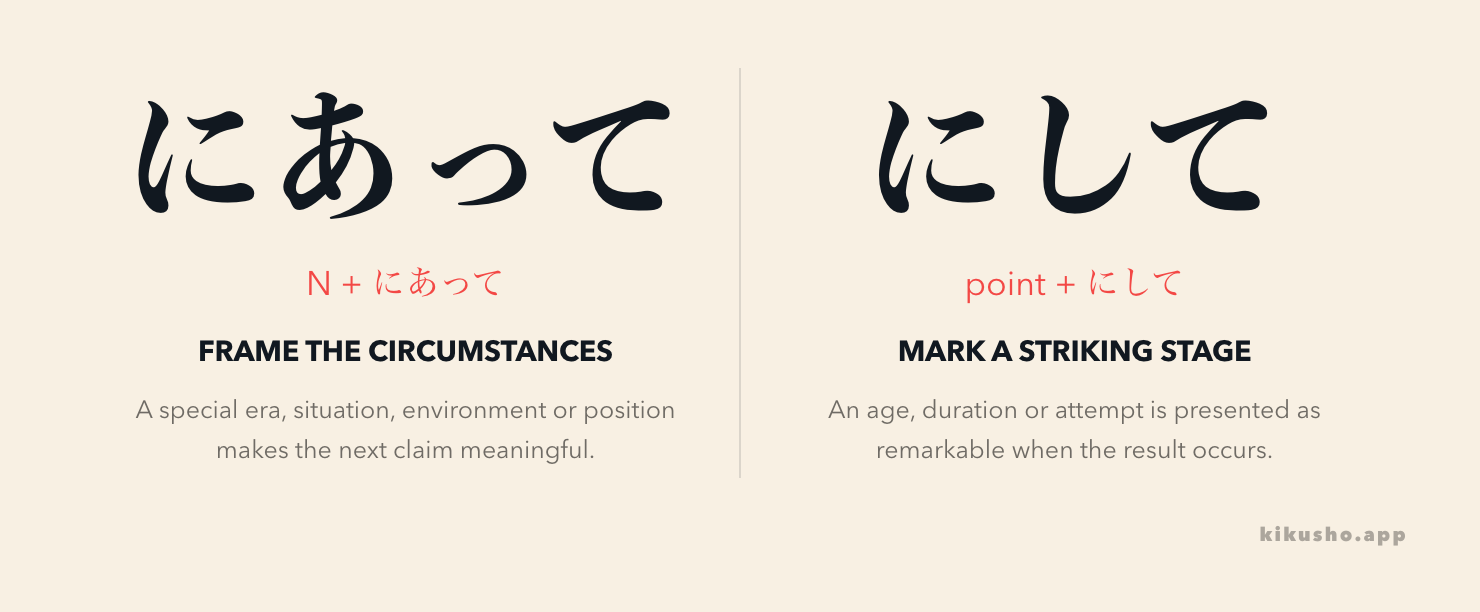
Both にあって and にして can follow a noun in formal Japanese, but they organize the sentence differently. にあって frames an exceptional situation in which the next statement matters; にして highlights a striking milestone such as an age, duration or attempt, or links two qualities in a literary style.
変化の激しい時代にあって、判断の速さが求められる。
へんかの はげしい じだいに あって、はんだんの はやさが もとめられる。
In an era of rapid change, quick judgment is required.
彼女は二十歳にして、自分の店を開いた。
かのじょは はたちに して、じぶんの みせを ひらいた。
At only twenty, she opened her own shop.
The first sentence asks you to interpret a claim within an era. The second focuses attention on twenty as an unexpectedly early stage. Translating both as “in” or “at” hides the choice that Japanese makes.
Choose a frame or a marked point
Use this test before looking for an English equivalent:
- Does the noun name a situation, period, environment or position that forms the background for the whole claim? Choose にあって.
- Does it name an age, duration, numbered attempt or brief span whose relation to the result is remarkable? Choose にして.
- Are two noun qualities presented as simultaneously true in elevated prose? This is also AにしてB.
| Form | What precedes it | What it contributes | Typical implication |
|---|---|---|---|
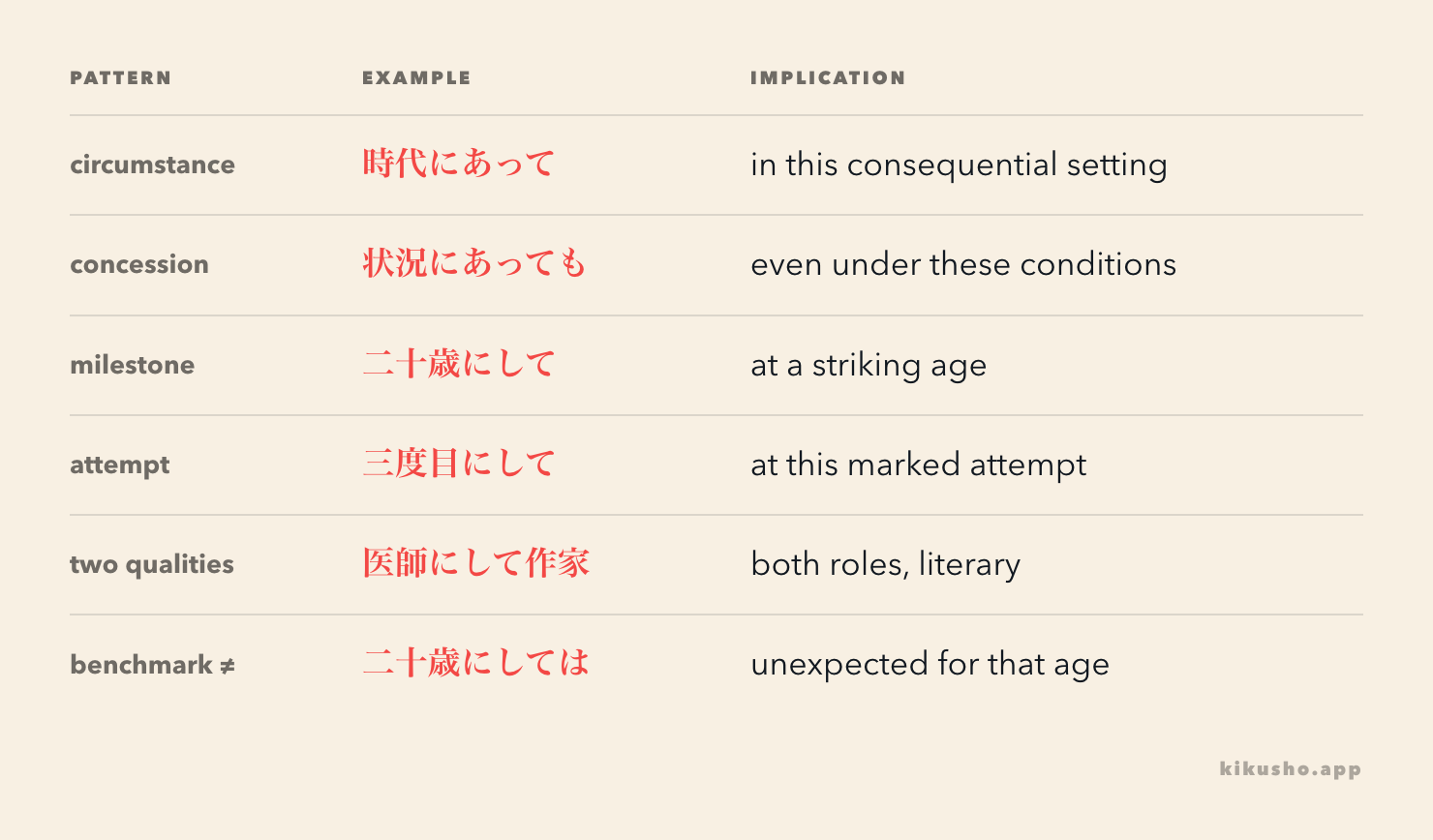
| N + にあって | 時代, 状況, 環境, 立場 | a consequential setting | “under these particular circumstances” |
| N + にあっても | difficult or unusual setting | setting plus concession | “even under these circumstances” |
| point + にして | age, time span, attempt | a marked stage | earlier, later, faster or more difficult than expected |
| A + にして + B | role or quality A, then B | literary coordination | the same subject is both A and B |
The forms overlap in formality, not in structure. 非常時にあって冷静だった places composure inside an emergency. 十八歳にして冷静な指揮官だった presents eighteen as a striking age for such composure.
にあって makes the circumstance interpretively important
にあって follows a noun. It is built from locative に and the connective form of ある, but the N1 pattern does more than mark a neutral location. It commonly selects a special situation and makes that situation relevant to what follows.
資源の限られた環境にあって、研究チームは工夫を重ねた。
しげんの かぎられた かんきょうに あって、けんきゅう チームは くふうを かさねた。
In an environment with limited resources, the research team kept finding creative solutions.
組織の責任者という立場にあって、彼は慎重な説明を求められた。
そしきの せきにんしゃという たちばに あって、かれは しんちょうな せつめいを もとめられた。
In his position as the person responsible for the organization, he was expected to explain matters carefully.
In the first example, the limited environment makes the ingenuity significant. In the second, the position creates an expectation. Plain で could locate each event, but it would weaken the sense that the setting bears on the conclusion.
にあっては can mark that setting as a topic:
災害時にあっては、正確な情報の共有が欠かせない。
さいがいじに あっては、せいかくな じょうほうの きょうゆうが かかせない。
During a disaster, sharing accurate information is essential.
にあっても adds a concessive relation:
厳しい状況にあっても、現場の職員は支援を続けた。
きびしい じょうきょうに あっても、げんばの しょくいんは しえんを つづけた。
Even under difficult circumstances, the staff on site continued providing support.
The も matters. The support continued despite a condition that could reasonably have prevented it.
Bunpro describes the construction as a formal frame for a noteworthy situation or condition and explicitly distinguishes it from the て-form of 遭う. 日本語NET independently defines it through a special situation or place and notes that it is more formal than で or において.
にして puts emphasis on the stage reached
For the milestone use, にして follows a noun or quantity that identifies a point: an age, a length of time, an attempt or a stage. The result at that point carries surprise, admiration, relief or another sense of significance.
三度目の挑戦にして、ようやく決勝まで進んだ。
さんどめの ちょうせんに して、ようやく けっしょうまで すすんだ。
On the third attempt, they finally advanced to the final.
開発開始から十年にして、製品が完成した。
かいはつ かいしから じゅうねんに して、せいひんが かんせいした。
Ten years after development began, the product was finally completed.
彼は七十歳にして、初めて海外で作品を発表した。
かれは ななじゅっさいに して、はじめて かいがいで さくひんを はっぴょうした。
At seventy, he presented his work overseas for the first time.
Words such as 初めて, ようやく and やっと often make the marked-stage reading explicit. They are common partners, not mandatory pieces. 一夜にして町の様子が変わった, “the town’s appearance changed overnight,” instead stresses the astonishing speed of the change.
A neutral time particle reports when something happened: 七十歳で退職した simply says “retired at seventy.” 七十歳にして新事業を始めた invites the reader to notice seventy as consequential or surprising. That evaluative weight makes にして common in biographies, commentary and aphoristic writing rather than ordinary scheduling.
JLPT Sensei supports noun attachment, the marked stage reading and frequent combinations with やっと, ようやく and 初めて. Nihongo to Japan separately identifies ages, durations and points as one major use and notes its literary, solemn register.
AにしてB joins two qualities in elevated prose
Bare にして also has a literary copular use. In AにしてB, one subject holds both descriptions.
山田氏は優れた技術者にして、若い研究者を導く教育者でもある。
やまだしは すぐれた ぎじゅつしゃに して、わかい けんきゅうしゃを みちびく きょういくしゃでも ある。
Ms Yamada is both an excellent engineer and an educator who guides young researchers.
その決断は大きな機会にして、重い責任でもあった。
その けつだんは おおきな きかいに して、おもい せきにんでも あった。
That decision was both a major opportunity and a heavy responsibility.
The everyday equivalents are AでもありBでもある and Aであると同時にB. The にして version sounds compressed and weighty. Context tells this use from a milestone: two parallel descriptions point to “both A and B,” while a number or stage followed by an event points to “at that marked point.”
Similar-looking strings belong to different constructions
Several common forms contain the same characters. Read the full structure rather than matching the final syllables.
| String | Structure | Meaning |
|---|---|---|
| 困難な時代にあって | N + formal にあって | in a difficult era |
| 事故に遭ってけがをした | N + に + 遭う | met with an accident and was injured |
| 六十歳にして挑戦する | marked-point にして | takes on a challenge at sixty |
| 六十歳にしては若く見える | benchmark にしては | looks young for sixty |
| 雨にしても雪にしても | paired にしても | whether rain or snow |
| 静かにしてください | adverbial に + する | please make it quiet / keep quiet |
The kanji disambiguates 遭って, but kana-only text can leave 事故にあって ambiguous until the predicate appears. Ask whether 事故 is a circumstance framing a general claim or the event someone encountered.
Bare にして is especially easy to overread as にしては. Compare:
十九歳にして代表に選ばれた。
At nineteen, she was selected as a representative. The age is a marked point.
十九歳にしては落ち着いている。
She is composed for a nineteen-year-old. The age supplies a benchmark for an unexpected judgment.
The に反して and にしては lesson develops that benchmark use. The にしても and は別として lesson covers concession and exception, while にあたって and に際して frame an occasion before an intentional event rather than circumstances already surrounding a statement.
Register explains why neither form fits every conversation
Both target patterns are formal. にあって is natural in reports, speeches, institutional writing and historical narration when the setting supports a claim. にして appears in biographies, commentary and polished prose when a milestone deserves emphasis.
In ordinary conversation, speakers usually choose a more direct form:
| Formal sentence | Conversational alternative |
|---|---|
| この状況にあって、協力が必要だ | この状況では、協力が必要だ |
| 五十歳にして新しい仕事を始めた | 五十歳で新しい仕事を始めた |
| 彼は医師にして作家でもある | 彼は医師でもあり、作家でもある |
The simpler sentence may lose a nuance, but it avoids sounding ceremonial in a routine exchange. Formality is therefore part of the answer, not an ornament added after choosing the grammar.
For review in Kikusho, save the noun and consequence together. A card containing only にあって = in cannot show why the situation matters, and にして = at cannot preserve the surprise attached to a milestone. Capturing the full sentence keeps the implication visible, and the editable explanation can name “circumstantial frame,” “marked stage” or “two simultaneous qualities.”
The references checked for this lesson place both patterns at N1. Those labels are useful study estimates, but the JLPT authority does not publish an exhaustive official grammar list. The stable evidence is the attachment, meaning and register shared across independently authored explanations.
Practice
Complete all seven questions before revealing the solutions.
Question 1
Choose the form that makes an unusual social situation the background for the statement.
人口が急速に減る地域( )、交通手段の確保は重要な課題だ。
- ア. にして
- イ. にあって
- ウ. にしては
- エ. によって
Question 2
Choose the form that highlights a strikingly early age.
彼女は十六歳( )、全国大会で優勝した。
- ア. にあって
- イ. にしても
- ウ. にして
- エ. において
Question 3
Add one particle to make the second statement hold despite the difficult circumstances.
厳しい競争の中にあって( )、その小さな会社は独自の方針を守った。
Question 4
Rewrite in the literary AにしてB style: “Professor Mori is both a historian and a novelist.”
森教授は歴史家でもあり、小説家でもある。
Question 5
Which sentence uses にして as a marked milestone rather than as “both A and B”?
- ア. 彼は医師にして、登山家でもある。
- イ. その賞は名誉にして、責任でもある。
- ウ. 六度目の応募にして、ついに採用された。
- エ. 彼女は研究者にして、経営者でもある。
Question 6
Choose the sentence that means “She looks young for seventy,” not “At seventy, she did something remarkable.”
- ア. 彼女は七十歳にあって若く見える。
- イ. 彼女は七十歳にして若く見える。
- ウ. 彼女は七十歳にしては若く見える。
- エ. 彼女は七十歳にあたって若く見える。
Question 7
Fill both blanks, then explain the different implication of each form.
技術が急速に変化する時代(前)、彼は八十歳(後)、新しい設計法を学び始めた。
- ア. 前 にして / 後 にあって
- イ. 前 にあって / 後 にして
- ウ. 前 にしては / 後 において
- エ. 前 によって / 後 にあたって
Answers and explanations
1.
イ. にあって. The rapidly declining population defines the consequential setting in which securing transport becomes an important issue. にして would invite a marked-stage or literary-pairing reading that the sentence does not support.
2.
ウ. にして. Sixteen is presented as a strikingly early age for winning a national competition. Neutral で could report the age, but にして adds the intended emphasis.
3.
Add も: 厳しい競争の中にあっても、その小さな会社は独自の方針を守った。 The company maintained its policy despite circumstances that could have pushed it to change.
4.
One natural answer is 森教授は歴史家にして、小説家でもある。 The two nouns describe simultaneous roles. The result is more literary than the original でもあり wording.
5.
ウ. 六度目の応募にして、ついに採用された. A numbered attempt establishes the stage at which the long-awaited result occurred. The other three answers place two roles or qualities in parallel.
6.
ウ. 彼女は七十歳にしては若く見える. にしては treats seventy as the benchmark and judges her appearance as unexpected for it. Bare にして marks an age as a consequential point but does not itself build this “for her age” comparison.
7.
イ. 前 にあって / 後 にして. 変化する時代にあって frames the broad environment in which learning is necessary. 八十歳にして then spotlights the age as a remarkable stage for beginning a new design method. The sentence uses the two patterns together because they answer different questions: under what circumstances, and at what noteworthy point.
Common questions
What is the difference between にあって and にして?
にあって places the following statement inside an exceptional situation, period, environment or position. にして highlights a striking point such as an age, duration or attempt; it can also join two roles in literary prose.
What does にあっても mean?
It frames an exceptional circumstance and adds concession: the result still holds even under that condition. 困難な状況にあっても therefore means even in difficult circumstances.
Is にして the same as にしては?
No. Bare にして can mark a striking milestone or link two simultaneous qualities. にしては sets a benchmark and says the result is unexpected for that benchmark.
Are にあって and にして N1 grammar?
The references checked for this lesson place both at N1. These are study-site estimates because the JLPT publishes no exhaustive official grammar list.