On this page
にかたくない lets a writer say that a situation or feeling is easy to imagine, infer or understand: literally, “not difficult.” You meet it with a small group of mental expressions, especially 想像に難くない and 察するに難くない, rather than as an all-purpose label for an easy job.
The negative makes the mental step easy
An exhibition is cancelled after years of preparation. A commentator need not have interviewed every artist to write that their disappointment is 想像に難くない(そうぞうに かたくない), “not hard to imagine.” The sentence evaluates the act of imagining. It does not make the cancellation easy for the people affected.
The kanji spelling is に難くない, read にかたくない. Shogakukan's 難い entry records かたい with the meaning difficult and the expression 想像するに難くない. In the construction here, 難くない negates that difficulty. Keeping “not” while translating the rest as “possible” would reverse the direction: the writer is making the mental operation accessible, not denying that it can be done.
This is N1 grammar in both JLPT Sensei's placement and Bunpro's lesson; the inventory records no placement disagreement. Those are editorial study classifications. They do not establish an official exhaustive JLPT syllabus or tell you how often this particular expression appears on an exam.
Attach it to an established mental expression
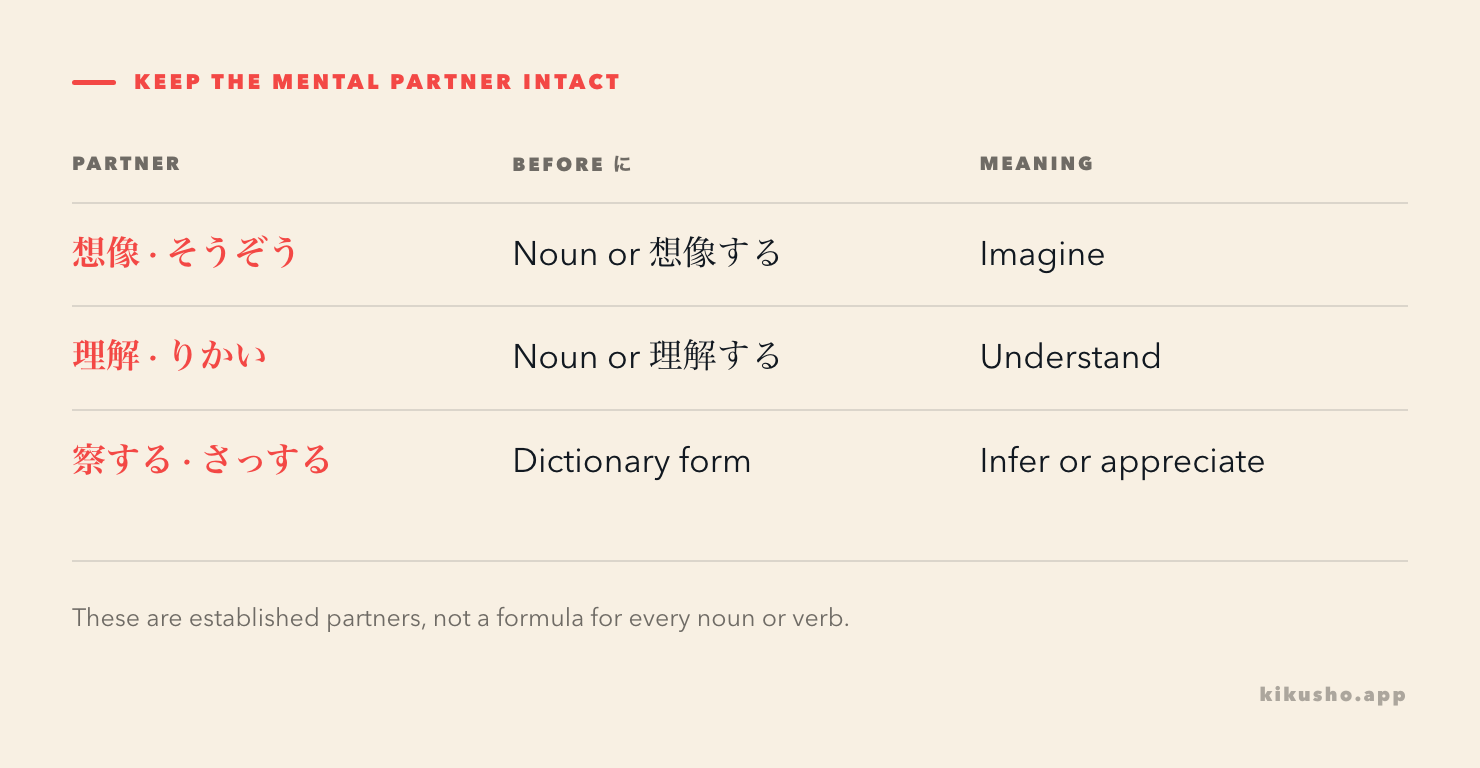
The two dependable starting frames are a verbal noun such as 想像(そうぞう), imagination, and a dictionary-form verb such as 察する(さっする), to infer or appreciate what someone is experiencing. The dictionary form stays intact before に.
| Material before に | Complete construction | Reading | Mental step |
|---|---|---|---|
| 想像 | 想像に難くない | そうぞうに かたくない | Picture a situation |
| 想像する | 想像するに難くない | そうぞうするに かたくない | Picture a situation |
| 理解 or 理解する | 理解(する)に難くない | りかい(する)に かたくない | Understand a feeling or reason |
| 察する | 察するに難くない | さっするに かたくない | Infer or appreciate a state |
想像に難くない and 想像するに難くない both work. Their availability does not mean you can remove する from every verb. Retain 察する in the last row; 察し is its ます-stem, not the dictionary form required by this pattern.
Bunpro's structure notes also give 予想(する)(よそう), predicting, and 推測(する)(すいそく), guessing, as less common partners. Recognise those as related mental operations. This page practises the three core partners in the table; it does not turn their shared formula into permission to attach the ending to every noun or verb you know.
A feeling, a reason and a consequence can be accessible
The construction has one job across these situations: the writer finds the mental step easy. The object of that step changes.
五年間準備した展覧会が中止になった。作家たちの落胆は、想像に難くない。
ごねんかん じゅんびした てんらんかいが ちゅうしに なった。さっかたちの らくたんは、そうぞうに かたくない。
An exhibition prepared over five years was cancelled. The artists' disappointment is not hard to imagine.
The first sentence supplies a reason to picture the emotion. 落胆(らくたん)is disappointment; the ending does not say that the artists find their own disappointment easy to bear. Do not let English “easy” drift from the observer's inference to the experience itself.
夜も休まず看病していた家族の疲れは、察するに難くない。
よるも やすまず かんびょうしていた かぞくの つかれは、さっするに かたくない。
It is not hard to appreciate the fatigue of the family who had been nursing someone without resting even at night.
Here 察する concerns a state inferred from circumstances. The sentence does not require the writer to share the family's exact experience. NIHONGO NET explains the pattern through imagining or understanding a situation without directly seeing it.
急に予定を変更された参加者たちの不満は、理解に難くない。
きゅうに よていを へんこうされた さんかしゃたちの ふまんは、りかいに かたくない。
The dissatisfaction of participants whose plans were suddenly changed is not hard to understand.
Understanding the dissatisfaction does not, by itself, endorse every demand the participants might make. The stated judgment is about understanding their reaction. An argument accepting or rejecting their demands would need something more in the passage.
For a consequence, keep the time frame:
来月から、その小さな店には毎日観光バスが三台来るという。店員の負担が増えることは、想像に難くない。
らいげつから、その ちいさな みせには まいにち かんこうバスが さんだい くると いう。てんいんの ふたんが ふえることは、そうぞうに かたくない。
From next month, three tourist coaches will reportedly come to that small shop each day. It is not hard to imagine the staff's workload increasing.
The last sentence is a readily imaginable consequence of the proposed change. It is not a report that the future workload has already been measured. A prediction can remain a prediction even when the writer finds it persuasive.
Formal wording does not raise anybody's status
A commentary, written explanation or prepared speech can comfortably carry に難くない. 絵でわかる日本語 describes it as stiff wording seldom used in conversation and gives both noun and dictionary-form partners. Recognise it in reading before trying to make every ordinary reply sound this way.
For a friend, 簡単に想像できる(かんたんに そうぞうできる), “I can easily imagine it,” may fit the same thought with plainer wording. 理解するのは難しくない(りかいするのは むずかしくない)states that understanding is not difficult. The mental judgment survives the paraphrase.
The expression itself supplies no honorific or humble transformation. Its formal vocabulary and the choice of a polite sentence ending are separate matters. The guide to Japanese politeness follows whose action is raised or lowered; that question does not explain the meaning of 想像に難くない.
Other formal negatives do different work. まじき and ずして judge unacceptable conduct or connect an absent action to a result. Their old-looking language is not a reason to translate this construction as condemnation or “without imagining.”
It cannot make every physical task an easy inference
Ask what is described as easy: understanding or doing? Carrying a light box is an easy physical action. In ordinary modern wording, この箱は簡単に運べます(この はこは かんたんに はこべます)means “This box can be carried easily.” It does not need the fixed mental-collocation pattern.
A broad formula “verb + にかたくない” leaves out that lexical restriction. The adjective's wider dictionary history does not mean that every conceivable combination is an equally natural example of the N1 pattern taught here. Use the established mental partners first; this is a scope limit, not a claim that no historical literary sentence could ever use another verb.
The potential-form lesson supplies a separate route for ability and possibility. In this page's physical example, 運べます is the potential form of 運ぶ. Knowing a task is easy to perform is different from being able to picture someone's difficulty with it.
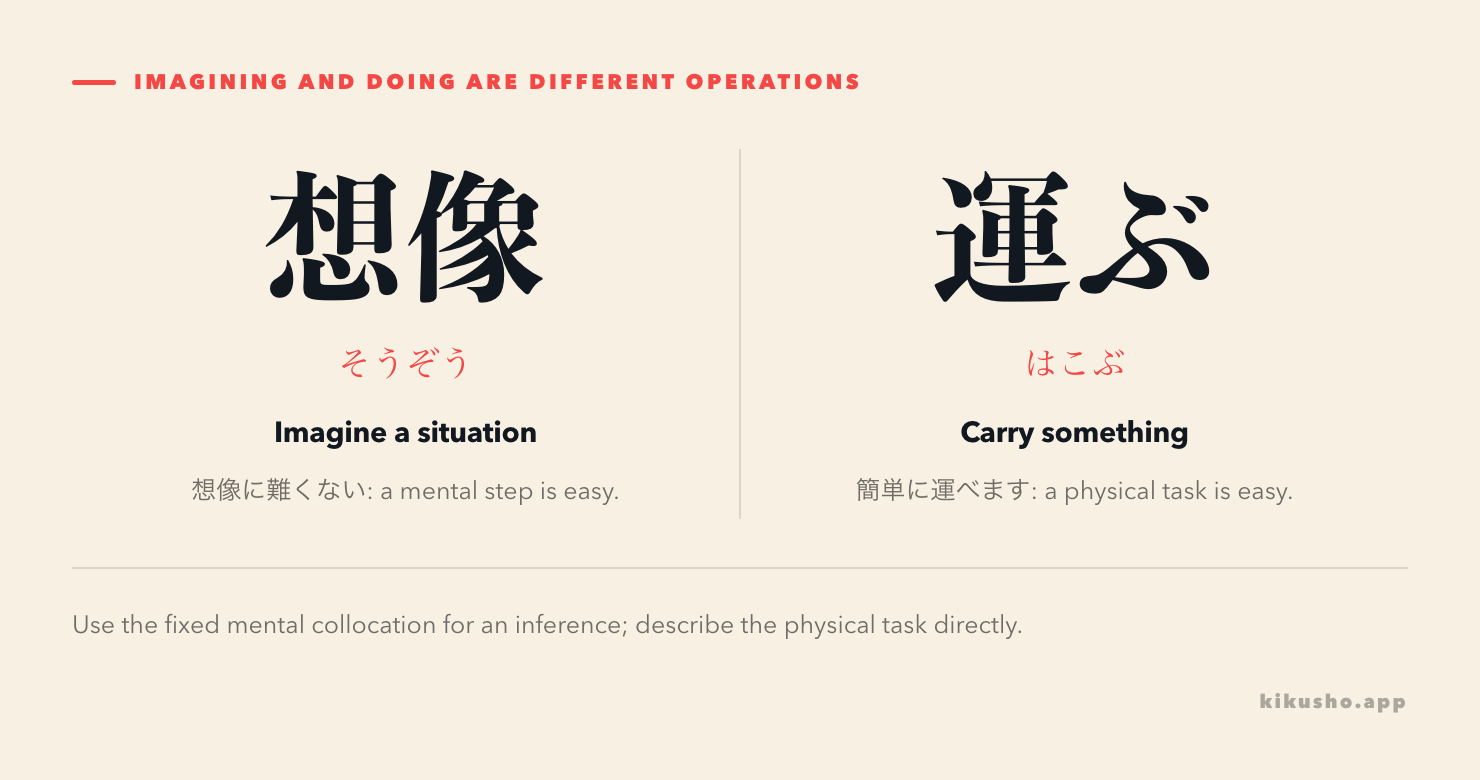
For a text capture in Kikusho, keep the cause beside the mental phrase in its editable example. 展覧会が中止になった gives 想像に難くない a reason to appear. The card's register note can preserve the written tone while the example tells you what the writer is inferring.
Practice questions
Question 1
A commentary says it is easy to imagine how demanding the preparation was. Complete the established expression.
準備がどんなに大変だったかは、想像( )難くない。
- A. を
- B. の
- C. に
- D. で
Question 2
Select the verb form retained before に in this construction.
家族の疲れは、( )に難くない。
- A. 察する
- B. 察し
- C. 察した
- D. 察して
Question 3
Use all four parts to complete the sentence. Which part occupies the starred position?
突然の中止と聞けば、__ __ ★ __。
- A. 落胆すること
- B. 難くない
- C. 作家たちが
- D. は想像に
Question 4
Choose the expression that connects the forecast to the writer's proposal.
来月から、小さな店に毎日観光バスが三台来る。現在の店員は二人だけだ。店員の負担が増えることは、( )。筆者は、この見通しを踏まえて人員の追加を提案している。
- A. 想像することができない
- B. 想像に難くない
- C. もう実際に確認されている
- D. 必ず起こると証明されている
Question 5
Which sentence uses the established mental collocation taught in this lesson?
- A. この箱は運ぶに難くない。
- B. この道は歩くに難くない。
- C. 作家たちの落胆は想像に難くない。
- D. この水は飲むに難くない。
Question 6
Fill the final blank with the judgment the expression contributes to this paragraph.
急な予定の変更で、参加者たちは交通費を無駄にした。彼らの不満は理解に難くない。ただし、筆者は参加者の要求をすべて受け入れるべきだとは述べていない。この表現が示すのは、( )。
- A. 不満が生じる理由は理解できるという判断
- B. 筆者がすべての要求に賛成しているという判断
- C. 参加者が不満を感じるはずがないという判断
- D. 変更には何の理由もないという証明
Answers and explanations
Trace the mental operation and the writer's evidence before checking each selection.
Answer 1: C, に. The complete phrase is 想像に難くない(そうぞうに かたくない). The question asks for this established frame; を, の and で do not replace its に. 大変 is たいへん, demanding or difficult here. The demanding work is what the writer can easily picture, not what the writer calls easy to perform.
Answer 2: A, 察する. Keep the dictionary-form verb before に. B supplies the ます-stem, C the past form and D the て-form. 想像 allows a noun frame as well, but that does not license removing the tail of 察する. 家族 is かぞく and 疲れ is つかれ.
Answer 3: D at ★. The sequence is C → A → D → B: 突然の中止と聞けば、作家たちが落胆することは想像に難くない。 “On hearing of the sudden cancellation, it is not hard to imagine the artists being disappointed.” The が-clause ends with こと, は makes that event the topic, and 想像に難くない supplies the judgment. The starred part contains は想像に, not the final negative.
Answer 4: B. The added coach visits and limited staffing support a forecast of greater workload. A denies the ability to imagine it, undermining the stated outlook. C turns the prediction into an already observed fact, while D invents a proof of inevitability. The paragraph gives neither. 見通し(みとおし)means outlook here; the proposal responds to that outlook.
Answer 5: C. 想像 is an established partner for a readily pictured feeling. A, B and D put physical actions into the same frame. They are outside the standard mental use practised here; ordinary wording would describe carrying, walking or drinking as easy directly. Do not treat a structural formula as a guarantee that every lexical choice has the same modern naturalness.
Answer 6: A. 理解に難くない makes the participants' dissatisfaction understandable. The next sentence expressly withholds any statement that all their demands should be accepted, so B adds approval the writer has not given. C reverses the reaction, and D asserts a proof about the change's reasons. 理解 concerns the reaction's accessibility, not agreement with every response to it.
Common questions
What does にかたくない mean?
It calls something easy to imagine, infer or understand, literally not difficult. It is a formal expression used with a limited group of mental words, especially 想像 and 察する, rather than a general way to say every task is easy.
Does 想像 need する before にかたくない?
Both 想像にかたくない and 想像するにかたくない are established. With 察する, retain the dictionary form: 察するにかたくない. Do not apply a blanket rule of removing する or substitute the ます-stem 察し.
How is 難くない read in this construction?
It is かたくない. The complete expression is に難くない, にかたくない in hiragana. The negative says that imagining or understanding presents no great difficulty; it does not say the described event is impossible.
Does にかたくない prove that a predicted event will happen?
No. It presents the mental judgment as easy to reach. A likely consequence can be easy to imagine without having been witnessed or proved inevitable. The surrounding passage supplies the evidence and any remaining uncertainty.