On this page
にあたって and に際して both translate as "on the occasion of," both require a real turning point rather than an ordinary day, and most bilingual dictionaries hand you the same English gloss for either. What decides between them is never the occasion itself. It is what the rest of the sentence is doing: getting ready for what's coming, or stating something that holds the moment it arrives.
Both forms refuse an ordinary Tuesday
にあたって and に際して attach the same way: directly onto a noun, or onto the plain dictionary form of a verb, with no の and no て-form in between. 転職するにあたって and 転職に際して are both grammatical; 転職したにあたって and 転職したに際して are not, because both forms mark an occasion still ahead of the speaker or level with it, never one already past.
That occasion has to earn the sentence. A job change, a wedding, an exam, a company's move to new premises: all of them qualify. 食事にあたって or 朝起きるに際して do not; routine, repeatable actions carry no weight for either form, and a native speaker reads both as odd the same way "on the occasion of breakfast" would read oddly in English. Each form also keeps a written twin, にあたり for にあたって and に際し for に際して, that drops the て because a notice board or a printed programme has no room for it. The twin changes nothing about meaning or the choice between the two families; it only tells you the sentence is being written down rather than said.
The question that decides: before the occasion, or level with it?
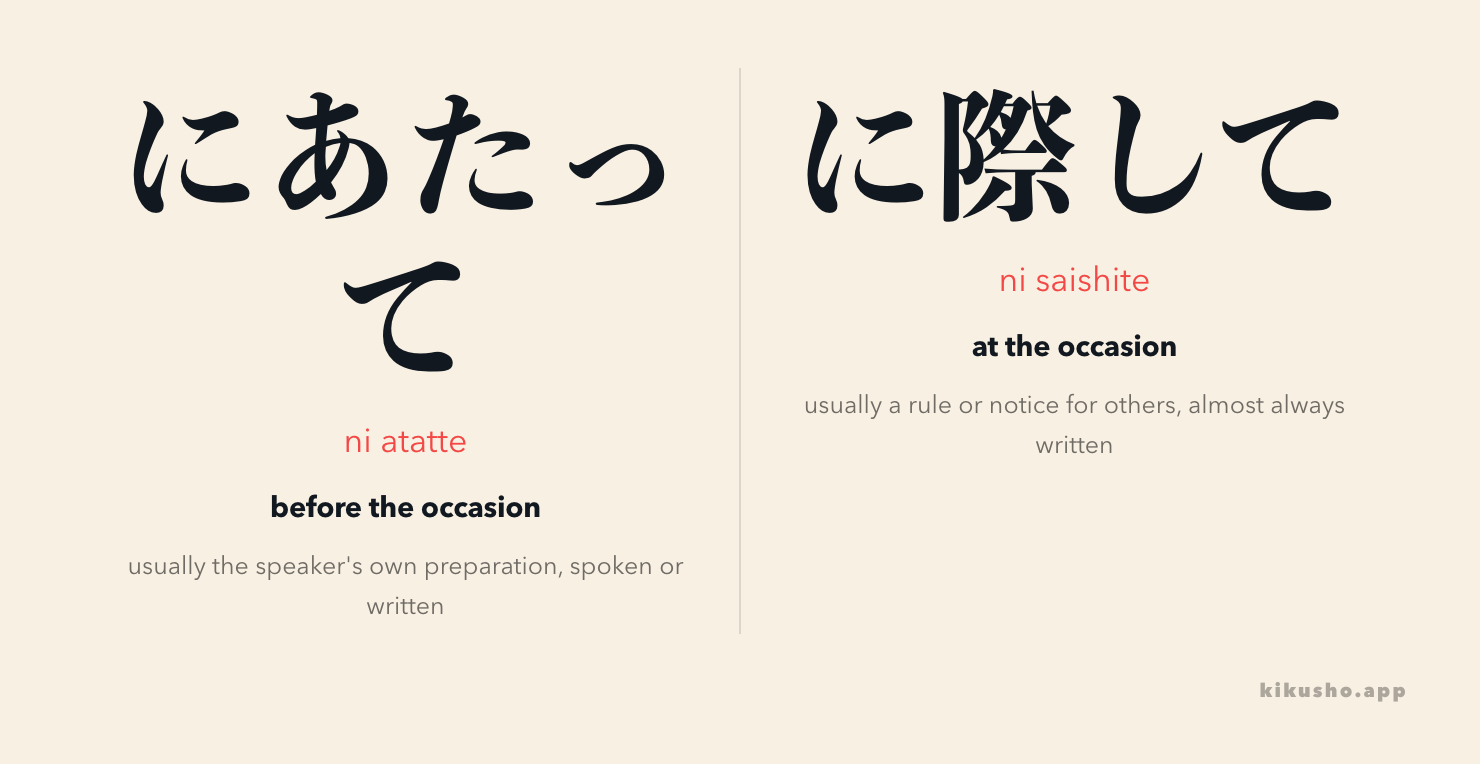
Once an occasion clears that bar, ask when the rest of the clause happens relative to it. にあたって places the clause before the occasion is realized: getting ready for it, bracing for it, doing something in view of it while it still lies ahead. に際して places the clause level with the occasion, happening at the same time it does. One test that catches most cases: try inserting "in the run-up to this, " before the clause. If that still makes sense, にあたって fits. If the clause reads more like something true right at the occasion, with no "before" to it, に際して fits instead.
The two also lean toward different kinds of clause, though this is a tendency worth noticing rather than a rule to apply on its own: what happens before an occasion is often the speaker's own preparation, so にあたって skews personal; what happens at an occasion is often a rule, greeting or announcement meant for whoever else is there, so に際して skews official. Treat that as a second check, not a substitute for the timing question.
にあたって is at home before the occasion, usually as your own preparation
転職するにあたって、これまでの実績を整理しておいた。 In preparing to change jobs, I put together a record of what I'd accomplished so far. The clause after にあたって names something the speaker did beforehand, on their own initiative, because the milestone was coming. 新しい店を開くにあたって、資金の計画を立てた。 In getting ready to open the new shop, I drew up a funding plan. Same shape, same ownership: the milestone belongs to the speaker, and so does the preparation.
にあたって shows up in speech as readily as in writing, in an interview answer, a wedding speech, a manager briefing a new hire, because resolve is something a person states about themselves out loud. That is the form's real ground: not formality for its own sake, but a first-person stance taken in view of what's ahead.
に際して is at home level with the occasion, usually as a rule for the room
入社式に際して、社長からの挨拶があった。 At the entrance ceremony, there was a speech from the president. Nobody is preparing for anything in that sentence; something simply took place at the moment the occasion arrived, and the clause reports it. ご利用に際しての注意事項は下記のとおりです。 The points to keep in mind when using this are as follows. に際しての here modifies 注意事項 directly, the attributive shape に際して takes on when a noun follows it, and the whole sentence is a notice addressed to a reader who is not the speaker.
That is where に際して lives almost exclusively: printed notices, ceremony programmes, contract clauses, the line before an announcement. It is heard far less often than にあたって, because most people rarely stand up and state a rule for a room out loud.
The overlap: one goodbye, said either way
出発にあたって一言ご挨拶申し上げます。 出発に際して一言ご挨拶申し上げます。 Both open a farewell speech the same way, and both are genuinely correct here: a departure is exactly the kind of occasion neither form refuses, and a set greeting formula does not force a choice the way a fresh sentence does.
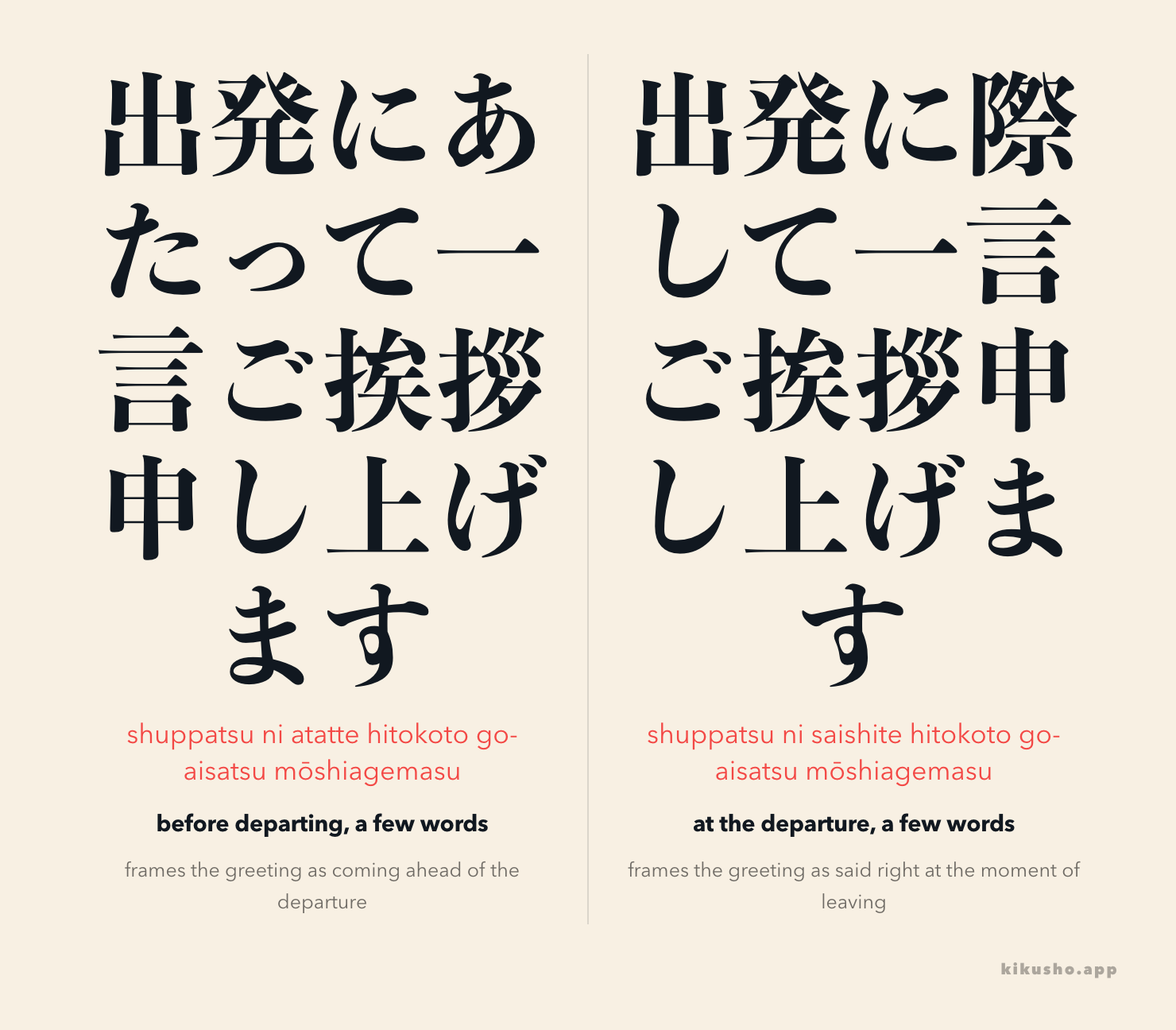
Look closely at what each version is technically claiming, though: にあたって frames the greeting as something offered in view of the departure that hasn't quite happened yet; に際して frames it as something said at the moment of departure itself. In a memorised formula nobody hears that difference. Write your own sentence instead of reusing the formula, and the difference reappears, because now there is a real choice to make about what the rest of the clause is doing.
Picking the wrong one moves the event in time
開会に際して、市長が挨拶をした。 At the opening, the mayor gave a speech, delivered right there at the ceremony itself. Swap in にあたって and the timing moves: 開会にあたって、市長が挨拶をした now reads as a speech given in the run-up to the opening, ahead of it, the way remarks at a rehearsal or a briefing the week before would be. Nothing else in the sentence changes, and the mayor still gives a speech either way; what moves is whether that speech happened at the ceremony or somewhere before it.
The reverse mistake does the same thing in the other direction. 面接を受けるにあたって、想定問答を用意した。 In preparing for the interview, I put together likely questions and answers, done beforehand, so the candidate walks in ready. Written as 面接を受けるに際して、想定問答を用意した instead, the sentence now claims the preparing happened at the interview itself, which is a stranger claim: nobody drafts likely questions while already sitting across from the interviewer.
A card that keeps either sentence whole, with the reading and the clause that pins its timing, teaches which side of the occasion the action falls on; a card with just にあたって or に際して glossed as "on the occasion of" teaches a translation and loses the one thing that decides between them. Register decisions like this one rarely come down to a single memorised rule: they come down to noticing, each time, whether the clause is still looking ahead or already there.
Practice: three questions where timing is the whole answer
Question 1. Choose the natural form: 「新しい仕事を始める___、必要な道具をそろえておいた。」(In getting ready to start the new job, I made sure I had the tools I'd need.)
a) にあたって b) に際して c) にあたった
Answer 1: にあたって. The clause that follows describes something the speaker did in advance to prepare, gathering tools before the job starts, which is exactly what にあたって marks. (b) would report the gathering as something that simply happened at the moment the job began, losing the "in advance" sense the sentence needs. (c) is not a form either pattern takes; both attach to the plain dictionary form, never the past tense.
Question 2. Put these into a natural sentence meaning "At the time of the merger, the company held a briefing for all employees.": 会社は ・ 合併 ・ に際して ・ 説明会を開いた
Answer 2: 会社は合併に際して説明会を開いた。 に際して attaches directly to the noun 合併, with no の in between, and the announcement clause 説明会を開いた comes after it. 会社は can open the sentence or sit just before 説明会を開いた, but に際して has to stay locked to 合併.
Question 3. Complete the dialogue with the natural form: 「A:来週、部長の送別会があるそうですね。 B:ええ、退職___、皆で色紙を用意しているんです。長年お世話になった方なので。」(A: I hear there's a farewell party for the department head next week. B: Yes, we're all preparing a card for his retirement. He's looked after us for years.)
a) するにあたって b) するに際して c) したに際して
Answer 3: するにあたって. 色紙を用意している describes something the group is doing ahead of the retirement, before it happens rather than at it, so にあたって is the fit. (b) would place the preparing at the retirement itself, as though the card only came together once he'd already left, which contradicts 来週 in A's line. (c) fails on form alone: neither pattern takes the past tense.
にあたって and に際して will keep translating the same in a dictionary. What tells them apart is never the word before them. It's whether the sentence after them is getting ready for something, or announcing it.
Common questions
Can にあたって and に際して both attach to the same greeting formula?
Yes. 出発にあたって一言ご挨拶申し上げます and 出発に際して一言ご挨拶申し上げます are both attested, fixed ways to open a farewell speech, and native speakers treat them as interchangeable there. Fixed formulas are the exception the rule below allows for; anywhere you are composing a fresh sentence, the test still decides.
Is に先立って a third version of the same pattern?
It overlaps in translation, close to "prior to," but it makes a stronger claim than either form here: に先立って states that one event is deliberately sequenced before another, with a gap between them, the way a rehearsal comes before opening night. にあたって only marks that something is being faced, not that a separate, earlier step is being named. It earns its own lesson rather than a footnote on this one.
Do にあたり and に際し mean something different from にあたって and に際して?
No. にあたり is the written form of にあたって, and に際し is the written form of に際して, the same relationship a full sentence has to its clipped version in a notice board. Meaning and the test below are identical; only にあたり and に際し drop the て because a notice does not need it.
Why can't にあたって or に際して attach to た-form or ている?
Both mark a point still ahead of the speaker, or level with it, never one already behind them. 卒業したにあたって is not a sentence anyone writes: the past tense already places graduation behind the speaker, and にあたって only ever points at what's still to come. Keep both forms on the plain dictionary form of a verb, or directly on a noun.