On this page
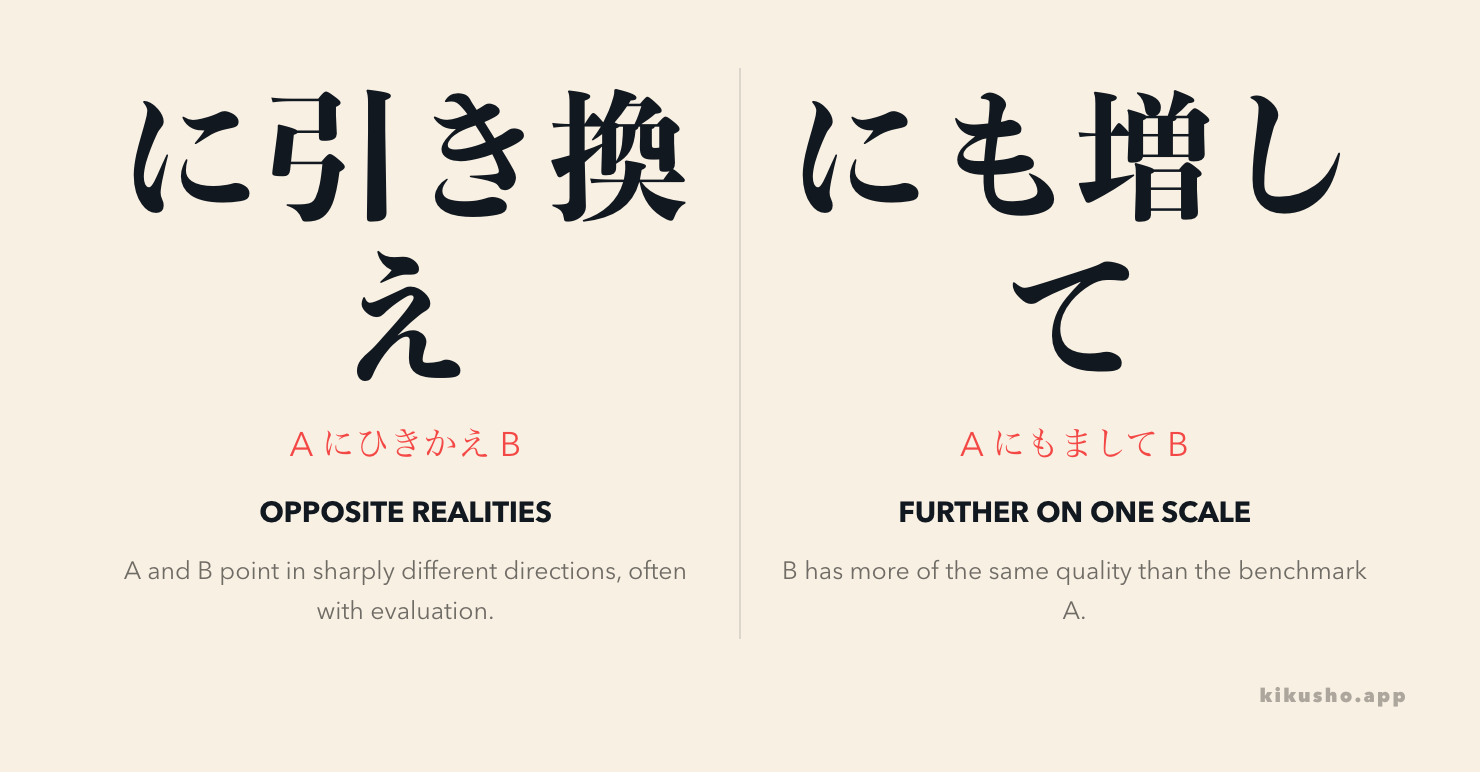
Choose に引き換え when two facts sit at sharply opposite ends of a contrast. Choose にも増して when both cases share one scale and the second goes further: hotter than last year, more important than anything else, or more careful than usual.
昨年は客が少なかったのに引き換え、今年は連日満席だ。
さくねんは きゃくが すくなかったのに ひきかえ、ことしは れんじつ まんせきだ。
Last year had few customers; in sharp contrast, this year is fully booked every day.
今年は昨年にも増して、予約が多い。
ことしは さくねんにも まして、よやくが おおい。
This year has even more bookings than last year.
The first sentence flips from scarcity to full capacity. The second keeps “number of bookings” as one scale and raises the degree. That structural difference decides the form.
Ask whether the second side reverses or exceeds the first
Both expressions compare, and both let the writer colour the comparison. Their logical shapes are different.
| Form | Relationship | Question to ask | Typical effect |
|---|---|---|---|
| A に引き換え B | A and B are sharply opposed | “Are these contrasting facts?” | surprise, criticism, admiration or dissatisfaction |
| A にも増して B | B exceeds A on one quality | “Is B even more X than A?” | intensification beyond a prior case or standard |
With に引き換え, the predicates often point in opposite directions: one person works steadily while another avoids responsibility; one period was prosperous while another is difficult. With にも増して, the property continues in the same direction. If last year was busy, this year is busier. If safety already matters, it matters even more now.
This gives you a substitution test. If AよりさらにB preserves the intended relation, にも増して is a candidate. If the sentence needs Aとは対照的に, choose に引き換え.
に引き換え makes the contrast evaluative
引き換え(ひきかえ) evokes exchanging or switching one thing for another. In this grammar pattern, it places one known fact beside a markedly different one. The speaker commonly evaluates the gap rather than presenting a neutral pair.
計画を着実に進める姉に引き換え、弟は準備さえ始めていない。
けいかくを ちゃくじつに すすめる あねに ひきかえ、おとうとは じゅんびさえ はじめていない。
In sharp contrast to the older sister, who steadily advances her plan, the younger brother has not even started preparing.
海側は人でにぎわっているのに引き換え、山側の道は静まり返っていた。
うみがわは ひとで にぎわっているのに ひきかえ、やまがわの みちは しずまりかえっていた。
The seaside was crowded with people, whereas the mountain road was completely quiet.
The second example is not automatically criticism. The evaluation can be admiration, disappointment or simply the speaker’s sense that the contrast is striking. What matters is the pronounced opposition.
Attachment depends on what supplies the first fact:
| First side | Attachment | Example opening |
|---|---|---|
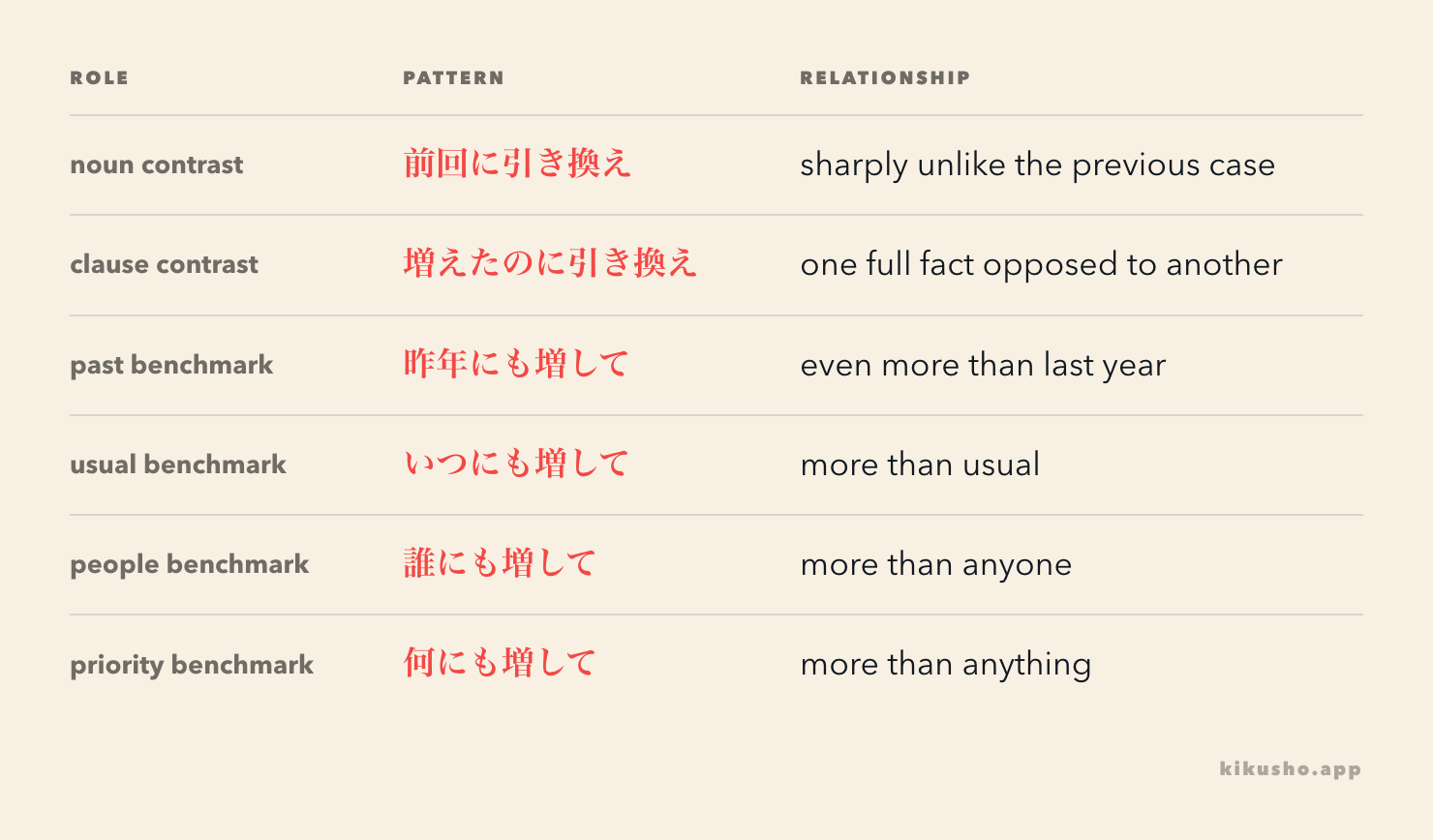
| noun | N + に引き換え | 前回の結果に引き換え |
| verb clause | plain clause + のに引き換え | 売り上げが伸びたのに引き換え |
| い-adjective clause | plain adjective + のに引き換え | 去年は暑かったのに引き換え |
| な-adjective or noun clause | である + のに引き換え | 姉が慎重であるのに引き換え |
For a noun that already identifies the comparison item, direct attachment is the cleanest: 兄に引き換え, 前回に引き換え. When you need a complete proposition, add nominalizing の after its plain form.
You can also begin a new sentence with それに引き換え:
第一案は費用が低く、準備も簡単だ。それに引き換え、第二案は時間も人手もかかる。
The first proposal is inexpensive and easy to prepare. In sharp contrast, the second requires both time and labour.
Bunpro supports the direct noun form, clause-plus-の attachments, the strong evaluative gap and それに引き換え. 日本語NET independently distinguishes this subjective opposition from the more neutral contrast available with に対して.
にも増して moves further along one scale
にも増して(にもまして) follows a noun that supplies a benchmark. The second case exceeds that benchmark in quantity, intensity, importance or another degree.
今朝は昨日にも増して冷え込んだ。
けさは きのうにも まして ひえこんだ。
This morning was even colder than yesterday.
経験にも増して、判断力が求められる仕事だ。
けいけんにも まして、はんだんりょくが もとめられる しごとだ。
It is a job that demands sound judgment even more than experience.
The benchmark itself need not be weak. 経験にも増して判断力が必要だ can acknowledge that experience matters while ranking judgment above it. The construction adds or increases; it does not deny A.
Time nouns are especially common because they make change easy to measure:
| Benchmark | Expression | Reading in context |
|---|---|---|
| a previous period | 去年にも増して | even more than last year |
| a prior state | 以前にも増して | even more than before |
| the usual pattern | 例年にも増して | even more than in an ordinary year |
| the normal occasion | いつにも増して | more than usual / ever |
Question words widen the comparison set. 誰にも増して ranks someone above everyone; 何にも増して ranks one concern above everything; いつにも増して compares the present occasion with all the usual ones.
佐藤さんは誰にも増して、利用者の声を丁寧に聞いている。
さとうさんは だれにも まして、りようしゃの こえを ていねいに きいている。
Ms Sato listens to users more carefully than anyone.
緊急時には、何にも増して正確な連絡が大切だ。
きんきゅうじには、なににも まして せいかくな れんらくが たいせつだ。
In an emergency, accurate communication matters more than anything.
それにも増して can take an entire previous statement as its benchmark. It means “beyond that” or “even more than that,” so the next fact must rise higher on a relevant scale.
日本語教師のN1et confirms noun attachment, comparisons with prior periods, question-word combinations and それにも増して. 日本語教師のまる得 independently describes the shared-property relationship: A has the quality, but B has it to a greater degree.
The same topic produces two different arguments
Consider two annual surveys:
前回は回答率が高かったのに引き換え、今回は半数にも届かなかった。
ぜんかいは かいとうりつが たかかったのに ひきかえ、こんかいは はんすうにも とどかなかった。
The previous response rate was high; in sharp contrast, this time it did not even reach half.
今回は前回にも増して、自由記述の回答が多かった。
こんかいは ぜんかいにも まして、じゆう きじゅつの かいとうが おおかった。
This time there were even more free-response answers than last time.
The first compares two results with opposing evaluations. The second measures the same count in the same direction. に引き換え makes you formulate both sides as facts; にも増して lets the benchmark sit inside one degree comparison.
Neutral comparison forms do less interpretive work
に比べて is the safer general comparison when you only want to measure a difference:
去年に比べて、今年は参加者が多い。
Compared with last year, there are more participants this year.
This statement can be entirely neutral. 去年にも増して今年は参加者が多い adds the sense that the number has risen beyond an already relevant benchmark. 去年に引き換え今年は参加者が多い invites a sharper opposition, so it fits better when last year was notably quiet or disappointing.
Contrastive のに対して also sets two propositions side by side without requiring the speaker’s pronounced praise or dissatisfaction. The に比べて and に対して lesson covers those neutral structures. 反面 and 一方で instead organize two sides of a subject or two parallel developments. 以上に is a wider “more than” expression and need not carry the established-period flavour common with にも増して.
Do not confuse に引き換え with と引き換えに. The latter means “in exchange for” or “at the cost of”:
商品券と引き換えに、景品を受け取った。
I received the prize in exchange for the voucher.
Here there is an actual exchange. The order Xと引き換えに and the exchange relation separate it from comparative Xに引き換え.
Register and certainty affect the choice
Both target forms suit careful speech and writing. に引き換え can sound pointed because it often exposes a good-versus-bad gap. Use it cautiously when comparing people: the grammar may turn a factual difference into criticism. にも増して is formal but often positive or neutral in reports, speeches and commentary.
The first side of に引き換え is normally treated as an established fact. If the second case is only a forecast, a neutral comparison such as に比べて is often safer. 来月は今月に比べて忙しくなるだろう simply predicts a difference; the stronger に引き換え frame sounds as though the opposed realities are already available for judgment.
When saving either pattern in Kikusho, keep the benchmark and the outcome on the card. A fragment such as 昨年にも増して does not show which quality increased, while 静かな兄に引き換え hides the contrasting fact still to come. The whole sentence preserves the decision you will need to reproduce during review, and you can edit the generated nuance note before saving it.
The independent references checked here place both constructions at N1 and agree on their central relation. These are editorial study labels; the JLPT authority does not publish an exhaustive official list of grammar items.
Practice
For each of the seven items, identify the comparison’s direction before you reveal the solutions.
Question 1
Choose the form that presents two siblings in sharp evaluative opposition.
約束を必ず守る姉( )、弟は何度注意しても時間に遅れる。
- ア. にも増して
- イ. に引き換え
- ウ. に比べると
- エ. と引き換えに
Question 2
Choose the form that says this winter is colder than last winter on the same scale.
この冬は昨冬( )、寒さが厳しい。
- ア. に引き換え
- イ. と引き換えに
- ウ. にも増して
- エ. に対して
Question 3
Complete the attachment after a verb clause.
国内の注文が増えた( )、海外からの注文は減少した。
Question 4
Use a question word with にも増して to say “More than anything, accurate information is necessary.”
Question 5
Which sentence uses に引き換え naturally?
- ア. 去年は暑かったに引き換え、今年は涼しい。
- イ. 去年は暑かったのに引き換え、今年は涼しい。
- ウ. 去年にも引き換え、今年は涼しい。
- エ. 去年と引き換えに、今年は涼しい。
Question 6
Which sentence says that Ms Mori works more carefully than anyone, without criticizing the other people?
- ア. 森さんは誰に引き換え、丁寧に働く。
- イ. 森さんは誰と引き換えに、丁寧に働く。
- ウ. 森さんは誰にも増して、丁寧に働く。
- エ. 森さんは誰なのに引き換え、丁寧に働く。
Question 7
Fill both blanks and state why the forms cannot be reversed.
旧館は設備が古く暗かった(前)、新館は明るく使いやすい。さらに、開館初日は予想(後)、多くの人が訪れた。
- ア. 前 のに引き換え / 後 にも増して
- イ. 前 にも増して / 後 のに引き換え
- ウ. 前 と引き換えに / 後 に対して
- エ. 前 のに対して / 後 と引き換えに
Answers and explanations
1.
イ. に引き換え. The sister’s reliability and the brother’s repeated lateness are opposed and evaluated. にも増して would require the second case to exceed the first on one shared property.
2.
ウ. にも増して. Last winter is the benchmark and this winter has a greater degree of cold. Nothing in the sentence reverses from one quality to its opposite.
3.
のに引き換え. The complete fact 国内の注文が増えた takes nominalizing の before に引き換え. The following fall in overseas orders supplies the sharply contrasting fact.
4.
One natural answer is 何にも増して、正確な情報が必要だ。 何 widens the comparison to everything else, and the sentence ranks accurate information above that set.
5.
イ. 去年は暑かったのに引き換え、今年は涼しい. A plain い-adjective clause needs の before に引き換え. The other choices either omit that nominalizer or replace the comparison with an exchange structure.
6.
ウ. 森さんは誰にも増して、丁寧に働く. 誰にも増して means “more than anyone.” It ranks the degree of careful work and does not itself condemn the other workers.
7.
ア. 前 のに引き換え / 後 にも増して. The old building’s darkness and the new building’s brightness are opposing facts, so the first gap takes のに引き換え. The turnout exceeded an expected degree, so 予想にも増して provides the benchmark. Reversing the forms would treat opposites as one increasing quality and an expectation as a complete contrary fact.
Common questions
What is the difference between に引き換え and にも増して?
に引き換え places two facts in sharp, often evaluative opposition. にも増して says that the second case has more of one quality than the named benchmark.
What comes before に引き換え?
A noun attaches directly. A verb or adjective clause is normally followed by の, as in 増えたのに引き換え; nouns and な-adjectives may use であるの.
Can にも増して follow question words?
Yes. いつにも増して means more than usual or ever, 何にも増して means more than anything, and 誰にも増して means more than anyone.
Are に引き換え and にも増して N1 grammar?
The references checked for both constructions place them at N1. These are study-resource estimates because the JLPT publishes no exhaustive grammar list.