On this page
以上に(いじょうに) means that a degree goes beyond the benchmark placed before it. 予想以上に難しかった does not mean “it was at least difficult”; it means the actual difficulty exceeded what was expected.
The benchmark can be an expectation, a necessary amount, another person, an earlier time or a whole clause. Use 以上に when the phrase modifies a following predicate, and 以上の when it modifies a noun. That simple split prevents many errors with an expression that English often reduces to “more than.”
JLPT Sensei and Bunpro both place this comparative pattern at N2. Bunpro lists noun, adjective and clause benchmarks and separates the pattern from the numeric threshold reading. The JLPT publishes no exhaustive grammar syllabus, so N2 here is a source-based study placement rather than an official checklist claim.
以上に puts the benchmark before a degree
Read the expression from left to right:
benchmark + 以上に + predicate whose degree exceeds it
試験は予想以上に難しかった。
The exam was more difficult than expected.
予想 supplies the expected level. 以上 says the actual result is above that level, and に connects the comparison adverbially to 難しかった. The sentence does not tell us exactly how difficult the exam was. It only locates the actual degree beyond the expectation.
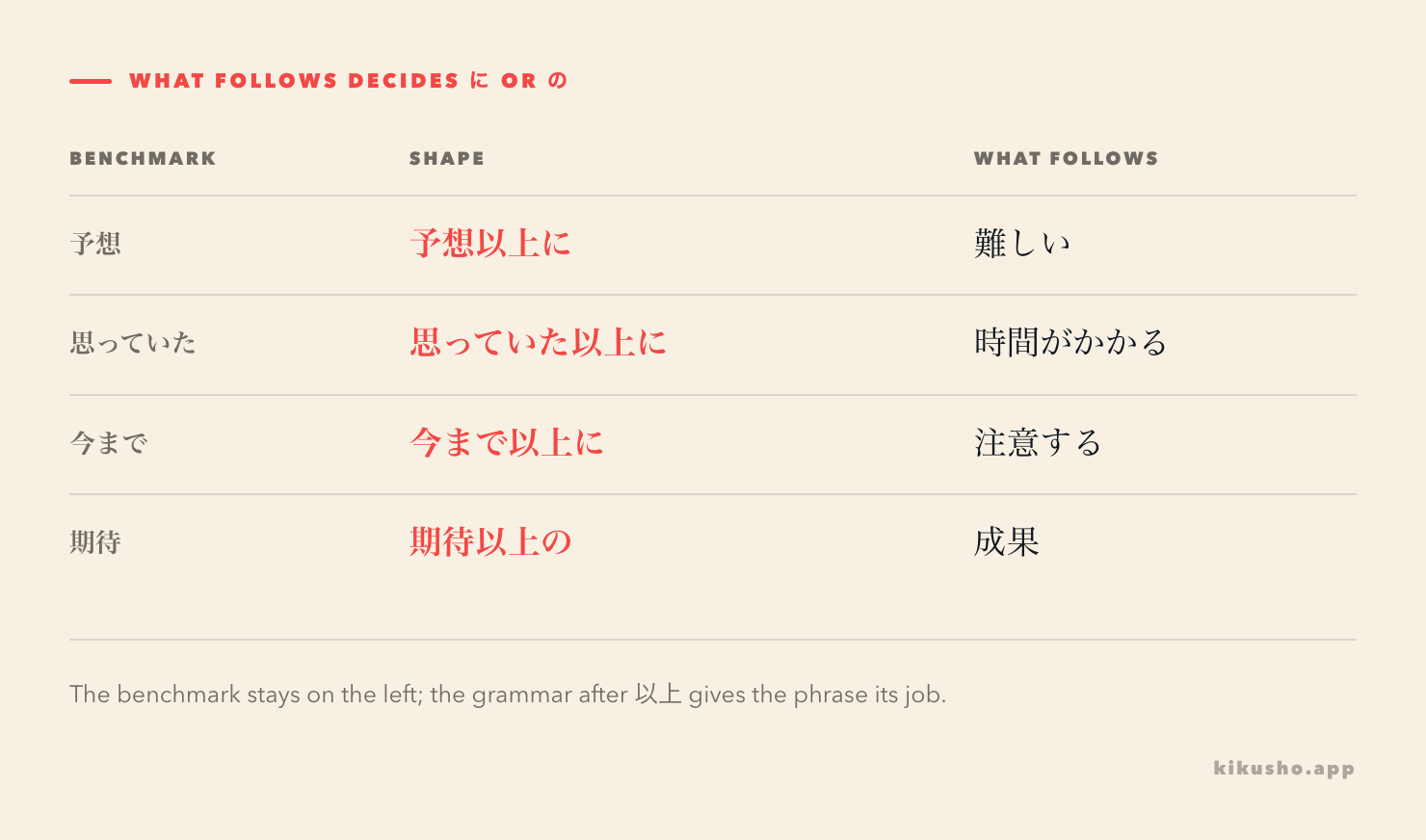
| Benchmark | Comparative phrase | Result beyond it |
|---|---|---|
| 予想, expectation | 予想以上に | 難しい, difficult |
| 思っていた, what I had thought | 思っていた以上に | 時間がかかる, take time |
| 今まで, until now | 今まで以上に | 注意する, be careful |
| 期待, expectations | 期待以上の | 成果, results |
The form before 以上 need not be a single noun. A plain clause can define the entire benchmark:
修理には思っていた以上に時間がかかった。
The repair took more time than I had thought.
Here 思っていた is not the result. It describes the earlier estimate that reality exceeded. This clause pattern is especially useful with 思う, 考える, 聞く and 見る, because a speaker often compares reality with a prior belief or impression.
に and の depend on what comes next
Choose the particle by the job of the entire comparison phrase, not by the word before 以上.
反応は予想以上に大きかった。
The reaction was greater than expected.
予想以上の反応があった。
There was a greater reaction than expected.
In the first sentence, 予想以上に modifies the predicate 大きかった, so the adverbial particle is に. In the second, 予想以上の directly modifies the noun 反応, so it needs の. The benchmark and the comparison are unchanged.
This contrast also explains a common sentence-final form:
結果は期待以上だった。
The result exceeded expectations.
There is no following verb or adjective for に to modify and no following noun for の to attach to. 期待以上 itself is the predicate before だった. Do not add に mechanically every time the English translation contains “more than.”
Common benchmark phrases are worth learning as complete frames:
- 予想以上に: more than expected
- 想像以上に: beyond what one imagined
- 期待以上に: beyond expectations
- 必要以上に: more than necessary
- 今まで/これまで以上に: more than ever before
- 以前以上に: more than before
必要以上に心配しないでください。
Please do not worry more than necessary.
必要以上に does not claim that worry is completely unnecessary. It sets the necessary or reasonable amount as the boundary and rejects the excess beyond it.
The benchmark can be a person, time or earlier state
Expectation phrases are frequent, but surprise is not part of the grammar itself. A person or an earlier period can serve as an ordinary comparison benchmark.
今年の夏は去年以上に暑い。
This summer is hotter than last summer.
彼は私以上にこの町の歴史に詳しい。
He knows the history of this town better than I do.
次の発表では、今まで以上に分かりやすく説明したい。
In the next presentation, I want to explain things more clearly than ever before.
The first two examples compare degrees across a time and two people. The third treats the speaker's previous performance as the level to surpass. 今まで以上に often appears with effort, attention, cooperation and improvement because it points forward from an established past.
The Kotobank dictionary entry for 以上 records both the boundary sense and a qualitative comparison in which one thing has a more marked degree than another. That shared image of crossing a line connects the readings, but it does not make their sentence patterns interchangeable.
より compares neutrally; 以上に emphasizes the level crossed
より is the ordinary starting point for a comparison:
今年は去年より暑い。
This year is hotter than last year.
今年は去年以上に暑い。
This year is even hotter than last year.
Both sentences compare this year with last year. より simply identifies last year as the comparator. 以上に presents last year's heat as a degree that this year goes beyond; in a suitable context, it can suggest that last year was already notably hot. That suggestion comes from treating the earlier degree as a meaningful benchmark, not from a rule that 以上に always means “surprisingly.”
The overlap is closest with thoughts and predictions:
試験は思ったより難しかった。
The exam was harder than I thought.
試験は思った以上に難しかった。
The exam was harder than I had expected; it went beyond the level I had imagined.
The より version is a neutral correction to the speaker's estimate. The 以上に version puts more weight on crossing the imagined limit. Context and tone can make the difference small, so do not invent a dramatic surprise when none is present. Yasu Japanese School's 以上に guide likewise illustrates both expectation benchmarks and direct comparisons with another person or thing.
Three uses of 以上 must stay separate
The same written form appears in three structures that answer different questions.
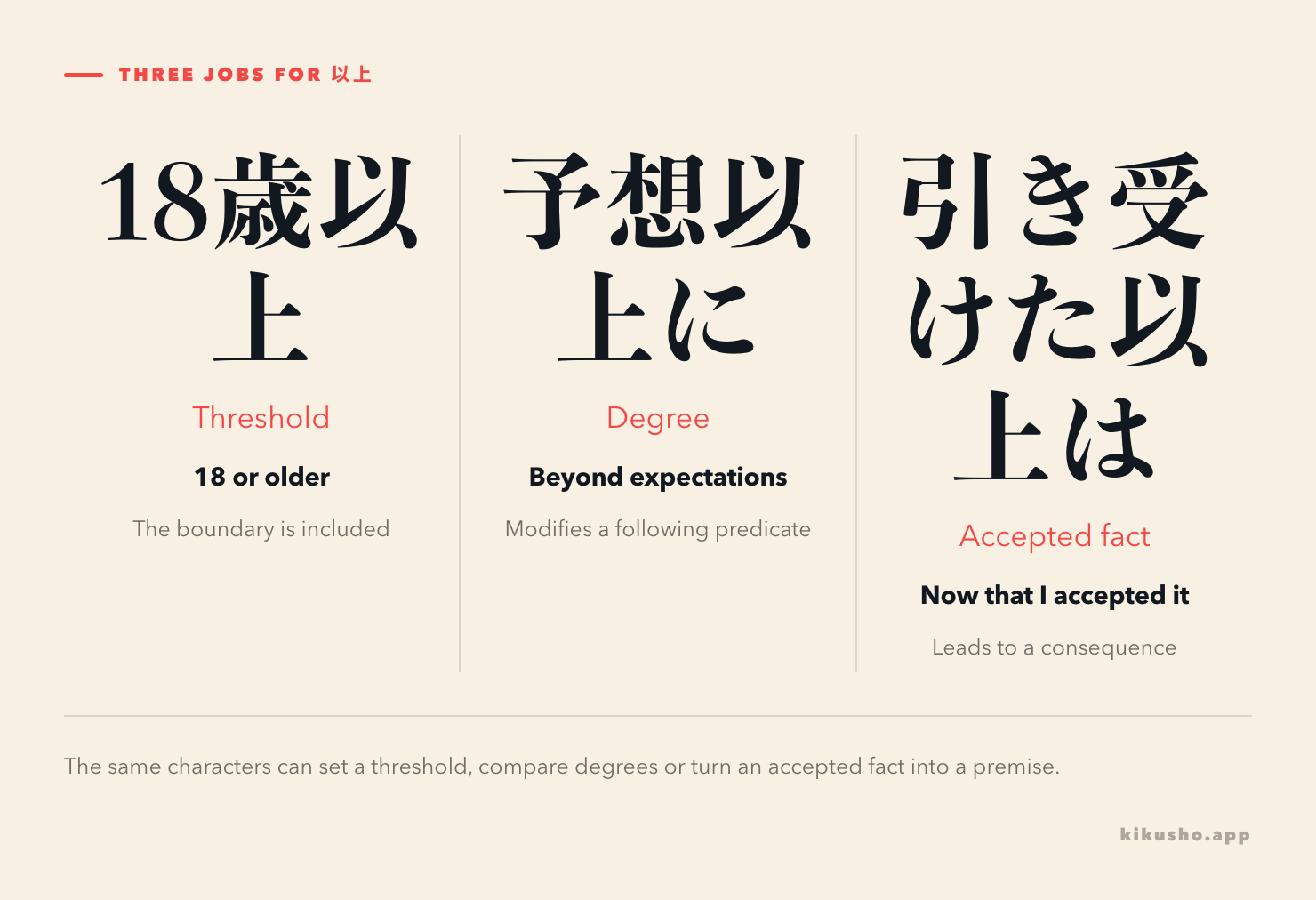
Numeric 以上 sets an inclusive lower limit
このイベントは十八歳以上の方が参加できます。
People aged 18 or older can join this event.
The boundary is included: an 18-year-old qualifies. This is the count or threshold use of 以上, often translated as “at least,” “or more” or “and above.” It does not by itself say that one quality exceeds another.
Comparative 以上に describes a degree beyond a benchmark
イベントは予想以上に混んでいた。
The event was more crowded than expected.
Here 予想 is not a minimum admission rule. It is the expected degree of crowding, and reality went beyond it. The following adjective receives the adverbial comparison through に.
以上は accepts a fact and draws a consequence
引き受けた以上は、最後までやる。
Now that I have accepted it, I will see it through.
This 以上は does not compare two degrees. It accepts 引き受けた as a firm premise, then derives a commitment. The separate 以上は, からには and 上は lesson explains that consequence pattern and its register.
| Form | Question it answers | Core reading |
|---|---|---|
| 十八歳以上 | Who meets the threshold? | 18 or older, including 18 |
| 予想以上に混んでいる | How crowded compared with the benchmark? | more crowded than expected |
| 引き受けた以上はやる | What follows from accepting this fact? | now that I accepted it, I will act |
The particle after 以上 is therefore not decorative. It helps reveal whether the phrase modifies a predicate, modifies a noun, marks an accepted premise or simply sits inside a numeric noun phrase.
Register and recall depend on the whole benchmark
以上に is standard rather than strongly formal or casual. It appears naturally in conversation, reports, reviews and presentations. Expectation-based combinations often evaluate an experience, while 必要以上に is common in advice and warnings and これまで以上に suits promises or plans for improvement.
新しい辞書は期待以上に使いやすかった。
The new dictionary was easier to use than expected.
今後はこれまで以上に安全を重視します。
From now on, we will place even greater emphasis on safety.
The second sentence sounds at home in a formal announcement, but the pattern itself is not limited to that setting. A friend can say 思った以上においしかった about lunch with no special formality.
In Kikusho, save the benchmark and the result together. A card containing only 以上に = more than hides the decision the grammar asks you to make. Save 修理には思っていた以上に時間がかかった, then mark earlier estimate → actual time beyond it. For 以上の, keep the following noun visible too. That lets a review test both meaning and attachment.
Practice: identify the benchmark and what follows
Work through all six prompts before revealing the explanation block.
Question 1 — grammar choice. Complete the sentence: 試験は予想__難しかった。
A. 以上に B. 以上は C. 以上で D. 以上を
Question 2 — grammar choice. Which phrase correctly means “results beyond expectations” before the noun 成果?
A. 期待以上に成果 B. 期待以上な成果 C. 期待以上の成果 D. 期待以上で成果
Question 3 — text grammar. Read 今年の夏は去年以上に暑い。 What is the benchmark, and does the sentence establish a numerical temperature threshold?
Question 4 — text grammar. Read 十八歳以上の方が参加できます。 Is an 18-year-old included, and which use of 以上 is this?
Question 5 — sentence composition. Put the chunks in order: 修理には/思っていた/以上に/時間が/かかった.
Question 6 — text grammar. Read 必要以上に心配したが、結果は期待以上だった。 Why does the first 以上 take に, while the second ends directly with だった?
Answers and explanations
For Question 1, choose A: 以上に. 予想 supplies the benchmark and 難しかった is the predicate whose degree exceeds it. に connects the comparative phrase adverbially to that predicate. 以上は would introduce an accepted premise and consequence instead.
Answer 2: C, 期待以上の成果. The complete comparison directly modifies the noun 成果, so it takes の. Use 期待以上に when a predicate follows, as in 期待以上に成功した.
Answer 3. 去年 is the benchmark: this summer's heat exceeds last summer's. The sentence compares two degrees; it does not give a number that counts as a minimum temperature.
Answer 4. Yes. Numeric 以上 sets an inclusive lower threshold, so 十八歳以上 includes people who are exactly 18 as well as those who are older. This is not comparative 以上に.
Answer 5. 修理には思っていた以上に時間がかかった。 The plain clause 思っていた supplies the earlier estimate, 以上に marks actual time as beyond it, and 時間がかかった states the result.
Answer 6. 必要以上に modifies the verb 心配した, so it needs the adverbial に: the worry exceeded the necessary degree. 期待以上 is itself the predicate before だった, so there is no following predicate for に to modify and no following noun requiring の.
Common questions
What does 以上に mean in Japanese?
以上に means that the degree of something goes beyond the benchmark before it. In 予想以上に難しい, the actual difficulty exceeds the expected level; in 去年以上に暑い, this year's heat exceeds last year's.
What is the difference between 以上に and 以上の?
Use 以上に before a predicate, as in 予想以上に難しかった. Use 以上の before a noun, as in 予想以上の難しさ. The benchmark relation stays the same; に and の give the phrase different jobs in the sentence.
What is the difference between 以上に and より?
より is the neutral comparison marker. 以上に presents the first element as a level or extent that the result goes beyond, and often sounds emphatic with expectations, needs and an already notable earlier state.
Is 以上 in 18歳以上 the same grammar as 予想以上に?
They share the idea of a boundary, but their jobs differ. 18歳以上 sets an inclusive threshold meaning 18 or older, while 予想以上に compares the actual degree with an expectation and modifies the following predicate.