On this page
Use に言わせれば when X supplies the opinion: “if you ask X” or “in X’s view.” Use にかかっては/にかかったら/にかかると/にかかれば when X’s skill or power produces a remarkable result: “when it is in X’s hands.”
専門家に言わせれば、この計画には問題が多い。
せんもんかにいわせれば、このけいかくにはもんだいがおおい。
In an expert’s view, this plan has many problems.
専門家の手にかかれば、この資料も分かりやすくなる。
せんもんかのてにかかれば、このしりょうもわかりやすくなる。
In an expert’s hands, even this material will become easy to understand.
The same expert appears before two forms of かかれば, yet the relationship changes completely. In the first sentence, the expert is imagined speaking. In the second, the expert handles and transforms the material.
Decide whether X supplies an opinion or a result
| What X contributes | Pattern | Practical cue |
|---|---|---|
| a judgment, assessment or personal claim | X に言わせれば | if you ask X; in X’s view |
| skill, technique or power that changes the outcome | X にかかっては and variants | when X handles it; in X’s hands |
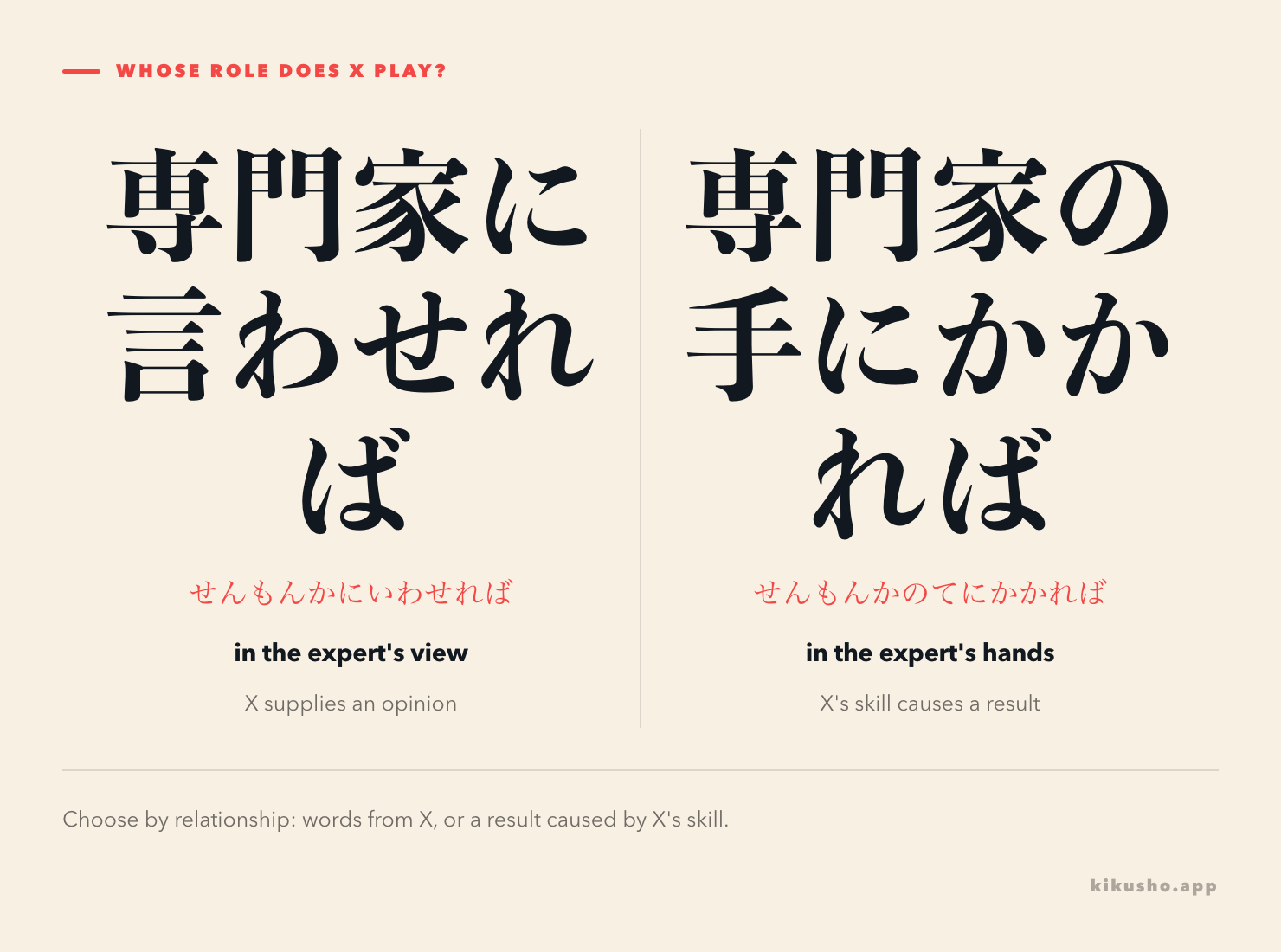
The shared English word “if” hides the choice that matters. Their conditional forms are visible, but each has developed a conventional N1 use, so identify the noun’s role before choosing an English phrase.
に言わせれば attributes the judgment to a person
Attach に言わせれば directly to a noun that can hold and express an opinion: a person, group, profession or organization.
医者に言わせれば、その程度の運動では足りないそうだ。
いしゃにいわせれば、そのていどのうんどうではたりないそうだ。
According to the doctor’s own assessment, that amount of exercise is apparently insufficient.
地元の人に言わせれば、春より秋のほうがこの町らしい。
じもとのひとにいわせれば、はるよりあきのほうがこのまちらしい。
If you ask locals, autumn represents this town better than spring.
The form comes from the causative 言わせる, “make or let someone say,” plus ば. In this established frame, however, you are not normally describing literal coercion. You are presenting the following proposition as what X would say.
The nearby forms に言わせると and に言わせたら can make the same attribution:
父に言わせると、その道具はまだ十分使える。
ちちにいわせると、そのどうぐはまだじゅうぶんつかえる。
According to my father, that tool is still perfectly usable.
彼女に言わせたら、私たちは準備をしすぎなのだろう。
かのじょにいわせたら、わたしたちはじゅんびをしすぎなのだろう。
If you asked her, we are probably overpreparing.
JLPT Sensei gives person noun + に言わせれば and the “if you ask” meaning. Bunpro independently groups the pattern with に言わせると and に言わせたら. The Japanese explanation at 絵でわかる日本語 also emphasizes that A is a person and that the construction presents A’s opinion.
The expression can sound emphatic
私に言わせれば often introduces a firmer opinion than plain 私は. Depending on tone, it can suggest “if you want my honest assessment” or “as far as I am concerned.” That confidence may be useful in criticism, but it can also sound dismissive.
私に言わせれば、その説明は問題の一部にしか答えていない。
わたしにいわせれば、そのせつめいはもんだいのいちぶにしかこたえていない。
If you ask me, that explanation answers only part of the problem.
For a neutral personal evaluation, 私にとって may fit better. For an imagined view from someone else’s circumstances, 親にしたら or 親にすれば may fit. The にしたら and にすれば lesson separates that reconstructed viewpoint from a directly attributed opinion.
Do not put a mere criterion before に言わせれば. 価格に言わせれば is unnatural because price cannot speak. To say “in terms of price,” choose 価格から言うと. The から言うと, から見ると and からすると comparison explains criteria, viewing angles and evidence-based inferences.
にかかっては makes someone’s ability decisive
In this family, X is a person, professional, machine, force or especially Xの手 whose handling produces a notable outcome. The result often sounds better, faster or more complete than expected.
この古い時計も、あの職人にかかると新品のようになる。
このふるいとけいも、あのしょくにんにかかるとしんぴんのようになる。
When that craftsperson works on it, even this old watch becomes like new.
どんな難しい役でも、彼女にかかれば自然な人物に見えてくる。
どんなむずかしいやくでも、かのじょにかかればしぜんなじんぶつにみえてくる。
In her hands, even a difficult role begins to look like a real person.
母の手にかかったら、残り物が立派な夕食になった。
ははのてにかかったら、のこりものがりっぱなゆうしょくになった。
Once my mother got hold of them, the leftovers became an impressive dinner.
The subject being handled is often marked with も or introduced by どんな…でも, because the speaker highlights what this agent can accomplish even with difficult material. Praise is common, but the grammar itself describes effective power rather than moral approval:
腕のいい詐欺師にかかっては、経験のある人でもだまされかねない。
うでのいいさぎしにかかっては、けいけんのあるひとでもだまされかねない。
Faced with a skilled fraudster, even an experienced person could be deceived.
絵でわかる日本語 explains the four forms as a shared construction in which A’s action leads to a result different from what one might expect, using both a person and 人の手. JLPT Sensei’s reference independently records the full family as N1 study grammar.
The four variants keep their ordinary conditional shape
The variants share one central image: something comes under X’s influence, and a striking consequence follows. The endings still contribute their ordinary discourse tendencies.
| Form | Useful tendency | Example frame |
|---|---|---|
| X にかかると | a regular or characteristic result | 彼にかかると、難問も簡単に見える |
| X にかかれば | a conditional prediction about X’s handling | 彼にかかれば、きっと解決する |
| X にかかったら | a conversational event or hypothesis | 彼にかかったら、すぐ直った |
| X にかかっては | X is topicalized as the decisive agent | 彼にかかっては、誰もかなわない |
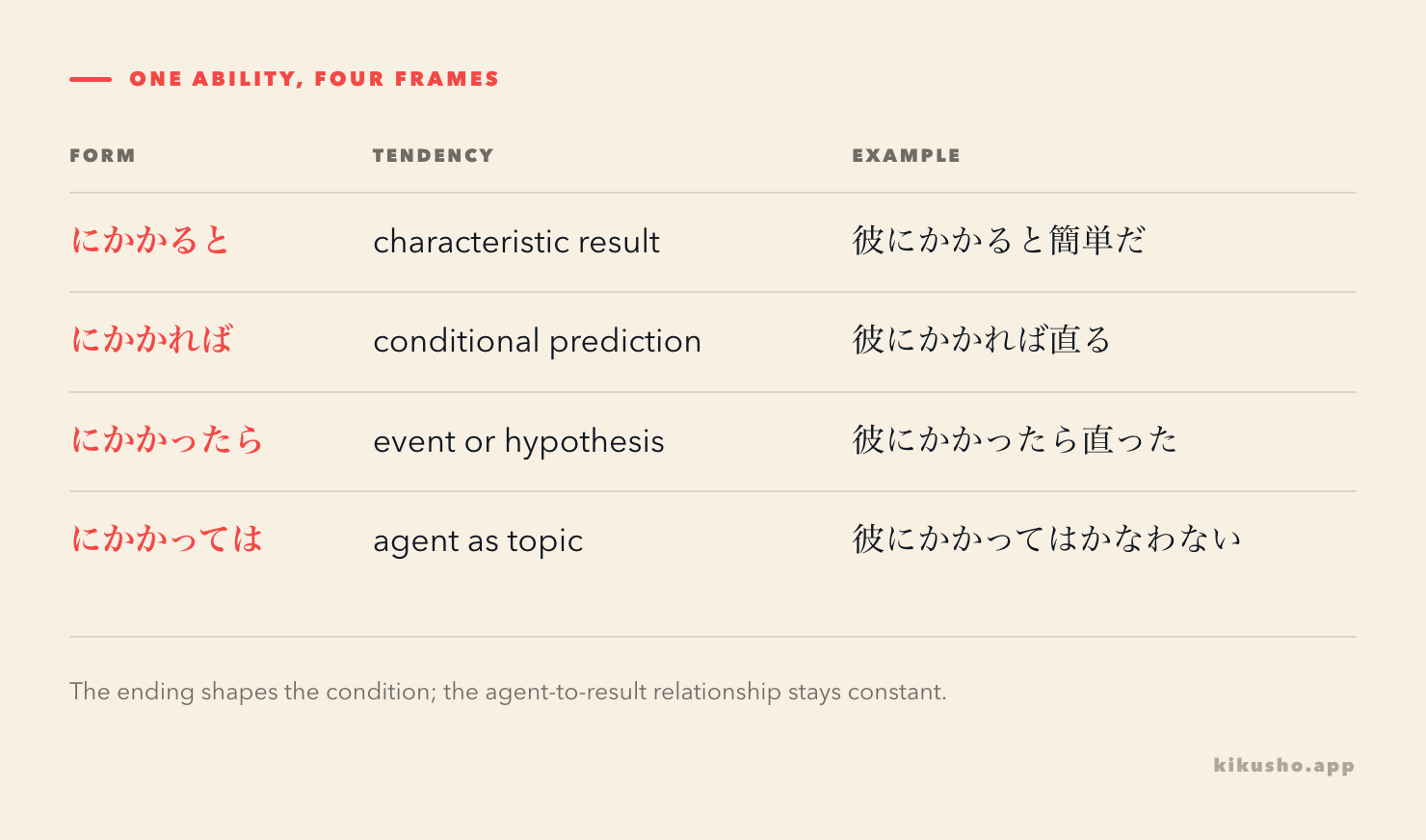
These are tendencies, not four separate dictionary meanings. と readily presents a characteristic consequence, ば a condition, and たら a conversational condition or completed occasion. ては highlights the agent as a topic or condition. The surrounding time expression, modality and context do more work than the ending alone.
この編集者にかかると、長い文章も読みやすくなる。
このへんしゅうしゃにかかると、ながいぶんしょうもよみやすくなる。
When this editor handles it, even a long text becomes easy to read.
この編集者にかかれば、締め切りまでに整えてくれるだろう。
このへんしゅうしゃにかかれば、しめきりまでにととのえてくれるだろう。
In this editor’s hands, it will probably be ready by the deadline.
The first sentence describes a recognizable ability. The second predicts the outcome in the present case. Avoid inventing a strict certainty ranking that real context cannot sustain.
Separate three other uses of かかる
The sound sequence alone does not identify the N1 pattern.
- 完成まで三時間かかる means “completion takes three hours.”
- インフルエンザにかかる means “catch influenza.”
- 成功は準備にかかっている means “success depends on preparation.”
None of these presents a skilled handler producing a striking result. In particular, にかかっている, “depend on,” is a separate construction: the noun is a determining factor, not an agent whose hands transform something. The dedicated にかかっている lesson develops its noun and embedded-question patterns.
Also distinguish 私に言わせてもらえば, literally “if you let me say this.” It claims permission or room to give one’s own view and can introduce disagreement. 私に言わせれば more directly frames the proposition as the speaker’s assessment. They can sound close in debate, but their social stance is not identical.
Keep the decisive relationship on the card
A flashcard containing only にかかれば = if handled by does not show whether the preceding noun is an agent, a dependency factor or part of another use of かかる. Save the complete hinge:
どんな難しい修理でも、彼の手にかかれば一日で終わる。
No matter how difficult the repair, in his hands it is finished in one day.
In Kikusho, preserve both the capable person and the surprising outcome. For に言わせれば, preserve the opinion holder and the judgment. At review time, ask “who supplies the words?” or “who causes the result?” before recalling an English gloss.
Practice: identify what the person contributes
Work through the full set before revealing the explanation panel.
Question 1 — opinion source
Choose the form that means “in the architect’s view.”
建築家__、この窓の配置には改善の余地がある。
- ア. の手にかかれば
- イ. に言わせれば
- ウ. にかかると
- エ. にかかっている
Question 2 — skilled result
Choose the natural form for a chef turning ordinary vegetables into a feast.
普通の野菜でも、この料理人__、豪華な一皿になる。
- ア. に言わせれば
- イ. にとって
- ウ. の手にかかれば
- エ. から言うと
Question 3 — attachment
Which noun naturally completes __に言わせれば、その判定は厳しすぎる?
- ア. 規則
- イ. 値段
- ウ. 元選手
- エ. 雨
Question 4 — variant in context
Choose the form that most naturally presents the designer’s characteristic effect.
あのデザイナー__、小さな部屋も広く見える。
- ア. にかかると
- イ. に言わせれば
- ウ. にかかっている
- エ. にとって
Question 5 — sentence composition
Arrange the pieces to say “If you ask the residents, this market is busiest in the morning.”
- この市場は朝が一番にぎやかだ
- 住民に言わせれば
Question 6 — meaning boundary
In 合格できるかどうかは、最後の一か月にかかっている, does にかかっている praise someone’s skill? Explain its actual relationship.
Question 7 — connected contrast
Choose the pair that first attributes an opinion to a director and then describes an actor’s transformative ability.
監督( )、この役には静かな緊張感が必要だ。あの俳優( )、短い台詞でも忘れられない場面になる。
- ア. にかかれば/に言わせれば
- イ. に言わせれば/にかかると
- ウ. にとって/にかかっている
- エ. からすると/に言わせたら
Answers and explanations
1. イ, に言わせれば. The architect supplies a professional judgment about the window arrangement. の手にかかれば and にかかると would require the architect’s work to cause a result, while にかかっている expresses dependency.
2. ウ, の手にかかれば. The cook’s skill transforms ordinary ingredients into an impressive dish. The sentence reports an outcome, not the cook’s opinion.
3. ウ, 元選手. A former player can hold and express an opinion about the decision. Rules, price and rain are not opinion holders in this context.
4. ア, にかかると. The sentence presents a characteristic result of the designer’s work: small rooms appear spacious. The other choices express an opinion, dependency or evaluation relationship.
5. 住民に言わせれば、この市場は朝が一番にぎやかだ。 The residents are the opinion holders, and the following clause gives their assessment of the market.
6. No. Here AはBにかかっている means that A depends on B: passing depends on the final month. The noun is a decisive factor, not a capable agent handling and transforming an object.
7. イ, に言わせれば/にかかると. The director supplies the opinion that the role needs quiet tension. The actor’s performance then produces the memorable result. The pair tests the central contrast between words and ability.
Level and review note
The frozen Kikusho inventory places both assigned records at N1, and the checked teaching references used here agree on that study placement. The forms に言わせると and に言わせたら are included as members of the opinion-attribution family; the four にかかる variants are one agent-to-result family. Ordinary causative 言わせる, time-taking かかる, illness かかる and dependency にかかっている are contrasts and receive no inventory credit. The JLPT organizers state that they do not publish an exhaustive itemized grammar list, so the level is a source-backed study label rather than an official syllabus claim.
Common questions
What is the difference between に言わせれば and にかかっては?
に言わせれば identifies whose opinion the following judgment represents. にかかっては identifies the person or hands whose skill produces a notable result. Ask whether X supplies words or performs the work.
What comes before に言わせれば?
A noun naming a person, group or other opinion holder attaches directly: 専門家に言わせれば or 親に言わせれば. It does not normally follow an object, criterion or piece of evidence.
Are にかかっては, にかかったら, にかかると and にかかれば different grammar points?
They are conditional or topic-shaped variants of the same idiomatic relationship: when something is handled by X, a striking result follows. The ordinary force of と, ば, たら and は remains, but context usually matters more than a rigid translation.
Is にかかっている the same pattern?
No. 成功は努力にかかっている means that success depends on effort. The pattern taught here places a capable agent before にかかる and describes what happens in that agent’s hands.