On this page
Use に限ったことではない to say that a phenomenon is not unique to the named case. Use によらず when a policy, judgment or result stays independent of the named condition.
人手不足は、この業界に限ったことではない。
ひとでぶそくは、このぎょうかいにかぎったことではない。
Staff shortages are not unique to this industry.
この制度は、業界によらず利用できる。
このせいどは、ぎょうかいによらずりようできる。
This system can be used regardless of industry.
The first speaker starts with a problem seen in one industry and widens the observation: other industries have it too. The second sentence defines access that does not change from one industry to another.
One form widens a fact; the other holds a result constant
| Question to ask | Pattern | Logical move |
|---|---|---|
| Is this phenomenon exclusive to X? | X に限ったことではない | No; it occurs beyond X |
| Does X determine the following result? | X によらず Y | No; Y remains true across X |
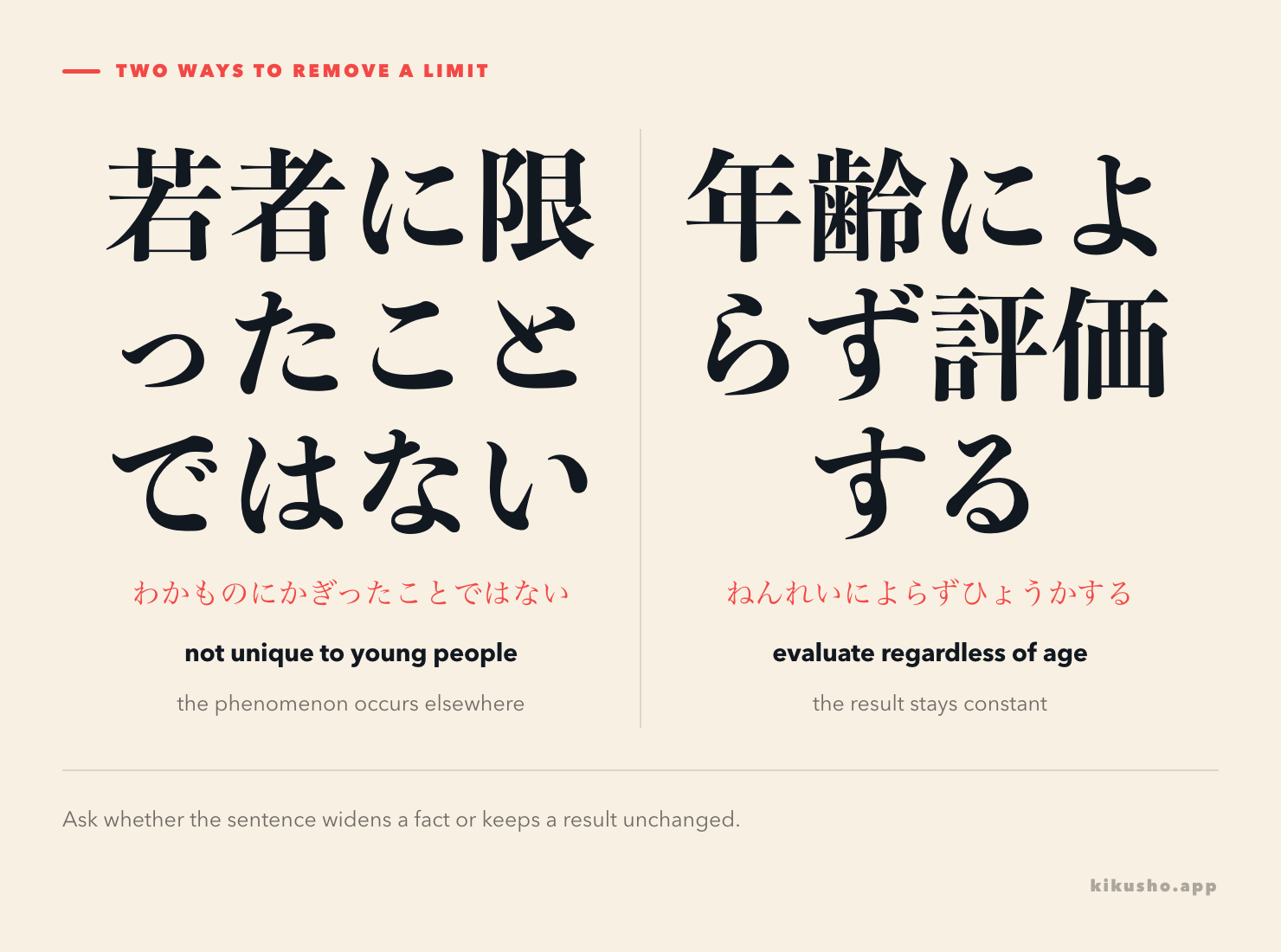
Both constructions can lead to an English “not limited to” or “regardless of.” Their sentence jobs are different. に限ったことではない normally completes a claim, while によらず normally links a condition to the main clause.
に限ったことではない rejects a supposed special case
Attach the complete expression to a noun naming a group, place, time or situation:
正しい敬語に迷うのは、若者に限ったことではない。
ただしいけいごにまようのは、わかものにかぎったことではない。
Uncertainty about correct honorific language is not limited to young people.
夏の電力不足は、この地域に限ったことではありません。
なつのでんりょくぶそくは、このちいきにかぎったことではありません。
Summer electricity shortages are not restricted to this region.
彼が遅れるのは、今日に限ったことではない。
かれがおくれるのは、きょうにかぎったことではない。
His being late is not something limited to today.
The phenomenon often appears first as Aのは or as a topic with は. The noun before the grammar names the case someone might wrongly treat as exceptional. The expression then denies that exclusivity.
Bunpro analyzes noun + に限ったことではない as a formal, emphatic statement that something is not confined to A. 日本語NET independently gives the same noun attachment and N1 placement across people, countries, years and individual occasions.
The broadened range can remain implicit
The sentence does not have to list every other case. 若者に限ったことではない is complete even when the writer does not add 大人にもある. The discourse already asks whether the problem belongs only to young people, and the predicate answers no.
Problems and criticism are common because writers often correct an unfair generalization:
情報を確かめずに広める傾向は、個人に限ったことではない。企業にも見られる。
じょうほうをたしかめずにひろめるけいこうは、こじんにかぎったことではない。きぎょうにもみられる。
The tendency to spread information without checking it is not limited to individuals. It is seen in companies too.
The grammar does not require a negative phenomenon, however. A positive ability can also extend beyond the named group:
新しい表現を生み出す力は、専門家に限ったことではない。
あたらしいひょうげんをうみだすちからは、せんもんかにかぎったことではない。
The ability to create new expressions is not exclusive to specialists.
The conversational contraction に限ったことじゃない preserves the meaning. The fuller ではありません raises politeness. The long form itself remains more deliberate than everyday だけじゃない.
によらず makes the main result independent
The central frame is condition + によらず + result. The condition might ordinarily affect the outcome, but the sentence says that this result does not vary with it.
年齢によらず、同じ基準で作品を評価します。
ねんれいによらず、おなじきじゅんでさくひんをひょうかします。
We evaluate the works by the same standard regardless of age.
天候によらず、説明会はオンラインで行います。
てんこうによらず、せつめいかいはオンラインでおこないます。
The information session will be held online regardless of the weather.
The following clause must tell the reader what stays fixed: the standard, eligibility, price, action or conclusion. 年齢によらず alone names no result and leaves the practical claim unfinished.
にほんご部 teaches noun + によらず as “without relation to that” and places it at N1. The advanced grammar reference reproduced at DOJG Lite documents a wider range of attachments, including nouns, question words, alternatives, whether-or-not phrases and Nのいかん.
Package alternatives before によらず
The condition can explicitly contain two possibilities:
経験のあるなしによらず、応募者全員と面接します。
けいけんのあるなしによらず、おうぼしゃぜんいんとめんせつします。
We interview every applicant regardless of whether they have experience.
参加するかどうかによらず、資料は全員に送られます。
さんかするかどうかによらず、しりょうはぜんいんにおくられます。
The materials will be sent to everyone whether or not they participate.
誰が担当するかによらず、同じ手順で記録してください。
だれがたんとうするかによらず、おなじてじゅんできろくしてください。
Regardless of who is responsible, record it using the same procedure.
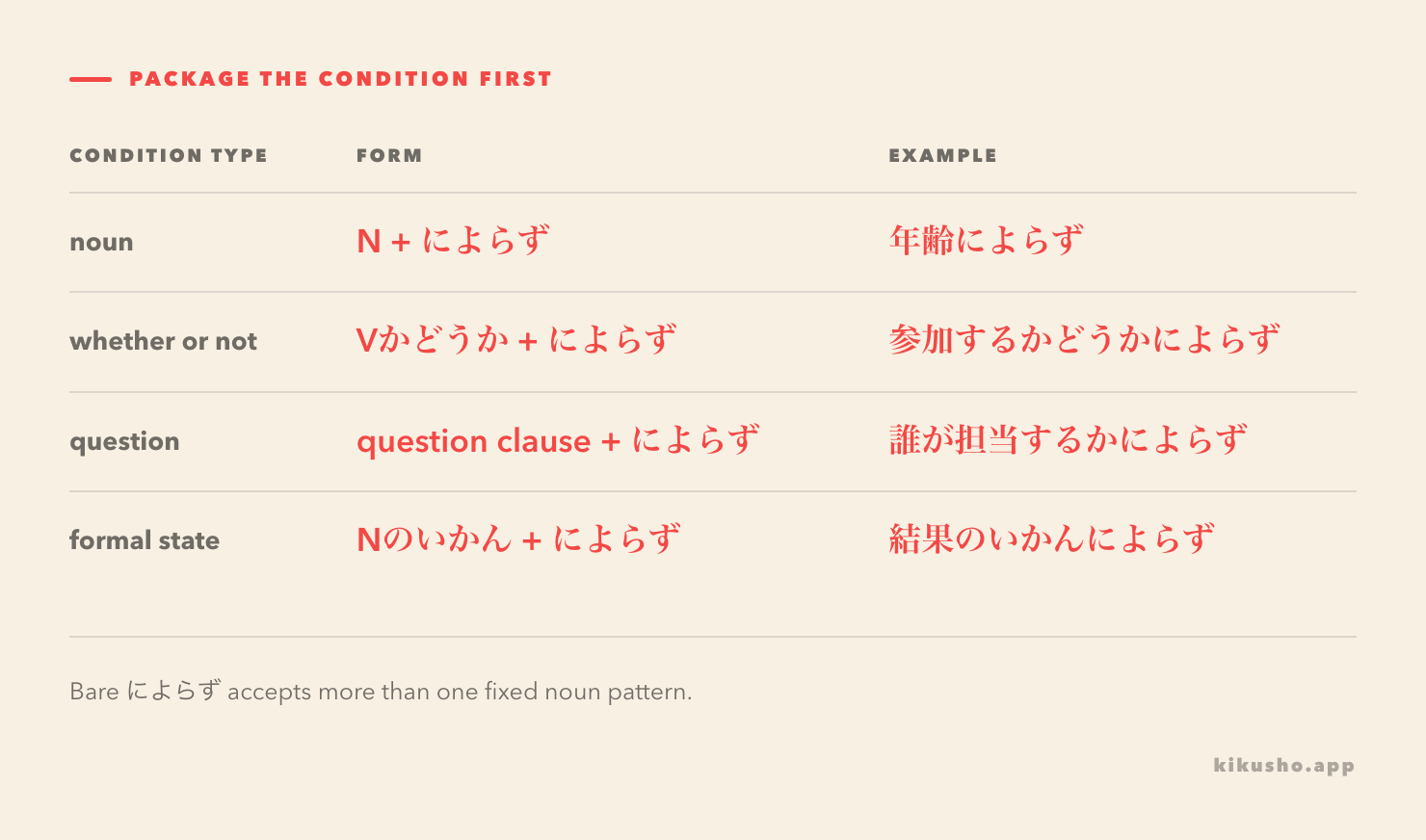
These longer phrases act as one condition. Do not attach the connector directly to a polite form such as 参加しますによらず. Build the embedded question first: 参加するかどうかによらず.
Means can be rejected as well as criteria
With a method, source or support before it, によらず can mean “without relying on” rather than merely “regardless of.”
武力によらず、対話によって解決するべきだ。
ぶりょくによらず、たいわによってかいけつするべきだ。
The issue should be resolved through dialogue, without resorting to force.
Here the contrast is between two means. The sentence rejects force as the basis or method and chooses dialogue. The negative よらず is related to による, whose meanings include dependence and means. Context decides whether “regardless of X” or “without relying on X” is the smoother translation.
Do not substitute the forms mechanically
Compare these two reports about regional flooding:
洪水被害は、この県に限ったことではない。
Flood damage is not unique to this prefecture.
県によらず、同じ基準で被害を調査する。
Damage is investigated by the same standard regardless of prefecture.
The first sentence broadens where the damage occurs. The second holds the investigation standard constant across locations. Replacing one marker with the other would require rebuilding the whole proposition.
The N2 form に限らず is closer in meaning to “not only A; B too”: この県に限らず、隣県でも被害が出た. It connects the first case to a wider set. The に限る, に限り, に限らず and に限って lesson covers that family. に限ったことではない makes the non-exclusivity itself the predicate and often corrects a belief that one case is special.
にかかわらず and を問わず can overlap with criterion-based によらず. The N2 regardless-of comparison explains their category and policy uses. Do not invent an absolute difference where several forms fit; learn the attachment and the relationship the writer foregrounds.
The fixed いかんによらず is an especially formal subset: 結果のいかんによらず公表する, “publish regardless of the result.” The 如何 family lesson contrasts that unchanged outcome with いかんでは, where the result does depend on circumstances. Bare によらず is broader because it can follow ordinary nouns and packaged questions without いかん.
Preserve both sides when you save the sentence
A card containing only 年齢によらず = regardless of age hides the result that age fails to change. Keep 年齢によらず、同じ基準で評価する so the invariant policy remains visible.
For に限ったことではない, save the phenomenon and the rejected special case together: 敬語に迷うのは、若者に限ったことではない. In Kikusho, the full sentence lets you ask two different retrieval questions: “Where else does this happen?” and “What remains unchanged across the condition?”
Practice: widen the fact or remove dependence
Try every item before opening the explanation panel.
Question 1 — phenomenon beyond one group
Choose the form that corrects the belief that only beginners make this error.
この間違いは、初心者__。
- ア. によらず
- イ. に限ったことではない
- ウ. によって
- エ. にかかっている
Question 2 — unchanged policy
Choose the form that says the fee stays the same across nationalities.
国籍__、参加費は同じです。
- ア. に限ったことではなく
- イ. に限って
- ウ. によらず
- エ. によっては
Question 3 — packaged question
Which phrase correctly means “regardless of whether you attend”?
- ア. 参加しますによらず
- イ. 参加するかどうかによらず
- ウ. 参加に限ったことではない
- エ. 参加したことによって
Question 4 — time is not exceptional
Complete the sentence: 彼が締切直前に慌てるのは、今回( )。前回も同じだった。
- ア. によらず
- イ. による
- ウ. に限ったことではない
- エ. を問う
Question 5 — sentence composition
Arrange the pieces to say “Regardless of experience, everyone is evaluated by the same criteria.”
- 全員を同じ基準で評価します
- 経験によらず
Question 6 — means or criterion
In 広告によらず、利用者の紹介で客を増やした, is advertising one value in a range, or a means the business did not rely on? Explain.
Question 7 — connected contrast
Choose the pair that first broadens a social problem beyond one city, then holds assistance constant across residence.
空き家の増加は、この町( )。支援制度は、居住地( )利用できます。
- ア. によらず/に限ったことではない
- イ. に限ったことではない/によらず
- ウ. に限って/によって
- エ. にかかわって/に限り
Answers and explanations
1. イ, に限ったことではない. The sentence denies that the error belongs exclusively to beginners. によらず would need a following result that remains unchanged across levels.
2. ウ, によらず. Nationality is the condition that does not change the fee. によっては would say the result can vary depending on nationality, reversing the intended relationship.
3. イ, 参加するかどうかによらず. The embedded かどうか packages attendance as a yes-or-no condition before によらず. A polite verb cannot be attached directly in option ア.
4. ウ, に限ったことではない. The following sentence proves that the last-minute rush is not unique to this occasion. によらず would link a condition to an invariant main clause rather than complete this claim.
5. 経験によらず、全員を同じ基準で評価します。 Experience does not determine the criteria, and the main clause states the policy that remains constant.
6. It is a means the business did not rely on. The company gained customers through user referrals instead of through advertising. The sentence contrasts methods, so “without relying on advertising” is more precise than treating advertising as one demographic category.
7. イ, に限ったことではない/によらず. The first clause says the increase in empty homes occurs beyond this town. The second says eligibility for the support program does not change with place of residence.
Level and review note
The frozen Kikusho inventory assigns both target records to N1, with no recorded level disagreement. Bunpro and 日本語NET use N1 for に限ったことではない; JLPT Sensei and にほんご部 use N1 for によらず. The N2 に限らず, にかかわらず and を問わず patterns and the separately mapped いかんによらず family appear only as contrasts or prerequisites here. The JLPT organizers explain that no exhaustive official grammar list is published. N1 therefore records the agreement among the checked study references, not an item on an official syllabus.
Common questions
What is the difference between に限ったことではない and によらず?
に限ったことではない says a phenomenon is not unique to the named case. によらず connects a condition to a result or policy that stays the same whatever that condition is. The first widens a description; the second removes dependence.
What comes before に限ったことではない?
A noun naming the apparently special group, place, time or case attaches directly: 若者に限ったことではない, 日本に限ったことではない, or 今日に限ったことではない.
Can によらず follow a clause?
It commonly follows a noun, but it also follows packaged alternatives and questions, such as 経験のあるなしによらず and 誰が担当するかによらず. Do not put it directly after an ordinary polite verb.
Is によらず the same as いかんによらず?
いかんによらず is a fixed, especially formal member of the wider によらず family. Bare によらず also follows ordinary criteria, alternative phrases and means, so its attachment is broader.