On this page
A notice saying 理由のいかんによらず applies its rule whatever the reason: いかんによらず means “regardless of.” In the same family, いかんだ, いかんでは and いかんによっては make an outcome depend on the condition instead.
The ending after いかん decides the relationship
This N1 grammar lesson covers two construction groups: いかんだ / いかんでは / いかんによっては, and いかんにかかわらず / いかんによらず / いかんを問わず. The six expressions belong together because translating いかん alone cannot tell you which relationship the sentence states.
Read いかん as ikan. It can be written 如何 in these frames. Shogakukan's dictionary entry identifies the noun's sense as a matter's circumstances, course or state. Kanjipedia confirms the reading and notes that 如何 can have other readings in other expressions. Do not read this entire family as いかが simply because you recognise that spelling.
| Frame after the noun phrase | Reading | What it states |
|---|---|---|
| いかんだ | ikan da | The outcome depends on that factor |
| いかんでは | ikan de wa | Under some states of that factor, the following result applies |
| いかんによっては | ikan ni yotte wa | Depending on that factor, one possible result is introduced |
| いかんによらず | ikan ni yorazu | The stated result holds regardless of the factor |
| いかんにかかわらず | ikan ni kakawarazu | The stated result holds regardless of the factor |
| いかんを問わず | ikan o towazu | The factor's differences are set aside for the stated result |
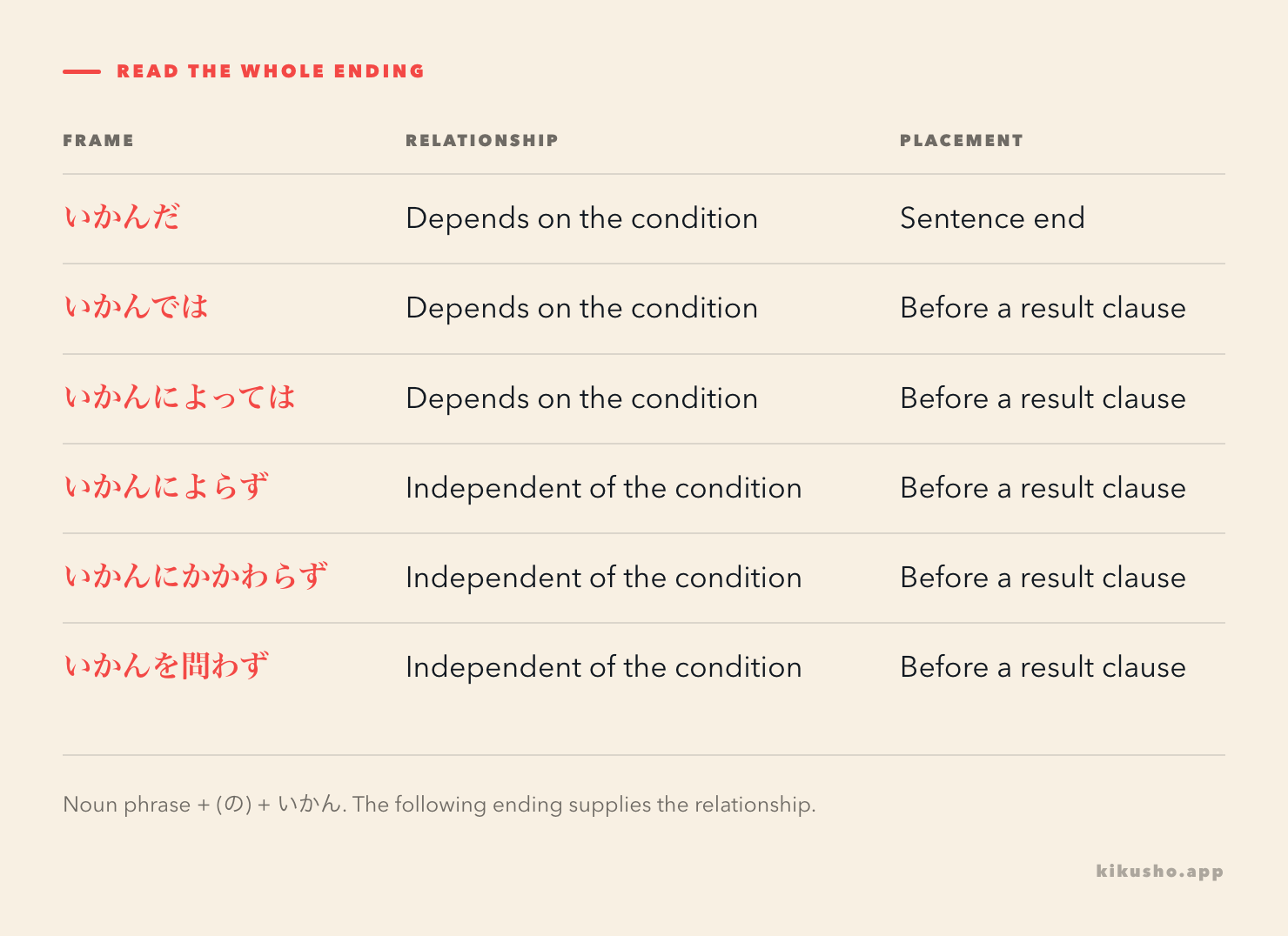
The three expressions in the second group overlap in meaning. A question offering all three complete endings with only “regardless of the result” as its clue would not have a reliable single answer. Particle attachment can still distinguish them: に belongs in によらず and にかかわらず; を belongs in を問わず.
A noun phrase supplies the condition
The shared starting point is noun phrase + (の) + いかん. Choose something whose content, state or degree can vary, such as a reason, an inspection result, people's response or the number attending.
| Noun phrase | Without の | With の |
|---|---|---|
| 理由 — reason | 理由いかんによらず | 理由のいかんによらず |
| 点検の結果 — inspection result | 点検の結果いかんでは | 点検の結果のいかんでは |
| 参加人数 — number attending | 参加人数いかんによっては | 参加人数のいかんによっては |
Read 理由 as りゆう, 点検 as てんけん, 結果 as けっか, and 参加人数 as さんかにんずう. In 点検の結果, the first の already connects “inspection” to “result.” Adding another before いかん gives 点検の結果のいかん; leaving it out gives 点検の結果いかん. Both retain the inspection-result noun phrase.
Bunpro's formation tables show optional の for the depending-on frames. The independently written Japanese teacher's regardless lesson gives the same option for all three regardless frames. Optional の is not permission to remove the later に or を.
A bare polite verb does not provide this noun attachment: 点検しましたいかんでは is not the pattern. A clause may be incorporated into a larger noun phrase, but begin with the checked noun frames above rather than treating いかん as an ending you can add to anything.
いかんだ ends the dependency; では and によっては continue it
来月もこの企画を続けるかどうかは、参加者の反応いかんだ。
らいげつも この きかくを つづけるか どうかは、さんかしゃの はんのういかんだ。
Whether we continue this project next month depends on the participants' response.
Here 反応, read はんのう, means response or reaction. The sentence ends with いかんだ: it identifies the determining factor without yet telling you what the response will be. The polite ending can be いかんです, and formal writing can use いかんである. The noun connection stays intact. The teacher's いかんだ explanation verifies this sentence-final dependency.
For a following clause, the linking form いかんで states dependence. いかんでは and いかんによっては can single out a result possible under some conditions:
点検の結果いかんでは、使用を中止することがあります。
てんけんの けっかいかんでは、しようを ちゅうしする ことが あります。
Depending on the inspection result, we may stop use.
参加人数のいかんによっては、会場を変更します。
さんかにんずうの いかんによっては、かいじょうを へんこうします。
Depending on the number attending, we will change the venue.
中止する means stop or cancel; 変更する, read へんこうする, means change. The second example leaves a venue change conditional. It does not announce that every attendance figure requires a new venue. Nor does either ending tell you a numerical threshold: that information needs to appear elsewhere.
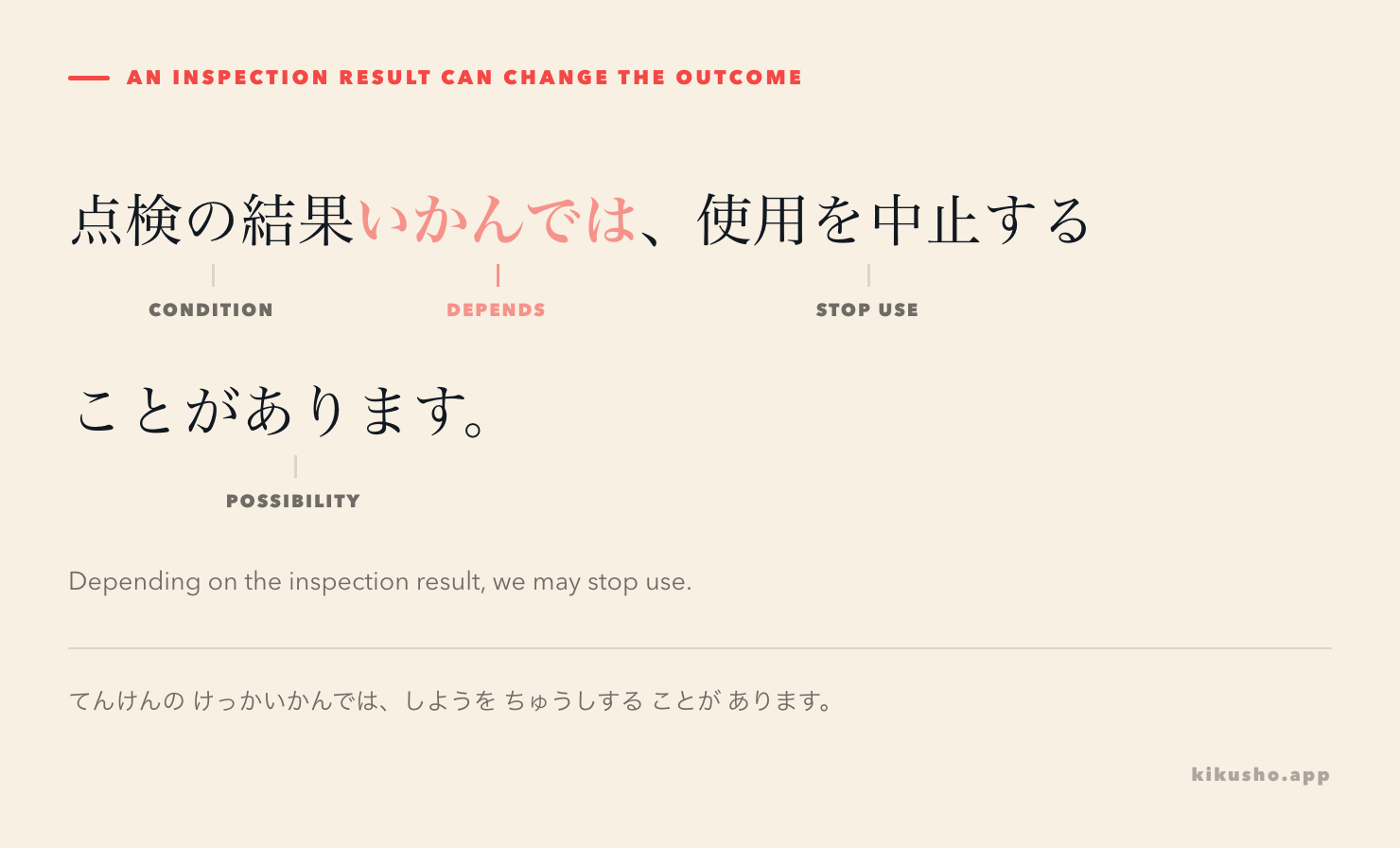
The final ことがあります makes the stopping a possibility here. Do not turn every いかんでは sentence into an absolute prediction. The native teacher's clause-linking lesson and Bunpro's 如何 entry both distinguish this dependency from the regardless group.
The three regardless frames hold the stated result constant
理由のいかんによらず、締切後の追加は受け付けません。
りゆうの いかんによらず、しめきりごの ついかは うけつけません。
Whatever the reason, we will not accept additions after the deadline.
締切, read しめきり, is a deadline; 追加, read ついか, is an addition. The organiser's rule excludes late additions across reasons. It does not claim that nobody has a reason, or that the organiser refuses to hear one.
専攻のいかんにかかわらず、この説明会に申し込めます。
せんこうの いかんに かかわらず、この せつめいかいに もうしこめます。
You can apply for this information session regardless of your major.
審査の結果のいかんを問わず、全員にメールで連絡します。
しんさの けっかの いかんを とわず、ぜんいんに メールで れんらくします。
We will contact everyone by email, whatever the screening result.
Read 専攻 as せんこう, “major” or “specialisation,” and 審査 as しんさ, “screening” or “evaluation.” The last sentence promises notification to everyone; it does not promise that everyone passes. That difference matters when reading an application notice.
Bunpro's いかん〜ず entry and JLPT Sensei's grouped lesson verify this group. For the simpler noun constructions without いかん, the N2 にかかわらず and を問わず comparison already teaches their category and condition uses. Review those shorter frames before tackling the formal いかん variants.
Formal wording does not remove the other conditions
Bunpro labels both groups formal, and the consulted Katsukawa teaching page treats them as fixed ways to express the two relationships. They fit documents and announcements; an organiser can also use them when speaking formally. The grammar is not restricted to silent reading.
An ordinary rewrite of 理由のいかんによらず is 理由に関係なく, “regardless of the reason.” For dependency, a friend might say 参加者の反応によるね, “It depends on the participants' response.” These rewrites preserve the relationship; changing every formal いかん to a single casual word would not.
Keep the condition's scope precise. “Regardless of major” can coexist with a requirement to reserve a place. “Whatever the screening result, everyone receives an email” can coexist with different decisions for different applicants. Likewise, いかんでは supplies no particular cut-off by itself.
This lesson does not cover every word written with 如何, such as いかが or the separate idioms いかんせん and いかんともしがたい. It also does not replace the distinct concession and minimum-unit rules taught in であれ and たりとも. The preceding ところを lesson supplies another useful announcement skill: acknowledging an imposition before making a request, rather than defining a condition.
Bunpro and the inspected Japanese teacher lessons place these two groups at N1. The official JLPT FAQ describes why the organisers stopped releasing item lists for grammar, words and kanji. N1 here is a source-backed study placement. The N2 regardless connectors, noun phrases and ordinary plain/polite predicates are prerequisites.
When you save vocabulary from an application notice in Kikusho, retain 審査の結果 with the whole notification sentence in the editable example. A card reduced to 審査 = “screening” cannot show whether an email is conditional on passing or goes to everyone. Text capture lets you keep that part of the notice and check it before saving.
Practice
These eight questions are original. Keep your choices until the shared answer block below Question 8. For Questions 4 and 5, use every fragment once and give the letter in the starred slot.
Question 1: supply the particle
Select the missing particle without replacing the printed 問わず.
審査の結果のいかん( )問わず、全員に通知します。
A. が
B. を
C. に
D. で
通知する(つうちする)means notify.
Question 2: choose the continuation
A safety inspection may permit use or require it to stop. Complete the sentence to make stopping conditional on that result.
点検の結果( )、機器の使用を中止することがあります。
A. いかんにかかわらず
B. いかんを問わず
C. いかんによらず
D. いかんによっては
機器(きき)means equipment.
Question 3: interpret the message
審査の結果のいかんによらず、全員に通知します。
Which reading fits?
A. Only successful applicants receive a notification.
B. No screening will be carried out.
C. Everyone receives a notification, whatever the outcome.
D. A notification proves that the applicant passed.
Question 4: assemble the statement
Complete the promise to contact everyone whatever the screening outcome. What occupies ★?
審査の _ _ ★ _ 連絡します。
A. 全員に
B. いかん
C. 結果の
D. を問わず
Question 5: construct the predicate
State that continuing the project depends on the participants' response. Give the letter at ★.
企画を続けるかどうかは、 _ _ ★ _。
A. 反応
B. 参加者の
C. だ
D. いかん
Question 6: write a conditional announcement
Use 参加人数, いかんでは and 会場を変更することがあります to say that the venue may change depending on the number attending. Write one complete Japanese sentence. You may use の where appropriate.
Question 7: connect the inspection paragraph
来週の見学会は土曜日を予定しています。安全が確認できれば予定どおり開催し、確認できなければ延期します。つまり、点検の結果( )、開催を延期する可能性があります。日程が決まり次第、全員に連絡します。
見学会(けんがくかい)is a visit or tour; 延期する(えんきする)means postpone; 日程(にってい)is the schedule.
Choose the ending that preserves the stated dependence on safety.
A. いかんによらず
B. いかんを問わず
C. いかんにかかわらず
D. いかんでは
Question 8: finish the submission paragraph
作品はテーマのいかんを問わず受け付けます。ただし、提出は作者一人につき二点までです。したがって、( )。
作品(さくひん)means work or creation; 提出(ていしゅつ)means submission; 作者(さくしゃ)means creator. 二点(にてん)counts two works here.
Which sentence follows the whole rule?
A. テーマが自由なので、提出できる数にも制限はありません。
B. どのテーマでも応募できますが、三点の提出は認められません。
C. 二点出せば、テーマによって受け付けてもらえないことがあります。
D. テーマを説明しなければ、作品は審査されません。
Stop here with your completed choices and sentence before opening the explanations.
Answers and explanations
Answer 1: B. The connection is いかんを問わず. A, C and D cannot replace を while retaining 問わず as printed. The optional の before いかん is a different connection and is already present in this sentence.
Answer 2: D. 点検の結果いかんによっては makes stopping depend on the inspection result. A, B and C all express independence from the result, so they fail the requested relationship. They are plausible regardless expressions, not different spellings of the dependency.
Answer 3: C. 全員 identifies everyone, and いかんによらず keeps the notification independent of the outcome. A restricts the recipients, B wrongly removes the screening itself, and D confuses being notified with passing. The sentence announces communication, not a shared screening decision.
Answer 4: D. Place the fragments as C → B → D → A, giving 審査の結果のいかんを問わず全員に連絡します。 結果の completes the screening-result phrase and connects it to いかん; を問わず then supplies the regardless relation; 全員に identifies the recipients. D is third. C, B and A belong in the other slots.
Answer 5: D. Use B → A → D → C: 企画を続けるかどうかは、参加者の反応いかんだ。 参加者の modifies 反応, いかん follows the noun phrase, and だ finishes the dependency predicate. D occupies ★. A, B and C fill the second, first and fourth slots respectively.
Answer 6: model sentence. 参加人数のいかんでは、会場を変更することがあります。 Read it as さんかにんずうの いかんでは、かいじょうを へんこうする ことが あります: “Depending on the number attending, we may change the venue.” 参加人数いかんでは、会場を変更することがあります is also acceptable. The connecting の can be omitted; the は in the requested いかんでは remains. A regardless ending would change the stated condition.
Answer 7: D. The paragraph already gives two cases: confirmed safety allows the scheduled event, while failure to confirm it requires postponement. いかんでは connects that variable result to the possibility of postponement. A, B and C would make the statement independent of the inspection outcome instead. The final promise to contact everyone does not make the event date unconditional.
Answer 8: B. テーマのいかんを問わず removes theme as the stated distinction, but ただし retains a separate maximum of two works per creator. B allows any theme and excludes three submissions. A discards the explicit limit; C invents a theme-based rejection; D invents a requirement to explain the theme. Read the connector and the exception as parts of the same policy.
Common questions
What does いかんによらず mean?
It means regardless of how the preceding condition is. In 理由のいかんによらず, the stated rule holds whatever the reason. It does not say that no reason exists.
Is の required before いかん?
These constructions allow a noun phrase with or without の. 結果いかん and 結果のいかん can both introduce the condition. Do not confuse that optional の with the に in によらず or the を in を問わず.
How is いかんだ different from いかんによらず?
いかんだ says an outcome depends on the preceding factor. いかんによらず says the stated outcome is unaffected by that factor. Read the entire ending after いかん before translating it.
Is this N1 grammar only used in writing?
Bunpro and the consulted Japanese teacher references classify these forms as N1 grammar. They have a formal register suited to announcements and documents, but formal speech can also use them. They are not the default wording for a chat with a friend.