On this page
にかかわらず says that a condition does not change the result; を問わず sets aside differences within a category or range. Both can mean “regardless of,” and a noun such as 年齢, “age,” can support either expression without making one wrong.
Decide what stays the same
This N2 grammar comparison teaches ~にかかわらず (ni kakawarazu) and ~を問わず, read ~をとわず (o towazu, also romanised wo towazu). Start with the thing being held constant: admission, a price, an instruction or some other result.
| Construction | Useful reading question | Example phrase |
|---|---|---|
| にかかわらず | Does the outcome hold whatever the condition is? | 天候にかかわらず — irrespective of the weather |
| を問わず | Are distinctions within this category being set aside? | 経験の有無を問わず — with or without experience |
The questions describe tendencies in emphasis. They are not a machine for assigning every noun to only one construction. Experience, age and many other conditions can fit both. When reading a notice, identify exactly which distinction the writer removes, then check the rest of the policy.
Read 天候 as てんこう, “weather conditions”; 経験 as けいけん, “experience”; and 有無 as うむ, “presence or absence.” In 経験の有無, the issue is whether someone has experience.
にかかわらず keeps a condition from changing the result
この会場は、天候にかかわらず利用できます。
この かいじょうは、てんこうに かかわらず りようできます。
This venue can be used irrespective of the weather.
The stated availability does not vary with the weather. The sentence does not assert that the weather is bad today. A rule can cover different possible circumstances without reporting which one is currently true.
The noun connection is simply noun phrase + にかかわらず. No だ is needed in 天候にかかわらず. For a verb condition, an explicit “whether” phrase makes the alternatives clear:
参加するかどうかにかかわらず、明日までに返事をください。
さんかするか どうかに かかわらず、あしたまでに へんじを ください。
Please reply by tomorrow whether you will participate or not.
The instruction applies to both decisions. It does not require participation. The Japanese teacher's formation notes give noun attachment, repeated positive and negative forms, and question phrases such as かどうか. Bunpro's lesson independently explains the outcome as unaffected by the condition.
Build the condition before adding the connector
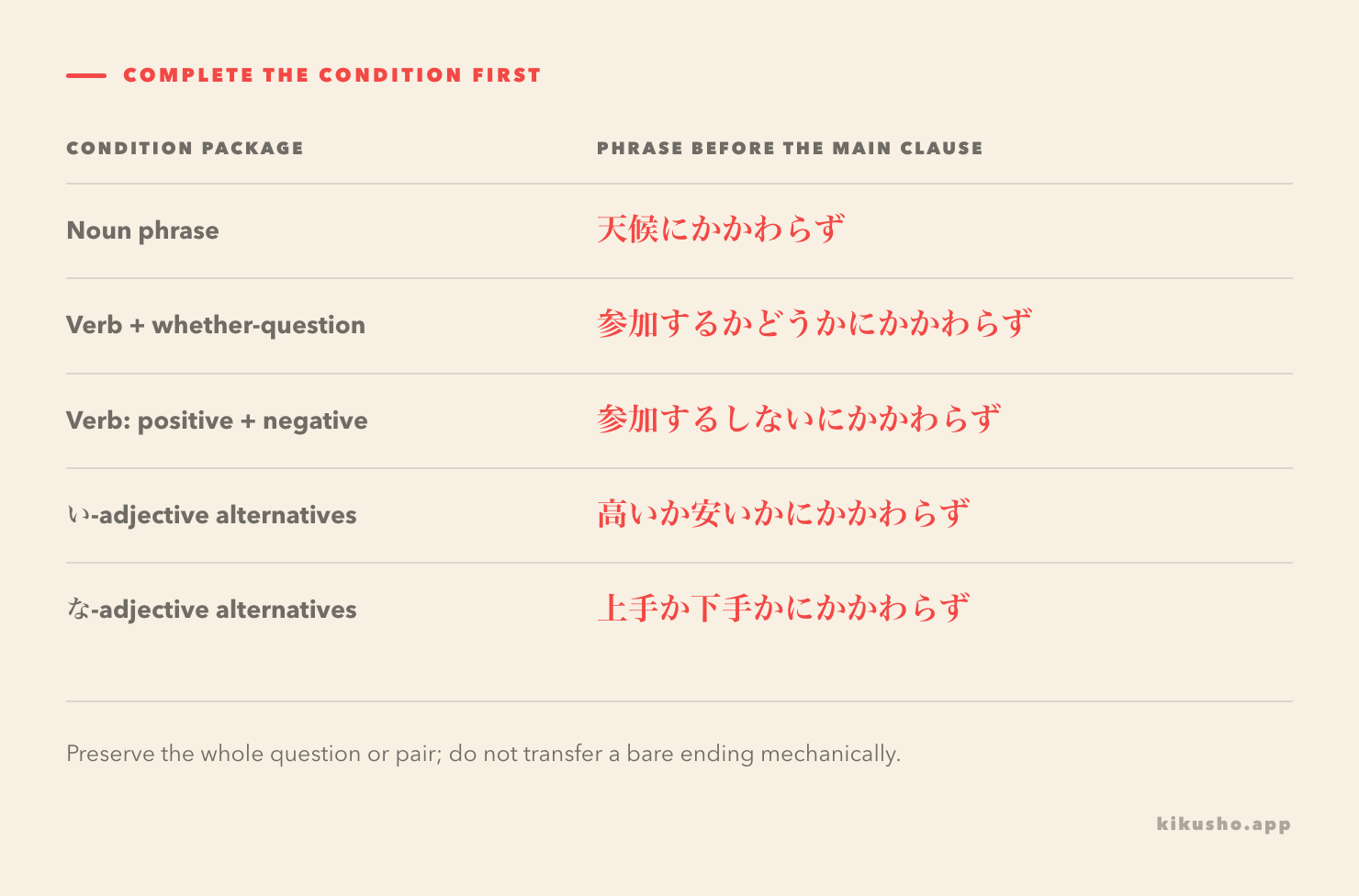
These are usable starting frames. With a verb or adjective, preserve the question or pair that names the alternatives.
| Material | Example before the main clause | Meaning |
|---|---|---|
| Noun phrase | 天候にかかわらず | Whatever the weather |
| Verb + かどうか | 参加するかどうかにかかわらず | Whether someone participates or not |
| Verb positive + negative | 参加するしないにかかわらず | Whether someone participates or not |
| い-adjective alternatives | 高いか安いかにかかわらず | Whether it is expensive or cheap |
| な-adjective alternatives | 上手か下手かにかかわらず | Whether someone is good or bad at it |
The third row keeps 参加する and 参加しない together. The final two rows express alternatives, so they are not permission to replace every ordinary adjective ending with にかかわらず. In the question phrase 上手か下手か, do not insert だ before each か.
上手か下手かにかかわらず、全員が作品を発表します。
じょうずか へたかに かかわらず、ぜんいんが さくひんを はっぴょうします。
Everyone will present their work, whether they are good at it or not.
Read 上手 as じょうず, 下手 as へた, and 作品 as さくひん, “work” or “creation.” The sentence includes both skill levels; it does not judge which level each person has.
を問わず covers a category or range
The central frame is noun phrase + を問わず. Typical nouns name a dimension with different possible values: age, nationality, field, experience or an outcome. The category must make sense in the stated policy; any concrete object does not become a useful condition just because it is a noun.
この講座には、経験の有無を問わず申し込めます。
この こうざには、けいけんの うむを とわず もうしこめます。
You can apply for this course with or without experience.
Both experienced and inexperienced applicants are within the scope. 問わず comes from 問う, but “not asking” is too literal as a rule for the organiser. They might collect experience information and still admit both groups. The grammar removes the distinction as the stated barrier; it does not prohibit a question on the application form.
The scope can also cover a range of times:
この相談窓口は、昼夜を問わず電話を受け付けています。
この そうだんまどぐちは、ちゅうやを とわず でんわを うけつけています。
This advice service takes telephone calls day and night.
Here 昼夜, read ちゅうや, includes daytime and nighttime. It does not name one person's age or qualification. The teacher's を問わず reference includes category nouns and time ranges. Avoid turning that into a blanket claim that にかかわらず is impossible with every paired noun.
Nouns are the main starting point, but を問わず is not restricted to bare nouns in every use. Bunpro's formation table and examples also allow question and alternative phrases. 参加するかどうかを問わず can mean “whether someone participates or not.” It keeps the whole question phrase before を; 参加しますを問わず does not provide that connection.
A shared category can take either expression
Compare these invitations:
年齢にかかわらず参加できます。
ねんれいに かかわらず さんかできます。
You can participate regardless of age.
年齢を問わず参加できます。
ねんれいを とわず さんかできます。
Participation is open irrespective of age.
Both say that age is not the participation barrier being imposed. The first presents participation as unaffected by age; the second presents the scope without an age distinction. Those perspectives overlap in this situation. A gap question with both complete phrases and only the gloss “regardless of age” would not have a dependable single answer.
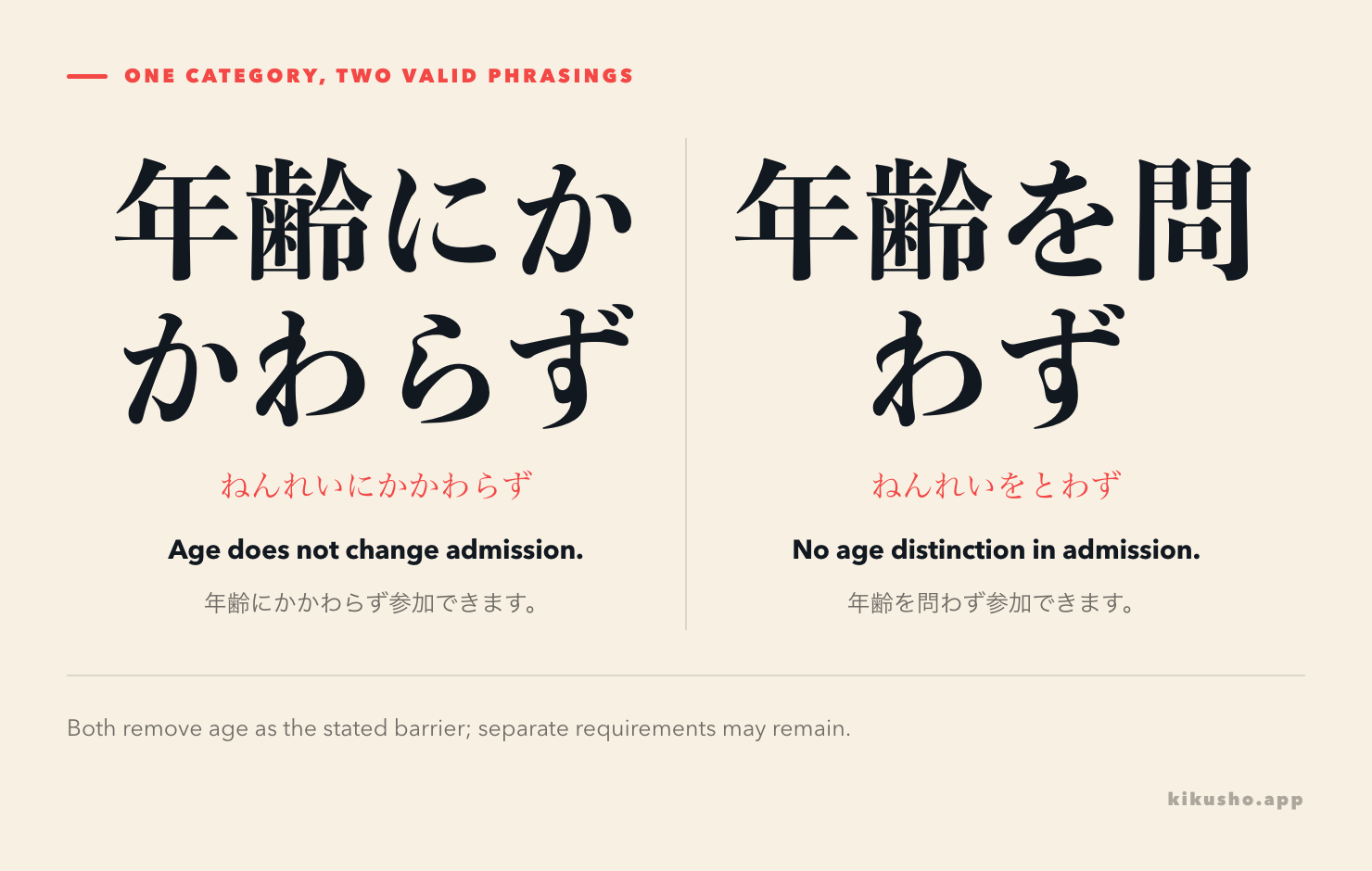
A separate requirement can remain. An age-inclusive event may still require a reservation. A course that accepts applicants without experience may still require everyone to attend a safety briefing. The connector removes the stated distinction, not every condition imaginable.
For a policy that deliberately changes according to experience, compare the neighboring lesson on に応じて and related forms. That condition-matching relationship differs from the invariance expressed here.
Register and も do different work
Bunpro labels both constructions formal, and the teacher's examples include written rules and announcements. They also occur in formal spoken explanations. “Which one is casual?” is a poor way to settle this pair; a slight register preference cannot make the shared age examples mutually exclusive.
Politeness can sit in the main clause: 年齢を問わず参加できます already ends politely. You do not need to turn the connector into a ます-form before continuing the sentence. A standalone notice can instead say 経験は問いません, “Experience is not a requirement.” That is a completed predicate, rather than the linking 問わず used above.
The neighboring にもかかわらず expresses a different relationship. 雨にもかかわらず集まった presents people gathering despite the rain. The rain is a circumstance being granted; the result goes against an expectation it invites. With 天候にかかわらず, a rule can hold across weather conditions without first asserting rain or surprise. The extra も is not a polite decoration.
For fuller practice with concession, ものの and とはいえ examine a granted fact and a qualifying continuation. Their attachments are their own; do not transplant the noun connection from this lesson.
The consulted Bunpro and Japanese teacher pages place both constructions at N2, agreeing with these two inventory units. This is a study classification. It does not establish an official exhaustive JLPT grammar list. Plain verb forms, negative forms and embedded questions are prerequisites.
In a course announcement, 有無 is worth keeping with what is present or absent. Paste that part of the notice into Kikusho when drafting its vocabulary card. Before saving, inspect whether the proposed example retains 経験の有無 and the permission given to both groups. Dropping the permission would leave the word but lose the admission rule.
Practice
Work through the eight questions in order. For Questions 4 and 5, arrange every fragment in the four slots and record the letter at ★. Keep your choices and reasons together until the final answer block.
Question 1: complete the connection
Keep 問わず as printed. Which particle completes the category phrase?
経験の有無( )問わず、説明会に参加できます。
A. が
B. に
C. を
D. で
Question 2: preserve the stated alternatives
Choose the phrase meaning “whether you participate or not.” The reply is required in either case.
( )、明日までに返事をください。
A. 参加するかどうかにかかわらず
B. 参加しますを問わず
C. 参加したとたんに
D. 参加するに応じて
Question 3: assess the two invitations
Compare 年齢にかかわらず参加できます and 年齢を問わず参加できます. Which statement preserves their shared meaning?
A. The first excludes older applicants; the second excludes younger ones.
B. Both assert that everyone is old but can participate despite that fact.
C. Both guarantee that reservations and every other requirement are absent.
D. Both remove age as the stated participation barrier.
Question 4: assemble the notice
Complete the notice saying anyone can apply with or without experience. Select the fragment in the starred position.
この講座には、経験の _ _ ★ _ 申し込めます。
A. 誰でも
B. 問わず
C. を
D. 有無
Question 5: construct the condition
Arrange the parts to request contact by Friday whether the person attends or not. Give the letter in the third slot. 出席する(しゅっせきする)means to attend.
出席する _ _ ★ _、金曜日までに連絡してください。
A. かかわらず
B. か
C. に
D. どうか
Question 6: read the admission rule
今回の見学会には、経験の有無を問わず申し込めます。ただし、当日は全員が安全説明を受けてから入場してください。
見学会(けんがくかい)is a visit or tour; 安全説明(あんぜんせつめい)is a safety briefing; 入場(にゅうじょう)means entry.
Which reading fits the whole notice?
A. First-time visitors cannot apply.
B. Experienced visitors alone must attend the briefing.
C. Staff are prohibited from collecting experience information.
D. Experience does not restrict applications, but everyone must attend the briefing before entry.
Question 7: connect the pricing statement
晴れても雨が降っても、料金は五百円です。天候( )、同じ料金で利用できます。
料金(りょうきん)means fee. Choose the connector stating that weather does not change the fee.
A. にかかわらず
B. に応じて
C. をもとに
D. のために
Question 8: retain the remaining limit
この展示では、作品の大きさにかかわらず、作者一人につき一点まで受け付けます。
展示(てんじ)means exhibition; 作者(さくしゃ)means creator; 一点(いってん)is one item or work here.
What does this notice allow?
A. Only large works are accepted.
B. Up to one work per creator is accepted, whatever its size.
C. Each creator can submit any number of works because size does not matter.
D. Every work is sold at the same price.
Pause here and check that each choice follows the complete sentence, including any separate restriction.
Answers and explanations
Answer 1: C. 経験の有無を問わず uses the noun phrase plus を問わず. A, B and D do not supply this connection while keeping 問わず unchanged. にかかわらず would be another possible expression, but it would require replacing the printed connector.
Answer 2: A. 参加するかどうか packages participation as a yes-or-no question; にかかわらず makes the reply apply to both answers. B places を after a polite verb without that phrase. C means immediately upon participating, changing the condition and timing. D mechanically puts に応じて after a bare verb and does not express the required invariance. 参加するかどうかを問わず would also be possible, but is not an option here.
Answer 3: D. Both invitations say age is not the stated admission barrier. A invents exclusions, B invents a fact about everyone's age and reads concession into the phrases, and C removes requirements that neither sentence discusses. The overlap is part of the grammar, not an error to eliminate.
Answer 4: B. The order is D → C → B → A: この講座には、経験の有無を問わず誰でも申し込めます。経験の fixes 有無 at the start of these slots; を follows that noun phrase, 問わず links it to the permission, and 誰でも means anyone. B is third. D, C and A occupy the other positions, respectively.
Answer 5: C. The sequence is B → D → C → A: 出席するかどうかにかかわらず、金曜日までに連絡してください。かどうか forms the whether-question; にかかわらず follows it. C belongs at ★. B and D build the question before that slot; A finishes the connector after it.
Answer 6: D. 経験の有無を問わず admits applications from both experience groups. ただし introduces a separate condition: 全員 must receive the briefing before entry. A excludes a group the notice includes; B reduces 全員 to experienced visitors; C mistakes disregard as a criterion for a ban on asking about it.
Answer 7: A. 天候にかかわらず states the same price across weather conditions, matching the first sentence's sunny and rainy cases. B makes weather a basis for adjustment; C names it as a basis; D supplies a reason. Those do not express the specified independence of the fee from weather.
Answer 8: B. 大きさにかかわらず removes size as the relevant distinction; 作者一人につき一点まで retains a maximum of one work per creator. A adds a size exclusion, C discards the explicit quantity limit, and D invents sales and pricing. A condition can be irrelevant while another remains decisive.
Common questions
What is the difference between にかかわらず and を問わず?
にかかわらず presents a result or policy as unaffected by a condition. を問わず sets aside distinctions within a category or range. Their meanings overlap, so 年齢にかかわらず and 年齢を問わず can both introduce participation without an age restriction.
Can を問わず follow a verb?
Noun plus を問わず is the main starting pattern. Question or alternative phrases can also precede it, such as 参加するかどうかを問わず. Do not attach it mechanically to a polite verb as 参加しますを問わず.
Does を問わず mean an organiser cannot ask about the category?
In 年齢を問わず, age is not used to exclude people from the stated scope. It does not itself prohibit collecting age information, remove other requirements or promise that every possible restriction is absent.
Is にかかわらず the same as にもかかわらず?
にかかわらず means irrespective of a condition. にもかかわらず presents a result despite a circumstance, often contrary to an expectation. The extra も changes the relationship; it is not just a politeness addition.