On this page
に先駆けて and を控えて can both connect a present action to something later, but they choose different viewpoints. Use に先駆けて when an action leads the field or precedes a milestone; use を控えて when an important event is approaching and shapes what people do or feel now.
Compare the marked nouns:
当社は他社に先駆けて、新しい決済方法を導入した。
とうしゃは たしゃに さきがけて、あたらしい けっさいほうほうを どうにゅうした。
Our company introduced the new payment method ahead of other companies.
新サービスの開始を控えて、担当者は最終確認を行った。
しんサービスの かいしを ひかえて、たんとうしゃは さいしゅうかくにんを おこなった。
With the new service launch approaching, the person in charge performed a final check.
In the first sentence, 他社 supplies the competitors that the company beat to the action. In the second, 開始 is the future event facing the person now. Both sentences look forward, but only the first claims precedence.
Two ways to stand before something
The easiest test is to ask what the marked noun contributes.
| Question about the noun | Choose | Core picture |
|---|---|---|
| Who or what did the subject act before? | Nに先駆けて | action B leads N |
| Which milestone did action B precede? | Nに先駆けて | action B → milestone N |
| What important event is now approaching? | Nを控えて | present situation → event N |
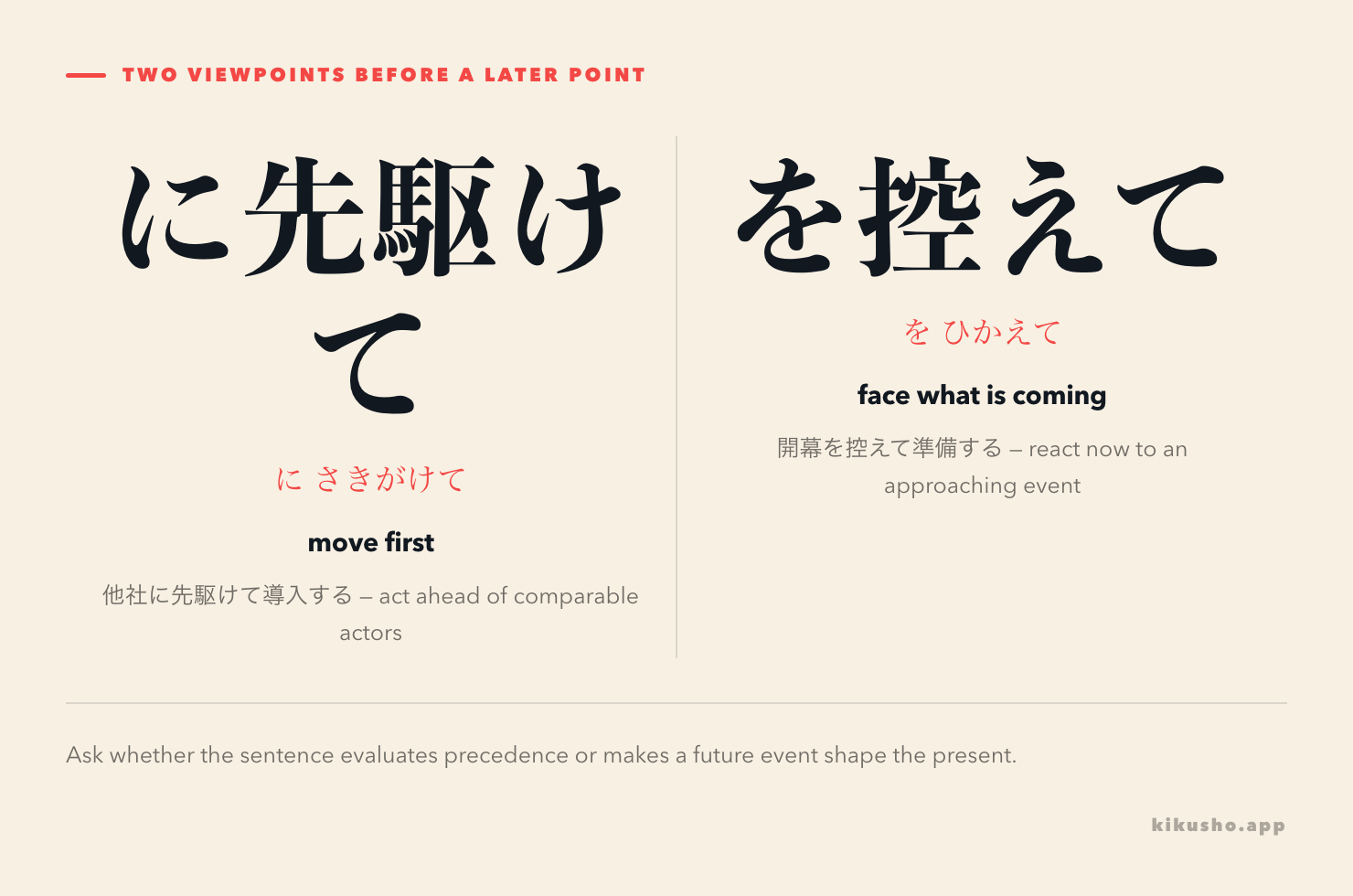
The English word “before” hides this difference. に先駆けて evaluates the order: one launch, country or person is first, or one special action is offered before a wider release. を控えて sets the scene from the present: the exam, election, departure or opening is close enough to cause preparation, tension, activity or restraint.
に先駆けて: act first or open the way
に先駆けて(にさきがけて, ni sakigakete) follows a noun. It comes from 先駆ける, to take the lead or pioneer. The noun can identify the group that will follow:
この研究所は世界に先駆けて、その治療法の実験を始めた。
この けんきゅうじょは せかいに さきがけて、その ちりょうほうの じっけんを はじめた。
This institute began testing the treatment ahead of the rest of the world.
市は他の地域に先駆けて、すべての手続きをオンライン化した。
しは ほかの ちいきに さきがけて、すべての てつづきを オンラインかした。
The city moved all procedures online ahead of other regions.
Words such as 世界, 全国, 業界, 他社 and 他国 fit naturally because they define a field in which someone can lead. Bunpro's に先駆けて reference explains this as doing B before A and often opening the way for comparable people or organizations to follow. It gives the attachment N + に先駆け(て) and places the pattern at N1.
The noun can instead be a later milestone:
一般公開に先駆けて、会員向けの試写会が開かれた。
いっぱんこうかいに さきがけて、かいいんむけの ししゃかいが ひらかれた。
Before the public release, a preview was held for members.
Here the preview is a privileged early step, not an ordinary chore. JLPT Sensei's に先駆けて lesson records both “prior to” and pioneering uses at N1. A useful shared idea is meaningful precedence: B is noteworthy because it occurs before N.
That makes 寝るに先駆けて歯を磨く far too grand for “brush your teeth before bed.” Use 寝る前に. The 前に and 後で lesson covers neutral everyday order.
The shorter connective に先駆け has the same relationship. Before a noun, use に先駆けた:
- 発売に先駆け、予約受付を開始した。 Reservations opened before the release.
- 業界に先駆けた取り組み is an initiative ahead of the industry.
を控えて: face an important event ahead
を控えて(をひかえて, o hikaete) also follows a noun, but that noun is normally a scheduled or expected event: an exam, match, opening, election, departure, deadline or ceremony.
国際大会を控えて、代表選手の練習は一段と厳しくなった。
こくさいたいかいを ひかえて、だいひょうせんしゅの れんしゅうは いちだんと きびしくなった。
With the international tournament approaching, the national team's training became even tougher.
卒業を控えた学生たちが、将来について話し合っている。
そつぎょうを ひかえた がくせいたちが、しょうらいについて はなしあっている。
The students who are nearing graduation are discussing their futures.
The event has not happened yet. Its approach explains the current preparation, mood or change. を控え is a compact written connective, while を控えた + noun modifies a noun. を控えている describes a person or institution currently having the event ahead:
姉は来月、出産を控えている。
あねは らいげつ、しゅっさんを ひかえている。
My older sister is expecting to give birth next month.
JLPT Sensei's を控えて reference places the form at N1 and documents both the simple Nを控えて shape and a version with an explicit future point. Study sites assign JLPT levels because the official test does not publish an exhaustive grammar list; the two independent references in this lesson agree on N1 for both targets.
Put the event and the time in separate slots
When you state exactly how far away the event is, use this frame:
event を time に控えて
試験を一週間後に控えて、図書館の利用者が増えている。
しけんを いっしゅうかんごに ひかえて、としょかんの りようしゃが ふえている。
With the exam one week away, library use is increasing.
開幕を翌日に控え、会場では安全確認が続いた。
かいまくを よくじつに ひかえ、かいじょうでは あんぜんかくにんが つづいた。
With the opening one day away, safety checks continued at the venue.
The event takes を; the position in time takes に. A plain time expression can also sit elsewhere in the sentence, as in 来月、出産を控えている. The explicit frame is valuable on the JLPT because the particles show exactly which noun is the event and which phrase locates it.
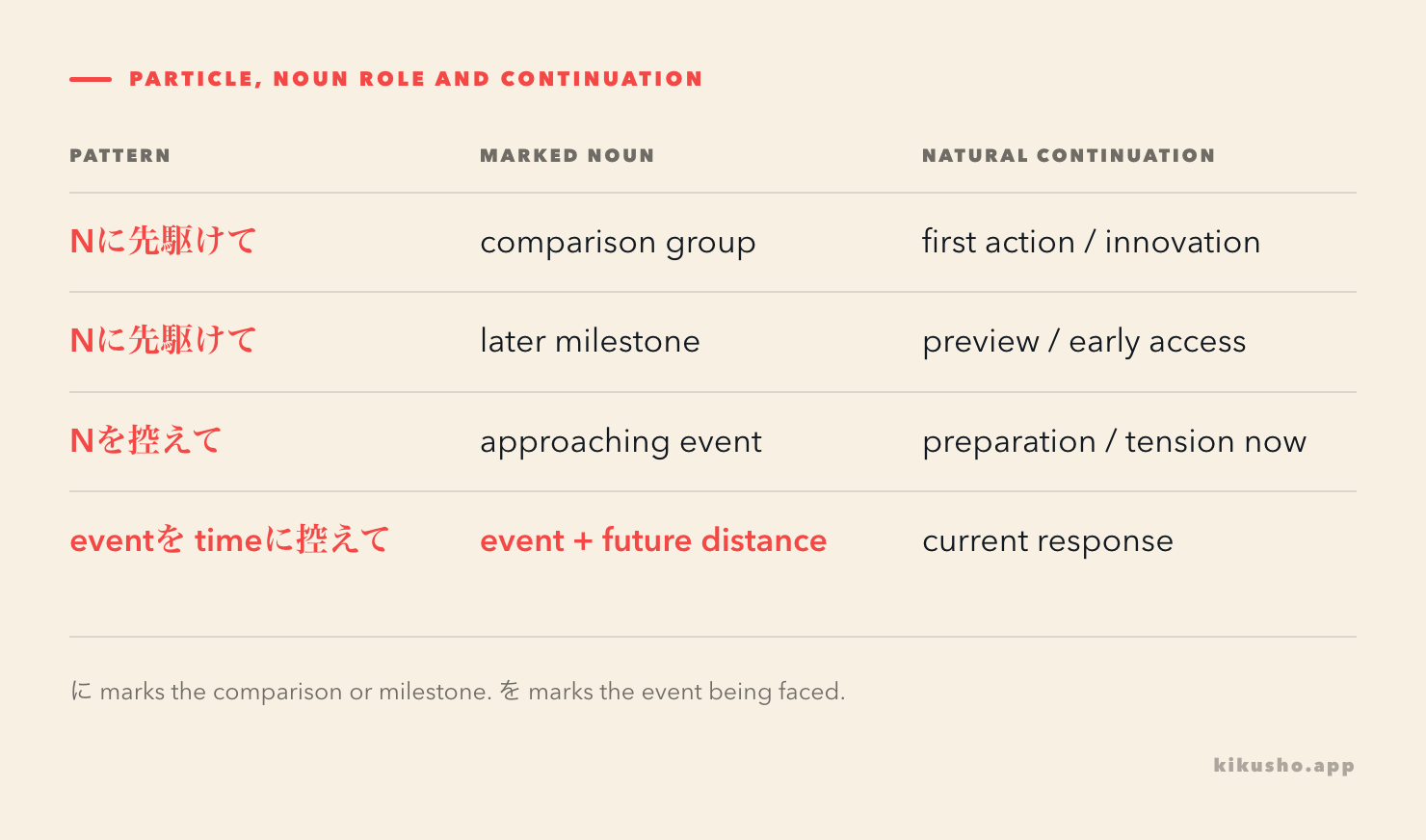
| Feature | に先駆けて | を控えて |
|---|---|---|
| attachment | Nに先駆けて | event Nを控えて |
| noun's role | comparison group or later milestone | approaching event |
| speaker's focus | being early, leading, privileged advance | preparation, anticipation or pressure now |
| compact form | Nに先駆け | Nを控え |
| modifier | Nに先駆けた + noun | Nを控えた + noun |
| explicit future distance | not part of its core frame | eventを timeに控えて |
Why the two forms do not simply swap
Suppose a publisher is preparing a new dictionary.
全国発売に先駆けて、東京で先行販売を行った。
Before the nationwide release, the publisher held an advance sale in Tokyo.
The point is special access before the main release. The sentence evaluates the Tokyo sale as early.
全国発売を控えて、倉庫では発送作業が続いている。
With the nationwide release approaching, shipping work continues at the warehouse.
Now the release is a future pressure on the current scene. The workers are not necessarily first in any field. The same noun, 全国発売, receives a different particle because its role has changed.
Compare the nearby formal pattern に先立って. It usually orders an advance action before an important event and often presents that action as preparation. に先駆けて can overlap when a preview precedes a release, but it more readily highlights priority, innovation or early access. The detailed に先立ち comparison shows its attachment and formal planning frame.
Do not mistake the grammar for the other senses of 控える
控える is a polysemous verb. These sentences have the same surface particle but different relationships:
- 健康のため、酒を控えている。 I am limiting or avoiding alcohol for my health.
- 連絡先を手帳に控えた。 I noted the contact information in my notebook.
- 試験を来週に控えている。 I have an exam coming up next week.
An approaching-event reading needs an event that can occupy a future position. Alcohol is something a person can consume less of; contact information is something a person can record; an exam is something a person can face. The article on four context-sensitive N1 verbs compares these three 控える paths in their wider lexical context.
When you save examples in Kikusho, keep the phrase that resolves the role. A card containing only 控える = refrain will misread an upcoming exam. Preserve 試験を一週間後に控える so the event, particle and future distance remain visible. The generated suggestion stays editable, so you can keep the particular contrast that made the sentence useful.
Practice: choose the viewpoint
Answer all seven questions before opening the explanations. These original items test attachment, time direction and context rather than copied exam questions.
Question 1 · ahead of a group
Complete: その企業は他社( )、再利用できる容器を導入した。
- A. を控えて
- B. に先駆けて
- C. を先立って
- D. に控えた
Question 2 · approaching event
Complete: 決勝戦( )、選手たちは集中力を高めている。
- A. を控えて
- B. に先駆けて
- C. に以来
- D. を先駆けて
Question 3 · explicit distance
Which sentence correctly means “With the opening three days away, final checks began”?
- A. 開店に三日後を控えて、最終確認が始まった。
- B. 開店を三日後に控えて、最終確認が始まった。
- C. 開店を三日後に先駆けて、最終確認が始まった。
- D. 開店に三日後を先駆けて、最終確認が始まった。
Question 4 · early access
Complete: 一般公開( )、報道関係者向けの内覧会が行われた。
- A. を控えてだけ
- B. に先駆けて
- C. を以来
- D. に控えるため
Question 5 · describing people before a milestone
Select the natural noun phrase for “students nearing graduation.”
- A. 卒業に先駆けて学生
- B. 卒業を控えた学生
- C. 卒業を控えての学生
- D. 卒業に控えた学生
Question 6 · lexical boundary
What does 控えて mean here?
医者の助言で、甘い物を控えている。
- A. Sweets are about to occur.
- B. The speaker leads sweets.
- C. The speaker is limiting sweets.
- D. The speaker records sweets.
Question 7 · read the whole sentence
Two cities will introduce the same recycling system. City A starts first. Which sentence makes that leadership the main point?
- A. A市は制度の開始を控えて、住民説明会を開いた。
- B. A市はB市に先駆けて、新制度を導入した。
- C. A市は新制度を一週間後に控えた。
- D. A市は制度を控えたので、導入しなかった。
Answers and explanations
Answer 1
B. に先駆けて. 他社 names the comparable organizations that will follow. The company's introduction is noteworthy because it occurs ahead of them. を控えて would incorrectly present other companies as a scheduled event.
Answer 2
A. を控えて. The final is an important approaching event, and the athletes' present concentration responds to it. に先駆けて would frame their action as prior to the final but would lose the intended “facing the final” viewpoint.
Answer 3
B. 開店を三日後に控えて、最終確認が始まった. The event takes を and its future position takes に: event を time に控えて. The other choices reverse those roles or combine the time expression with に先駆けて incorrectly.
Answer 4
B. に先駆けて. The press preview is privileged early access before the general opening. This event-based use of に先駆けて still highlights meaningful precedence rather than simply reporting two routine actions.
Answer 5
B. 卒業を控えた学生. を控えた is the noun-modifying form, and 卒業 is the event ahead of the students. に先駆けて is connective, while C and D do not form the required modifier.
Answer 6
C. The speaker is limiting sweets. 甘い物 is something consumed less often on medical advice. It is not an event positioned in the future, so this is the restraint sense of 控える.
Answer 7
B. A市はB市に先駆けて、新制度を導入した. B市 supplies the comparison and A市 acts first. A describes preparations before a launch, C leaves the sentence incomplete as a claim about leadership, and D uses the restraint sense.
Make the marked noun answer the right question
Choose に先駆けて when you can answer “ahead of whom?” or “ahead of which wider release?” Choose を控えて when you can answer “which event is now close enough to affect this scene?” Then check the particle: に marks the comparison or milestone, while を marks the event being faced.
That viewpoint is more reliable than translating both forms as “before.” It predicts the natural continuation as well: innovation and early access after に先駆けて; preparation, tension and intensified activity after を控えて.
Common questions
What is the difference between に先駆けて and を控えて?
に先駆けて presents an action as earlier than a comparable group or later milestone, often with a pioneering nuance. を控えて presents an important scheduled event as approaching and affecting the present situation.
What comes before に先駆けて?
A noun comes before に先駆けて: 他社に先駆けて means ahead of other companies, while 一般公開に先駆けて means prior to public release. The compact form に先駆け and the noun-modifying form に先駆けた also occur.
How do you say an event is one week away with を控えて?
Use event を time に控えて, as in 試験を一週間後に控えて. The event is the object of 控える, and the time phrase states where it stands in the future.
Does を控えて always mean an event is approaching?
No. 控える also means to limit or refrain from something and to note information. An important event noun, often with a future time phrase, identifies the approaching-event use taught here.