On this page
にしたところで, としたところで and Vたところで all concede a point without letting it overturn the conclusion. The difference lies in what is conceded: a representative case, an assumed premise or an action whose expected benefit will not materialize.
Compare these three frames:
社長にしたところで、すべての事情を知っているわけではない。
しゃちょうに したところで、すべての じじょうを しっている わけではない。
Even the company president does not know every circumstance.
来月開始するとしたところで、準備期間は一か月しかない。
らいげつ かいしすると したところで、じゅんびきかんは いっかげつしか ない。
Even assuming we start next month, we have only one month to prepare.
今から急いだところで、最終列車には間に合わない。
いまから いそいだところで、さいしゅうれっしゃには まにあわない。
Even if we hurry now, we will not catch the last train.
The first sentence selects a person who might be expected to know more. The second temporarily accepts a schedule as an assumption. The third imagines an effort and denies its hoped-for effect.
First identify what the concession puts on the table
| What the first clause offers | Main form | Question to ask |
|---|---|---|
| one person, option or case from a set | Xにしたところで | Even for which case? |
| a proposition accepted for argument | Xとしたところで | Even assuming what? |
| an action imagined as completed | Vたところで | Would doing it change the result? |
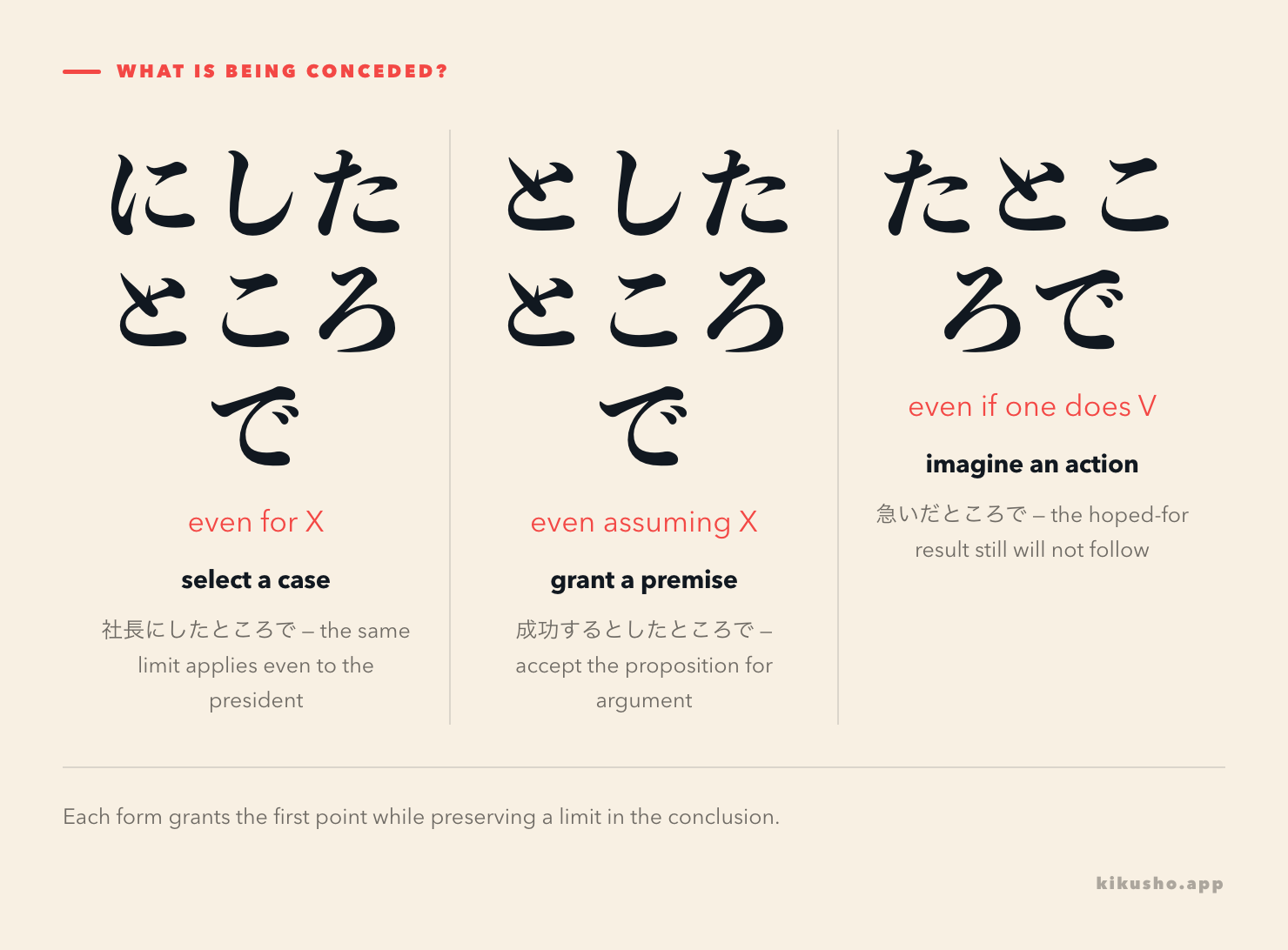
All three constructions constrain the conclusion. They do not introduce a happy surprise. The following clause says that a limit, problem or unchanged fact remains after the speaker grants the first point.
にしたところで selects one case under the same limit
Xにしたところで(にしたところで, ni shita tokoro de) often follows a noun or noun-like expression. It picks X from a wider set and says that the conclusion applies even to X. A person noun commonly yields “even for X” or “from X's position too.”
経験豊富な社員にしたところで、この変更を説明なしで理解するのは難しい。
けいけんほうふな しゃいんに したところで、この へんこうを せつめいなしで りかいするのは むずかしい。
Even for an experienced employee, understanding this change without an explanation is difficult.
The experienced employee is a strong test case. If the limit applies there, less experienced employees are implicitly included.
The selected case can also be an option:
別の案にしたところで、費用が大きく下がることはない。
べつの あんに したところで、ひようが おおきく さがることは ない。
Even if we went with another plan, the cost would not fall substantially.
Here 別の案にする means choosing another plan. The concession imagines selecting that alternative and says the financial limit remains.
Bunpro's にしたところで reference describes the form as choosing a case or perspective from which the result does not change. Its structure section gives N + にしたところで, alongside としたところで, and places the construction at N1.
The shorter にしたって is less formal:
専門家にしたって、未来を正確に予測することはできない。
Even an expert cannot predict the future precisely.
The Japanese-teacher explanation from 毎日のんびり日本語教師 records plain-form attachment, with である available after nouns and な-adjectives, and notes the tendency to select one member while implying that the same conclusion applies to similar cases. It also shows that the second clause is often unfavorable.
としたところで accepts an assumption for argument
Xとしたところで(としたところで, to shita tokoro de) presents X as something to suppose. The quoted material before とする can be a proposition:
予算が承認されるとしたところで、工事の開始は来年になる。
よさんが しょうにんされると したところで、こうじの かいしは らいねんに なる。
Even assuming the budget is approved, construction will not begin until next year.
The speaker grants approval for the sake of the argument. That generous assumption still cannot remove the time limit.
全員が賛成するとしたところで、法律上の問題は残る。
ぜんいんが さんせいすると したところで、ほうりつじょうの もんだいは のこる。
Even supposing everyone agrees, the legal problem remains.
This is close to としても, the broader “even assuming” form. としたところで more strongly anticipates that the granted premise will fail to change the outcome. The としても and にしても lesson teaches the neutral premise first; the present N1 pattern adds a stronger sense of limited power over the conclusion.
Do not force a mechanical swap between に and と. With a person or option, にしたところで readily selects the case. With a full proposed situation, としたところで readily quotes the assumption. Both can be translated “even if,” so the role of the preceding expression matters more than the English gloss.
Vたところで imagines an action with little effect
Vたところで(たところで, ta tokoro de) attaches directly to the verb's た-form. Although the form looks past, this concessive use is usually hypothetical. The action may not have happened at all.
いくら説明したところで、本人に聞く気がなければ伝わらない。
いくら せつめいしたところで、ほんにんに きく きが なければ つたわらない。
No matter how much you explain, it will not get through if the person is unwilling to listen.
売上が倍になったところで、今の赤字をすべて解消することはできない。
うりあげが ばいに なったところで、いまの あかじを すべて かいしょうすることは できない。
Even if sales doubled, the current deficit could not be eliminated completely.
The first clause supplies an apparently useful action or improvement. The second blocks its expected payoff. いくら, どんなに, 今さら and どうせ often sharpen the speaker's judgment:
- 今さら謝ったところで、失った信頼はすぐには戻らない。 Even apologizing now will not restore the lost trust immediately.
- どんなに急いだところで、到着は閉店後になる。 No matter how much we hurry, arrival will be after closing.
- 一人で考えたところで、出せる案はせいぜい二、三個だ。 Even if I think alone, I can produce only two or three ideas at most.
日本語NET's たところで lesson gives Vた + ところで, places it at N1 and describes a result that fails to meet the expected goal. It notes that requests such as てください and invitations such as ましょう do not fit the following clause. Bunpro's independent entry likewise stresses a hypothetical action followed by an unchanged or usually unfavorable result.
Read the result, not only the verb ending
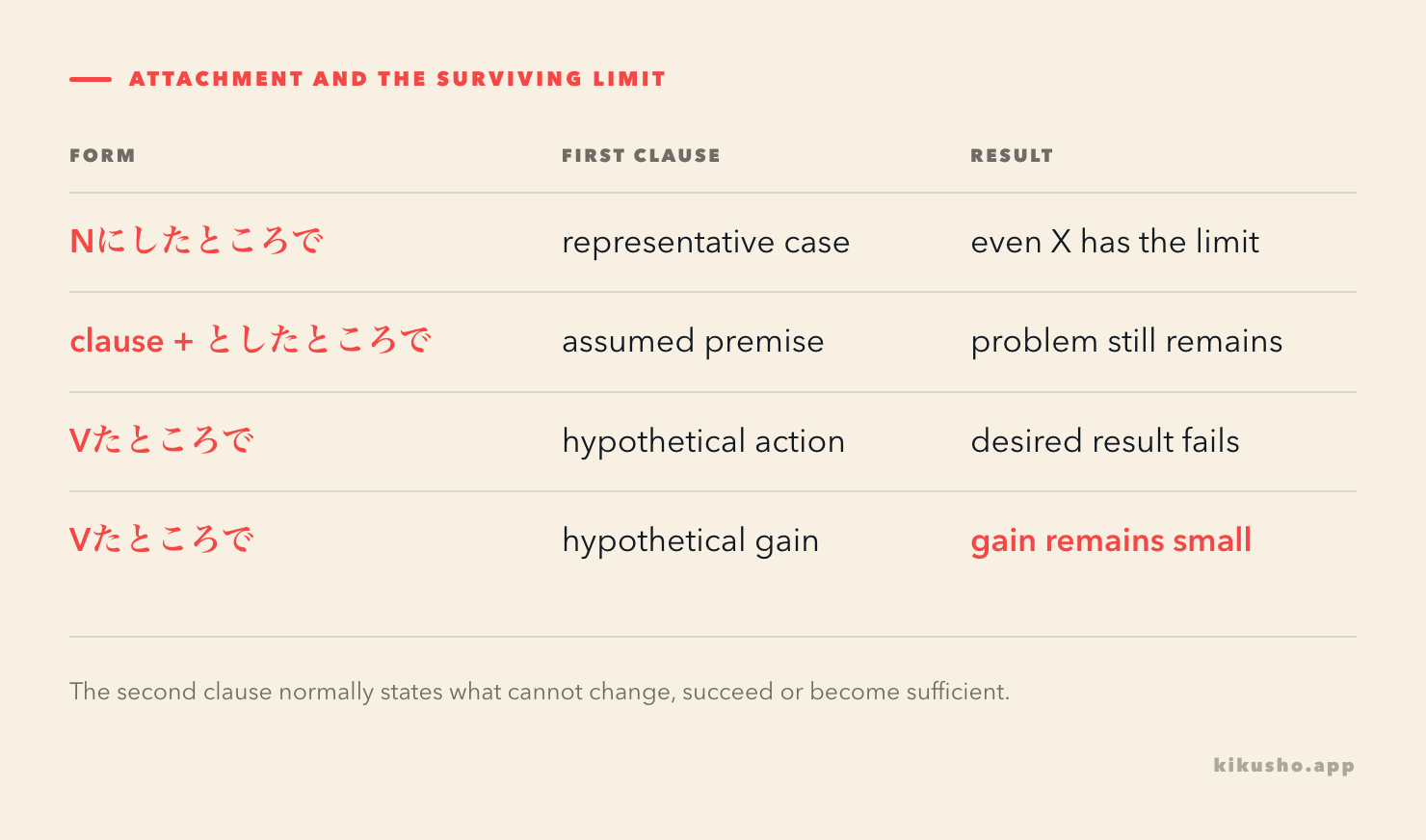
The following clause need not contain a grammatical ない every time, but it normally carries a negative or limited conclusion.
| First clause | Natural result | Why it fits |
|---|---|---|
| 急いだところで | 間に合わない | desired result is impossible |
| 売上が増えたところで | 利益はわずかだ | gain remains limited |
| 今さら話し合ったところで | 時間の無駄だ | action has no useful effect |
| 専門家にしたところで | 全部は分からない | even a strong case has the limit |
| 成功するとしたところで | 問題は残る | granted assumption changes too little |
An affirmative success claim clashes with the intended construction:
× 毎日練習したところで、大会で優勝した。
Intended: I practiced every day and won the tournament.
This reports an actual cause and success, so 毎日練習したので、大会で優勝した is appropriate. To use the concession, preserve the limited result: 毎日練習したところで、必ず優勝できるとは限らない, “Even if you practice every day, victory is not guaranteed.”
Three different strings ending in ところで
The visual string たところで does not always express concession. Read the whole clause.
| Sentence | Function |
|---|---|
| 何度説明したところで、理解してもらえない。 | concessive: even if I explain repeatedly |
| 駅に着いたところで、友達から電話が来た。 | temporal stage: when I had reached the station |
| 資料は完成しました。ところで、次の会議はいつですか。 | discourse connector: by the way |
The concessive reading predicts an unchanged or restricted outcome. The temporal reading locates another event at a stage. Sentence-initial ところで leaves one topic for another. The ところで and ところが comparison covers that discourse connector and explicitly separates it from verb-attached uses.
At an earlier level, 書いたところです means “I have just written it.” Adding で does not automatically create the N1 concession; syntax and the following result decide. Review the before, during and just-finished ところ stages when the timing use is uncertain.
The useful contrast with ても
Neutral ても can introduce many kinds of concession:
雨が降っても、試合は行います。
Even if it rains, the match will take place.
This does not imply that holding the match is futile. たところで is narrower:
雨がやんだところで、グラウンドは今日中には乾かない。
Even if the rain stops, the field will not dry today.
Stopping rain sounds helpful, but the conclusion denies enough benefit. That limitation is why たところで combines naturally with resignation, skeptical forecasts and advice to stop wasting effort. The nearby ても始まらない and てもしょうがない lesson shifts the futility judgment into the predicate itself.
When saving one of these sentences in Kikusho, keep both halves. A card containing only 相談したところで cannot show whether the expression is temporal or concessive. Preserving 今さら相談したところで、結論は変わらない keeps the cue, hypothetical action and unchanged result together for review.
Practice: trace the surviving limit
Complete all seven items before opening the explanations. The answer block stays below the full question set.
Question 1 · a strong representative case
Complete: ベテランの技術者( )、この装置を説明なしで修理するのは難しい。
- A. にしたところで
- B. たところで
- C. ところで
- D. にしたところ
Question 2 · an assumed premise
Complete: 計画が予定どおり進む( )、完成まで二年はかかる。
- A. にしたところで
- B. としたところで
- C. たばかりで
- D. ところが
Question 3 · an action with no payoff
Complete: 今から駅まで走っ( )、終電には間に合わない。
- A. にしたところで
- B. ているところで
- C. たところで
- D. としたところ
Question 4 · interpret the た-form
In いくら頼んだところで、彼は考えを変えない, has the request necessarily happened already?
- A. Yes; た always reports a completed past event here.
- B. No; the construction imagines the request and predicts no change.
- C. Yes; ところで means “just after.”
- D. No; 頼んだ means the speaker refused to ask.
Question 5 · choose the compatible result
Finish: 売上が少し増えたところで、( )。
- A. 必ず会社は大成功した
- B. 赤字を解消するには足りない
- C. もっと売ってください
- D. 祝賀会を開きましょう
Question 6 · distinguish three ところで patterns
Which sentence uses ところで as the fixed “by the way” connector?
- A. 何度読んだところで、意味は分からない。
- B. 駅に着いたところで、雨が降り始めた。
- C. 報告は以上です。ところで、来週の予定は決まりましたか。
- D. 社長にしたところで、答えられない。
Question 7 · read the paragraph
Read the short exchange:
A: 専門家に相談すれば、すぐ解決するでしょう。
B: 専門家(甲)、資料がなければ判断できないよ。今から資料を集め(乙)、今日の会議には間に合わない。
Choose the pair that marks “even for an expert” and then “even if we gather them.”
- Case then action: 甲 にしたところで / 乙 たところで
- Action then case: 甲 たところで / 乙 にしたところで
- Assumption then reversal: 甲 としたところで / 乙 ところが
- Topic shift then case: 甲 ところで / 乙 にしたって
Answers and explanations
1 — A, にしたところで. ベテランの技術者 is the strongest representative case. The sentence says that even such an expert faces the same difficulty, implying that others do too. たところで must attach directly to a verb in the た-form.
2 — B, としたところで. The complete proposition 計画が予定どおり進む is accepted as an assumption. Even under that favorable premise, the two-year lower limit remains.
3 — C, たところで. 走る becomes the た-form 走った before ところで. The action is hypothetical, and the following clause denies its desired result: catching the last train.
4 — B. The た-form is part of the concessive pattern and does not prove that the request occurred. いくら and the unchanged result 考えを変えない support the hypothetical “no matter how much we ask” reading.
5 — B, 赤字を解消するには足りない. The small rise in sales fails to produce enough benefit, so the deficit remains. A reports a successful past result, while C and D are a request and an invitation, which do not state the required limitation.
6 — C. The report ends, and sentence-initial ところで opens a separate question. A is the N1 concessive Vたところで pattern, B locates rain at the arrival stage, and D selects the president as a representative case.
7 — Case then action. 専門家にしたところで selects the expert as a strong case that still needs documents. 集めたところで imagines gathering the documents now but denies that the effort can meet today's deadline.
Grant the first point, then inspect what survives
Use にしたところで when you single out a person, option or case and show that the same restriction applies there. Use としたところで when you temporarily accept a whole assumption. Use Vたところで when you imagine an action and judge that its hoped-for result remains impossible, inadequate or unchanged.
The decisive evidence usually sits in the second clause. If it preserves a limit after the first point has been granted, the concession works. If it simply reports when something happened or changes the subject, you are looking at a different ところで construction.
Common questions
What is the difference between にしたところで and たところで?
Xにしたところで selects X as a case and says the same limitation applies even there, often meaning even for X. Vたところで imagines performing an action but predicts that the desired result still will not follow.
What does としたところで mean?
Xとしたところで asks the reader to accept X as an assumption, then says the conclusion remains limited or unchanged. It often translates as even supposing X or even assuming that X.
Does the た in Vたところで describe a past action?
Usually no in this concessive pattern. The た-form builds a hypothetical action: 急いだところで間に合わない means that even hurrying now will not make the person arrive in time.
What normally follows Vたところで?
The following clause normally gives an unchanged, negative or limited result, such as 間に合わない, 何も変わらない, 無駄だ or せいぜい一日分だけだ.