On this page
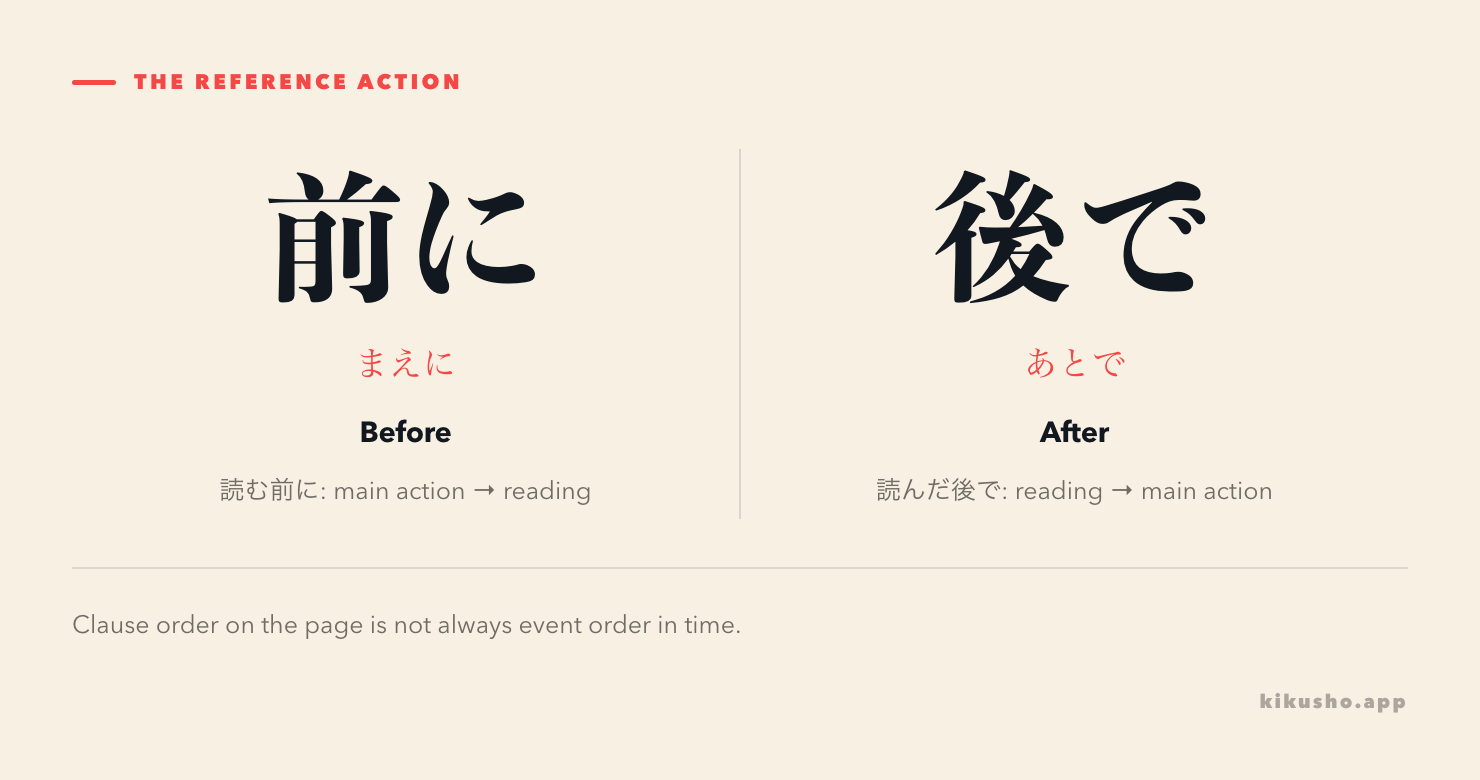
Use a dictionary-form verb before 前に(まえに) for “before doing,” and a plain た-form before 後で(あとで) for “after doing.” The first form stays non-past even in a past account; the second stays in the た-form even in tomorrow's plan.
Ask which action happens first, then choose the form
In A前にB, you do B before A. In A後でB, you do B after A. The event beside 前 or 後 is your reference point, not automatically the first event on the timeline.
| Pattern | Order in time | Verb beside the time expression |
|---|---|---|
| A前にB | B → A | A in dictionary form |
| A後でB | A → B | A in plain た-form |
| Event noun の前にB | B → named event | Noun + の |
| Event noun の後でB | Named event → B | Noun + の |
Suppose you make tea and then read a book. You can describe that sequence from either side:
本を読む前に、お茶を入れます。
ほんを よむまえに、おちゃを いれます。
I make tea before reading the book.
お茶を入れた後で、本を読みます。
おちゃを いれたあとで、ほんを よみます。
After making tea, I read the book.
The two sentences choose different reference actions while preserving the order. They need not describe how long you wait between the actions. Nothing in 後で alone means “immediately afterward.”
前に keeps the reference action in dictionary form
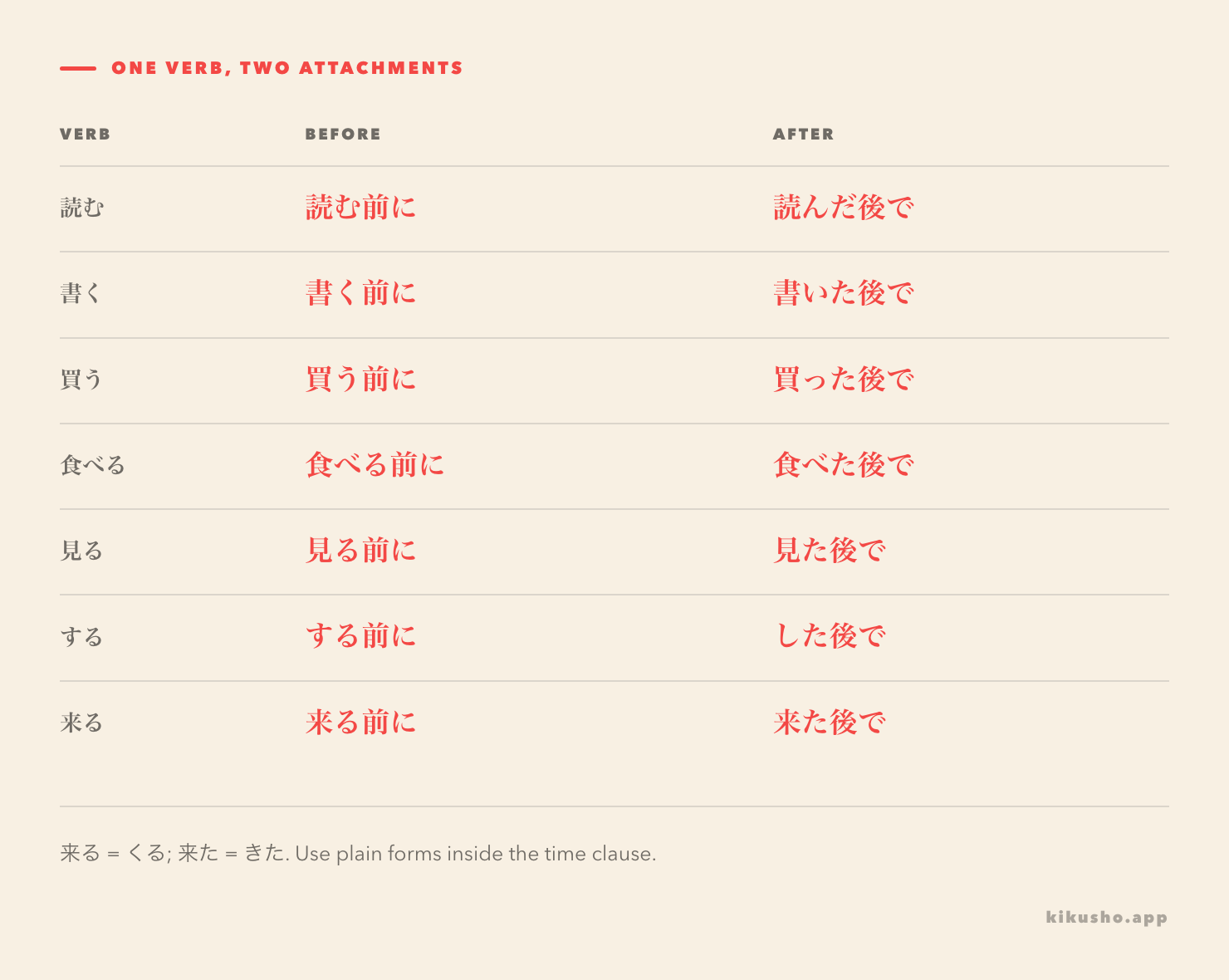
For the basic affirmative construction, attach 前に directly to the verb's dictionary form. Keep its object and other necessary words inside the clause. 本を読む前に is “before reading the book,” not simply “before the book.”
| Dictionary form | Before doing | After doing |
|---|---|---|
| 読む(よむ), read | 読む前に | 読んだ後で |
| 書く(かく), write | 書く前に | 書いた後で |
| 買う(かう), buy | 買う前に | 買った後で |
| 食べる(たべる), eat | 食べる前に | 食べた後で |
| 見る(みる), see/watch | 見る前に | 見た後で |
| する, do | する前に | した後で |
| 来る(くる), come | 来る前に(くるまえに) | 来た後で(きたあとで) |
If the dictionary forms are unfamiliar, start with Japanese verb groups and polite endings. This page teaches the time constructions, rather than a second account of every verb class.
Changing the final action to past does not change 読む before 前に:
昨日本を読む前に、お茶を入れました。
きのう ほんを よむまえに、おちゃを いれました。
Yesterday I made tea before reading the book.
Yesterday places the account in the past. 入れました reports the tea-making as past and polite. 読む前に still presents reading as later than that tea-making. Translating the English words “before I read” one by one into 読んだ前に loses the attachment rule.
A before-clause also need not promise that its reference action eventually happens. A direction to do something before leaving tells you where the action belongs if you leave; it is not evidence that the departure has already taken place.
後で uses the た-form for completion relative to the next action
Before 後で, use the plain た-form: 読む → 読んだ, 書く → 書いた, する → した. Voiced だ endings belong to the same conjugation family. 読んた is not the past form of 読む.
The た-form lesson explains those sound changes. Here the important question is completion by the time the following action happens, rather than completion by the time you speak.
明日本を読んだ後で、友達に貸します。
あした ほんを よんだあとで、ともだちに かします。
Tomorrow, after I read the book, I will lend it to a friend.
Both actions belong to tomorrow. 読んだ makes the reading complete relative to lending. The final 貸します is non-past and polite. Changing 読んだ to 読む merely because you see 明日 would break this after-doing construction.
You can report a completed sequence with the same inner form:
昨日本を読んだ後で、友達に貸しました。
きのう ほんを よんだあとで、ともだちに かしました。
Yesterday, after reading the book, I lent it to a friend.
The clause ending decides the politeness of these examples. Use 読んだ後で、貸します in a polite plan, not 読みました後で. These time expressions themselves are ordinary standard Japanese, usable in speech and writing.
Event nouns need の; verb clauses do not
With an event noun, the two sides share an attachment: noun + の. A class or a meeting can be the time reference without a separate verb.
授業の前に、ノートを開きます。
じゅぎょうの まえに、ノートを ひらきます。
I open my notebook before class.
授業の後で、先生に質問します。
じゅぎょうの あとで、せんせいに しつもんします。
I ask the teacher a question after class.
If you replace the noun with a verb clause, remove の and build that clause normally:
授業が終わった後で、先生に質問します。
じゅぎょうが おわったあとで、せんせいに しつもんします。
After class finishes, I ask the teacher a question.
授業の後で names the event; 授業が終わった後で explicitly names its finishing. Both can fit the same situation. 終わったの後で combines two attachment routes that should stay separate here.
Context also decides whether 前 concerns time or space. 学校の前に can mean “in front of the school”; 授業の前に means “before class” in the examples above. For physical positions, see Japanese location words and の. This lesson's comparison concerns action order, not every spatial use of 前.
Later is less specific than after a named action
On its own, 後で can mean “later.” 後で電話します (あとで でんわします), “I'll call later,” does not specify the event you will wait for. Adding a clause makes the reference explicit: 買い物をした後で、電話します (かいものを したあとで、でんわします), “I'll call after shopping.”
Both expressions are useful, but a loose promise to call later cannot answer “before or after shopping?” without more context. Retain the reference event when that order matters.
In Kikusho, paste the sentence from a message about your plans and check its generated card before saving. Keep the full time clause in the editable example: a card containing only “after” cannot remind you whether the speaker said later in general or after finishing a particular task. You can review that example alongside its audio later.
The references place the pair across an N5–N4 boundary
JLPT Sensei's 前に page estimates N5 and gives the dictionary-form and noun attachments. Its 後で page estimates N4; Bunpro's independently written 後で lesson also places that construction in N4 and confirms the standard register and “later” use. This N5-section comparison introduces the N4-labelled partner deliberately; that placement does not turn it into an officially certified N5 item.
Mango Languages' comparison by Akiko Kashiwagi-Wood verifies the forms across past accounts and future plans, plus event-noun attachment. These are editorial level estimates, not an exhaustive official JLPT syllabus. The exercises below practise the specific forms taught here.
Practice
Draw the two events for each question in chronological order and identify which one the time clause names. Finish the six questions first; the explanations follow Question 6.
Question 1
Yesterday, you wrote your name before entering the room. Choose the verb form for the blank:
昨日部屋に( )前に、名前を書きました。
きのう へやに( )まえに、なまえを かきました。
- ア. 入った
- イ. 入ります
- ウ. 入る
- エ. 入って
Question 2
Complete a plan for tomorrow: “After buying the bread, I will go home.” Choose the needed form of 買う(かう), keeping 後で.
明日パンを( )後で、家に帰ります。
あした パンを( )あとで、いえに かえります。
- ア. 買う
- イ. 買いました
- ウ. 買った
- エ. 買いた
Question 3
Read the diary:
昨日、まず窓を開けました。それから部屋を掃除しました。
きのう、まず まどを あけました。それから へやを そうじしました。
Yesterday, first I opened the window. Then I cleaned the room.
Which sentence preserves that order?
- ア. 窓を開ける前に、部屋を掃除しました。
- イ. 窓を開けた後で、部屋を掃除しました。
- ウ. 部屋を掃除した後で、窓を開けました。
- エ. 部屋を掃除する前に、窓を閉めました。
開ける(あける) means open; 閉める(しめる) means close.
Question 4
Use the event noun 会議(かいぎ), “meeting,” to say you will drink water before the meeting. Choose the attachment:
会議( )前に、水を飲みます。
かいぎ( )まえに、みずを のみます。
- ア. を
- イ. で
- ウ. が
- エ. の
Question 5
Write “After my friend came, we watched a film” using 友達が来る, 後で, and 映画を見ました. Put the time clause first. Add the kana reading for 来る after changing its form.
Question 6
Read the message:
明日はまず郵便局へ行きます。それから銀行へ行きます。
あしたは まず ゆうびんきょくへ いきます。それから ぎんこうへ いきます。
Tomorrow I will first go to the post office. Then I will go to the bank.
Complete the sentence so that it describes the same plan:
銀行へ( )前に、郵便局へ行きます。
ぎんこうへ( )まえに、ゆうびんきょくへ いきます。
- ア. 行った
- イ. 行く
- ウ. 行きました
- エ. 行って
Answers and explanations
Answer 1
ウ. 入る(はいる). The sentence is 昨日部屋に入る前に、名前を書きました, “Yesterday I wrote my name before entering the room.” The writing happens first. Yesterday and 書きました make the account past, while the before-clause keeps the dictionary form. 入った is the plain past, 入ります the polite non-past, and 入って the て-form; none supplies the required dictionary attachment here.
Answer 2
ウ. 買った(かった): 明日パンを買った後で、家に帰ります, “Tomorrow, after buying the bread, I will go home.” 買う becomes 買った, not 買いた. The purchase will be complete when you go home. It remains tomorrow's plan; the た-form inside the clause does not relocate it to yesterday. 買う後で would substitute the wrong form, and 買いました後で would use a polite ending where the plain form is needed.
Answer 3
イ. 窓を開けた後で、部屋を掃除しました (まどを あけたあとで、へやを そうじしました), “After opening the window, I cleaned the room.” This preserves opening → cleaning. ア and ウ put cleaning first. エ changes opening to closing; even though its cleaning reference comes later, it reports a different action from the diary. The た-form 開けた is correct before 後で.
Answer 4
エ. の gives 会議の前に、水を飲みます, “I will drink water before the meeting.” 会議 is an event noun, so this route needs の. を, で and が can have other jobs in Japanese, but none replaces the noun-linking の in this phrase. Compare a full verb clause such as 会議が始まる前に, “before the meeting begins”: が marks the subject inside that clause and the verb then attaches directly.
Answer 5
友達が来た後で、映画を見ました。
ともだちが きたあとで、えいがを みました。
“After my friend came, we watched a film.”
来る(くる) changes to 来た(きた). Do not retain the reading くる or create 来った. Arrival precedes watching, and 見ました reports the final action as past and polite. 来たの後で would incorrectly add the event-noun attachment after the verb clause. “We” follows the situation in the English prompt; Japanese does not need a separate subject for 映画を見ました here.
Answer 6
イ. 行く(いく). 銀行へ行く前に、郵便局へ行きます means “Before going to the bank, I will go to the post office.” The post-office visit happens first, even though the bank appears first in the sentence. 行った, 行きました and 行って do not give the dictionary form required before 前に. Drawing post office → bank before choosing an option prevents word order on the page from being mistaken for event order.
Common questions
Do I use a past form before 前に when the whole sentence is past?
For the basic before-doing construction, keep the dictionary form: 読む前に, not 読んだ前に. The final verb can be past, as in 本を読む前に、お茶を入れました, meaning I made tea before reading the book.
Why does 後で take the ta-form in a future plan?
The ta-form presents the first action as completed relative to the second action. 明日本を読んだ後で、友達に貸します means Tomorrow, after I read the book, I will lend it to a friend. It does not say the reading happened yesterday.
Do nouns take の before both 前に and 後で?
Event nouns use の in these patterns: 授業の前に means before class and 授業の後で means after class. Verb clauses attach directly, as in 授業が終わった後で; do not insert の after 終わった.