On this page
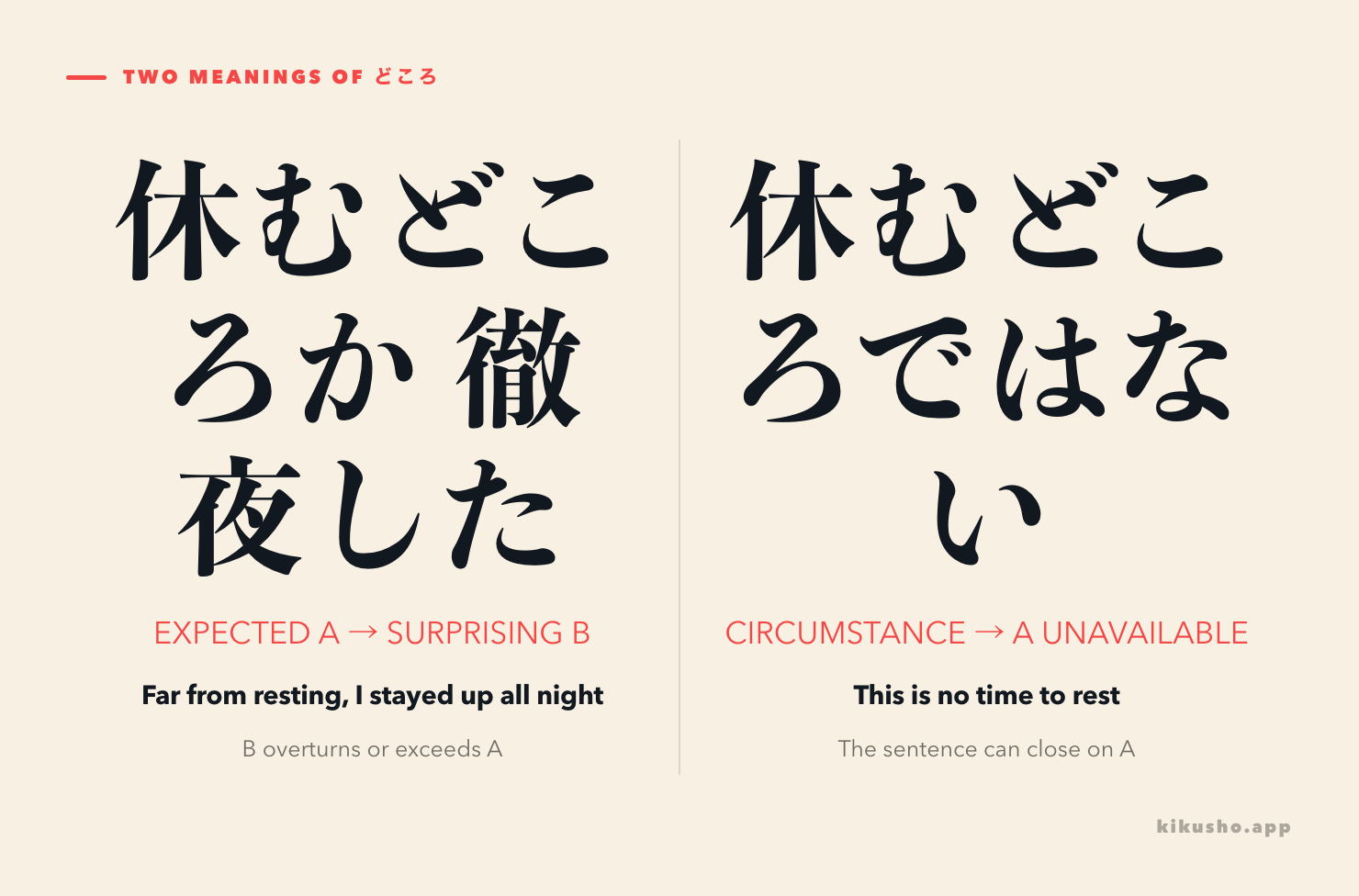
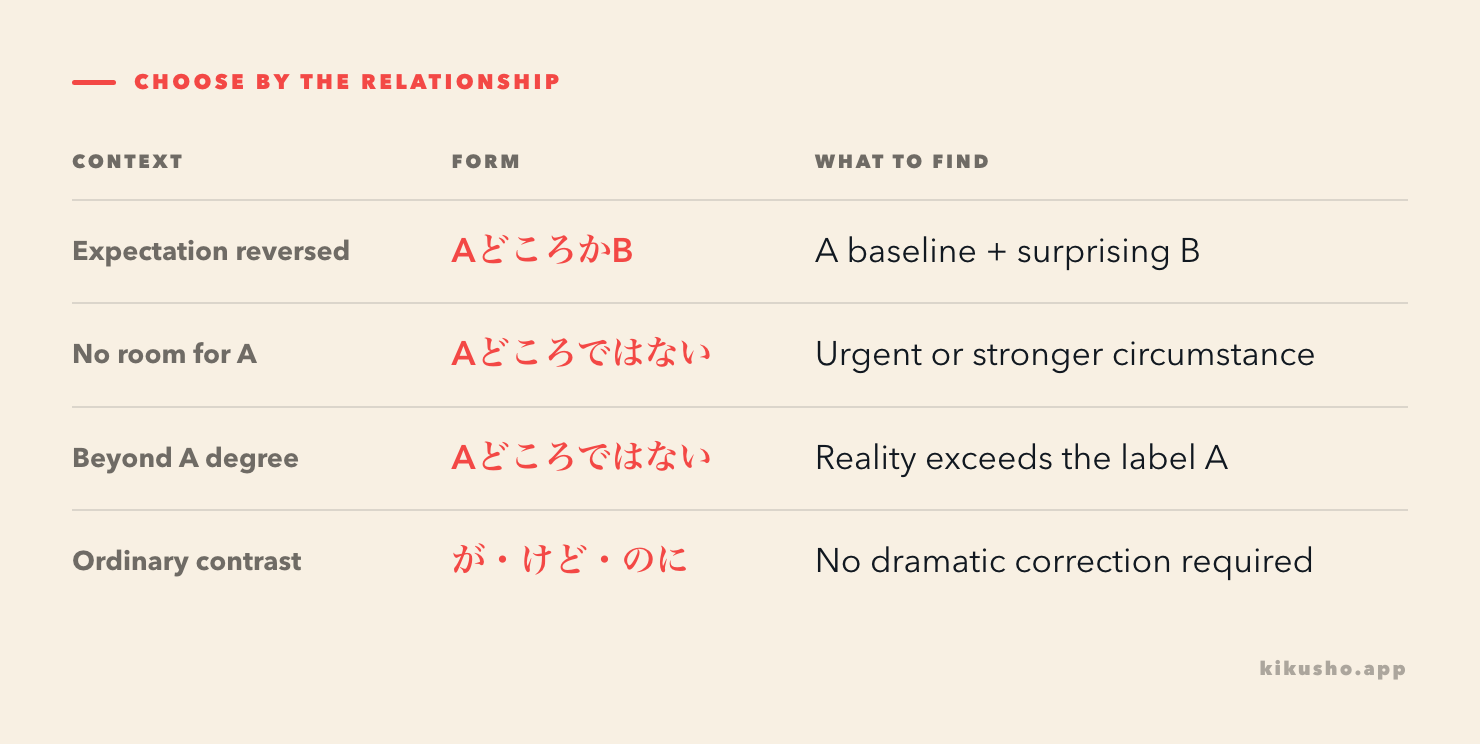
Use AどころかB when B overturns or goes beyond the expectation in A. Use Aどころではない when the current circumstances leave no room for A, or when reality is far beyond the level described by A.
薬を飲んだが、よくなるどころか、熱が上がった。
くすりを のんだが、よくなるどころか、ねつが あがった。
I took medicine, but far from getting better, my fever rose.
高熱があるので、仕事どころではない。
こうねつが あるので、しごとどころではない。
I have a high fever, so I am in no condition to work.
The first sentence needs an actual result after どころか: improvement was plausible, but the fever rose. The second closes on 仕事 because the fever makes work out of the question. This lesson covers inventory items g-a18b9ccdef52, どころか, and g-968b5b96d22e, どころではない.
Ask whether the sentence reveals B or rules out A
Both forms contain どころ, historically related to a “place” or “level,” and both may be translated with “far from.” The useful production test is grammatical: does the speaker reveal a surprising B, or explain why A is unavailable?
| Speaker's move | Form | Dependable shape |
|---|---|---|
| reject or exceed A, then reveal B | AどころかB | 休むどころか、徹夜した |
| say circumstances leave no room for A | Aどころではない | 締め切り前で、休むどころではない |
Translate only after identifying that move. English “far from” can represent either form, but Japanese still distinguishes an A-to-B reversal from a judgement about whether A is possible or appropriate now.
どころか makes B the surprising correction
The core pattern is AどころかB. A creates a baseline: an expected result, a modest category or one end of a scale. B rejects that baseline and supplies something more surprising.
運動を始めたのに、痩せるどころか太ってしまった。
うんどうを はじめたのに、やせるどころか ふとってしまった。
Although I started exercising, far from losing weight, I gained weight.
失敗するどころか、彼女の案が最優秀賞を取った。
しっぱいするどころか、かのじょの あんが さいゆうしゅうしょうを とった。
Far from failing, her proposal won first prize.
The direction is not fixed as good to bad. The first reversal is unwelcome; the second is welcome. What matters is that B is farther from the expected A than an ordinary contrast would suggest. JLPT Sensei illustrates the same expectation-reversal logic, and the Japan Foundation's Marugoto teacher guide notes that B is often negative but does not have to be.
The pattern can also move along a scale:
一週間の休みどころか、一日も休めない。
いっしゅうかんの やすみどころか、いちにちも やすめない。
Far from getting a week off, I cannot take even one day off.
Here B does not state the lexical opposite of A. It presents a much more extreme reality. も, さえ and かえって often make that distance explicit, but they are helpers rather than required parts of どころか.
Common productive attachments are:
| Material before どころか | Example | Reading |
|---|---|---|
| plain verb | 減るどころか増えた | far from decreasing, it increased |
| い-adjective | 安いどころか高かった | far from cheap, it was expensive |
| noun | 初心者どころかプロだ | far from a beginner, they are a professional |
| な-adjective | 静かなどころか、騒がしい | far from quiet, it is noisy |
Reference tables vary in how they display な-adjective attachment. Bunpro shows な-adjective + な, while MLC Japanese Language School groups the pattern under plain forms and warns not to insert copular だ after nouns or な-adjectives. The safe point is firm: do not produce 静かだどころか or 初心者だどころか. Learn complete attested chunks rather than manufacturing the attachment from an English adjective.
どころではない says A does not fit the situation
Aどころではない usually follows a noun or a plain verb. It says that a stronger circumstance consumes the time, attention, ability or emotional space needed for A.
締め切りが今日なので、休憩どころではない。
しめきりが きょうなので、きゅうけいどころではない。
The deadline is today, so this is no time for a break.
家が浸水して、旅行を楽しむどころではなかった。
いえが しんすいして、りょこうを たのしむどころではなかった。
Our house flooded, so we were in no position to enjoy the trip.
Bunpro describes A as out of the question because more important circumstances intervene. The reason is often stated before the form. Without that reason, the listener may know the situation already, or それどころではない can refer back to it:
A: 今夜、映画を見ない?
B: 明日が試験だから、それどころじゃないよ。
A: Want to watch a film tonight?
B: My exam is tomorrow, so I have no time for that.
どころじゃない is the conversational contraction. Past どころではなかった places the lack of scope in the past. どころではなくなった says circumstances changed so that A ceased to be realistic: 急用が入って、買い物どころではなくなった, “An urgent matter came up, so shopping was no longer an option.”
The same “not at A's level” logic can intensify a description:
山頂は寒いどころではなかった。指先の感覚がなくなった。
さんちょうは さむいどころではなかった。ゆびさきの かんかくが なくなった。
“Cold” did not begin to describe the summit. I lost feeling in my fingertips.
This use goes beyond ordinary 寒い rather than ruling out an activity. The following evidence tells you which reading is active: an urgent circumstance usually gives “no room for A,” while a stronger degree gives “far beyond A.”
Compare the two around the same action
休むどころか、二晩続けて徹夜した。
Far from resting, I stayed up all night two nights in a row.
締め切り前で、休むどころではない。
With the deadline approaching, this is no time to rest.
The first has a complete comparison: A is 休む, and B is the more surprising 二晩続けて徹夜した. The second does not promise a B comparison. 締め切り前 supplies the circumstance, and the predicate judges rest as unavailable.
Use this decision sequence:
- If you can label the clauses “expected A / surprising B,” choose どころか.
- If the sentence answers “Why is A impossible or inappropriate now?”, choose どころではない.
- If A is merely contrasted with B, consider が, けど or のに instead. A plain difference is not automatically a dramatic reversal.
Do not confuse these forms with the unvoiced ところ in the ところで and ところが lesson. Sentence-opening ところが is a conjunction that reveals an unexpected result after a previous sentence. どころか attaches directly to A inside its comparison, and どころではない is a predicate. The dakuten changes both the form and the grammar.
Capture both the baseline and the pressure in Kikusho
For どころか, save A and B together. A card containing only 痩せるどころか hides the actual correction and cannot test whether the reversal makes sense. For どころではない, keep the circumstance: 締め切りが今日なので、休憩どころではない is more useful than an isolated translation of the ending.
Add a short note such as “expected improvement → fever rose” or “deadline removes room for a break.” During review, reconstruct that relationship before revealing the answer. This trains the choice the grammar encodes instead of memorising two expressions as the same English phrase.
Practice: identify the relation before the form
Complete all six tasks before opening the answer block.
Question 1 — expectation reversal. Choose the completion.
新しい薬を飲んだが、よくなる__、症状が悪化した。
- ア. どころではなく
- イ. どころか
- ウ. ところで
- エ. だけで
Question 2 — circumstances. The speaker is handling an emergency and has no time for lunch.
緊急の対応が続いて、昼食__。
- ア. どころか夕食だ
- イ. ところがない
- ウ. どころではない
- エ. どころか食べた
Question 3 — attachment. Which sentence correctly means “Far from decreasing, the work increased”?
- ア. 仕事は減るだどころか増えた。
- イ. 仕事は減ったどころではない増えた。
- ウ. 仕事は減るどころか増えた。
- エ. 仕事は減るところか増えた。
Question 4 — composition. Arrange every chunk once: 一日も / 一週間の休みどころか / 休めない.
Question 5 — connected text. Choose B's natural reply.
A: 引っ越しの準備中だけど、今夜ゲームをしない?
B: 明日の朝までに全部箱に入れないと。__。
- ア. それどころじゃないよ
- イ. それどころかゲームだよ
- ウ. ところでゲームだよ
- エ. それだけではないよ
Question 6 — positive reversal. Which sentence presents a welcome result that exceeded the feared outcome?
- ア. 失敗するどころか、最優秀賞を取った。
- イ. 失敗したので、受賞どころではない。
- ウ. 失敗どころではなく、家に帰った。
- エ. 失敗したところで、賞を取った。
Answers and explanations
Answer 1: イ, どころか. Improvement is the expected A; worsening symptoms are the surprising B. ア would need a predicate shaped as よくなるどころではない and would describe improvement as unavailable rather than reveal the comparison cleanly.
Answer 2: ウ, どころではない. The continuing emergency removes the time and attention required for lunch. No second comparative result is needed.
Answer 3: ウ. A plain nonpast verb attaches directly: 減るどころか増えた. ア wrongly inserts だ, イ mixes the predicate with an unmarked B, and エ uses unvoiced ところ.
Answer 4: 一週間の休みどころか、一日も休めない. A week off is the generous baseline; being unable to take even one day is the more extreme B. も strengthens the minimum-scale reading.
Answer 5: ア, それどころじゃないよ. The packing deadline makes gaming out of the question. それ refers back to the invitation, and じゃない is the natural conversational contraction.
Answer 6: ア. The feared A is failure, while winning first prize is the unexpectedly better B. どころか can reverse a negative expectation toward a positive outcome; it is not restricted to bad news.
The level label is a study estimate
JLPT Sensei and MLC teach both forms in N2 materials. Bunpro places どころではない at N2 but どころか at N3. That disagreement is useful: it warns against treating a third-party label as an official boundary. The JLPT does not publish an exhaustive grammar syllabus.
For this lesson, Codex compared both inventory items with the cited sources, then checked the attachments, original examples, translations, register claims, level disagreement and all six exercises. This is an AI review; no human Japanese review is claimed.
Common questions
What is the difference between どころか and どころではない?
AどころかB rejects or exceeds the expectation in A and supplies a more surprising B. Aどころではない says that circumstances leave no time, capacity or appropriate situation for A, or that reality lies far beyond A's level.
Does どころか need a second clause?
Yes. Its comparison depends on B: AどころかB means “far from A, B” or “let alone A, B.” Particles such as も, さえ and かえって often sharpen B, but they are not compulsory.
Is どころじゃない different from どころではない?
どころじゃない is the ordinary conversational contraction of どころではない. The meaning is the same, while ではない suits more neutral or formal prose.
Are どころか and どころではない N2 grammar?
JLPT Sensei and MLC teach both at N2; Bunpro places どころではない at N2 and どころか at N3. These are editorial study estimates because the JLPT does not publish an exhaustive grammar list by level.