On this page
恥ずかしい思いをした means that you went through an embarrassing experience, not that you formed an embarrassing thought. The pattern adjective + 思いをする turns a feeling into the kind of episode someone experienced: fear during an injection, loneliness after a move, or frustration after a narrow loss.
Compare the direct description 発表で恥ずかしかった, “I was embarrassed during the presentation,” with this version:
発表で失敗して、恥ずかしい思いをした。
はっぴょうで しっぱいして、はずかしい おもいを した。
I made a mistake during the presentation and went through an embarrassing experience.
Both describe embarrassment. 思いをした gives the event a boundary and lets the speaker look back on it as something lived through.
Attach the adjective directly to 思い
思い(おもい)is a noun here. The adjective therefore follows the ordinary rules for modifying a noun.
| Modifier | Pattern | Example | Meaning |
|---|---|---|---|
| い-adjective | Aい + 思いをする | 怖い思いをする | have a frightening experience |
| い-adjective | Aい + 思いをした | 悔しい思いをした | experienced frustration |
| な-adjective | Aな + 思いをする | 嫌な思いをする | have an unpleasant experience |
| な-adjective | Aな + 思いをした | 不快な思いをした | had an uncomfortable experience |
Do not remove the final い from an い-adjective: 怖い思い, not 怖な思い. Do not place だ before 思い after a な-adjective: 嫌な思い, not 嫌だ思い.
The phrase can also take a demonstrative instead of repeating the adjective:
二度とあんな思いをしたくない。
にどと あんな おもいを したくない。
I never want to go through anything like that again.
Here あんな思い points back to an experience already known from context. こんな思い points to what the speaker is going through now or treats as psychologically close; そんな思い points toward the listener's account or an experience just mentioned.
JLPT Sensei's assigned reference gives the same い-adjective and な-adjective attachments. Its English gloss “to think; to feel” needs one refinement: in this construction, 思い usually names the quality of an experience rather than a proposition being thought.
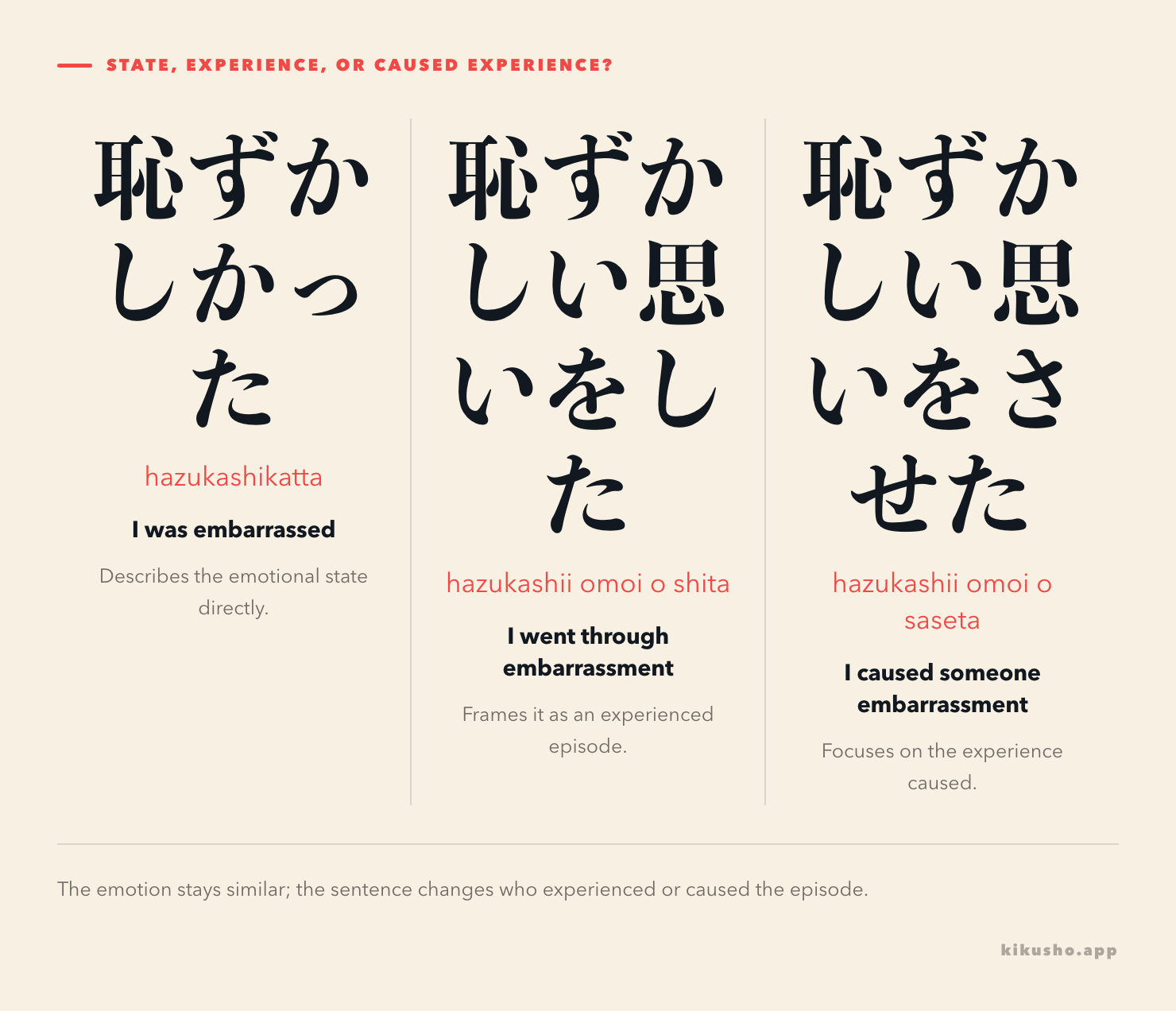
The plain adjective describes a state; 思いをした frames an episode
The difference is not a change in the emotion itself. It is a change in how the speaker presents it.
| Sentence | Focus |
|---|---|
| 面接の間、ずっと緊張していた。 | the continuing state of being nervous |
| 面接で緊張する思いをした。 | unnatural: 緊張する does not work as an adjective here |
| 面接で心細い思いをした。 | the interview as an experience of insecurity |
Use a simple adjective when the state is all you need: 一人で寂しかった, “I was lonely by myself.” Use 寂しい思いをした when you want to present the loneliness as something the person endured or remembers.
知らない町で一人になり、心細い思いをした。
しらない まちで ひとりに なり、こころぼそい おもいを した。
I was left alone in an unfamiliar town and felt painfully insecure.
This does not guarantee that the feeling lasted a long time. A sudden scare can still be 怖い思いをした. The noun 思い packages the event as an experience; duration comes from the situation and any time expression.
Conjugate する to place the experience in time
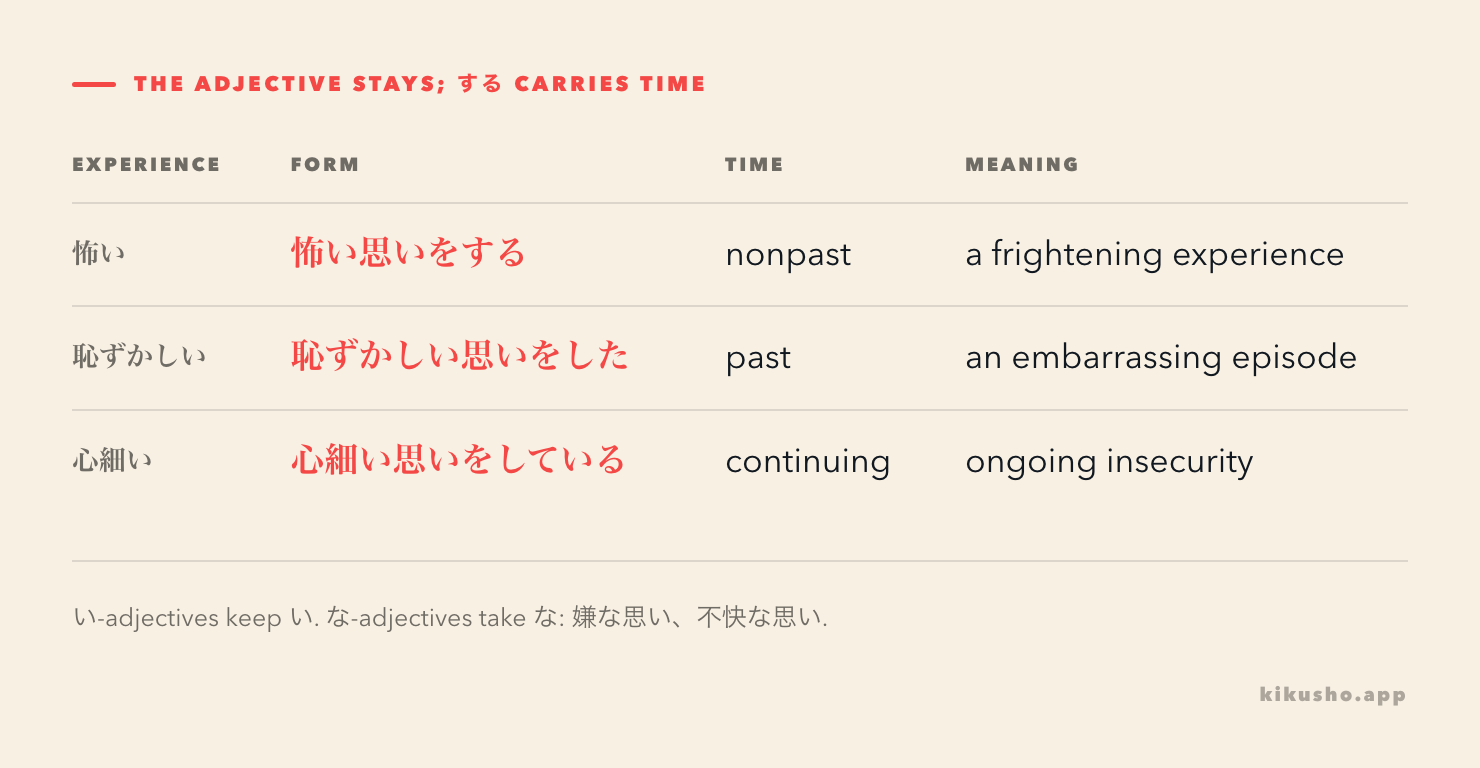
The adjective does not change for tense. Conjugate する at the end.
| Ending | Use | Example |
|---|---|---|
| 思いをする | habitual, general or future experience | 注射のたびに怖い思いをする。 |
| 思いをした | completed experience | 試合に負けて悔しい思いをした。 |
| 思いをしている | continuing or repeated experience | 彼女は慣れない土地で心細い思いをしている。 |
| 思いをしたくない | experience the subject wants to avoid | もう嫌な思いをしたくない。 |
The past is especially common because this pattern suits remembered episodes. The nonpast works naturally for repeated situations, warnings and predictions:
準備をしないと、発表で恥ずかしい思いをするかもしれない。
じゅんびを しないと、はっぴょうで はずかしい おもいを するかもしれない。
Without preparation, you may have an embarrassing experience during the presentation.
思いをしている can describe someone still living through the emotional state. It can also present a repeated situation over a period. Do not translate ている mechanically as an action visibly in progress; the surrounding time frame settles the reading.
と思う and 気がする report a judgment or impression instead
The shared characters in 思い and 思う do not make the constructions interchangeable.
田中さんも来ると思う。
I think Tanaka will come too.
田中さんも来るような気がする。
I have a feeling that Tanaka will come too.
一人で来て、心細い思いをした。
I came alone and had an unsettling, lonely experience.
The clause before と思う is the content of a belief. ような気がする presents that clause as a tentative impression. 心細い思いをした does neither: 心細い modifies the noun 思い, and を marks that experienced feeling as the object of した.
The lesson on ような気がする handles tentative impressions and their attachment. For the broader choice among 思う, 考える and 気がする, see words for thinking. Neither pattern is a substitute for naming a lived episode with 思いをする.
This difference also prevents a common mistranslation. つらい思いをした is not “I thought painfully.” It is “I suffered” or “I went through a painful experience.” The exact English depends on the adjective and situation.
思いをさせる shifts attention to the person affected
When someone causes another person to have the experience, する becomes させる.
子どもに寂しい思いをさせたくない。
こどもに さびしい おもいを させたくない。
I do not want to make the child feel lonely.
長く待たせて、みんなに嫌な思いをさせてしまった。
ながく またせて、みんなに いやな おもいを させてしまった。
By keeping everyone waiting, I caused them an unpleasant experience.
The person affected commonly takes に. 思い remains the object marked by を, while させる is the causative form of する. This is not a passive form: the sentence presents a cause, an experiencer and the experience caused.
The general Japanese causative lesson explains how に and を behave with other verbs. In this fixed-looking phrase, learning person に + adjective + 思いをさせる as one frame keeps the two roles visible.
Unpleasant experiences are common, but positive ones are possible
Many frequent partners describe hardship or discomfort: 嫌な, 窮屈な, つらい, 苦しい, 寂しい, 恥ずかしい and 肩身の狭い. A Ritsumeikan University study of constructions with 思い lists these combinations and analyzes 思いをする as “experience.” It also records the causative 子どもには不自由な思いをさせたくない. The relevant pages are available in the university repository.
Positive adjectives are not excluded:
久しぶりに友人と集まり、楽しい思いをした。
ひさしぶりに ゆうじんと あつまり、たのしい おもいを した。
I got together with friends after a long time and had a pleasant experience.
Kotobank's dictionary material treats 思いをする as an experience sense of 思い and gives both つらい思いをする and 楽しい思いをする. This supports a better rule than “the pattern is negative”: painful experiences are highly conventional, but the adjective and context decide the evaluation.
Not every adjective works merely because its grammar is correct. The modifier should describe how the experience felt to someone. 頭がいい思いをする does not mean “experience being intelligent,” because 頭がいい describes a person's ability rather than the felt quality of an episode. Use 自分の答えが正しくて、うれしかった if the intended experience is happiness about a correct answer.
The N1 label describes a study list, not the register
JLPT Sensei and JapaneseTest4You place 思いをする at N1. The Japanese-teacher site Edewakaru labels it outside its JLPT grammar list and notes that it is common in conversation. The disagreement is plausible because the construction uses elementary pieces while its natural adjective combinations and experience framing require more lexical judgment.
The JLPT does not publish an exhaustive official grammar syllabus. Treat N1 as the assigned study-list placement, not as a claim that the phrase is rare, formal or restricted to an exam. 嫌な思いをした is ordinary Japanese.
When you save this pattern in Kikusho, keep the event with it. 恥ずかしい思いをした is clearer with the reason 発表で失敗して; 怖い思いをした is easier to retrieve with the moment that caused the fear. The card then tests the connection between episode and emotion rather than a floating translation of 思い.
Practice: choose the experience, tense and experiencer
Question 1 · attach an い-adjective
Complete: 一人で夜道を歩いて、怖( )思いをした。
- A. く
- B. い
- C. な
- D. だ
The next item changes the adjective class while keeping 思い as the noun being modified.
Question 2 · attach a な-adjective
Complete: 店員の失礼な態度で、不快( )思いをした。
- A. の
- B. だ
- C. な
- D. に
Question 3 · report a completed experience
You made a mistake during yesterday's presentation and want to frame the embarrassment as an episode you went through. Which sentence best fits?
- A. 発表で失敗して、恥ずかしいと思いをする。
- B. 発表で失敗して、恥ずかしい思いをした。
- C. 発表で失敗して、恥ずかしい気がした。
- D. 発表で失敗して、恥ずかしいだと思った。
Question 4 · distinguish a belief from an experience
Which sentence means “I think Tanaka will come too”?
- A. 田中さんも来ると思う。
- B. 田中さんも来る思いをする。
- C. 田中さんも来る嫌な思いをする。
- D. 田中さんも来る思いをさせる。
Question 5 · identify the experiencer
In 子どもに寂しい思いをさせたくない, who would experience the loneliness?
- A. The speaker
- B. The child
- C. An unnamed teacher
- D. 思い itself
Question 6 · find the unsuitable modifier
Which combination does not naturally describe the felt quality of an experience?
- A. つらい思いをする
- B. 嫌な思いをする
- C. 楽しい思いをする
- D. 頭がいい思いをする
Question 7 · build the avoidance sentence
Arrange the pieces to say “I never want to go through anything like that again.”
したくない / 二度と / あんな / 思いを
Answers and explanations
Answer 1
B. い. 怖い is an い-adjective and keeps い when it modifies the noun 思い: 怖い思い.
Answer 2
C. な. 不快 is a な-adjective, so the noun-modifying form is 不快な思い. だ cannot stand directly before the noun.
Answer 3
B. 発表で失敗して、恥ずかしい思いをした. 恥ずかしい modifies 思い, and past した presents yesterday's embarrassment as a completed experience. A inserts 思う where the noun 思い belongs and leaves the event nonpast.
Answer 4
A. 田中さんも来ると思う. The clause 田中さんも来る is the content of the speaker's belief. 思いをする requires an adjective or another expression that describes the quality of an experience.
Answer 5
B. The child. 子ども takes に as the person affected by the causative させる. The speaker wants to avoid causing the child a lonely experience.
Answer 6
D. 頭がいい思いをする. 頭がいい describes intellectual ability, not how an episode felt. The other three adjectives can naturally evaluate an experience.
Answer 7
二度とあんな思いをしたくない。 二度と pairs with the negative したくない, while あんな思い points back to the kind of experience the speaker wants to avoid.
Read 思い as experience when をする follows it
The kanji may tempt you toward “thought,” but the particles and modifier settle the parse. When an emotional adjective modifies 思い and をする follows, first ask what kind of experience the person had. That reading turns 悔しい思いをした from an abstract thought into the remembered frustration the sentence is describing.
Common questions
What does 思いをする mean after an adjective?
Adjective + 思いをする means to have or go through an experience that feels that way. 恥ずかしい思いをした presents embarrassment as an episode the person experienced, rather than merely saying 恥ずかしかった.
How do adjectives attach to 思いをする?
An い-adjective keeps い, as in 怖い思いをする. A な-adjective takes な, as in 嫌な思いをする or 不快な思いをする.
Can 思いをする describe a positive experience?
Yes. 楽しい思いをする and いい思いをする are possible, although the pattern is especially common with unpleasant, painful or embarrassing experiences.
What is the difference between 思いをする and 思いをさせる?
思いをする presents what the subject experiences. Person に plus 思いをさせる presents someone as causing that person to have the experience, as in 子どもに寂しい思いをさせたくない.