On this page
Repeat the same noun on both sides of という to mean every relevant N, without a single exception. 棚という棚を調べた does not name a kind of shelf; it paints the search moving through every shelf in the place.
引っ越しの前に、棚という棚を開けて忘れ物がないか確認した。
ひっこしのまえに、たなというたなをあけてわすれものがないかかくにんした。
Before moving, I opened every single shelf and checked that nothing had been left behind.
This is the N1 repeated-noun construction NというN (g-9cf107c7e7a6). It is strongly emphatic. The set comes from the situation, and the predicate applies across that set with no exceptions.
The same noun appears twice, then the sentence particle follows
The basic shape is compact:
| Pattern | Role in the sentence | Example |
|---|---|---|
| NというN + を | every N is the object | 隙間という隙間をのぞいた |
| NというN + が | every N is the subject | 道という道が混んでいた |
| NというN + に | every N is the destination or target | 店という店に問い合わせた |
| NというN + で | every N is the setting | 会議という会議で同じ問題が出た |
The role particle comes after the second noun because the whole sequence is one noun phrase. Do not put を, が or に after the first noun.
迷子の猫を探して、家の中の隙間という隙間をのぞいた。
まいごのねこをさがして、いえのなかのすきまというすきまをのぞいた。
Looking for the lost cat, I peered into every last gap in the house.
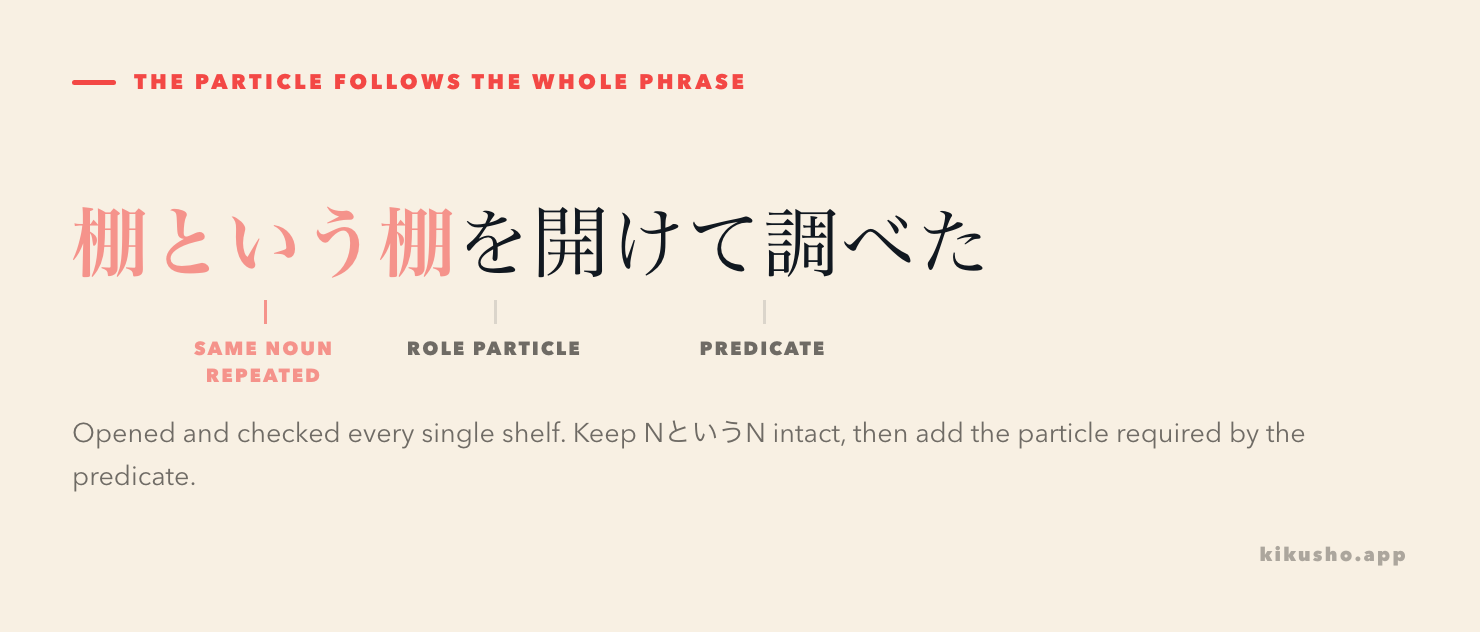
The first and second nouns normally match. That visible repetition is the quickest way to separate this construction from an ordinary name such as 「こもれび」という店, “a shop called Komorebi,” where the two sides do different jobs.
The context supplies the set that has no exceptions
NというN does not make a claim about every N in the universe. It exhausts the set made relevant by the surrounding scene.
連休の初日は、駅へ向かう道という道が車で混んでいた。
れんきゅうのしょにちは、えきへむかうみちというみちがくるまでこんでいた。
On the first day of the holiday, every road leading to the station was jammed with cars.
The sentence concerns the roads that lead to that station in that situation. It does not claim that every road everywhere was congested. A modifier can make the boundary explicit, as 駅へ向かう does here, or the previous sentence can establish it.
The nouns are often things that can be surveyed across a place: rooms, roads, windows, trees, shops, shelves or gaps. Event nouns also work when the context supplies a series of instances:
その写真家は、地域の祭りという祭りに足を運んで記録を残した。
そのしゃしんかは、ちいきのまつりというまつりにあしをはこんできろくをのこした。
The photographer went to every single festival in the area and documented it.
The construction needs a plausible set to range over. Repeating an arbitrary abstract noun does not automatically produce natural Japanese. Ask whether the listener can picture multiple relevant members, then whether the predicate can hold for each one.
The repetition makes neutral totality vivid
Compare three ways to describe a complete search:
| Sentence | What it foregrounds |
|---|---|
| すべての棚を調べた。 | a neutral statement that all the shelves were checked |
| どの棚も調べた。 | no shelf in the relevant choice set was omitted |
| 棚という棚を調べた。 | an emphatic sweep through every single shelf |
The facts can be the same. The repeated noun adds rhetoric: it makes the reader feel the search touching one member after another. This is why the construction is at home in narrative, description and forceful statements. In an inventory report or a plain procedural note, すべての棚 will often be the quieter choice.
強風のあと、公園の木という木に折れた枝が引っかかっていた。
きょうふうのあと、こうえんのきというきにおれたえだがひっかかっていた。
After the strong wind, broken branches were caught in every tree in the park.
Here 木という木 turns a broad scene into a row of individually affected trees. It is stronger than simply reporting that there were branches in all the trees. That expressive force is useful, but it also makes the form too marked for every neutral “all.”
Ordinary という names or quotes; repeated NというN exhausts
The spelling という appears in several constructions. Check what stands on each side before assigning a meaning.
| Form | Relationship | Meaning |
|---|---|---|
| 「こもれび」という店 | name + category | a shop called Komorebi |
| 閉店するという知らせ | clause + content noun | news that the shop will close |
| 店という店 | same noun repeated | every single shop |
| 今日という今日は | fixed focal repetition | today of all days; this very day |
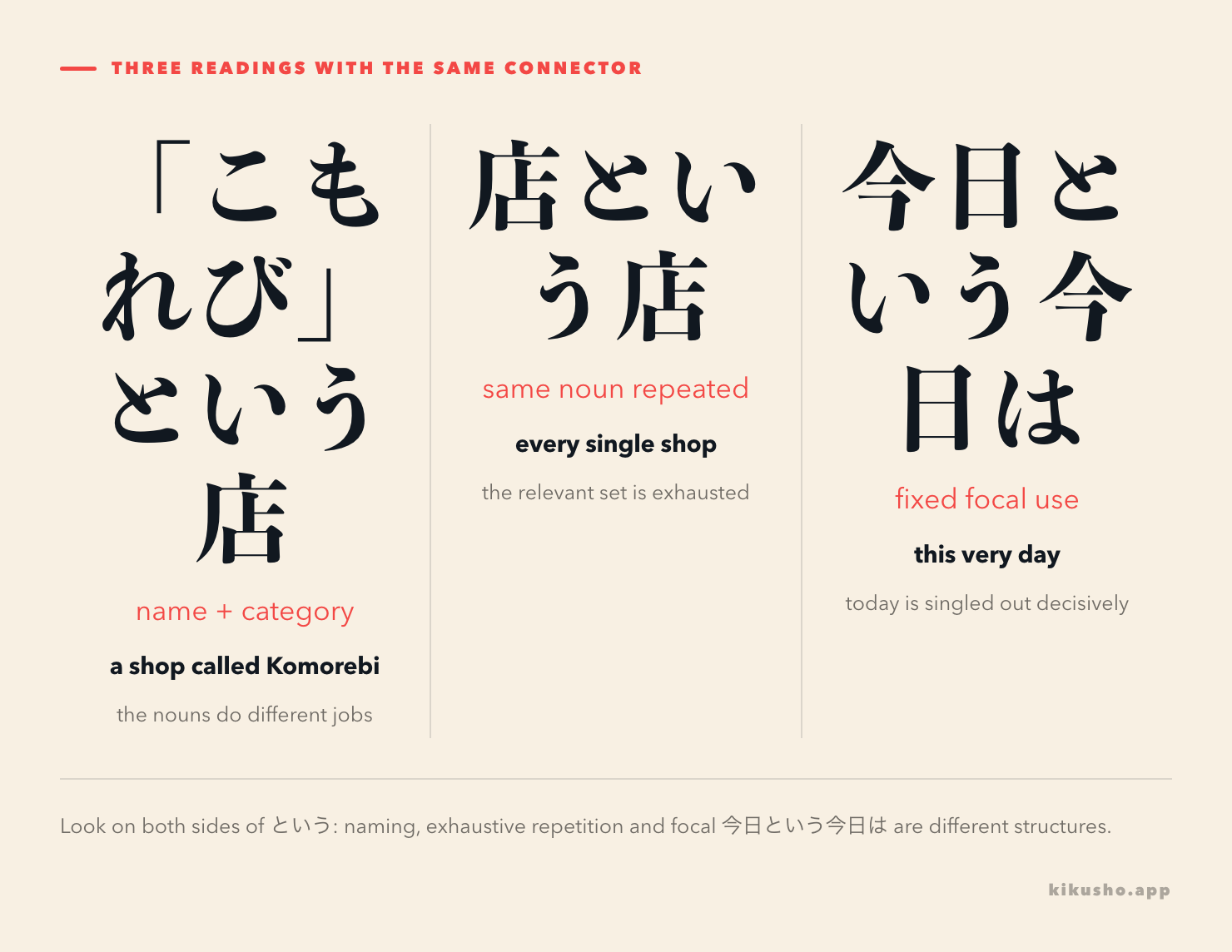
In 「こもれび」という店, こもれび identifies the shop and 店 gives its category. In 店という店, 店 appears twice and the scene supplies several shops. The foundation lesson on naming and clause content develops the first two rows; this lesson concerns the repeated form in the third row.
The related といった also points from examples to a category: 机や棚といった家具, “furniture such as desks and shelves.” It does not exhaust the category. The といった lesson shows why representative examples and “every single one” lead in opposite directions.
今日という今日は singles out one day
今日という今日は looks like the repeated-noun pattern, but it does not distribute a predicate across multiple todays. It is an idiomatic focal expression: today of all days or this very day. It often carries resolve, exasperation or a sense that the present occasion is decisive.
今日という今日は、先延ばしにしてきた話を最後までしよう。
きょうというきょうは、さきのばしにしてきたはなしをさいごまでしよう。
Today, once and for all, let us finish the conversation we have kept putting off.
今度という今度は、同じ間違いを繰り返さない。
こんどというこんどは、おなじまちがいをくりかえさない。
This time, for sure, I will not repeat the same mistake.
Treat these as a small conventional extension, not as proof that any time noun can be repeated freely. The particle は is part of the common focal frame, and the following sentence normally tells you what is finally different, settled or intolerable on this occasion.
というもの belongs to a different structure
Do not merge repeated NというN with Nというもの just because both can sound emphatic.
棚という棚を調べた。
I checked every single shelf.
三年間というもの、毎朝その記録をつけた。
For the entire three years, I kept that record every morning.
The first sentence distributes the search across the members of a set. In the second, というもの frames a span as one sustained whole. The というもの and というわけだ lesson covers that duration pattern and its limits.
This distinction also prevents a common reading mistake. When the word after という is もの, do not assume that an earlier noun has merely been repeated. Find the full construction and ask whether the text is ranging over members, naming something, packaging content or framing a continuous span.
Practice: find the set, the particle and the force
Work through the full set before revealing the explanations.
Question 1 — grammar choice. The speaker searched every corner of the room for a missing earring.
なくしたイヤリングを探して、部屋の隅( )を調べた。
- ア. という隅
- イ. という隅に
- ウ. という隅を
- エ. といった隅を
Question 2 — particle position. Which sentence correctly makes every road the subject of 混んでいた?
- ア. 道がという道、混んでいた。
- イ. 道という道が混んでいた。
- ウ. 道をという道が混んでいた。
- エ. 道というが道は混んでいた。
Question 3 — interpretation. What does 町の店という店に問い合わせた mean in context?
- ア. I asked a shop called Machi.
- イ. I asked about the meaning of the word 店.
- ウ. I contacted every relevant shop in town.
- エ. I contacted shops such as the ones in town.
Question 4 — sentence composition. Put the four pieces in natural order to say “We opened every single window in the building.”
- 開けた
- 窓という
- 建物の
- 窓を
Question 5 — nuance. Which sentence most strongly evokes checking the shelves one by one with none omitted?
- ア. 棚がある。
- イ. 棚を一つ調べた。
- ウ. すべての棚を調べた。
- エ. 棚という棚を調べた。
Question 6 — boundary. Choose the correct interpretation of 「朝風」という雑誌.
- ア. every single magazine
- イ. a magazine called Asakaze
- ウ. magazines such as Asakaze
- エ. this very magazine, once and for all
Question 7 — connected text. Choose the only pair that matches both scenes.
台風のあと、村の道( )倒れた枝でふさがれていた。住民たちは、今日( )全部片づけようと作業を始めた。
- ア. という道が/という今日は
- イ. という道を/という今日を
- ウ. といった道が/という今日は
- エ. という道が/という今日が
Answers and explanations
Answer 1. ウ, という隅を. The repeated noun gives 隅という隅, every single corner, and を marks that whole phrase as the object of 調べた. ア lacks the object particle. イ changes the role to a location or target, and といった would introduce representative examples rather than exhaust all corners.
Answer 2. イ, 道という道が混んでいた. The two nouns remain adjacent around という, then が marks the complete phrase as the subject of 混んでいた. The other choices insert a particle inside the repeated form or break its order.
Answer 3. ウ. 町の店という店 ranges over every shop made relevant by the town context, and に marks each as the target of the inquiry. A naming phrase would use a name before という and a category after it; といった would be the cue for examples such as particular shops.
Answer 4. 建物の窓という窓を開けた. 建物の bounds the relevant set. 窓 repeats on both sides of という, and を follows the second 窓 because the full phrase is the object of 開けた.
Answer 5. エ, 棚という棚を調べた. ウ also states complete coverage, but it does so neutrally. The repeated-noun construction adds the emphatic sense of going through every single member with no exception. ア and イ do not describe a complete search.
Answer 6. イ, a magazine called Asakaze. 朝風 is a proper name and 雑誌 is its category, so the nouns are not identical and no set is being exhausted. The quotation marks reinforce the naming reading but are not what creates it.
Answer 7. ア, という道が/という今日は. 道という道が makes every road the subject of ふさがれていた. 今日という今日は is the conventional focal expression “today, once and for all,” and は introduces what the residents are determined to accomplish. The other choices use the wrong particle or replace exhaustive repetition with representative といった.
This page treats the exhaustive use as N1 grammar
JLPT Sensei and Bunpro both place repeated NというN at N1 and describe its all-without-exception force. 日本語教師のまる得 independently separates the exhaustive pattern from the conventional focal forms 今日という今日は and 今度という今度は. J-nihongo likewise treats identical-noun repetition as distinct from general naming or quotation.
Some indexes surface という at N3 or N4 because the ordinary naming and content constructions are learned earlier. That is a spelling match across different uses, not a disagreement that this exact exhaustive pattern should be taught as basic naming grammar. The exam authority gives broad proficiency descriptions rather than a definitive form-by-form syllabus, so N1 remains a study-guide placement.
OpenAI Codex completed the AI language review for this page. It checked the identical-noun formation, the role particles, context-bounded interpretation, emphatic register, the 今日という今日は extension, all Japanese examples and readings, and every question-to-answer mapping. No human review is claimed.
Common questions
What does NというN mean?
Repeating the same noun on both sides of という presents every relevant member of that set without exception. 棚という棚を調べた means that every single shelf in the relevant place was checked.
Where does the particle go in NというN?
Put the particle required by the main predicate after the second noun: 棚という棚を調べた, 道という道が混んでいた, or 店という店に聞いた. The full repeated-noun phrase fills one grammatical role.
How is NというN different from すべてのN?
Both can cover the complete relevant set. すべてのN is the neutral way to state totality; NというN is more rhetorical and makes the reader picture the members one by one, with no exception left over.
Does 今日という今日は mean every day?
No. 今日という今日は is an idiomatic focal use meaning this very day or today of all days. It often introduces a firm decision or emotional reaction about today specifically.