On this page
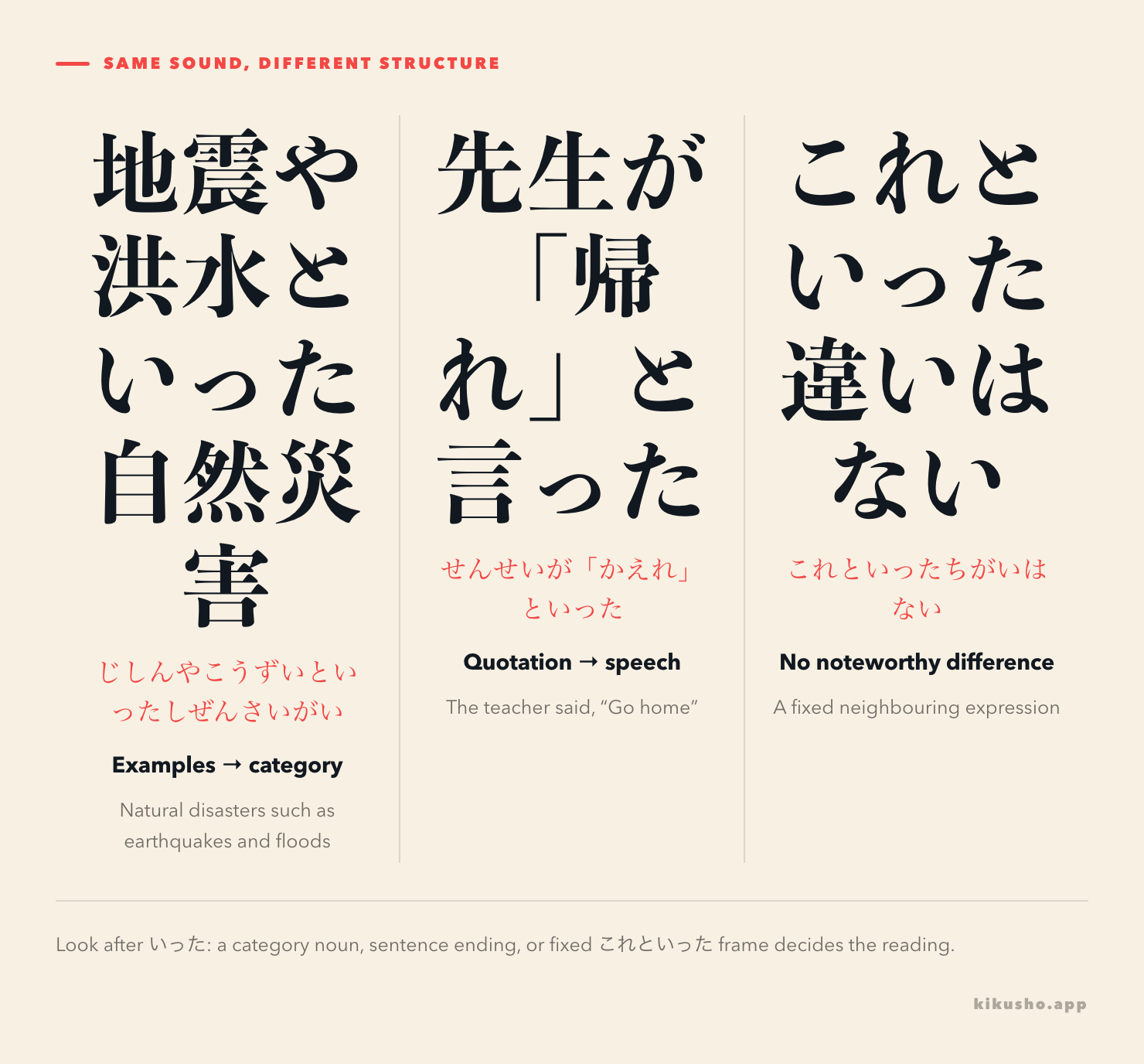
A notice asks visitors to prepare for 地震や洪水といった自然災害. Earthquakes and floods are the examples; natural disasters are the category. といった builds that example-to-category relationship and leaves room for other members that were not named.
Read the phrase from right to left when it first appears difficult: find the category noun after といった, then return to the examples before it.
といった presents members of a broader class
The core shape is:
example noun + といった + category noun
example A や example B + といった + category noun
地震や洪水といった自然災害に備える必要があります。
じしんやこうずいといったしぜんさいがいにそなえるひつようがあります。
We need to prepare for natural disasters such as earthquakes and floods.
The noun after といった controls the phrase. 自然災害 is what the sentence discusses; 地震 and 洪水 make that class concrete. The examples are representative rather than exhaustive. Fire, typhoons and other disasters are not excluded simply because the sentence did not name them.
JLPT Sensei's といった reference labels the pattern N2, gives noun attachment and describes it as a way to list examples. Bunpro's independent N2 account states the fuller frame noun + といった + noun and identifies the second noun as the general group.
Both sources place this use at N2. That is a shared study-guide estimate, not an official inventory boundary: the JLPT FAQ does not publish an exhaustive grammar syllabus.
The category noun comes immediately after といった
The structure is a noun phrase, not a finished sentence followed by an aside:
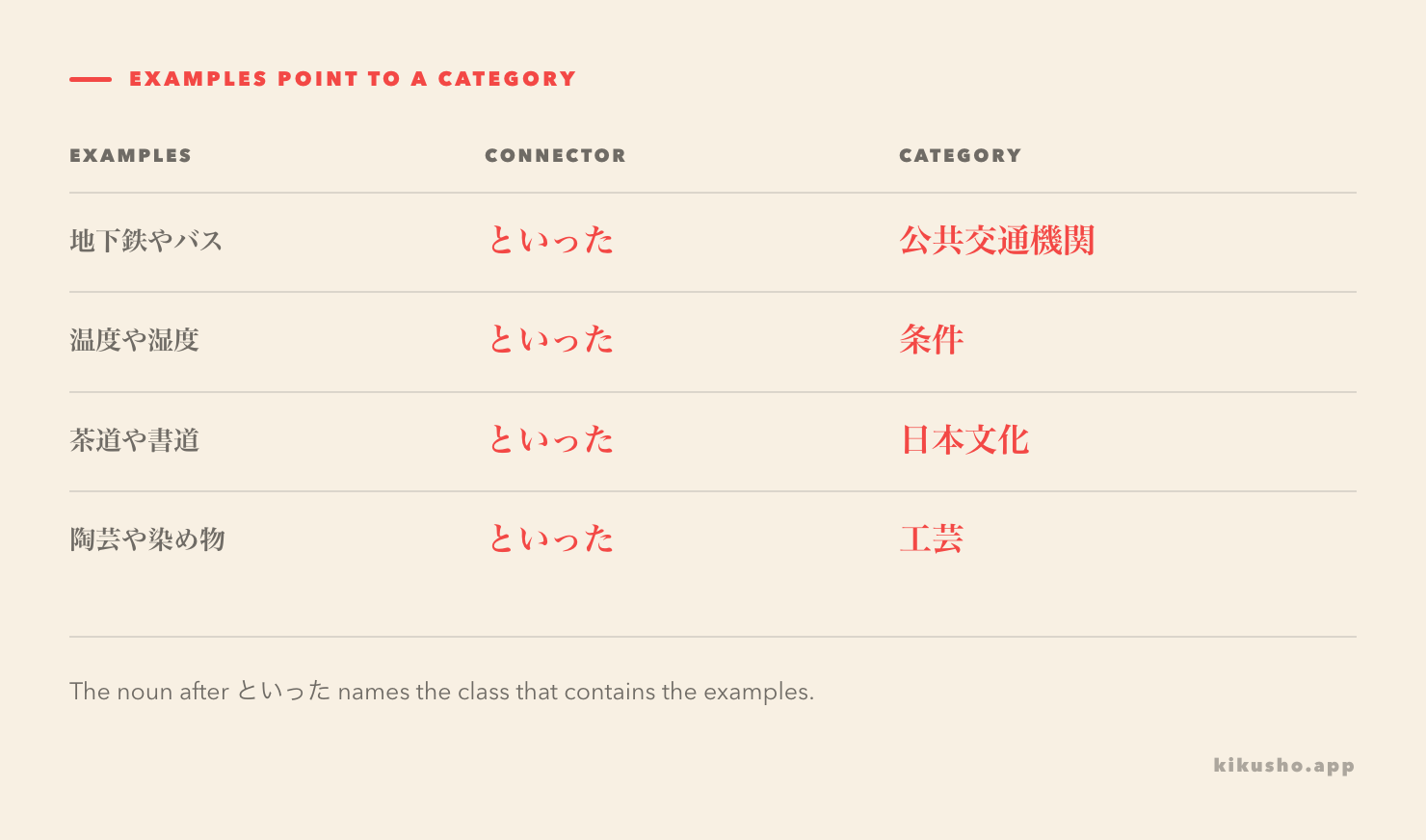
| Examples before といった | Category after it | Complete phrase |
|---|---|---|
| 地下鉄やバス | 公共交通機関 | 地下鉄やバスといった公共交通機関 |
| 温度や湿度 | 条件 | 温度や湿度といった条件 |
| 茶道や書道 | 日本文化 | 茶道や書道といった日本文化 |
| 陶芸や染め物 | 工芸 | 陶芸や染め物といった工芸 |
移動には、地下鉄やバスといった公共交通機関を利用してください。
いどうには、ちかてつやバスといったこうきょうこうつうきかんをりようしてください。
For travel, please use public transport such as the subway or bus.
The particle that follows the whole noun phrase belongs to the category noun. Here 公共交通機関を is the object of 利用する. Do not place を after each example. Likewise, 温度や湿度といった条件を記録した marks the complete set of conditions as the object.
Multiple examples often use や, because や itself presents an open list. とか can also connect examples:
ピアノとかギターといった楽器を習いたい。
ピアノとかギターといったがっきをならいたい。
I want to learn an instrument such as piano or guitar.
Commas can separate examples in compact written lists, but や makes the open relationship easiest to see. Nihongo Kyoshi Net gives N + といった and notes that the expression often appears with ~や~.
One example can represent the larger category
Two examples are common, but plurality is not a grammatical requirement:
読書といった静かな趣味なら、家でも続けられます。
どくしょといったしずかなしゅみなら、いえでもつづけられます。
A quiet hobby such as reading can be continued at home too.
The sentence offers reading as one recognizable member of 静かな趣味. Tanosuke's teacher-facing explanation explicitly notes that a single representative example can indicate the general content, although や and とか are frequent with longer lists.
This open-class meaning matters. Compare the following two phrases:
そばといった麺類
noodles such as soba「雪国」という小説
a novel called Snow Country
The first moves upward from one example to a category. The second supplies a name. The dedicated という lesson also covers stated content before nouns; neither naming nor reported content automatically creates an open set of examples.
といった differs from a literal report of speech
You may recognize いった as the plain past of 言う, “to say”. The grammatical pattern grew from that verb, but sentence structure tells you whether someone actually spoke.
先生が「今日はここまで」と言った。
せんせいが「きょうはここまで」といった。
The teacher said, “That is all for today.”
Here 先生が is the speaker, the quotation is the content, and 言った is the sentence's final verb. By contrast:
温度や湿度といった条件を確認した。
おんどやしつどといったじょうけんをかくにんした。
I checked conditions such as temperature and humidity.
Nobody needs to have said “temperature and humidity”. といった sits inside the noun phrase and 条件 follows it directly. The final verb is 確認した.
といった and など organize the sentence differently
Both can translate as “such as”. など is more flexible:
| Form | Can a category noun follow? | Can it stand without one? |
|---|---|---|
| AやBといったC | Yes; C is required in this pattern | No |
| AやBなどのC | Yes | No, because の points to C |
| AやBなどを… | No category noun is needed | Yes |
Compare:
机や椅子といった家具を新しくした。
I replaced furniture such as desks and chairs.机や椅子などを新しくした。
I replaced desks, chairs and similar things.
The first explicitly classifies the examples as 家具. The second leaves the larger group implicit. The lesson on とか, なんて, なんか and など compares the stance and placement of those example markers; the examples-and-alternatives lesson shows where など and とか can stand without a following category.
これといった is a fixed neighbouring expression
In これといった理由はない, the phrase does not mean “reasons such as this”. It means there is no particular or noteworthy reason:
これといった理由もないので、予定は変えません。
これといったりゆうもないので、よていはかえません。
There is no particular reason, so I will not change the plan.
This expression frequently appears with negation, questions or other contexts that search for a noteworthy candidate. Bunpro includes これといった理由もない among its examples. Learn it as a compact neighbour rather than forcing it into the ordinary example-plus-category diagram.
Store the hierarchy with the phrase
If you save only といった = such as, the direction disappears. Keep the examples and their category together. Kikusho can turn a sentence you photograph or paste into an editable card with its reading, meaning and example, then return it through offline review. When the card comes back, hide the category noun and supply it from the examples.
That retrieval is more useful than translating the connector: you are rebuilding the classification the writer chose.
Practice: find the examples and their category
Work through the six items before revealing the checks.
Item 1
Which sentence correctly means “We discussed environmental problems such as air pollution and water pollution”?
A. 大気汚染や水質汚染といった環境問題について話し合った。
B. 大気汚染といったや水質汚染の環境問題について話し合った。
C. 環境問題といった大気汚染や水質汚染について話し合った。
D. 大気汚染や水質汚染をといった環境問題について話し合った。
Item 2
Put these chunks in a natural order.
- ア. を記録した
- イ. 条件
- ウ. 温度や湿度
- エ. といった
Item 3
Read the sentence and identify the examples, the category noun and the particle attached to the complete noun phrase.
この講座では、茶道や書道といった日本文化を紹介します。
Item 4
Write one sentence meaning “I often drink beverages such as coffee and tea”, using コーヒー, 紅茶, 飲み物 and といった.
Item 5
Choose the form that names a particular novel rather than giving an example of a broader category.
「雪国」__小説を読んだ。
A. といった
B. という
C. などを
D. とか
Item 6
In これといった違いはありません, what does これといった contribute?
A. It gives “this” as one example of differences.
B. It reports that someone said there was a difference.
C. It means there is no particular or noteworthy difference.
D. It marks 違い as a quotation.
Your final check is the noun immediately to the right of といった.
Answers and explanations
Explanation 1
A. 大気汚染や水質汚染といった環境問題について話し合った。 大気汚染 and 水質汚染 are examples; 環境問題 is their broader category. B splits the list marker incorrectly, C reverses the hierarchy, and D puts を inside the example phrase instead of after the complete noun phrase.
Explanation 2
ウ → エ → イ → ア: 温度や湿度といった条件を記録した。 The complete sentence means “I recorded conditions such as temperature and humidity.” Examples come first, といった points forward to 条件, and を marks that whole noun phrase as the object of 記録した.
Explanation 3
The examples are 茶道 and 書道. Their category is 日本文化. The particle を follows that category and marks the full phrase 茶道や書道といった日本文化 as the object of 紹介します.
Explanation 4
One model answer is コーヒーや紅茶といった飲み物をよく飲みます。 It means “I often drink beverages such as coffee and tea.” や leaves the example list open, といった introduces the broader category 飲み物, and を marks it as the object.
Explanation 5
B. 「雪国」という小説を読んだ。 This means “I read a novel called Snow Country.” The quoted title names one specific novel. といった would normally need the preceding material to function as a representative example of the following category, which is not the intended relationship here.
Explanation 6
C. It means there is no particular or noteworthy difference. これといった違いはありません is a fixed neighbouring expression meaning “There is no notable difference.” It is not an ordinary list of examples and does not report anyone's words.
Common questions
What does といった mean in Japanese?
といった means “such as” or “like” when it places one or more representative examples before a broader category noun. In 地震や洪水といった自然災害, earthquakes and floods are examples of natural disasters.
What is the structure of といった?
The central structure is example noun or nouns + といった + category noun. Multiple examples are often joined with や or とか, and the category noun must follow といった directly in this use.
What is the difference between といった and という?
といった presents representative members of a broader class. という can name or identify the noun that follows, as in 「雪国」という小説, “a novel called Snow Country”, without implying a list of other examples.
Can といった follow only one example?
Yes. Several examples are common, but one representative example can introduce a larger class, as in 読書といった静かな趣味, “a quiet hobby such as reading”.