On this page
Use ~て(は)かなわない when a situation is so unpleasant or troublesome that it feels impossible to put up with: この部屋は蒸し暑くてかなわない, “This room is unbearably hot and humid.” The ending voices a complaint about the burden; it is not a general intensifier for every strong feeling.
この部屋は蒸し暑くてかなわない。
この へやは むしあつくて かなわない。
This room is unbearably hot and humid.
The speaker is not merely measuring the temperature. かなわない says the heat is causing difficulty and has reached the speaker's limit.
Connect a troublesome state to かなわない
The word before かなわない takes its connective form. Optional は can follow that connector.
| Source | Without は | With は |
|---|---|---|
| Vて | 待たされてかなわない | 待たされてはかなわない |
| い-adjective くて | 暑くてかなわない | 暑くてはかなわない |
| な-adjective で | 不便でかなわない | 不便ではかなわない |
| noun + では | — | 毎日残業ではかなわない |
For an い-adjective, replace final い with くて: 暑い → 暑くて. A な-adjective uses で: 不便だ → 不便で. A verb uses its ordinary て-form, and a passive verb is especially common when someone else's action imposes the burden. A noun normally enters this pattern as Nではかなわない, rather than by dropping は mechanically.
隣の工事がうるさくてかなわない。
となりの こうじが うるさくて かなわない。
The construction work next door is unbearably noisy.
駅から遠くて、毎日の通勤が不便でかなわない。
えきから とおくて、まいにちの つうきんが ふべんで かなわない。
It is far from the station, and the daily commute is terribly inconvenient.
Kotobank's Shogakukan dictionary material explicitly records adjective or verb forms followed by て(は)/で(は)かなわない for a state or act that cannot be endured. Japanesetest4you independently gives the same verb, い-adjective and な-adjective connections.
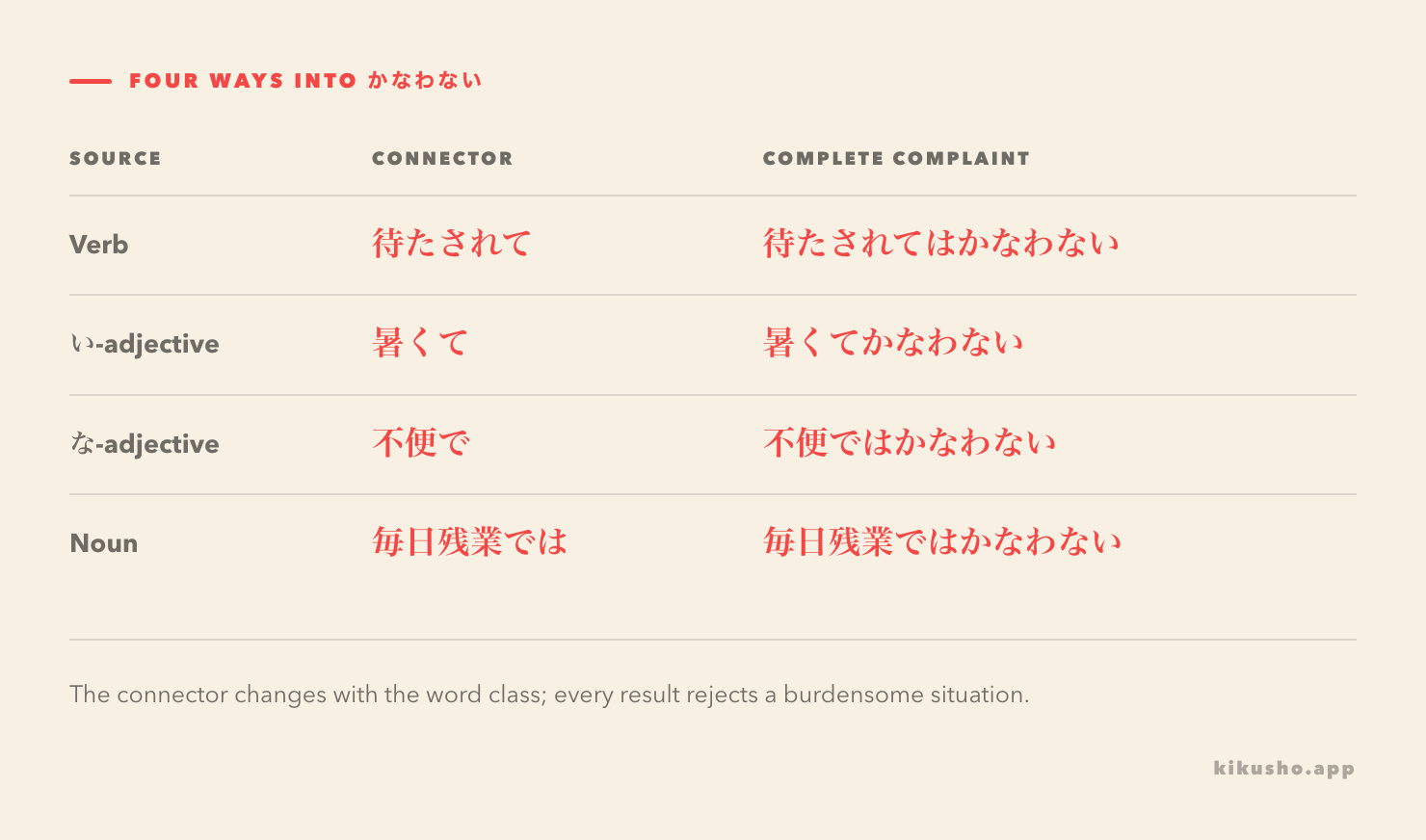
Without は, the sentence directly reports the burden
The shorter ~てかなわない readily evaluates an actual state affecting the speaker now.
朝から頭が痛くてかなわない。
あさから あたまが いたくて かなわない。
My head has been hurting terribly since this morning.
この椅子は座りにくくてかなわない。
この いすは すわりにくくて かなわない。
This chair is so uncomfortable to sit in that I cannot stand it.
The source can be physical, practical or psychological. What unifies the examples is the speaker's negative evaluation: the headache, chair or inconvenience is too much to tolerate. The construction does not require an external cause in every sentence, although outside irritants such as noise, heat and other people's behavior are very common.
The ending can move into the past:
昨日の会議は長すぎてかなわなかった。
きのうの かいぎは ながすぎて かなわなかった。
Yesterday's meeting was unbearably long.
Tense belongs to かなわない → かなわなかった. The adjective connector remains 長すぎて.
は makes the rejected circumstance stand out
In ~てはかなわない, は presents the preceding state or event as the circumstance the speaker finds unacceptable. This is common when the burden repeats, is imposed by someone else, or is being considered before it happens.
毎晩遅くまで騒がれてはかなわない。
まいばん おそくまで さわがれては かなわない。
I cannot put up with people making noise until late every night.
大事な会議に遅刻されてはかなわないので、開始時刻をもう一度伝えた。
だいじな かいぎに ちこくされては かなわないので、かいしじこくを もういちど つたえた。
I could not have them arrive late for the important meeting, so I told them the start time again.
The passive 騒がれる/遅刻される presents another person's behavior from the affected speaker's viewpoint. The second example also shows a preventive use: the speaker rejects the possible lateness and acts before it occurs.
Do not reduce は to a future-only marker. こう暑くてはかなわない can complain about heat the speaker is experiencing right now. The particle foregrounds “being this hot” as the condition under evaluation; context decides whether that condition is current, repeated or anticipated.
In casual speech, ては may contract to ちゃ, and では to じゃ:
毎日こんなに暑くちゃかなわない。
まいにち こんなに あつくちゃ かなわない。
I cannot take this much heat every day.
毎週休日出勤じゃかなわない。
まいしゅう きゅうじつしゅっきんじゃ かなわない。
Working on every day off is too much to put up with.
N1et's teaching guide documents these ては → ちゃ and では → じゃ contractions, as well as the frequency of passive forms in complaints. Treat them as conversational forms, not as spellings for formal writing.
The pattern normally rejects a negative burden
かなわない carries the stance “this causes trouble for me” or “I cannot tolerate this.” It therefore favors undesirable predicates and situations: うるさい, 暑い, 痛い, 不便だ, 面倒だ, repeated demands and unwanted actions.
同じ説明を何度も求められてはかなわない。
おなじ せつめいを なんども もとめられては かなわない。
I cannot stand being asked for the same explanation repeatedly.
The sentence sounds like a complaint and may blame the person responsible. Said directly to that person, it can feel sharp. In a workplace request, 同じ質問が続くと対応が難しいです or a concrete request may be more tactful. The grammar is ordinary spoken Japanese, but its stance is strong.
This negative orientation blocks a common substitution:
合格して、嬉しくてたまらない。
ごうかくして、うれしくて たまらない。
I passed, and I am beside myself with happiness.
For joy that is hard to contain, 嬉しくてたまらない is natural. 嬉しくてかなわない conflicts with the usual complaint reading unless an unusual context deliberately treats the joy as an unwanted burden.
Benri Japan likewise describes かなわない as a strong negative reaction to physical discomfort, nuisance or disliked circumstances, and contrasts it with the positive as well as negative range of てたまらない.
Compare three endings before translating
English “cannot stand” and “cannot help” blur constructions that organize the experience differently.
| Pattern | Center | Natural example |
|---|---|---|
| ~てかなわない | a negative burden causes trouble | 工事がうるさくてかなわない |
| ~てたまらない | a sensation, feeling or desire is overwhelmingly intense | 家族に会いたくてたまらない |
| ~てならない | a feeling or thought arises involuntarily | 結果が気になってならない |
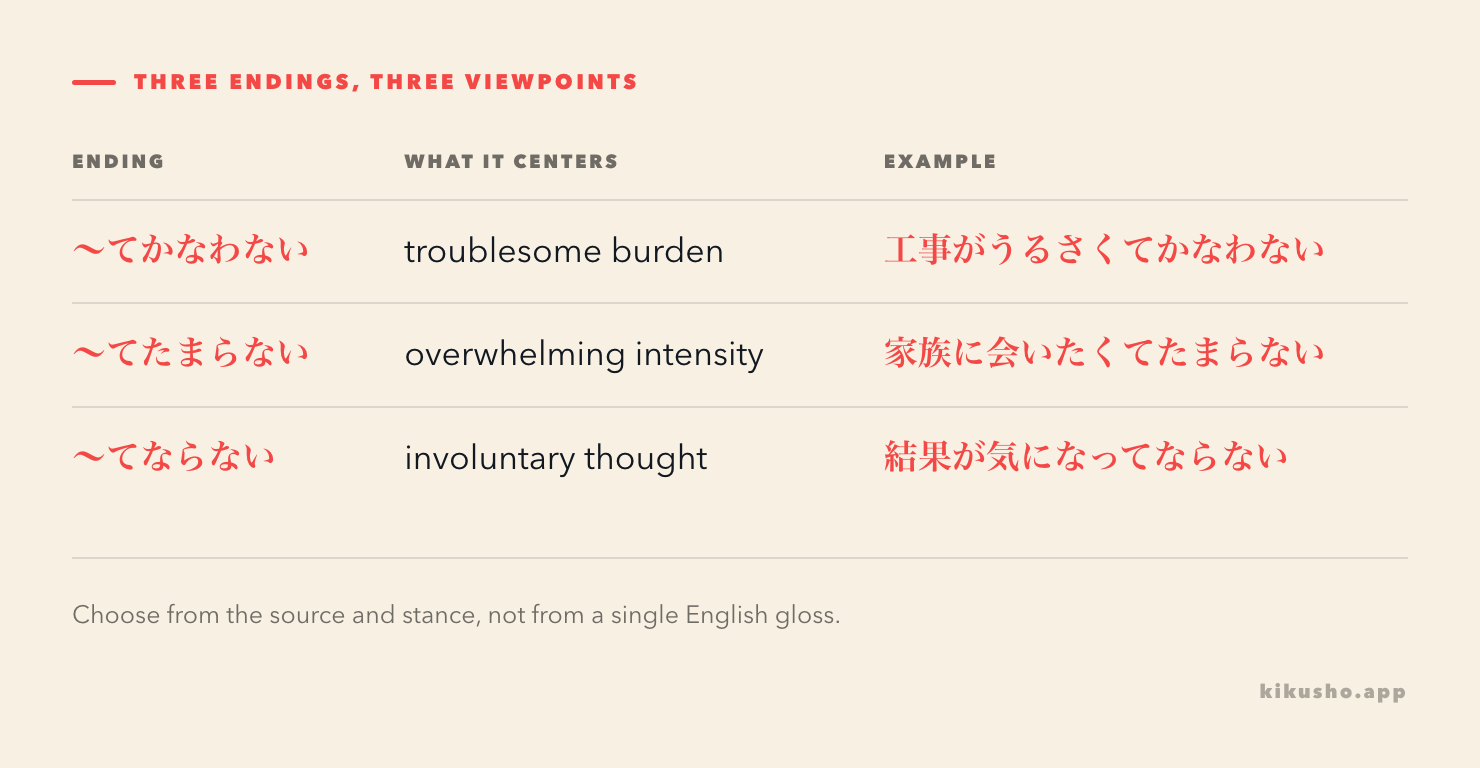
Heat and pain can overlap. 暑くてたまらない emphasizes the intensity of the sensation; 暑くてかなわない presents the heat as a troublesome burden and sounds more like a complaint. Both may fit the same afternoon, with a different stance.
The てたまらない lesson covers physical sensations, emotions and ~たい desires. The てならない comparison handles involuntary feelings and thoughts. ~てしょうがない is a broad conversational choice for a state the speaker cannot help; its dedicated lesson also separates the resulting irresistible action.
With は, ~てはたまらない can closely overlap with the target in rejected-event complaints: 何度も同じミスをされてはたまらない and されてはかなわない both object to repetition. The lexical center differs, but context may make the practical translations almost identical. Do not invent a rigid distinction where speakers have a real area of overlap.
Grammatical かなわない is not always lexical 敵わない
Study materials often write the target as ~て敵わない, linking the burden to an inability to stand up against it. Hiragana かなわない is also common and prevents three lexical words with the same reading from being confused.
| Form | Lexical meaning | Example |
|---|---|---|
| 敵わない | cannot match or compete with | テニスでは兄に敵わない |
| 叶わない | a wish does not come true | 願いが叶わない |
| 適わない | does not meet a condition or standard | この案は条件に適わない |
テニスでは、どうしても兄に敵わない。
テニスでは、どうしても あにに かなわない。
In tennis, I simply cannot match my older brother.
There is no て-form burden before 兄に敵わない. The particle に marks the person the speaker cannot match. Kotobank's bilingual dictionary entry records both the “cannot match” sense and the “cannot bear” use, including こう蒸し暑くてはかなわない. Read the whole frame before selecting a meaning or kanji.
N1 and N2 lists disagree
JLPT Sensei, Japanesetest4you, Bunpro and Benri Japan place the construction at N1. Tanosuke and N1et place it at N2. That disagreement reflects study sequencing rather than two different grammatical constructions: the connector is elementary, while the stance, passive complaints and overlap with neighboring intensity expressions require finer judgment.
The JLPT does not publish an exhaustive official grammar syllabus. Kikusho keeps the N1 placement assigned by its reference inventory, while recording the N2 estimates rather than presenting the boundary as official.
Save the trigger with the pattern when reviewing it. うるさくてかなわない becomes easier to distinguish from an inner feeling when the card preserves 隣の工事が. For the ては form, keep the affected viewpoint too: 毎晩遅くまで騒がれてはかなわない.
Practice: identify the burden and the speaker's stance
Question 1 · form an い-adjective
Complete: この部屋は暑( )かなわない。
- A. いて
- B. くて
- C. で
- D. にて
Question 2 · form a な-adjective
Complete: 駅から遠くて、通勤が不便( )かなわない。
- A. くて
- B. して
- C. で
- D. だて
Question 3 · choose the affected-person complaint
Which sentence complains that repeated late-night noise is intolerable?
- A. 毎晩遅くまで騒がれてはかなわない。
- B. 毎晩遅くまで騒いではならない。
- C. 毎晩遅くまで騒ぎたくてたまらない。
- D. 毎晩遅くまで騒がずにはいられない。
Question 4 · separate positive intensity
You passed the exam and can hardly contain your happiness. Which sentence fits?
- A. 合格して、嬉しくてかなわない。
- B. 合格して、嬉しくてたまらない。
- C. 合格して、嬉しくてはならない。
- D. 合格して、嬉しいではかなわない。
Question 5 · read lexical 敵わない
What does テニスでは兄に敵わない mean?
- A. My brother cannot bear playing tennis.
- B. My wish to play tennis did not come true.
- C. I cannot match my brother at tennis.
- D. Tennis does not meet my brother's conditions.
Question 6 · choose the current burden
Which sentence most directly complains about a headache affecting the speaker now?
- A. 朝から頭が痛くてかなわない。
- B. 朝から頭が痛くてはならない。
- C. 朝から頭が痛いに敵わない。
- D. 朝から頭を痛がってかなえる。
Question 7 · build the repeated-event complaint
Arrange all four chunks to say “I cannot stand being asked for the same explanation repeatedly.”
何度も / かなわない / 同じ説明を / 求められては
Answers and explanations
Open the explanations after choosing an answer for every item.
Answer 1
B. くて. 暑い is an い-adjective, so remove final い and add くて: 暑くてかなわない.
Answer 2
C. で. 不便だ is a な-adjective. Its connective form before かなわない is 不便で.
Answer 3
A. 毎晩遅くまで騒がれてはかなわない. The passive presents the speaker as affected by other people's noise, and てはかなわない rejects the repeated situation. B is a prohibition directed at the noisy person; C expresses a desire to make noise; D says the subject cannot refrain from making noise.
Answer 4
B. 合格して、嬉しくてたまらない. てたまらない can present positive emotion as overwhelmingly intense. The target てかなわない normally evaluates an unwanted burden, so A conflicts with the intended joyful context.
Answer 5
C. I cannot match my brother at tennis. This is lexical 敵わない with the rival marked by に. No connected state or event before かなわない creates the grammar pattern.
Answer 6
A. 朝から頭が痛くてかなわない. 痛い connects as 痛くて, and かなわない presents the headache as too much to bear. B resembles the prohibition てはならない, while C and D are malformed for the intended meaning.
Answer 7
同じ説明を何度も求められてはかなわない。 The passive 求められる becomes 求められては, foregrounding the repeated request as the unacceptable circumstance; かなわない supplies the complaint.
Hear the complaint before choosing the translation
The connector tells you what creates the burden, while かなわない reveals the speaker's refusal to tolerate it. Check whether は foregrounds a repeated or anticipated circumstance, then ask whether the sentence complains about trouble, intensifies an inner feeling, or compares two rivals. That sequence keeps ~てかなわない, ~てたまらない, and lexical 敵わない on separate paths.
Common questions
What does ~てかなわない mean?
It says that a situation is so unpleasant, troublesome or physically hard to bear that it causes the speaker real difficulty. 蒸し暑くてかなわない means that the humid heat is too much to stand.
What does は add in ~てはかなわない?
は foregrounds the preceding state or event as the circumstance the speaker rejects. It is especially common with repeated, imposed or anticipated events, but it can also evaluate a current state such as こう暑くてはかなわない.
How is ~てかなわない different from ~てたまらない?
~てかなわない normally voices a negative burden or complaint. ~てたまらない emphasizes overwhelming intensity and can describe pleasant feelings and desires, such as 嬉しくてたまらない and 会いたくてたまらない.
Is the kanji in ~て敵わない required?
No. Hiragana かなわない is common and keeps the grammatical expression easy to recognize. 敵わない connects it with the idea of being unable to withstand or match something, but 叶わない and 適わない have other lexical uses.