On this page
Use を経て when A is a route, period or process passed through before B. Use を機に when A is selected as the occasion or turning point for a new action or change. The first traces how you arrived; the second marks where a new direction began.
三回の審査を経て、新しい薬が承認された。
さんかいの しんさを へて、あたらしい くすりが しょうにんされた。
After going through three reviews, the new medicine was approved.
承認を機に、会社は海外での販売を始めた。
しょうにんを きに、かいしゃは かいがいでの はんばいを はじめた。
The company used the approval as the occasion to begin overseas sales.
Approval is the endpoint of the reviews in the first sentence. In the second, the same approval becomes the starting point for a different development. That change of direction is the test that English translations such as “after” often conceal.
Ask whether A is the road or the hinge
| Form | What A contributes | What B normally shows | Useful mental question |
|---|---|---|---|
| Nを経て、B | a route, elapsed period, experience or required stage | the point reached after passing through A | What did this pass through? |
| N/clause + のを機に、B | an event treated as a timely occasion or turning point | a new action, habit, policy or direction | What changed from this point? |
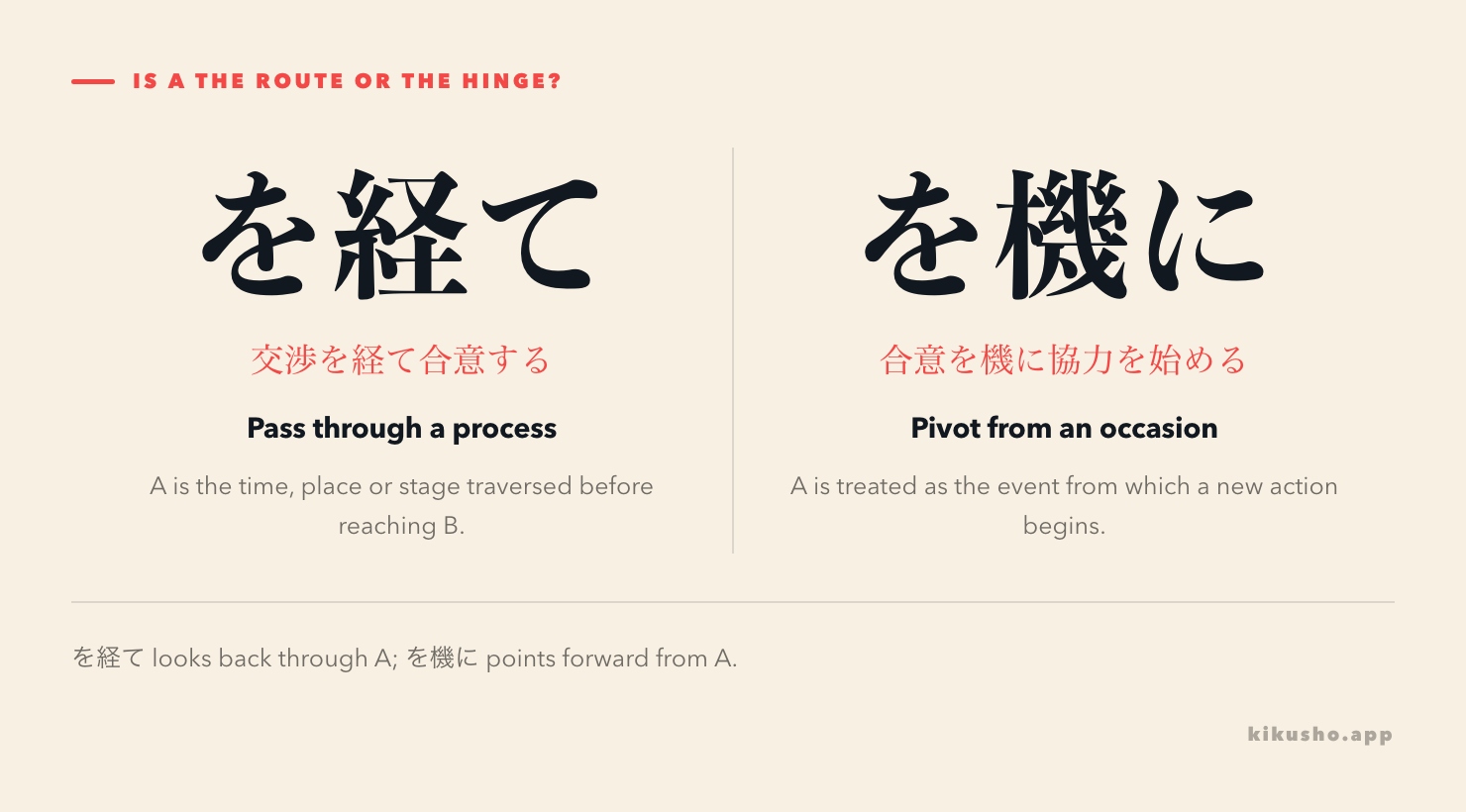
A long process can lead to change, and a major event can come after years of preparation. Time order alone therefore cannot decide. Ask what the writer foregrounds. を経て turns A into the middle of a path. を機に turns A into the boundary between an earlier state and what begins next.
を経て looks back through the path
経る(へる) means to pass through time, a place or an established course. Its connective form 経て follows a noun marked by を.
十年の歳月を経て、寺の修復が完了した。
じゅうねんの さいげつを へて、てらの しゅうふくが かんりょうした。
After ten years, the temple restoration was completed.
台北を経て、東京へ向かった。
たいぺいを へて、とうきょうへ むかった。
I travelled to Tokyo via Taipei.
専門家による審議を経て、基準が改定された。
せんもんかによる しんぎを へて、きじゅんが かいていされた。
The standards were revised after expert deliberation.
The noun before を経て may therefore name three different kinds of passage:
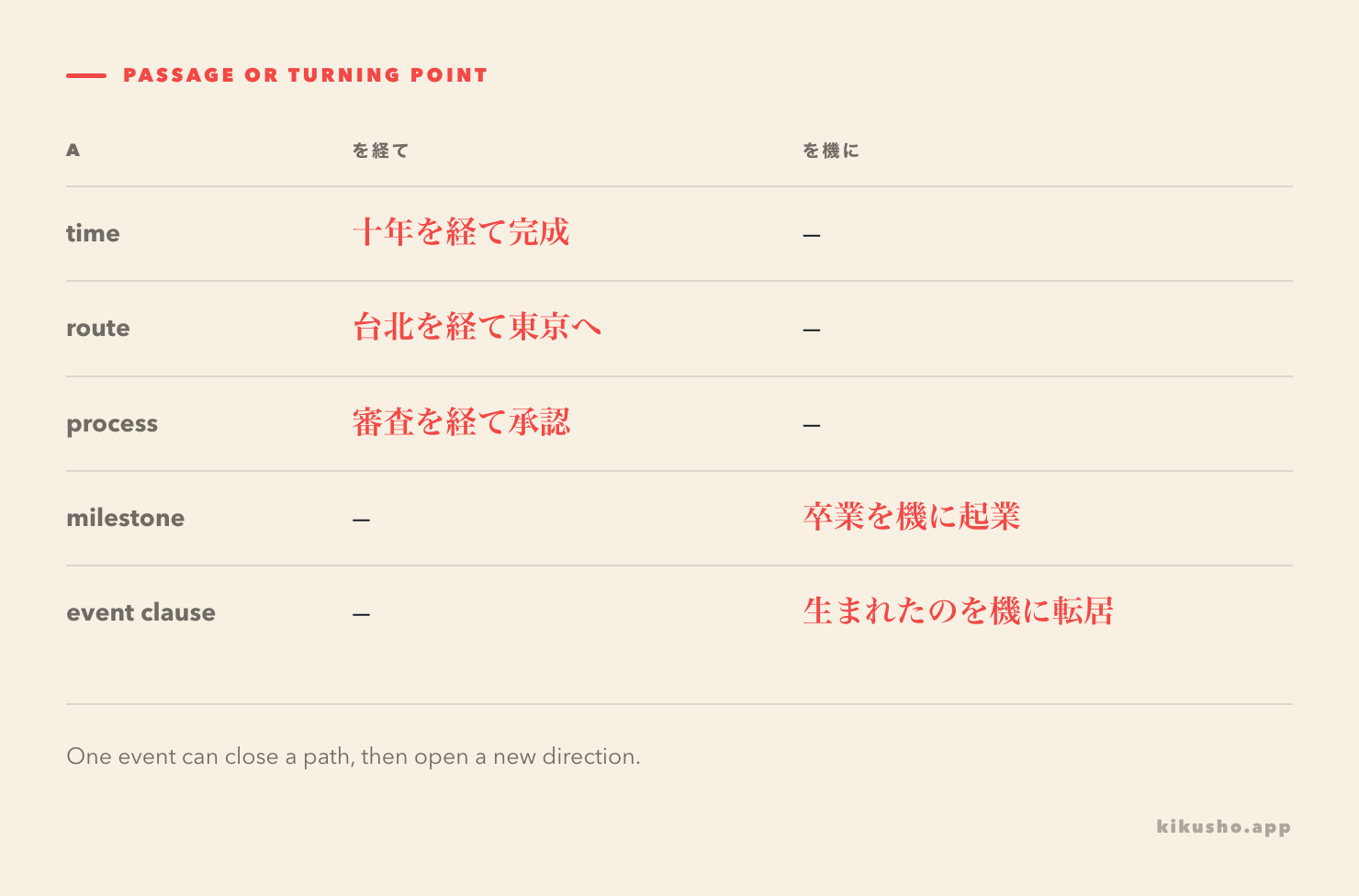
- time: 三年を経て, after three years had passed
- place or intermediary: 大阪を経て, via Osaka
- process or experience: 研修を経て, after going through training
JapaneseNET records those three uses and the attachment N + を経て. The Daijisen entry for 経る independently defines passage through elapsed time, a location and an established course or procedure.
This form does more than say that A happened earlier. It presents A as part of the route by which B was reached. 会議の後で決定した merely places the decision after the meeting. 会議での議論を経て決定した makes the discussion an intermediate stage in arriving at the decision.
Before a noun, use the past attributive form を経た:
長い交渉を経た合意
ながい こうしょうを へた ごうい
an agreement reached through lengthy negotiations
The pattern can describe an intentional procedure, but it does not itself mean “use A as an opportunity.” A background check, a decade or a transit city can all be stages even when nobody treats them as a motivating event.
を機に turns one event into a beginning
機(き) here means an occasion or opportunity. Aを機にB frames A as the point from which someone begins B or a broader change develops.
転職を機に、生活のリズムを見直した。
てんしょくを きに、せいかつの リズムを みなおした。
I used changing jobs as an occasion to reconsider my daily routine.
店の移転を機に、予約制度を導入した。
みせの いてんを きに、よやく せいどを どうにゅうした。
With the shop's relocation as a turning point, we introduced a reservation system.
A noun attaches directly. A full event clause is normally made noun-like with の:
子供が生まれたのを機に、郊外へ引っ越した。
こどもが うまれたのを きに、こうがいへ ひっこした。
When our child was born, we took the occasion to move to the suburbs.
Bunpro gives both N + を機に and V + の + を機に. It also notes the common nuance of actively making use of A's timing. Benri Japan describes A as a concrete milestone and B as the action or change that begins from it.
Several formal variants occur:
| Position | Form | Example |
|---|---|---|
| before a clause | Nを機に/Nを機にして | 卒業を機に働き始める |
| stronger formal framing | Nを機として | 開業を機として制度を改める |
| before a noun | Nを機に始めた + noun phrase | 移転を機に始めたサービス |
Do not replace を with が inside this frame. 卒業が機だ is not the construction being taught. If you want to identify something as the trigger, 卒業がきっかけだ uses a different noun and particle structure.
The same event can be endpoint and starting point
Consider a merger:
一年にわたる交渉を経て、両社は合併した。
いちねんに わたる こうしょうを へて、りょうしゃは がっぺいした。
After a year of negotiations, the two companies merged.
合併を機に、社内制度を統一した。
がっぺいを きに、しゃない せいどを とういつした。
The merger became the occasion for unifying internal systems.
The merger closes the first path and opens the second. を経て points backward through negotiations. を機に points forward from the merger into institutional change.
This also explains why these replacements fail:
- 香港を経てロンドンへ行く is natural because Hong Kong is a route. 香港を機にロンドンへ行く would require Hong Kong to be an occasion that prompted a new decision, not merely a stopover.
- 厳しい審査を経て採用された follows a selection process. 審査を機に採用された would oddly treat the review as an opportunity chosen for the hiring.
- 退職を機に料理を習い始めた marks retirement as a life turning point. 退職を経て料理を習い始めた is possible only when retirement is narrated as one stage along a wider path; it loses the deliberate pivot.
Keep 機, 契機 and きっかけ apart
を機に, を契機に and をきっかけに all look forward from an event. They differ mainly in weight and register, not in basic chronology.
- をきっかけに is broad and natural in personal speech.
- を機に is compact and somewhat formal; it often suggests making use of a milestone or timely occasion.
- を契機に is heavier and especially comfortable in institutional, public and historical writing.
The dedicated きっかけ and 契機 comparison develops the particle and register differences. Mainichi Nonbiri's を機に/を契機に explanation adds a useful limit: the later clause should show a distinct new action or development. For a series of the same kind of event, を皮切りに is the better frame.
All checked curriculum references place を経て and を機に at N1. This is preparation guidance rather than an official boundary. The JLPT publishes descriptions of proficiency and question types, but no exhaustive current list assigning every grammar form to one level.
When you save either construction in Kikusho, keep the endpoint or later change on the same card. 研修を経て配属された preserves the path and destination. 配属を機に一人暮らしを始めた preserves the turning point and new action. That complete relation is what you need to retrieve.
Practice: find the direction of the sentence
Follow the direction in each sentence through all seven items. Open the explanations only after you have committed to every choice.
Question 1 · required stages
Complete: 二度の面接( )、採用が決まった。
- ア. を経て
- イ. を機に
- ウ. を限りに
- エ. に反して
Question 2 · a life turning point
Complete: 大学卒業( )、故郷で会社を立ち上げた。
- ア. を経て
- イ. を機に
- ウ. にわたって
- エ. を問わず
Question 3 · physical route
Which sentence means “The package reached France via Singapore”?
- ア. 荷物はシンガポールを機にフランスへ届いた。
- イ. 荷物はシンガポールを経てフランスへ届いた。
- ウ. 荷物はシンガポールの機を経てフランスへ届いた。
- エ. 荷物はシンガポールに機してフランスへ届いた。
Question 4 · clause attachment
Complete: 父が入院した( )、家族で健康について話し合うようになった。
- ア. を経て
- イ. のを機に
- ウ. ことを経た
- エ. のが機で
Question 5 · noun modification
Which phrase means “an agreement reached through several rounds of consultation”?
- ア. 数回の協議を経て合意
- イ. 数回の協議を経た合意
- ウ. 数回の協議を機な合意
- エ. 数回の協議が経た合意
Question 6 · same event, two directions
Choose the pair:
長い準備(甲)、新店舗が開業した。開業(乙)、営業時間を延長した。
- ア. 甲 を機に / 乙 を経て
- イ. 甲 を経て / 乙 を機に
- ウ. 甲 を経た / 乙 が機に
- エ. 甲 に経て / 乙 を機で
Question 7 · an unsuitable continuation
Which continuation is least natural with 大阪への旅行を機に because it only adds another event of the same kind?
- ア. 写真を本格的に学び始めた。
- イ. 地方の建築に興味を持つようになった。
- ウ. 京都にも旅行した。
- エ. 毎月の支出を記録するようになった。
Answers and explanations
1 — ア, を経て. The interviews are stages in the selection route that ends in hiring. They are not presented as the occasion for a separate new action.
2 — イ, を機に. Graduation is framed as the milestone from which the speaker begins a company. The later clause opens a new direction.
3 — イ. Singapore is an intermediate place on the package's route. Only を経て carries the “via” meaning here.
4 — イ, のを機に. The finite clause 父が入院した is nominalized with の before taking を機に. The hospitalization becomes the turning point for a new family habit.
5 — イ. を経た is the attributive form before 合意. The consultation rounds form the process through which the agreement was reached.
6 — イ. Preparation is the path leading to the opening, so 甲 takes を経て. The opening then becomes the occasion for a new schedule, so 乙 takes を機に.
7 — ウ. A trip to Kyoto simply continues the same kind of activity as a trip to Osaka. 大阪への旅行を皮切りに、京都にも旅行した would naturally present the first trip as the start of a series. The other choices describe a distinct habit, interest or practice beginning from the Osaka trip.
Read from the middle outward
When both forms could be translated as “after,” inspect A and B separately. If A is a corridor of time, place or experience leading toward B, choose を経て. If B branches into something new because A has been treated as its occasion, choose を機に.
Then read the whole sequence. One event can sit between the two forms: 交渉を経て契約し、契約を機に共同開発を始めた. The contract is first a destination and then a departure point. That double view is why the contrast matters.
Common questions
What is the difference between を経て and を機に?
を経て presents A as a time, place, experience or process traversed before B is reached. を機に presents A as an occasion or turning point that prompts a new action, habit or development in B.
Can を経て describe both time and place?
Yes. 十年を経て marks ten years passing, while 香港を経てシンガポールへ行く marks Hong Kong as a route. It also describes procedures and experiences, as in 審査を経て決定する.
Can a verb come before を機に?
A noun attaches directly, as in 卒業を機に. A clause is normally nominalized with の, as in 子供が生まれたのを機に引っ越した.
Is を機に the same as を契機に?
Both frame an event as a turning point. を契機に is the heavier formal form and is especially common in institutional or historical writing; を機に is shorter and readily frames a life event or timely opportunity.