On this page
Use ~て初めて when completing A produces a new fact, experience or realization in B. Use ~てからでないと when B cannot proceed until A has happened first.
Both can translate as “not until,” so the English timing alone does not decide. Read B before choosing: a newly reached outcome calls for one form, while an unavailable action calls for the other.
This lesson covers N3 inventory items g-3b08c85dd0a3, て初めて, and g-5944d58ee996, てからでないと. JLPT Sensei lists て初めて at N3 and does the same for てからでないと. Bunpro instead places て初めて at N3 and てからでないと at N2. This lesson teaches the contrast without pretending that an editorial level boundary is official; the JLPT publishes no exhaustive grammar syllabus.
The rule is result after A versus restriction before A
Put both forms after a complete verb て-form, including forms ending in で.
| Pattern | What A does | What B does | Example shape |
|---|---|---|---|
| Aて初めて、B | creates the point after which something new becomes true | reports the new result, experience or realization | 暮らして初めて、分かった |
| Aてからでないと、Bない | sets a required first step | states what is impossible or unavailable without A | 見てからでないと、決められない |
| Aてからでなければ、Bない | sets the same requirement | gives a more formal conditional version | 確認してからでなければ、使えない |
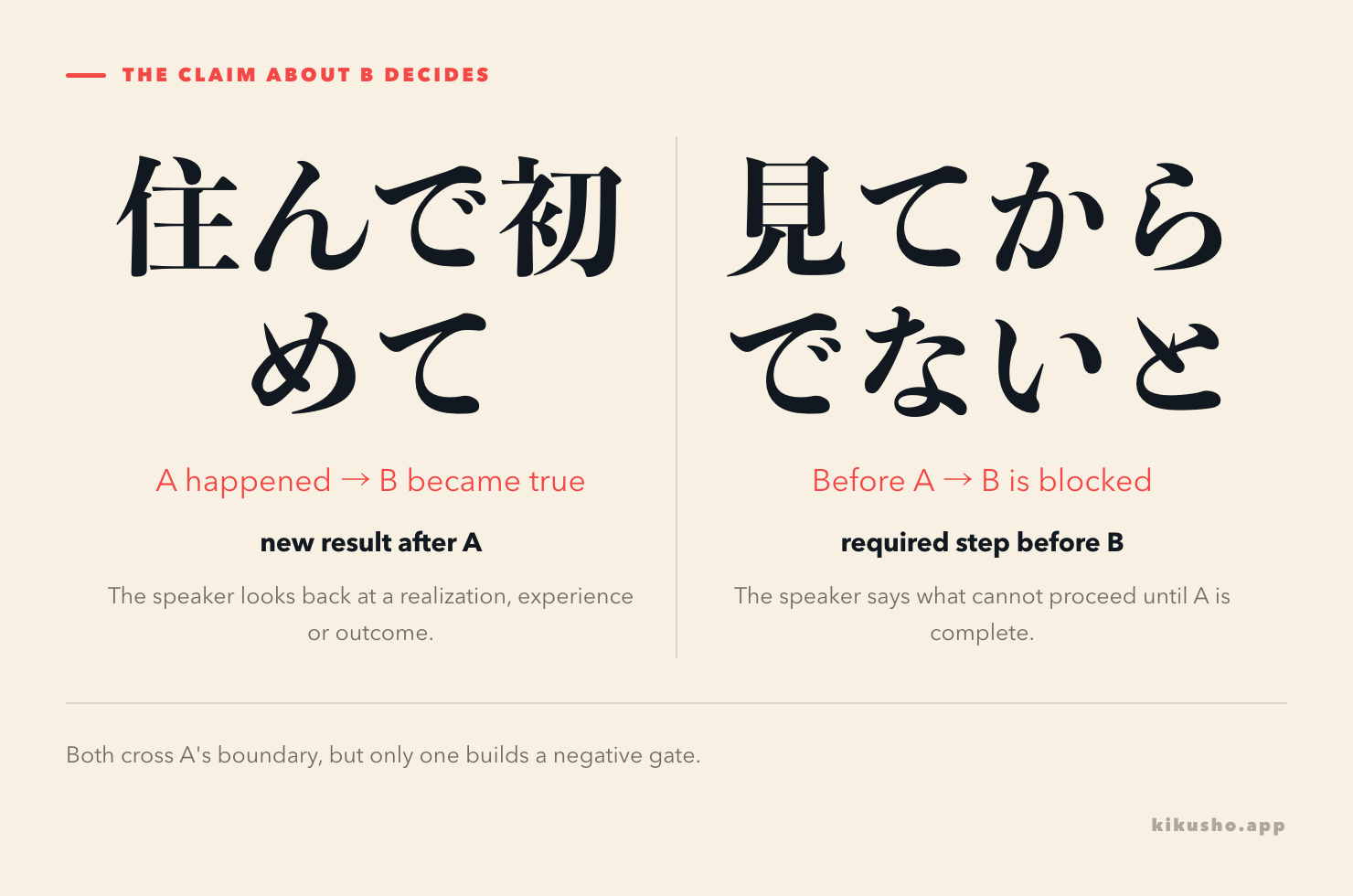
The て-form itself does not choose the meaning. 住む → 住んで初めて keeps voiced で; 読む → 読んでからでないと does the same. The material after that connection builds the relationship between the clauses.
Ask whether B is discovered or blocked
Use a two-part test while reading.
- Is B presented as the result that emerges once A is reached, often in hindsight? Choose ~て初めて.
- Is the sentence warning that B cannot happen yet because A is still required? Choose ~てからでないと or its variant ~てからでなければ.
The tense often helps. ~て初めて commonly appears in an account of something learned or experienced: 分かった, 気づいた, 知った, できた. It can also report a first event, such as seeing something for the first time. The point is that B becomes available only beyond A.
With ~てからでないと, the second clause commonly contains a negative or limiting expression: 分からない, 決められない, 入れない, 使えない, 無理だ. That ending keeps the gate closed until A is complete.
~て初めて reports the new result
海外で暮らして初めて、自分の国の良さが分かった。
かいがいで くらして はじめて、じぶんの くにの よさが わかった。
Only after living abroad did I understand what was good about my own country.
The speaker has already lived abroad and reached a new understanding. 初めて does more than place two events in order. It says the appreciation was not fully available before that experience.
Another common shape links a change in role to a new perspective:
親になって初めて、親の気持ちが分かった。
おやに なって はじめて、おやの きもちが わかった。
Only after becoming a parent did I understand how parents feel.
The second clause need not contain 分かる. 日本に来て初めて、桜を見た means the person saw cherry blossoms for the first time after coming to Japan. Realization is frequent because the construction suits hindsight, but a genuinely new event also fits.
~てからでないと keeps B unavailable
実物を見てからでないと、買うかどうか決められません。
じつぶつを みてからでないと、かうか どうか きめられません。
I cannot decide whether to buy it until I see the actual item.
The speaker has not necessarily seen the item yet. 見る is a prerequisite for the later decision, and 決められません names what remains impossible without it.
The variant ~てからでなければ carries the same condition in a form that often suits rules and formal explanations:
安全を確認してからでなければ、機械を動かせません。
あんぜんを かくにんしてからでなければ、きかいを うごかせません。
The machine cannot be operated until safety has been checked.
Do not read the longer ending as a new sequence meaning. でないと and でなければ both set the negative condition “if it is not after doing A.” The style changes more than the logical gate.
The same first clause can lead to two different readings
Compare two sentences built around 説明を聞く, “listen to the explanation.”
説明を聞いて初めて、この問題の意味が分かった。
せつめいを きいて はじめて、この もんだいの いみが わかった。
Only after hearing the explanation did I understand what this problem meant.
The explanation has been heard. The sentence looks back and identifies the understanding that resulted.
説明を聞いてからでないと、この問題には答えられない。
せつめいを きいてからでないと、この もんだいには こたえられない。
You cannot answer this problem until you hear the explanation.
This version sets a requirement. The answer is unavailable on the near side of the explanation.
The first event can be identical while the speaker's viewpoint changes. ~て初めて points to B as the newly reached side of the boundary. ~てからでないと points to B as blocked before the boundary.
Plain ~てから only orders the events
The basic ~てから pattern can simply state that A finishes before B:
説明を聞いてから、問題に答えました。
せつめいを きいてから、もんだいに こたえました。
I answered the problem after hearing the explanation.
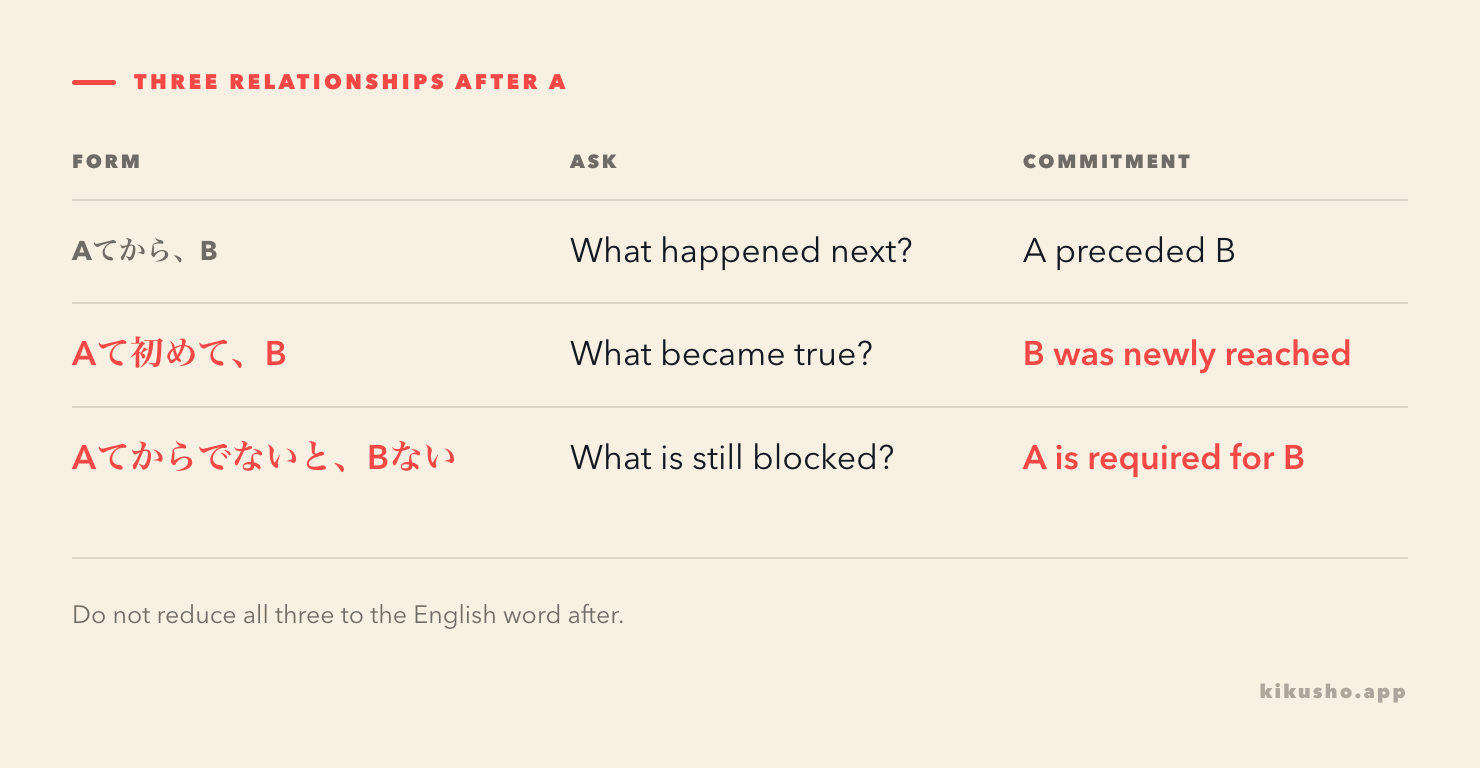
This reports sequence. It does not say that the speaker understood something for the first time, and it does not state that answering would have been impossible without the explanation.
| Form | Question it answers | Commitment |
|---|---|---|
| Aてから、B | What happened next? | A preceded B |
| Aて初めて、B | What became true only after A? | B was newly reached after A |
| Aてからでないと、Bない | What cannot happen before A? | A is required for B |
For a deliberately considered prerequisite rather than a strict impossibility, た上で may fit: 資料を読んだ上で決める means deciding after reading and considering the material. The 上で lesson separates that formal sequence from ordinary てから.
Keep the gate and its consequence together
If you photograph a notice containing 登録してからでないと入れません, highlight the complete two-clause sentence in Kikusho. A card cut after 登録して remembers the action but loses the barred entrance that makes it a prerequisite. Preserve the condition and the negative result in one editable example; the generated audio then keeps the boundary you need to hear.
The same principle helps with ~て初めて. Saving only 海外で暮らす drops the change in understanding. Keep the experience beside the discovery so the review tests the relationship instead of asking for an isolated translation of 初めて.
Practice: decide what happens on each side of A
Complete all six prompts before moving to the explanation block.
Question 1 — new realization. Someone understood the importance of health only after becoming ill. Choose the sentence that expresses that hindsight.
- A. 病気になって初めて、健康の大切さに気づいた。
- B. 病気になってからでないと、健康の大切さに気づいた。
- C. 病気になる前に、健康の大切さに気づいた。
Question 2 — required check. A company cannot announce a result before confirming it with the person concerned. Select the appropriate line.
- A. 本人に確認して初めて、結果を公表できません。
- B. 本人に確認してからでないと、結果を公表できません。
- C. 本人に確認しながら、結果を公表できません。
Question 3 — sentence composition. Say “Only after living abroad did I understand what was good about my own country.” Use 海外で暮らす, 自分の国の良さが分かる and ~て初めて.
Question 4 — sentence composition. Say “You cannot enter until you register.” Use 登録する, 中に入れない and ~てからでないと.
Question 5 — sentence order. Arrange every chunk once to express a necessary safety check.
機械を / 安全を確認して / 動かせません / からでなければ
Question 6 — text grammar. Read the pair below. Has the explanation already produced a result in each sentence, or is it still presented as a required step? State what B claims.
- 説明を聞いて初めて、意味が分かった。
- 説明を聞いてからでないと、答えられない。
Answers and explanations
Answer 1. A, 病気になって初めて、健康の大切さに気づいた。 The illness occurred and led to a new realization. B combines the prerequisite form with an affirmative past result, losing the expected blocked conclusion. C places the realization before the illness and reverses the intended timing.
Answer 2. B, 本人に確認してからでないと、結果を公表できません。 Confirmation is the required first step, and 公表できません names what cannot happen without it. A uses the hindsight form but ends with a negative ability statement that does not report a newly reached result. C describes overlapping actions with ~ながら.
Answer 3. One model is 海外で暮らして初めて、自分の国の良さが分かりました。 (かいがいで くらして はじめて、じぶんの くにの よさが わかりました). 暮らす → 暮らして precedes 初めて; the polite past 分かりました reports the later understanding.
Answer 4. 登録してからでないと、中に入れません。 (とうろくしてからでないと、なかに はいれません). 登録する → 登録して supplies A, while 入れません keeps entry unavailable until registration is complete.
Answer 5. 安全を確認してからでなければ、機械を動かせません。 (あんぜんを かくにんしてからでなければ、きかいを うごかせません). The check fills the prerequisite slot; the negative potential 動かせません supplies the blocked action.
Answer 6. In sentence 1, the explanation has already been heard, and B reports the understanding that appeared afterward. In sentence 2, hearing the explanation is framed as a requirement; B says an answer remains impossible before that step. The pair differs in the claim about B, not in the form of 聞く.
Common questions
What is the difference between ~て初めて and ~てからでないと?
~て初めて looks back at a result, experience or realization that became true only after A. ~てからでないと makes A a requirement and says B cannot happen or be done before A is complete.
How do you form ~て初めて?
Put the first verb in its て- or で-form and add 初めて: 住む becomes 住んで初めて. The following clause names what happened, became possible or was understood only after that first experience.
What normally follows ~てからでないと?
The following clause is normally negative or limiting, such as 決められない, 入れない, 分からない or 無理だ. It states what remains blocked unless the first action happens.
Are these forms N3 grammar?
JLPT Sensei places both at N3, and Bunpro places ~て初めて at N3 but ~てからでないと at N2. These are editorial estimates because the JLPT does not publish an exhaustive official grammar list.