On this page
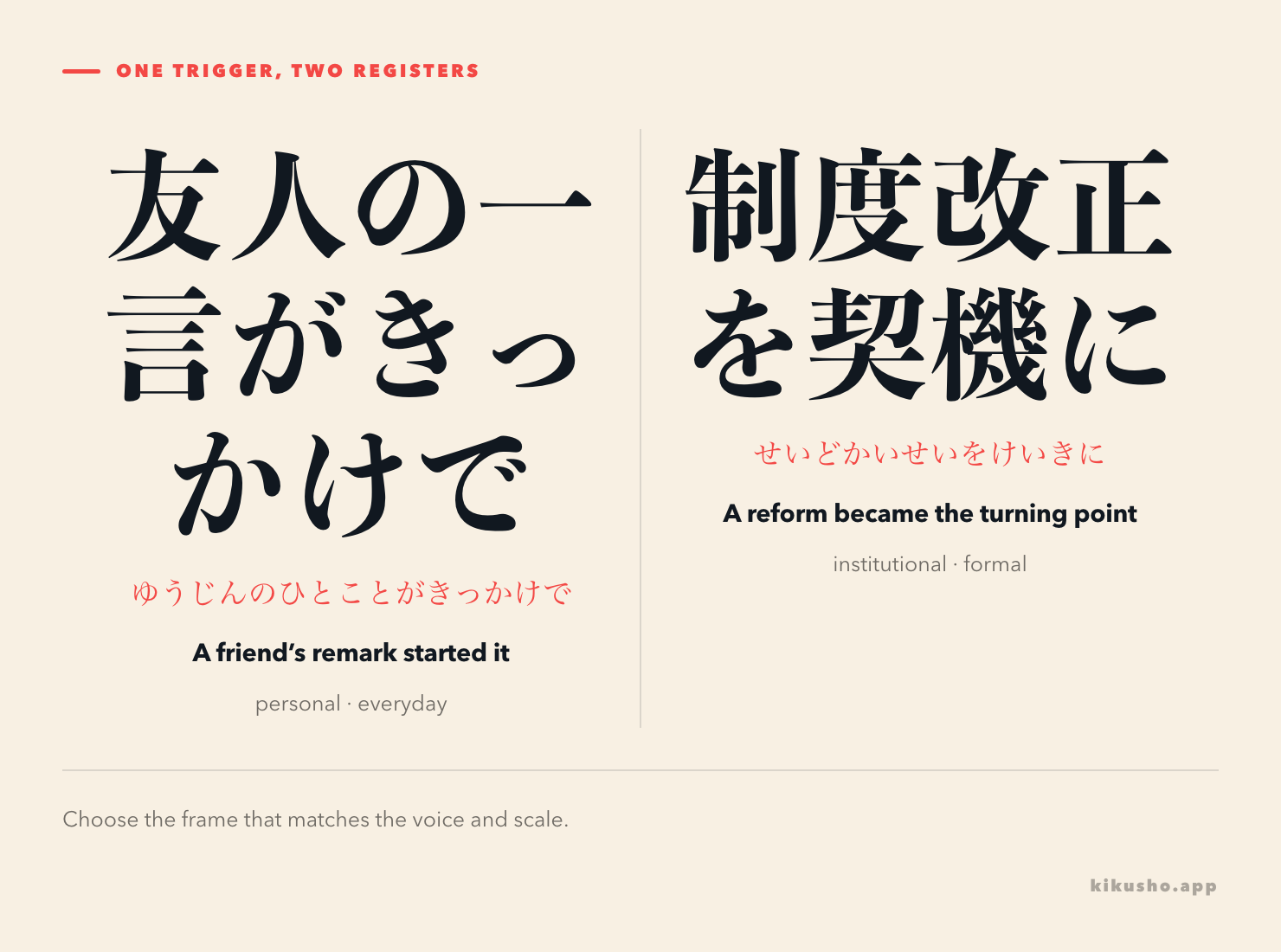
AがきっかけでB presents A as the trigger that led to B. AをきっかけにB frames A as the starting point for B, while formal Aを契機にB often turns a public, institutional or established event into a turning point.
友人の一言がきっかけで、日本語を勉強し始めた。
ゆうじんのひとことがきっかけで、にほんごをべんきょうしはじめた。
A friend's remark was the trigger that made me start studying Japanese.
制度改正を契機に、会社は研修制度を見直した。
せいどかいせいをけいきに、かいしゃはけんしゅうせいどをみなおした。
Taking the regulatory reform as a turning point, the company reviewed its training system.
The three patterns overlap, but they do not merely mean “because.” Their shared requirement is a meaningful beginning, change or later development after the trigger.
Three frames for one idea
The particles reveal how the speaker organizes the event.
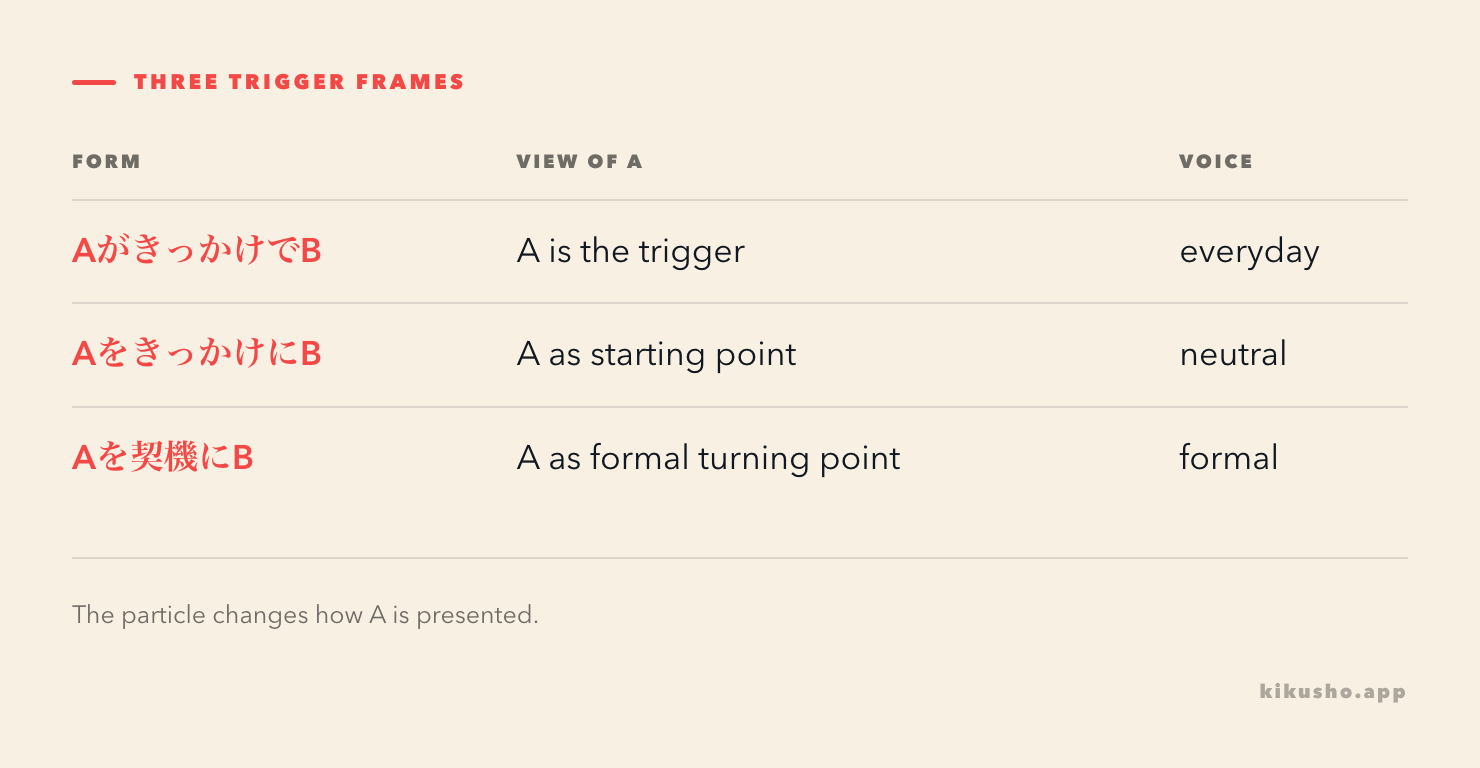
| Pattern | Literal frame | Natural question it answers | Typical tone |
|---|---|---|---|
| AがきっかけでB | A is the trigger, and B follows | What made B begin? | everyday and personal |
| AをきっかけにB | taking A as the trigger, B begins | From what point did B change? | neutral; speech and writing |
| Aを契機にB | taking A as the occasion or turning point, B begins | What event launched this development? | formal, public or institutional |
With がきっかけで, A belongs inside the predicate Aがきっかけだ: “A is the trigger.” The connective で then links that description to the result.
アニメがきっかけで、日本の歴史にも興味を持つようになった。
アニメがきっかけで、にほんのれきしにもきょうみをもつようになった。
Anime was the trigger that led me to become interested in Japanese history too.
This is a natural answer to 日本語を始めたきっかけは何ですか — “What made you start Japanese?” The speaker identifies the thing that played the role of trigger.
With をきっかけに, the speaker selects or frames A as a starting point. The longer forms をきっかけにして and をきっかけとして make that framing especially visible.
留学をきっかけに、将来について真剣に考えるようになった。
りゅうがくをきっかけに、しょうらいについてしんけんにかんがえるようになった。
Studying abroad prompted me to start thinking seriously about my future.
The same event can often take either construction:
先生の助言がきっかけで、研究テーマを変えた。
My teacher's advice was the trigger that led me to change my research topic.
先生の助言をきっかけに、研究テーマを変えた。
Taking my teacher's advice as a starting point, I changed my research topic.
The first sentence identifies the cause-like trigger. The second views the advice as the boundary between “before” and “after.” The real-world sequence is the same; the grammatical camera has moved.
きっかけ is broad; 契機 is formal
きっかけ is the everyday choice for a meeting, remark, book, hobby or chance experience that starts something. It works naturally in conversation and personal writing.
旅行先で彼女に会ったことをきっかけに、二人は連絡を取り始めた。
りょこうさきでかのじょにあったことをきっかけに、ふたりはれんらくをとりはじめた。
Meeting her while travelling led the two of them to start keeping in touch.
契機 is a Sino-Japanese noun read けいき. It is common in reports, news, policy, business and historical explanation. It often takes a clearly established event as the point from which a wider change develops.
震災を契機に、地域の防災計画が全面的に見直された。
しんさいをけいきに、ちいきのぼうさいけいかくがぜんめんてきにみなおされた。
The disaster prompted a complete review of the region's disaster-prevention plan.
新工場の完成を契機として、海外市場への進出を加速させた。
しんこうじょうのかんせいをけいきとして、かいがいしじょうへのしんしゅつをかそくさせた。
With the completion of the new factory as a turning point, the company accelerated its expansion overseas.
This is a register tendency, not a rigid difference in truth conditions. 留学をきっかけに sounds personal and ordinary; 留学を契機に is possible when the writer treats the experience as a formal turning point. Likewise, an organization can use をきっかけに when it wants a less formal voice.
Research on the two expressions supports this graded contrast. A Japanese-language education study in 日本語教育方法研究会誌 notes that textbook paraphrases alone can produce unnatural sentences, then describes をきっかけに as particularly compatible with individual experiences and one-off or accidental events. Earlier work summarized there associates を契機に more strongly with an established event. Learner references give a useful practical version of the same distinction: J-nihongo marks 契機 and 機 as more formal, while JapaneseNET's 契機 lesson labels it written language.
Put nouns or nominalized clauses before the pattern
A noun attaches directly:
- 就職がきっかけで — employment was the trigger
- 就職をきっかけに — taking employment as the starting point
- 就職を契機に — with employment as a formal turning point
A verb clause needs to become noun-like before をきっかけに. Use の or こと:
この本を読んだのをきっかけに、環境問題を調べ始めた。
このほんをよんだのをきっかけに、かんきょうもんだいをしらべはじめた。
Reading this book prompted me to start researching environmental issues.
大会で負けたことをきっかけに、練習方法を変えた。
たいかいでまけたことをきっかけに、れんしゅうほうほうをかえた。
Losing in the tournament prompted me to change how I trained.
The plain past form is common because the triggering event has already occurred. Nのきっかけ has a different internal structure: 日本語を始めたきっかけ means “the trigger for starting Japanese.” Do not insert を into that noun phrase.
For 契機, compact event nouns are the safest core pattern: 入社を契機に, 法改正を契機に, 震災を契機に. Formal prose also uses longer nominalized events, but turning the event into a clear noun usually makes the sentence tighter.
The result must develop beyond the trigger
The clause after the pattern normally describes a new action, habit, state, expansion or course of events. Common partners include 始める, ようになる, 変わる, 見直す, 広がる and 発展する.
病気をきっかけに、毎朝歩くようになった。
びょうきをきっかけに、まいあさあるくようになった。
An illness prompted me to start walking every morning.
The illness does not merely cause one immediate reaction. It begins a lasting habit. That “event → later development” relation is the center of the grammar.
For an ordinary immediate reason, use から, ので or another cause expression:
雨が降ったので、試合が中止になった。
あめがふったので、しあいがちゅうしになった。
The match was cancelled because it rained.
雨をきっかけに試合が中止になった is awkward if it only reports a direct cancellation. It becomes plausible when the rain launches a broader development: 大雨をきっかけに、市は排水計画を見直した — “The heavy rain prompted the city to review its drainage plan.”
The trigger must also do more than locate an action in time. 卒業式で写真を撮った simply says that photos were taken at the ceremony. 卒業式をきっかけに写真を撮り始めた says that the ceremony began a new photography habit.
Do not force a positive interpretation. A trigger can lead to improvement, decline, conflict or any neutral change. Nor must it be planned: a chance meeting can be a きっかけ, while an official reform can be deliberately used as a 契機.
Choose by structure, scale and voice
Use this three-step decision:
- If the sentence says “A was the trigger,” choose AがきっかけでB.
- If the sentence says “taking A as the starting point,” choose AをきっかけにB.
- If the same framing belongs to formal reporting, policy, business or historical analysis, consider Aを契機にB.
Bunpro's きっかけ entry illustrates both particle views: が marks something as the trigger, while を presents something taken as the trigger. The examples also show the nominalized pattern Vたのをきっかけに. Keep that particle distinction visible even when an English translation makes both sentences sound like “because of.”
When saving these forms in Kikusho, capture the trigger and the later change together. Save 留学をきっかけに、考え方が変わった, not only をきっかけに. Add a register note such as “personal/neutral” or “formal/institutional.” The complete before-and-after pair makes the card usable for recall.
Practice: identify the trigger frame
Answer all six questions before opening the explanations. Every answer is kept together below Question 6 so the next solution does not appear while you are still working.
Question 1 — particle and structure. Complete “A friend's recommendation was the trigger that made me read the book.”
友人の勧め__、その本を読んだ。
- ア. がきっかけで
- イ. をきっかけで
- ウ. が契機に
- エ. にきっかけで
Question 2 — personal starting point. Which completion best fits a neutral account of a personal experience?
留学__、自分の文化について考えるようになった。
- ア. が理由に
- イ. を契機で
- ウ. をきっかけに
- エ. がきっかけに
Question 3 — formal register. A policy report describes a legal revision launching an institutional review. Which is the best completion?
法改正__、行政手続きが見直された。
- ア. を契機に
- イ. がきっかけに
- ウ. のきっかけで
- エ. を契機で
Question 4 — clause attachment. Which sentence correctly says that reading a novel prompted the speaker to study history?
- ア. 小説を読んだをきっかけに、歴史を勉強し始めた。
- イ. 小説を読むがきっかけに、歴史を勉強し始めた。
- ウ. 小説を読んできっかけに、歴史を勉強し始めた。
- エ. 小説を読んだのをきっかけに、歴史を勉強し始めた。
Question 5 — sentence composition. Arrange these four chunks into “A chance encounter prompted the two of them to start talking.” Use each chunk exactly once.
- 偶然の出会いを
- きっかけに
- 二人は
- 話し始めた
Question 6 — connected meaning. Which sentence uses きっかけ unnaturally because it describes only an immediate cause, with no later action or development?
- ア. 入院をきっかけに、食生活を変えた。
- イ. 大雨をきっかけに、市は防災計画を見直した。
- ウ. 雨をきっかけに、今日の試合が中止になった。
- エ. 友人の紹介をきっかけに、二人は連絡を取り始めた。
Answers and explanations
Answer 1. ア, がきっかけで. 友人の勧め is marked with が as the thing that was the trigger. で connects that predicate to the later action. The を pattern would require をきっかけに, not をきっかけで.
Answer 2. ウ, をきっかけに. A personal study-abroad experience is framed as the starting point for a change in thought. を契機に could be grammatical in more formal prose, but it is not the best neutral personal choice here.
Answer 3. ア, を契機に. A legal revision and an institutional review fit the formal scale and register of 契機. The fixed particle sequence is を契機に.
Answer 4. エ, 小説を読んだのをきっかけに、歴史を勉強し始めた. The clause 小説を読んだ becomes noun-like with の before it takes をきっかけに. A bare finite verb cannot attach directly to をきっかけに.
Answer 5. 偶然の出会いをきっかけに、二人は話し始めた. The chance encounter is framed with をきっかけに as the point from which the new interaction began.
Answer 6. ウ is unnatural in the intended ordinary reading. Rain directly caused today's cancellation, so 雨が降ったので、今日の試合が中止になった is better. The other sentences all connect a trigger to a later habit, institutional review or developing relationship.
Where these patterns sit in JLPT study
The curriculum sources agree on を契機に as N2: both Bunpro and JapaneseNET place it there. JLPT Sensei, Bunpro and J-nihongo also teach きっかけ in an N2 context. JapaneseNET instead files its きっかけ lesson under N3, so there is a real placement disagreement across study providers.
These labels are study guidance, not an official exhaustive grammar list. The official JLPT FAQ explains that the test no longer publishes complete vocabulary, kanji and grammar specifications. For N2 performance, the durable skill is to recognize the trigger-to-development relation, select the correct particle frame, and adjust the register from personal きっかけ to formal 契機.
An AI review by OpenAI Codex checked both target items, every Japanese example, the translations, the six questions and their explanations. No human reviewer took part.
Common questions
What is the difference between がきっかけで and をきっかけに?
AがきっかけでB presents A as the trigger that led to B. AをきっかけにB frames A as the starting point from which B begins or changes. They often describe the same event, but their grammar and viewpoint differ.
What is the difference between をきっかけに and を契機に?
Both can mark an event that starts a later action or development. をきっかけに is common for personal experiences and chance encounters; を契機に sounds more formal and often accompanies institutional, public or established events.
Can a verb come before きっかけ?
Yes. Nominalize the clause: 本を読んだのをきっかけに or 本を読んだことをきっかけに. A noun can attach directly, as in 留学をきっかけに.
Can きっかけ replace から or ので for every cause?
No. きっかけ normally points to the start of a later action, change or development. Use から or ので for an ordinary immediate reason such as a match being cancelled because it rained.