On this page
を顧みず says that the subject fails to consider something that deserved attention. をものともせず(に) says that an obstacle fails to deter the subject. Both can accompany brave action, but only the first can just as naturally condemn neglect.
隊員は自分の危険も顧みず、子供を助けに向かった。
たいいんは じぶんの きけんも かえりみず、こどもを たすけに むかった。
The rescue worker went to save the child without regard for his own danger.
隊員は激しい雨をものともせず、捜索を続けた。
たいいんは はげしい あめを ものともせず、そうさくを つづけた。
Undeterred by the heavy rain, the rescue worker continued the search.
The first sentence asks what the person neglected to weigh. The second asks what hardship the person overcame. That difference controls the speaker's judgment.
Ask whether A deserved thought or resisted progress
| Form | Role of A | Speaker's view of the subject | Frequent nouns |
|---|---|---|---|
| Nを/も顧みず、B | risk, advice, duty or person not given due consideration | brave, reckless, selfish or devoted, depending on context | 危険, 命, 健康, 忠告, 家族, 採算 |
| Nをものともせず(に)、B | adversity that could have blocked or discouraged B | usually strong, resilient or impressive | 困難, 反対, 怪我, 寒さ, 批判, 不況 |
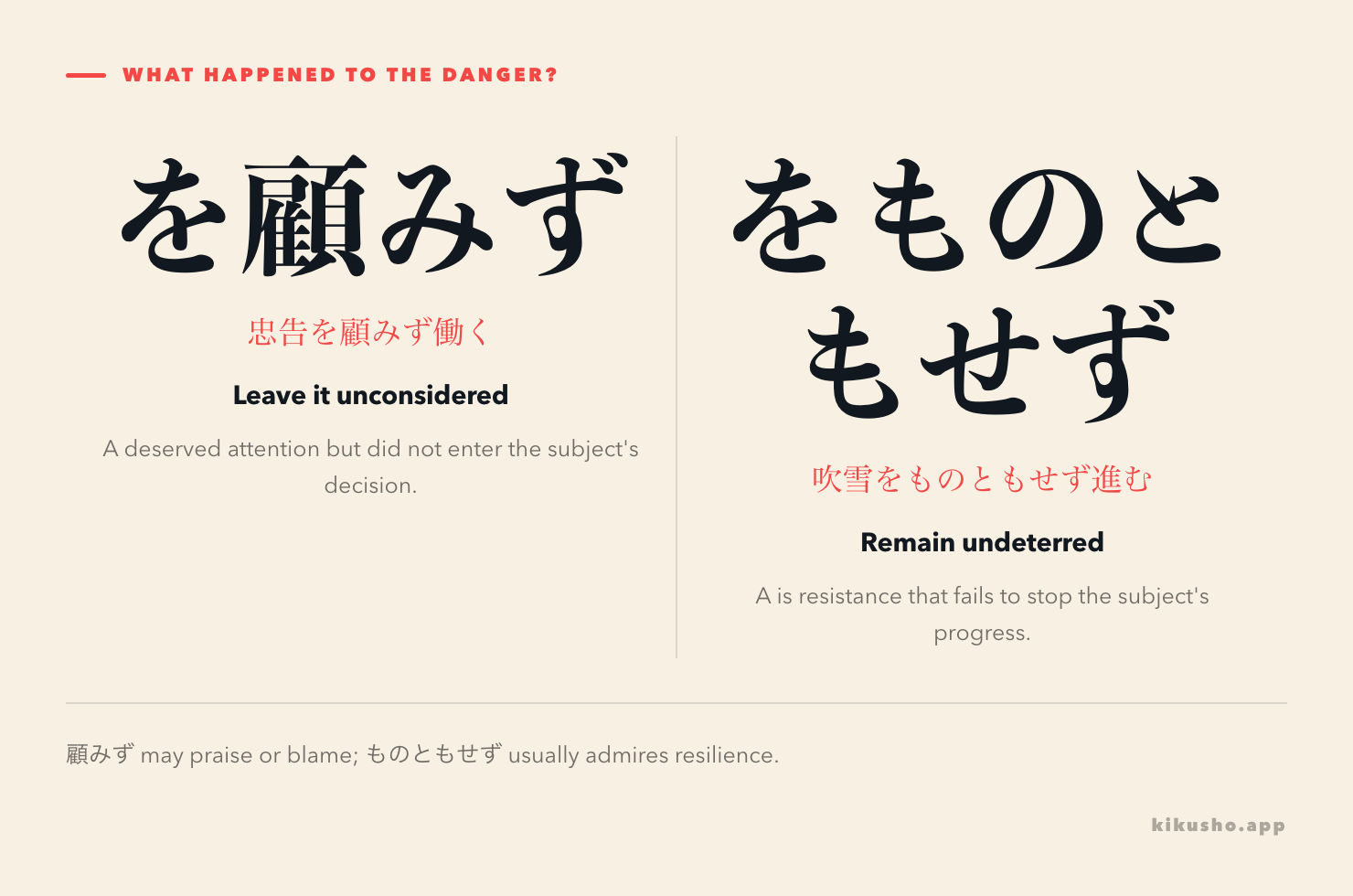
English regardless of or despite can flatten both patterns. Replace the translation with a question. Did the subject omit consideration that might have changed the action? Choose を顧みず. Did the subject meet resistance and continue as though it had little power? Choose をものともせず(に).
を顧みず leaves something unconsidered
顧みる(かえりみる) can mean to look back on or give thought to something. The literary negative connective 顧みず means “without considering” or “without heeding.” A noun comes before it with を or emphatic も.
彼は医師の忠告を顧みず、働き続けた。
かれは いしの ちゅうこくを かえりみず、はたらきつづけた。
He kept working without heeding his doctor's advice.
会社は採算を顧みず、店舗を増やした。
かいしゃは さいさんを かえりみず、てんぽを ふやした。
The company expanded its stores without regard for profitability.
彼女は自分の命も顧みず、川に飛び込んだ。
かのじょは じぶんの いのちも かえりみず、かわに とびこんだ。
Without even considering her own life, she jumped into the river.
The grammar does not supply praise by itself. The river sentence invites admiration because a person risks herself to save someone. Ignoring medical advice can be reckless. Ignoring profitability can be principled in a relief effort or irresponsible in ordinary management. You must read the beneficiary and consequence.
Ede Wakaru Nihongo confirms N + を/も顧みず, the “without considering” meaning and both admirable and blameworthy contexts. IMABI's comparative lesson independently explains that も is emphatic and gives risk, danger and advice as objects.
The ordinary negative form appears when the phrase modifies a noun or ends a sentence:
| Job | Form | Example |
|---|---|---|
| connect to a later action | Nを顧みず(に) + clause | 健康を顧みず働く |
| modify a noun | Nを顧みない + noun | 家族を顧みない生活 |
| finish the statement | Nを顧みなかった | 忠告を顧みなかった |
Do not confuse 顧みる with 省みる, also read かえりみる. 顧みる looks back toward a person, condition or consequence and is the spelling used in this pattern. 省みる commonly means to reflect on your own conduct, as in 自分の行いを省みる.
をものともせずに makes an obstacle look powerless
Nをものともせず(に)B says the subject continues B without being defeated, frightened or discouraged by N. The final に is optional.
選手は足の怪我をものともせず、最後まで走り抜いた。
せんしゅは あしの けがを ものともせず、さいごまで はしりぬいた。
Undeterred by a leg injury, the athlete ran to the finish.
住民たちは厳しい寒さをものともせずに、復旧作業を進めた。
じゅうみんたちは きびしい さむさを ものともせずに、ふっきゅう さぎょうを すすめた。
The residents pressed on with recovery work despite the severe cold.
彼女は周囲の批判をものともせず、研究を続けた。
かのじょは しゅういの ひはんを ものともせず、けんきゅうを つづけた。
She continued her research, undeterred by criticism around her.
The pattern is more than neutral concession. 怪我をしたにもかかわらず走った reports a result contrary to expectation. 怪我をものともせず走った evaluates the injury as an obstacle that could not stop the runner.
Nihongo no N1et gives the core attachment N + をものともせず(に), notes that に is frequently omitted, and describes the observer's admiration. Japanese Teacher Marutoku likewise limits the usual nouns to dangers, difficulties, opposition, pressure and harsh conditions. Bunpro's N1 entry supplies examples with opposition, economic difficulty and physical strain.
Because the expression praises resilience so strongly, speakers usually apply it to someone else. 私は批判をものともせず成功した can sound like self-applause. A biography, report or narrator can make the evaluation more naturally than the actor can.
A nominalized clause is possible when the whole event is the obstacle:
息が苦しくなるのをものともせず、彼は坂を登り続けた。
いきが くるしくなるのを ものともせず、かれは さかを のぼりつづけた。
He continued climbing the slope, undeterred by becoming short of breath.
For production, a compact adversity noun such as 怪我, 反対 or 寒さ is the clearest core pattern.
The same danger can receive two judgments
Compare two accounts of the same rescue:
消防士は危険を顧みず、建物に入った。
しょうぼうしは きけんを かえりみず、たてものに はいった。
The firefighter entered the building without regard for the danger.
消防士は危険をものともせず、建物に入った。
しょうぼうしは きけんを ものともせず、たてものに はいった。
Undeterred by the danger, the firefighter entered the building.
Both can praise courage. を顧みず keeps the cost in view: the firefighter did not let personal risk enter the decision. をものともせず magnifies resolve: the danger is depicted as unable to stop the firefighter.
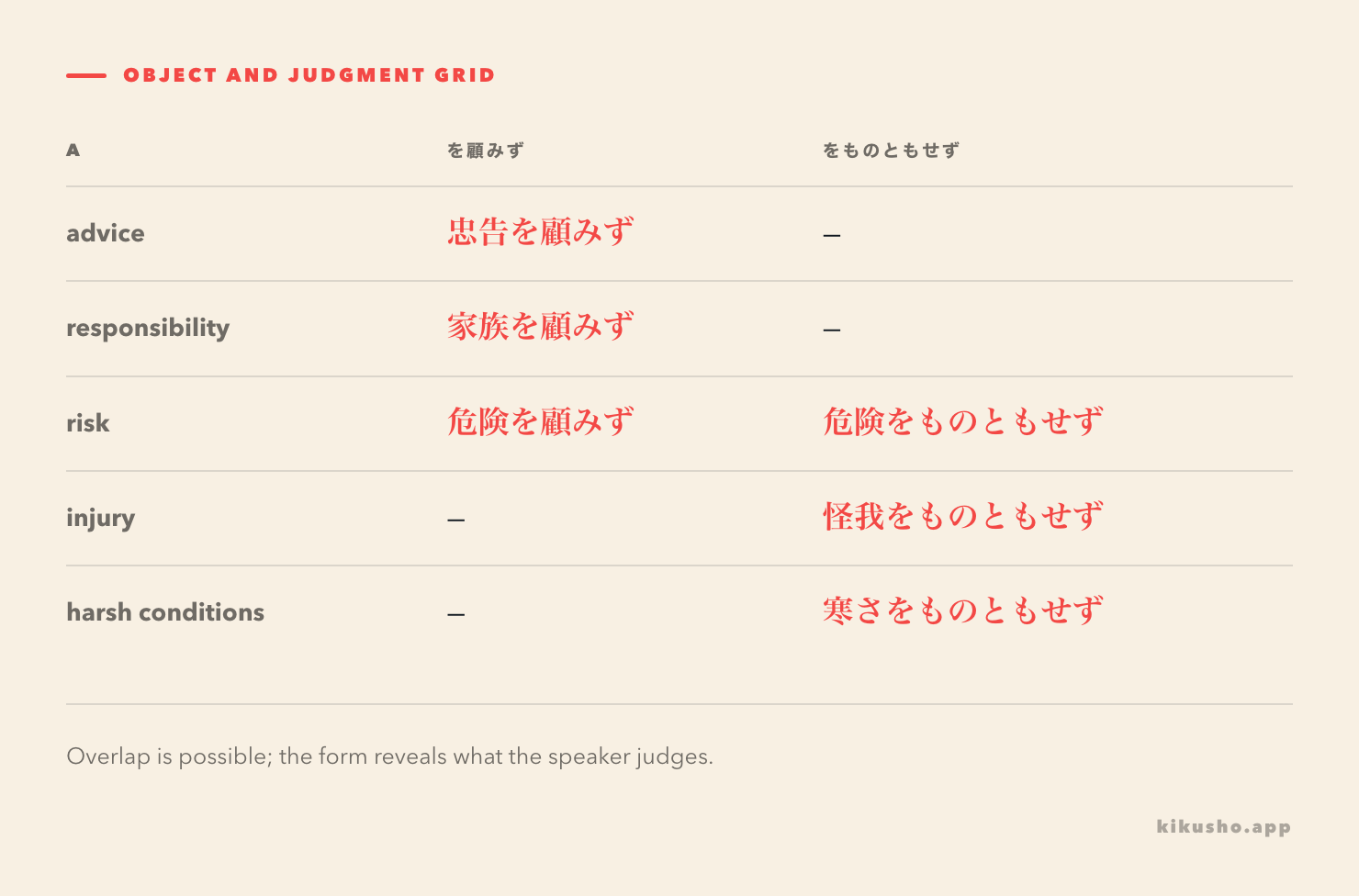
The overlap ends when A is owed care but is not an obstacle. 家族を顧みず仕事ばかりしている criticizes a person for neglecting family. 家族をものともせず would bizarrely cast the family itself as an adversity to defeat. Likewise, 医師の忠告を顧みず focuses on advice not heeded; 医師の忠告をものともせず turns that advice into resistance and sounds much more combative.
The reverse limit also matters. In 大雪をものともせず列車は走り続けた, snow is a physical impediment and the sentence celebrates continued movement. 大雪を顧みず would personify the train as failing to consider the snow, an odd viewpoint unless a human decision maker is understood.
Place nearby disregard forms by attitude
Several N1 expressions translate as “despite” or “regardless,” but they assign different attitudes:
- Nにもかかわらず states neutral concession: B happens although A predicts otherwise.
- Nをよそに says the subject acts apart from another person's concern, expectation or reaction, often critically.
- Nを押して stresses pushing through resistance such as illness or opposition by force of will.
- Nをものともせず presents adversity as no deterrent and often admires the subject.
- Nを顧みず says the subject did not consider N, leaving praise or blame to context.
The misplaced-attention lesson briefly locates をよそに as disregard for an external reaction. Here the useful boundary is internal: 顧みず names what should have been weighed, while ものともせず names what could have stopped progress.
The checked teaching references converge on an N1 placement, in agreement with Kikusho's inventory snapshot. Because the exam authority supplies neither a current catalogue of grammar points nor a guarantee that one form will appear, use N1 here as a source-backed study label.
For a Kikusho card, capture the form with the sentence's judgment. 反対を顧みず計画を進めた needs a note about whose concern was ignored. 反対をものともせず信念を貫いた needs the admired resolve. A bare translation such as “despite opposition” erases the decision you are trying to remember.
Practice: identify the speaker's judgment
Decide what A is doing in each sentence. Keep your seven choices closed until you have followed every consequence.
Question 1 · ignored advice
Complete: 彼は医師の忠告( )、徹夜で働き続けた。
- ア. を顧みず
- イ. をものともせず
- ウ. に基づいて
- エ. を機に
Question 2 · admired resilience
Complete: 選手は激しい痛み( )、試合を最後まで戦った。
- ア. を顧みない
- イ. をものともせず
- ウ. をよそへ
- エ. に先立ち
Question 3 · emphatic particle
Which sentence means “Without even considering his own safety, he went inside”?
- ア. 自分の安全をものにして、中へ入った。
- イ. 自分の安全が顧みず、中へ入った。
- ウ. 自分の安全も顧みず、中へ入った。
- エ. 自分の安全にものともせず、中へ入った。
Question 4 · noun modification
Which phrase naturally means “a lifestyle that neglects one's health”?
- ア. 健康を顧みず生活
- イ. 健康を顧みない生活
- ウ. 健康をものとも生活
- エ. 健康が顧みない生活
Question 5 · blame or praise
Read: 彼は家族を顧みず、仕事ばかりしている。 Which interpretation fits?
- ア. His family is a physical obstacle he heroically defeats.
- イ. He fails to give his family due consideration, and the sentence criticizes him.
- ウ. His family formally approves his work.
- エ. He works only after consulting his family.
Question 6 · optional に
Which pair contains two grammatical versions of the same pattern?
- ア. 困難をものともせず / 困難をものともせずに
- イ. 困難がものともせず / 困難にものでせず
- ウ. 困難を顧みるず / 困難も顧みてず
- エ. 困難にものともする / 困難をものにとも
Question 7 · same noun, changed viewpoint
Choose the pair that first stresses an unweighed risk, then an obstacle overcome:
記者は身の危険(甲)、現場へ向かった。激しい砲撃(乙)、取材を続けた。
- ア. 甲 をものともせず / 乙 を顧みず
- イ. 甲 も顧みず / 乙 をものともせず
- ウ. 甲 を機に / 乙 を経て
- エ. 甲 にもかかわらず / 乙 をよそに
Answers and explanations
1 — ア, を顧みず. A doctor's warning is advice that deserved consideration but was ignored. The sentence criticizes the subject for continuing harmful work.
2 — イ, をものともせず. Pain is presented as an adversity that could not deter the athlete. The construction adds admiration beyond neutral にもかかわらず.
3 — ウ. も replaces the ordinary object marker and emphasizes that the subject did not even consider personal safety. The other choices have the wrong particle or construction.
4 — イ. Before 生活, the verb takes its ordinary negative attributive form 顧みない. The connective 顧みず cannot directly modify the noun in this phrase.
5 — イ. Family is owed attention; it is not an obstacle the speaker admires someone for defeating. 顧みず therefore supports a criticism of neglect.
6 — ア. The final に in をものともせずに may be omitted. Both versions connect the adversity to the following action.
7 — イ. 身の危険も顧みず stresses risk left out of consideration. 激しい砲撃をものともせず portrays shelling as an obstacle that failed to stop the reporting.
A sentence can admire the act and still expose its cost
The strongest writing sometimes uses を顧みず precisely because praise is incomplete. 自分の健康も顧みず被災者を支えた honors devotion while leaving the neglected health visible. Replacing it with をものともせず would turn poor health into a defeated obstacle and soften that cost.
That is the final check: decide whether the sentence should keep A morally present. 顧みず leaves the unpaid cost on the page. ものともせず clears the obstacle from the path.
Common questions
What is the difference between を顧みず and をものともせずに?
を顧みず says the subject gives no consideration to a risk, warning, responsibility or affected person. をものともせずに presents a hardship as unable to deter the subject and often carries admiration for resilience.
Can を顧みず describe both bravery and neglect?
Yes. 危険を顧みず人を救った can praise courage, while 医師の忠告を顧みず無理をした criticizes someone for ignoring advice. The noun and consequence determine the judgment.
What is the difference between を顧みず and も顧みず?
Both are grammatical. を marks the ordinary object of 顧みる, while も adds emphasis such as “without even considering,” especially in phrases like 自分の命も顧みず.
Can I use をものともせずに about myself?
The form strongly evaluates someone as undeterred, so it is most natural in an observer's description. First-person use can sound self-congratulatory unless the context clearly supports that rhetoric.