On this page
を限りに makes A the final time or occasion before something stops. を境に(して) makes A the boundary across which a situation changes. Ask whether the sentence closes an activity or divides its history into a before and an after.
本日を限りに、電話での受付を終了します。
ほんじつを かぎりに、でんわでの うけつけを しゅうりょうします。
As of today, we will stop accepting requests by phone.
あの事故を境に、安全基準が大きく変わった。
あの じこを さかいに、あんぜん きじゅんが おおきく かわった。
That accident marked a major change in safety standards.
The first sentence cares about the last day of a service. The second cares about the contrast between standards before and after an event. English as of, after and from can hide that difference.
Decide whether A is the last item or a dividing line
| Form | What A becomes | What the later clause usually reports | Useful paraphrase |
|---|---|---|---|
| Nを限りに、B | the final time, period or occurrence | a continuing activity ends or will not happen again | Nを最後に |
| Nを境に(して)、B | the boundary between two phases | a state, relationship, habit or trend changes | Nの前後で変化して |
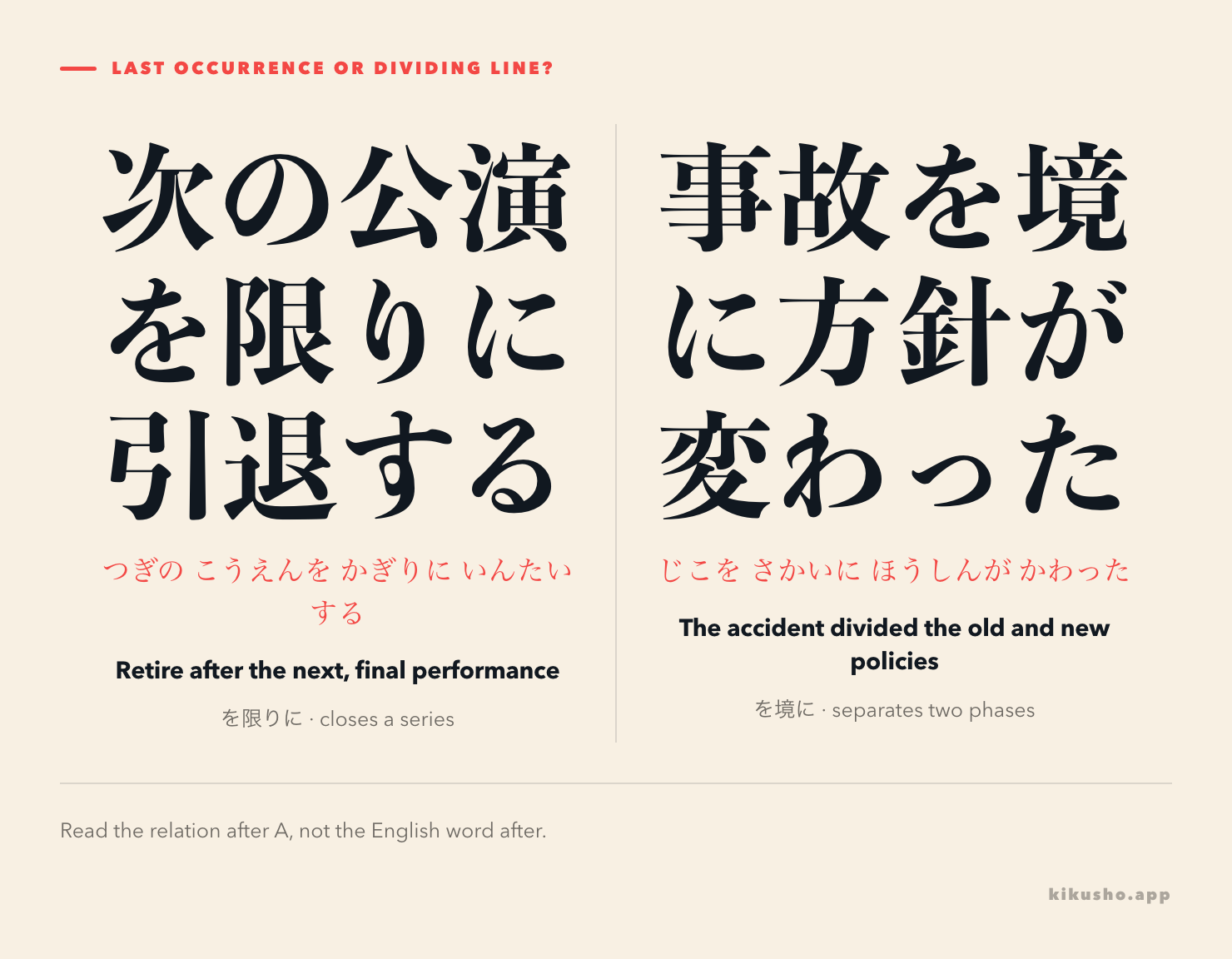
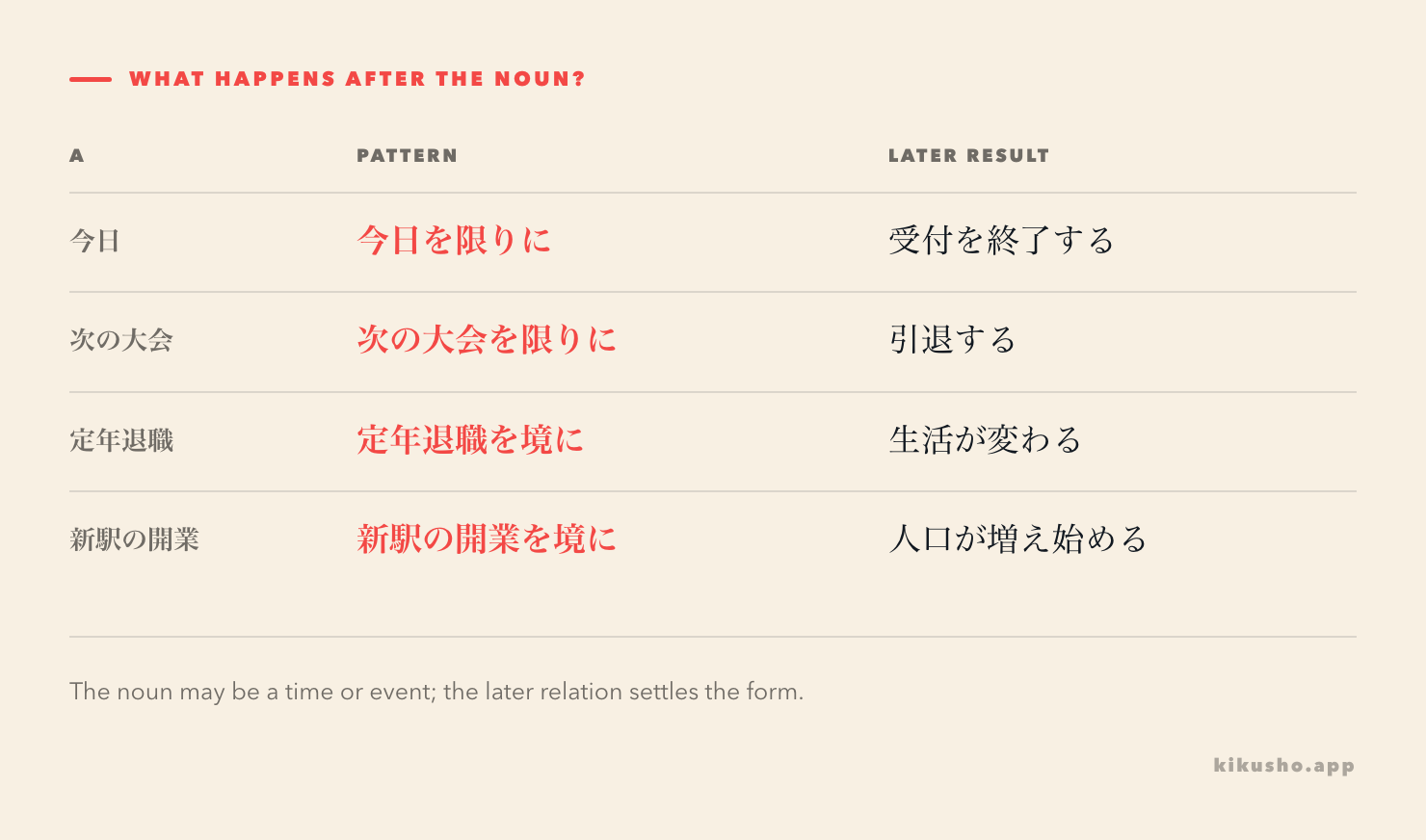
The verbs after A are strong clues. 終了する, やめる, 引退する, 閉店する and 解散する often close a run and attract を限りに. 変わる, 増える, 減る, なくなる, 始まる and 見直す often describe a new phase and attract を境に. The verb is evidence, not a mechanical rule: read what relation the speaker builds around A.
を限りに names the final occurrence
The core attachment is time or event noun + を限りに. A can be a calendar point such as 今日, 今月 or 今年度, or a bounded event such as 今回の公演 and 次の大会.
今学期を限りに、この講座は終了します。
こんがっきを かぎりに、この こうざは しゅうりょうします。
This course will end after the current term.
次の大会を限りに、現役を引退するつもりだ。
つぎの たいかいを かぎりに、げんえきを いんたいする つもりだ。
I intend to retire as an athlete after the next tournament.
今回を限りに、同じ遅刻は繰り返しません。
こんかいを かぎりに、おなじ ちこくは くりかえしません。
This will be the last time I am late like this.
The endpoint may be in the past, present or future. What matters is that the named occasion counts as the last member of something that has continued or recurred. A shop can announce a future closing; a speaker can make a decision beginning today; a biography can look back at the final performance.
Nihongo Kyoshi Net defines the pattern as making A the last point before an ongoing activity stops and gives N + を限りに. Nihongo no N1et independently gives the same noun attachment and illustrates personal decisions, scheduled closures and final events.
Do not transfer every use of 限り into this construction. 生きている限り means “as long as one lives.” 私の知る限り limits a claim to what the speaker knows. 声を限りに叫ぶ uses the noun 限り for the maximum extent of the voice. Only time or occasion + を限りに supplies the final-occurrence reading taught here.
を境に divides two phases
The attachment is event or time noun + を境に(して). A is a conceptual border. The later clause tells you how life, behavior, a relationship or a measurable trend differs on the far side of it.
定年退職を境に、父の生活のリズムが変わった。
ていねん たいしょくを さかいに、ちちの せいかつの リズムが かわった。
My father's daily rhythm changed after his retirement.
新駅の開業を境に、この町の人口は増え始めた。
しんえきの かいぎょうを さかいに、この まちの じんこうは ふえはじめた。
The opening of the new station marked the point when this town's population began to grow.
その敗北を境にして、チームは練習方法を全面的に見直した。
その はいぼくを さかいにして、チームは れんしゅう ほうほうを ぜんめんてきに みなおした。
After that defeat, the team completely reconsidered how it trained.
して is optional in this grammar. Both versions place the event between an earlier state and a later one. The form does more work than an ordinary 後で: it invites the reader to compare the two phases.
J-nihongo states that the boundary must involve a clear change rather than merely naming a starting time. Nihongo Kyoshi Net's を境に lesson likewise defines N + を境に through a substantial before-and-after change and illustrates shifts in relationships, residence, habits and expression.
A physical border can also take the ordinary noun 境: この川を境に二つの地域が分かれている means that the river divides two areas. That literal spatial use helps explain the image, but the N1 time pattern normally turns an event into a boundary in a history.
The same event can support either viewpoint
One event may be both a final occurrence and a turning point. The form tells the reader which relation matters.
昨年の公演を限りに、彼女は舞台を引退した。
さくねんの こうえんを かぎりに、かのじょは ぶたいを いんたいした。
She retired from the stage after last year's performance, which was her final one.
昨年の公演を境に、彼女の演技は大きく変わった。
さくねんの こうえんを さかいに、かのじょの えんぎは おおきく かわった。
Last year's performance marked a major change in her acting.
With を限りに, the performance belongs to the career being closed. With を境に, it separates two versions of the actor's work. Saying only “after last year's performance” loses both judgments.
This also explains an apparent overlap such as quitting smoking. 今日を限りにたばこをやめる presents today as the cutoff and often sounds like a decision. 結婚を境にたばこをやめた looks back on marriage as the line separating an old habit from a new life. Both report cessation, but they organize the event differently.
Nearby turning-point forms choose different relations
- Nをもって marks an official cutoff, means or standard. In a notice, 本日をもって受付を終了します is more institutional than 本日を限りに.
- Nを機に treats A as an occasion that prompts a new choice: 転職を機に勉強を始めた.
- Nを境に treats A as the dividing line revealed by a change: 転職を境に生活が変わった.
- N以来 simply measures from A to the present or another reference point. It does not by itself say that A caused or marked a sharp change.
- Nを最後に is the transparent paraphrase closest to Nを限りに.
The を経て and を機に comparison follows a process into its result and then a milestone into a new action. The three strong evaluations with 限り keeps the adjective pattern 限りだ separate from this temporal endpoint.
Independent teaching references place both target constructions at N1, and Kikusho's inventory records no level disagreement. The official JLPT FAQ explains why the post-2010 test no longer publishes itemized vocabulary, kanji and grammar specifications, so N1 here is a reference-supported study placement rather than an official guarantee about a future question.
A useful Kikusho capture should retain both sides of the pivot: the named event and what follows it. Saving only を境に = after erases the contrast between the earlier and later phases. The full sentence gives your next review enough context to reconstruct the relation.
Practice: identify the relation around A
Commit to an answer for every boundary before you unfold the key.
Question 1 · scheduled ending
Complete: 次回の公演( )、この劇団は解散します。
- ア. を限りに
- イ. を境に
- ウ. に限って
- エ. の限りで
Question 2 · a change in policy
Complete: あの事件( )、会社の安全方針が大きく変わった。
- ア. を限りに
- イ. を境に
- ウ. の限りでは
- エ. に限らず
Question 3 · one day, two viewpoints
Which pair first makes today the cutoff for a habit, then makes today the boundary of a wider life change?
- ア. 今日を境に酒をやめる / 今日を限りに生活が変わった
- イ. 今日を限りに酒をやめる / 今日を境に生活が変わった
- ウ. 今日に限り酒をやめる / 今日の境で生活を変わった
- エ. 今日の限りに酒をやめる / 今日が境に生活が変わった
Question 4 · noun attachment
Which sentence naturally uses a noun event as the boundary of a change?
- ア. 大学を卒業した境に、生活が変わった。
- イ. 大学卒業を境に、生活が変わった。
- ウ. 大学卒業が限りに、生活が変わった。
- エ. 大学卒業に境を、生活が変わった。
Question 5 · what the form asserts
Read: 今年度を限りに、この制度は廃止されます。 What does を限りに contribute?
- ア. The system changes repeatedly throughout the year.
- イ. This fiscal year is the final period in which the system exists.
- ウ. Only people in this fiscal year may use the system.
- エ. The claim is limited to what the speaker knows.
Question 6 · occasion or boundary
Choose the pair that presents moving as a prompt for a deliberate purchase, then as the line after which a relationship changed:
引っ越し(甲)、家具を買い替えた。引っ越し(乙)、近所の友人とは疎遠になった。
- ア. 甲 を境に / 乙 を機に
- イ. 甲 を機に / 乙 を境に
- ウ. 甲 を限りに / 乙 をもって
- エ. 甲 以来に / 乙 を最後で
Question 7 · build the announcement
Arrange the pieces into a natural sentence meaning “As of this month, this service will end.”
- このサービスは
- 今月を限りに
- 終了します
Answers and explanations
1 — ア, を限りに. The next performance is the troupe's final occurrence before it disbands. を境に would require a meaningful contrast between its condition before and after the performance.
2 — イ, を境に. The incident divides the company's old safety policy from its changed policy. The sentence describes a before-and-after shift rather than ending a repeated activity at its last occurrence.
3 — イ. 今日を限りに酒をやめる makes today the cutoff for drinking. 今日を境に生活が変わった looks back across today as a boundary separating two phases of life.
4 — イ. 大学卒業 is a noun event and attaches directly to を境に. The other choices break the required attachment or particle pattern.
5 — イ. The form identifies this fiscal year as the last period before the system ceases to exist. It is not the selective に限り, the knowledge-range 限りでは or a description of gradual change.
6 — イ. を機に presents the move as an occasion used to make a new purchase. を境に presents it as the boundary after which the friendship changed.
7 — 2 → 1 → 3. The complete sentence is 今月を限りに、このサービスは終了します。 The time noun plus を限りに comes first and marks the final period; the following clause states what will end.
Common questions
What is the difference between を限りに and を境に?
を限りに makes a time or event the final occurrence before an ongoing activity ends. を境に makes a time or event the boundary across which a state, relationship, habit or trend changes.
What comes before を限りに?
A noun naming a time or final occasion, such as 今日, 今月, 今学期 or 今回の公演, comes before を限りに. The following clause normally says that an activity ends, someone retires or something will no longer happen.
Can を境に be followed by して?
Yes. Both Nを境に and Nを境にして mark a before-and-after boundary. The longer form does not change the core meaning.
Is を限りに the same as をもって?
Both can mark a cutoff, but をもって is especially formal and common in official notices. を限りに presents the named occasion as the last one in a continuing series and also appears in personal decisions.