On this page
Use を兼ねて when one deliberate action also serves an additional purpose. In Aを兼ねてB, B is the main action, while the noun A names the extra purpose built into it.
運動を兼ねて、一駅先まで歩いている。
うんどうをかねて、ひとえきさきまであるいている。
I walk one station farther, also for exercise.
The speaker's main action is walking one station farther. 運動 explains the second purpose that the same walk fulfils; it is neither an accidental result nor a separate errand.
This page teaches the assigned N1 grammar item を兼ねて (g-a066753850bf). The level is a study-guide estimate: Kikusho's inventory, JLPT Sensei, Nihongo Kyoshi Net and Tanosuke place the form at N1, while Mainichi Nonbiri places it at N2. The JLPT organizers explain that they no longer publish an exhaustive item list, so the disagreement cannot be settled by an official grammar list.
One action carries a second purpose
The basic relationship is:
additional purpose + を兼ねて + main action
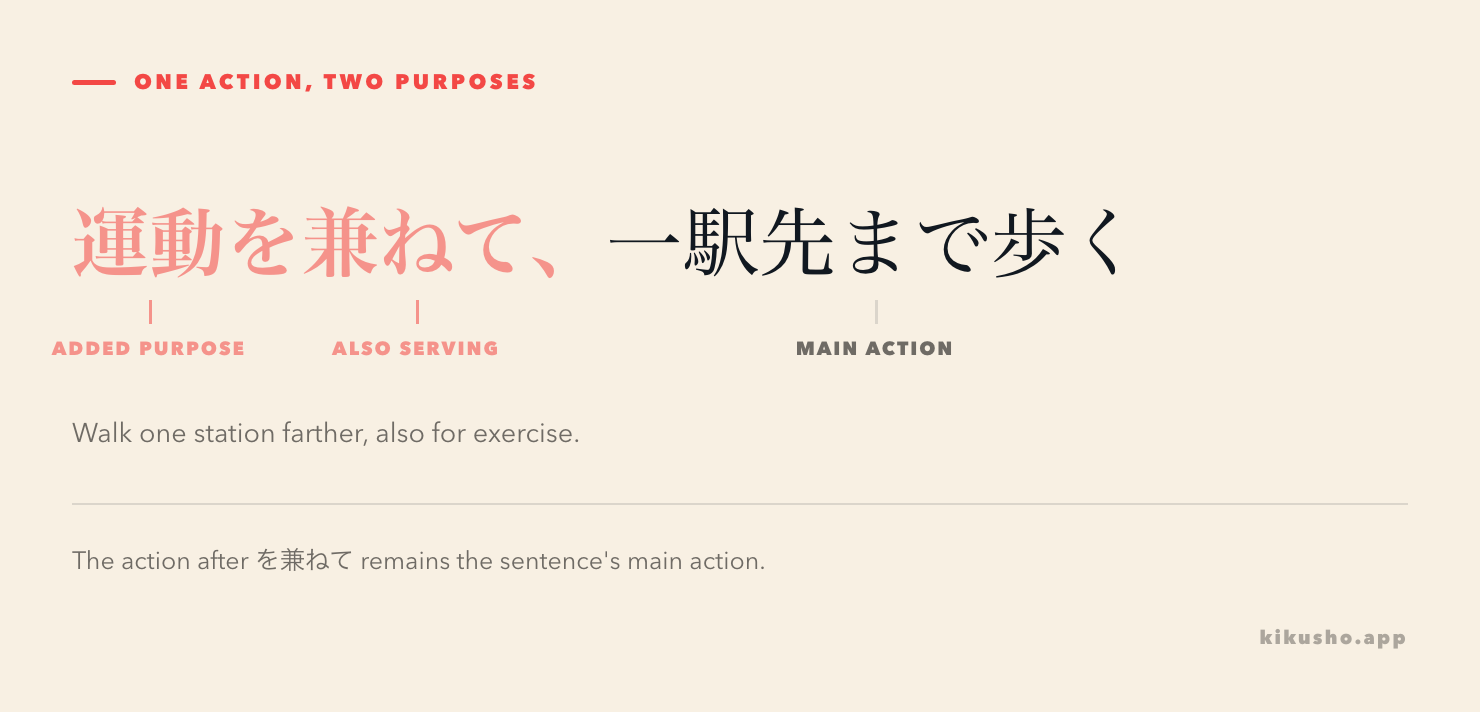
This order matters. The phrase before を兼ねて does not normally describe the main event. It tells you what else the following action is meant to accomplish.
市場調査を兼ねて、海外の店舗を視察した。
しじょうちょうさをかねて、かいがいのてんぽをしさつした。
We inspected stores overseas, also as market research.
お礼を兼ねて、先生を食事に招いた。
おれいをかねて、せんせいをしょくじにまねいた。
I invited my teacher to a meal, also as a way of thanking them.
The store visit is the action performed; market research is an added purpose. The meal invitation is the action performed; expressing thanks is another purpose the invitation serves. In both sentences, one chosen action naturally accomplishes both aims.
Attach a purpose noun before を兼ねて
Attach を兼ねて to a noun that can name a purpose, function or intended benefit.
| Purpose noun | Pattern | Main action |
|---|---|---|
| 運動, exercise | 運動を兼ねて | 歩く, walk |
| 市場調査, market research | 市場調査を兼ねて | 店舗を視察する, inspect stores |
| お礼, thanks | お礼を兼ねて | 食事に招く, invite someone to a meal |
| 研修, training | 研修を兼ねて | 工場を訪問する, visit a factory |
視察と研修を兼ねて、社員を新しい工場へ派遣した。
しさつとけんしゅうをかねて、しゃいんをあたらしいこうじょうへはけんした。
We sent employees to the new factory for both inspection and training.
The coordinated form N1とN2を兼ねて explicitly names two purposes. も can instead emphasize that the added purpose joins another motive already understood:
気分転換も兼ねて、海辺を歩いた。
きぶんてんかんもかねて、うみべをあるいた。
I walked by the sea, partly for a change of pace too.
も does not change the basic structure. It highlights the sense of “also” before 兼ねて.
The later clause remains the main action
Three checks help decide whether を兼ねて fits:
- There is one central action in the later clause.
- That action can intentionally serve the noun's purpose.
- The two purposes belong naturally to the same occasion.
昼食を兼ねて、取引先と打ち合わせをした。
ちゅうしょくをかねて、とりひきさきとうちあわせをした。
I met with a client over lunch, combining the meeting with lunch.
Here the meeting is the main action, and lunch is a second function of the same occasion. By contrast, 散歩を兼ねて雨が降った fails because rain is not a deliberate action that can serve the purpose of taking a walk. 買い物を兼ねて、その後映画を見た is also awkward if shopping and watching a film are simply two separate events; the grammar asks the reader to understand one integrated action or occasion.
The noun should name a purpose, not an emotion placed into an action. For that meaning, use を込めて:
感謝を込めて、手紙を書いた。
かんしゃをこめて、てがみをかいた。
I wrote the letter with gratitude.
The gratitude is expressed through the letter. It is not a second practical purpose in the same structural sense as exercise, research or training.
兼ねる can describe roles without this connector
The verb 兼ねる also has a lexical use: one person, room or object performs two roles or functions. This use is not the Nを兼ねて + action connector.
この部屋は書斎と客間を兼ねている。
このへやはしょさいときゃくまをかねている。
This room serves as both a study and a guest room.
部長が会議の司会と通訳を兼ねている。
ぶちょうがかいぎのしかいとつうやくをかねている。
The department head serves as both moderator and interpreter for the meeting.
The lexical pattern often appears as N1がN2を兼ねる or N1とN2を兼ねる. It describes what something is or which roles someone holds. The connector Nを兼ねて instead attaches that additional purpose to a following action.
Choose ついでに or がてら when the relation changes
English “while” and “also” can hide different Japanese relationships. Choose from the structure of the situation.
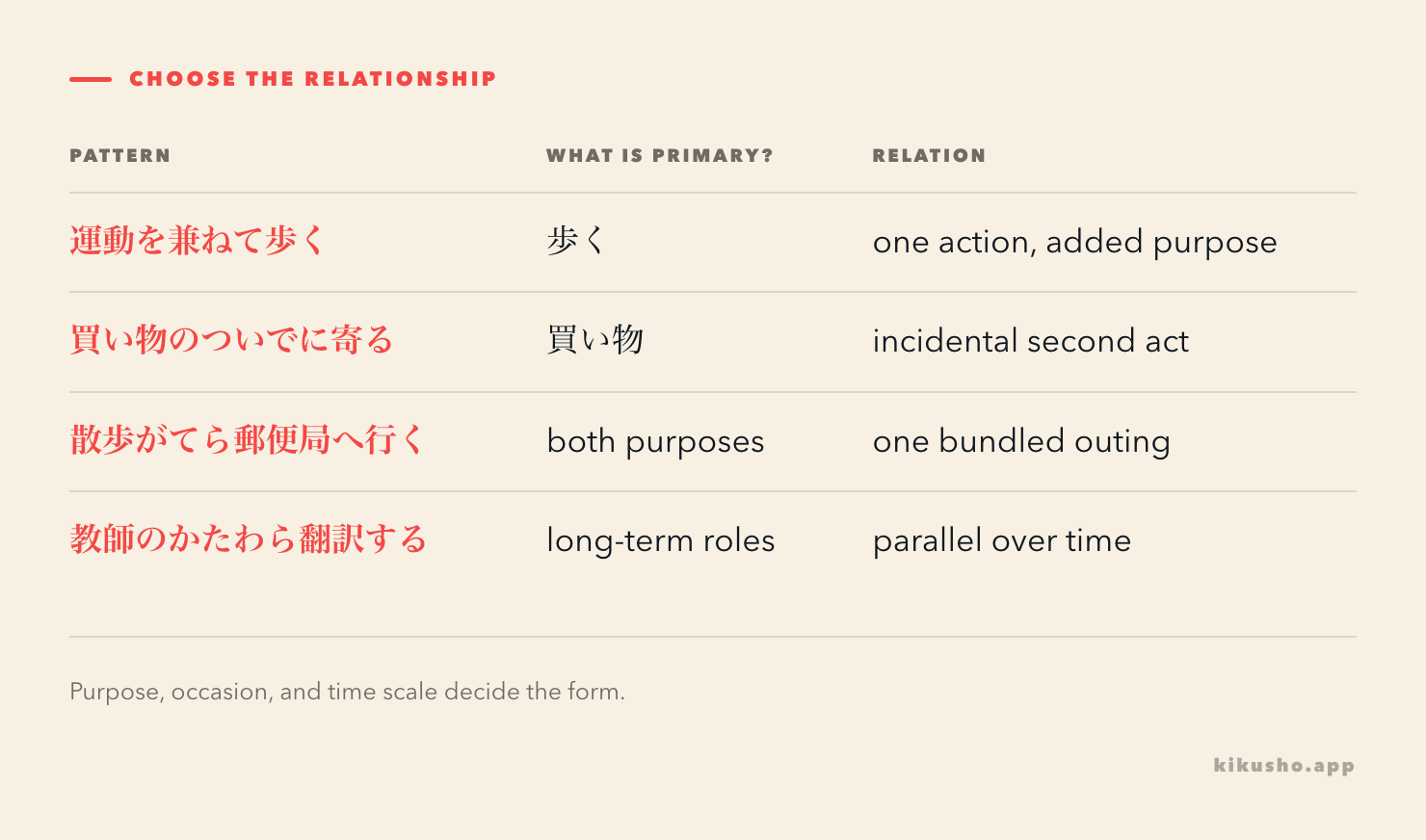
を兼ねて makes the action after it central and gives that action an additional purpose:
運動を兼ねて、会社まで歩いた。
うんどうをかねて、かいしゃまであるいた。
I walked to work, also for exercise.
ついでに starts from an action or occasion already under way, then adds a convenient extra act:
買い物のついでに、銀行に寄った。
かいもののついでに、ぎんこうによった。
While out shopping, I stopped at the bank too.
Shopping supplies the occasion; the bank visit is incidental. The 一度に and ついでに lesson develops that main-occasion and extra-errand relationship.
がてら often bundles two purposes into one outing and can make them feel more balanced:
散歩がてら、郵便局まで行った。
さんぽがてら、ゆうびんきょくまでいった。
I went to the post office while out for a walk.
The がてら, かたがた and かたわら lesson compares the outing, courtesy and long-term-role patterns in detail. がてら is especially comfortable with movement and outings; を兼ねて directly labels a purpose and works readily in planned, professional contexts such as research, training and inspection.
かたわら covers sustained parallel roles rather than one action with two purposes:
教師のかたわら、翻訳の仕事もしている。
きょうしのかたわら、ほんやくのしごともしている。
Alongside being a teacher, I also work as a translator.
Finally, にかこつけて treats one reason as a pretext for another aim, often with a critical tone: 出張にかこつけて観光した means someone used the business trip as an excuse to sightsee. 出張を兼ねて観光した instead presents the two purposes openly as part of the plan.
For a Kikusho card, keep the purpose noun and the whole following action together. Saving only 運動を兼ねて hides which act serves as exercise; saving only the final verb removes the added purpose. Recall the direction as extra purpose → を兼ねて → main action during offline review.
Practice: trace the two purposes
Trace the purpose relationship in every item, then reveal the feedback after Question 7.
Question 1 — identify the added purpose. Fill the gap in 運動( )、毎朝一駅先まで歩いている。
- ア. を兼ねて
- イ. のついでに
- ウ. を込めて
- エ. のかたわら
Question 2 — interpretation. Which sentence clearly presents one main action that also serves a second planned purpose?
- ア. 市場調査を兼ねて、海外の店舗を視察した。
- イ. 市場調査のついでに、偶然雨が降った。
- ウ. 市場調査を込めて、海外の店舗を視察した。
- エ. 市場調査のかたわら、一度だけ店に入った。
Question 3 — emphasis. Complete the sentence with the form that naturally emphasizes “also as a change of pace”: 気分転換( )、庭で昼食を取った。
- ア. のついでに
- イ. にかこつけて
- ウ. も兼ねて
- エ. を込めて
Question 4 — lexical 兼ねる. What does この部屋は書斎と客間を兼ねている mean?
- ア. The room is beside both the study and the guest room.
- イ. The room serves as both a study and a guest room.
- ウ. Someone visits the room for a second errand.
- エ. Someone puts the feeling of hospitality into the room.
Question 5 — を兼ねて or ついでに. You were already shopping and made a convenient extra stop at the bank. Which sentence best matches?
- ア. 銀行を兼ねて、買い物をした。
- イ. 買い物を込めて、銀行に寄った。
- ウ. 買い物のかたわら、銀行に寄った。
- エ. 買い物のついでに、銀行に寄った。
Question 6 — meaning boundary. Complete the sentence: 感謝( )、手紙を書いた。 The intended meaning is “I wrote the letter with gratitude.”
- ア. を兼ねて
- イ. を込めて
- ウ. がてら
- エ. のついでに
Question 7 — sentence composition. Put these pieces in natural order to say “I invited my teacher to a meal, also as a way of thanking them.”
- 先生を食事に招いた
- お礼を兼ねて
- 、
Answers and explanations
Answer 1. ア, を兼ねて. Walking one station farther is the main action, and exercise is its added purpose. のついでに would make exercise an established occasion followed by a separate extra act. を込めて expresses a feeling invested in an action, and noun + かたわら describes a sustained parallel role.
Answer 2. ア, 市場調査を兼ねて、海外の店舗を視察した. The inspection is one deliberate action that also performs market research. Rain in イ is accidental, を込めて in ウ does not mark a practical second purpose, and かたわら in エ needs a sustained parallel activity.
Answer 3. ウ, も兼ねて. The particle も emphasizes that eating lunch in the garden also serves as a change of pace. The basic purpose relationship remains the same as with を兼ねて.
Answer 4. イ. This is lexical 兼ねる: one room performs two functions, study and guest room. It does not connect an added purpose to a later main action.
Answer 5. エ, 買い物のついでに、銀行に寄った. Shopping was already the main occasion, and the bank was a convenient extra errand. を兼ねて would require a noun naming an added purpose that the following main action deliberately serves.
Answer 6. イ, を込めて. 感謝を込めて means putting or expressing gratitude through the letter. 感謝を兼ねて would present thanks as one practical purpose of a separate main action and would create a different relationship.
Answer 7. お礼を兼ねて、先生を食事に招いた. The invitation is the main action, and thanking the teacher is the added purpose. The purpose noun comes before を兼ねて, followed by the action that carries both aims.
Common questions
What does を兼ねて mean?
In Aを兼ねてB, B is the main action and A is an additional purpose that the same action deliberately fulfils. It often translates as “also as,” “partly for,” or “combining B with A.”
What comes before を兼ねて?
Put a noun before it: 運動を兼ねて, 市場調査を兼ねて or お礼を兼ねて. You can add も for emphasis, as in 気分転換も兼ねて, or coordinate two nouns with と.
What is the difference between を兼ねて and ついでに?
を兼ねて presents one planned action as serving an added purpose. ついでに starts from an established action or occasion and adds a convenient extra errand, so the two actions remain more distinct.
Is を兼ねて N1 or N2 grammar?
Kikusho, JLPT Sensei, Nihongo Kyoshi Net and Tanosuke place it at N1, while Mainichi Nonbiri lists it as N2. The official JLPT does not publish a current item-by-item grammar list, so level labels are study-guide estimates.