On this page
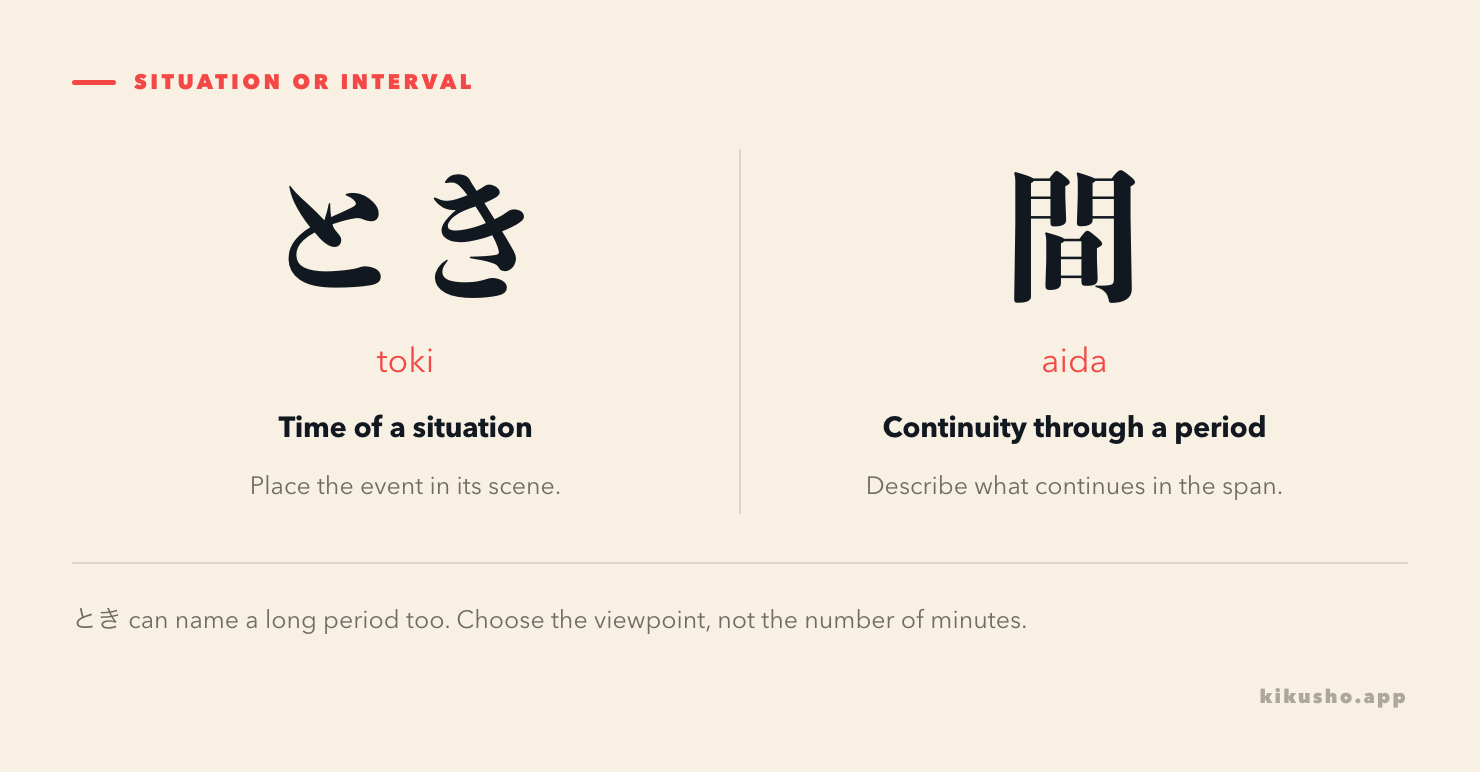
会議が始まったとき、窓を閉めました places closing the window at the start of a meeting. 会議の間、窓は閉まっていました instead reports that the window remained closed during the meeting: とき locates the situation, while 間, read あいだ, highlights the interval and what continues through it.
The window gives you a useful test. Are you reporting when someone closed it, or the state it stayed in?
Ask whether you are locating something or describing its duration
とき, read とき (toki), means the time when a situation applies or an event occurs. 間, read あいだ (aida) in this construction, names the span during which another activity or state continues.
| What you want to report | Useful frame | What the listener receives |
|---|---|---|
| what happened when the meeting began | 会議が始まったとき | the occasion of the action |
| what stayed true during the meeting | 会議の間 | the interval of the state |
| what you normally do when free | 暇なとき | a recurring situation |
| what continues while someone is reading | 読んでいる間 | a period of ongoing activity |
This N4 grammar comparison teaches とき and bare 間, without に. It builds on a form many learners meet at N5: JLPT Sensei labels とき N5, while Bunpro labels it N4. Sensei places bare 間 at N4. Treat とき as the earlier-level foundation for this comparison. These lists estimate learning stages; the JLPT does not publish an exhaustive official grammar syllabus.
とき gives an event or situation a place in time
You can place an action at the time something else happens:
会議が始まったとき、窓を閉めました。
かいぎがはじまったとき、まどをしめました。
When the meeting began, I closed the window.
始まった describes the meeting's beginning. 閉めました reports the action performed then. The sentence does not specify whether the window remained closed for the rest of the meeting.
とき can also introduce an ordinary repeated situation:
暇なとき、古い写真を整理します。
ひまなとき、ふるいしゃしんをせいりします。
When I have free time, I sort old photographs.
This is a habit, rather than the account of one particular afternoon. Context and the final predicate determine whether you are describing a single occasion, a routine or a future event.
The time phrase comes before the main statement: 暇なとき first, then what you do. Bunpro's own とき explanation covers both individual events and repeated situations.
Do not reduce とき to “one instant.” 子供のとき, こどものとき, means “when I was a child.” Childhood is long; とき can still use it to locate a memory. 学生のとき、京都に住んでいました means “When I was a student, I lived in Kyoto.” That describes a sustained state with とき, so sustained meaning alone never makes the form ungrammatical.
間 makes the interval part of the statement
With bare 間, the main statement describes what continues during the stated span:
会議の間、窓は閉まっていました。
かいぎのあいだ、まどはしまっていました。
The window was closed during the meeting.
閉まっていました describes the resulting closed state. It does not say who closed the window. This is the state counterpart to the earlier action 閉めました; the transitive and intransitive comparison explains that verb choice.
An ongoing action can provide the span:
先生が説明している間、ずっとメモを取っていました。
せんせいがせつめいしているあいだ、ずっとメモをとっていました。
I kept taking notes while the teacher was explaining.
説明している supplies the explanation in progress. ずっと makes the continued note-taking explicit. The two subjects can differ: the teacher explains, and you take notes. 間 does not require one person to perform both activities.
Mango Languages' account of duration, by Akiko Kashiwagi-Wood, distinguishes an activity that continues during an interval from an event merely occurring within it. JLPT Sensei's bare 間 lesson likewise pairs this continuing use with ずっと.
Continuity can also be a pattern repeated across a stay. 日本にいる間、毎晩、日記を書いていました means “While I was in Japan, I wrote a diary every evening.” 毎晩 states the frequency. Nobody is claiming that the pen moved without interruption from arrival to departure; the nightly routine held during the stay.
Both forms follow a modifier, with の or な where needed
The following table gives basic affirmative attachments. Choose an input that can supply a meaningful interval when using 間.
| Input | Before とき | Before 間 |
|---|---|---|
| noun 休み, break | 休みのとき | 休みの間 |
| な-adjective 静か, quiet | 静かなとき | 静かな間 |
| い-adjective 明るい, light | 明るいとき | 明るい間 |
| ongoing verb 読んでいる, reading | 読んでいるとき | 読んでいる間 |
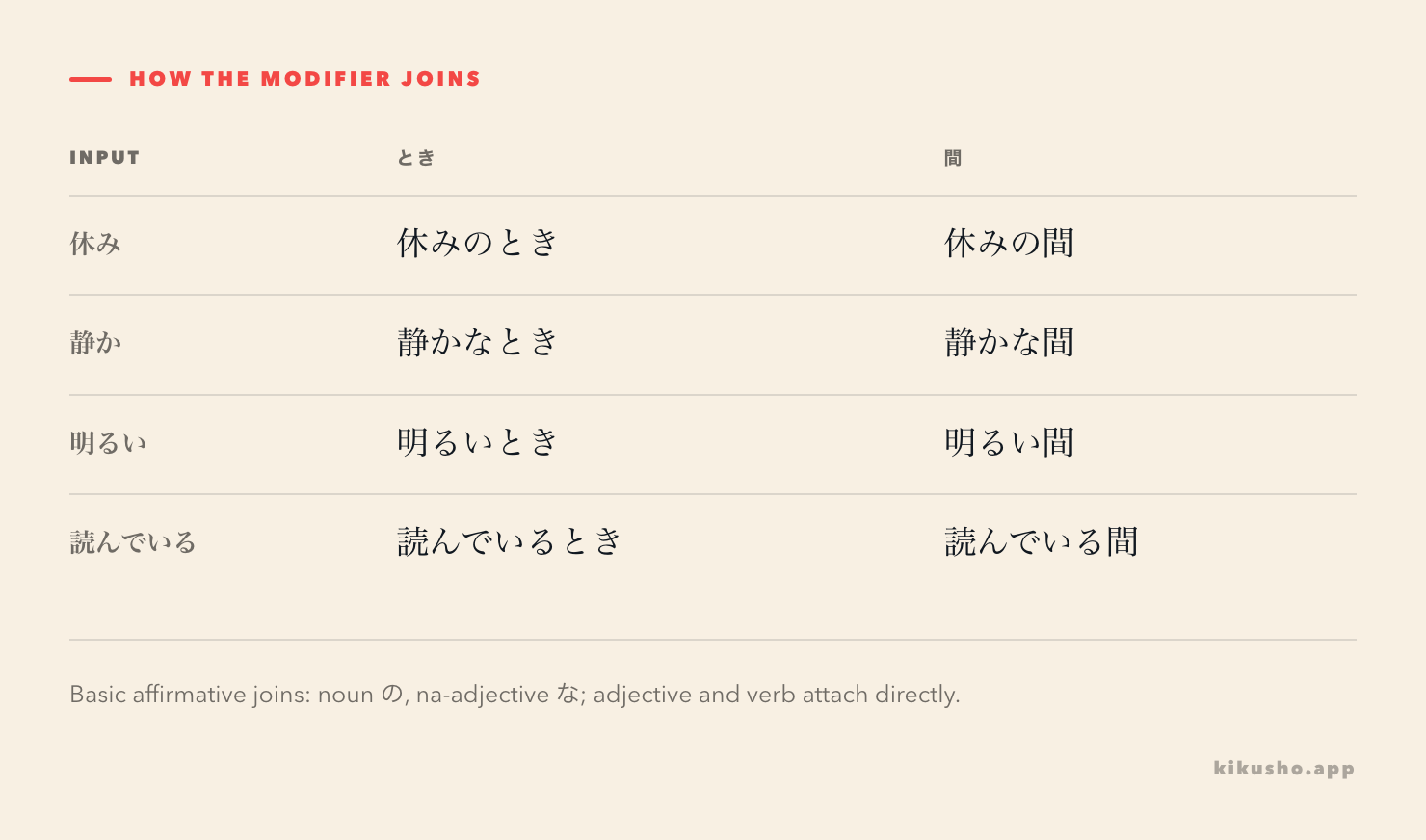
The noun's connection is の: 休みのとき. The affirmative な-adjective needs な: 静かな間. Do not carry a sentence-ending だ into 静かだとき, or add の after an い-adjective in 明るいの間.
The rule changes when you use an inflected predicate. 静かだったとき, “when it was quiet,” is a valid past description. 学生だったとき is also valid: “when I was a student.” The basic の and な table does not forbid these complete past modifiers. Tofugu's とき reference explains the distinction between basic attachments and inflected predicates.
For a verb in these ordinary clauses, use the plain form before the time noun. 読んでいる間 fits even when the main statement ends politely. The politeness of the complete statement belongs on its final predicate; 読んでいます間 is not the basic attachment.
The inner tense shows your viewpoint at the main event
A past final verb does not force a past form before とき. Compare two reports from the same completed museum trip:
| Report | Viewpoint |
|---|---|
| 博物館に行くとき、駅で切符を買いました。 | I bought a ticket at the station on the way to the museum. |
| 博物館に行ったとき、入口で地図をもらいました。 | When I visited the museum, I received a map at the entrance. |
Read the first as はくぶつかんにいくとき、えきできっぷをかいました, and the second as はくぶつかんにいったとき、いりぐちでちずをもらいました.
Both main events belong to the past. In the first report, 行く pictures going as still ahead or in progress at the time of the ticket purchase. In the second, 行った pictures the visit as reached when the map was handed over. The final 買いました/もらいました reports the completed main event.
The same relative viewpoint can appear in a request about the future:
家に着いたとき、電話してください。
いえについたとき、でんわしてください。
Please call when you have arrived home.
着いた pictures arrival as completed at the point of the call. It does not mean that the person has already arrived now. Mayumi Ito's Mango lesson on とき explains this relative completion separately from the tense of the main statement.
Avoid a new mechanical rule saying every るとき means “before” and every たとき means “strictly after.” Verb meaning and viewpoint still matter. At a departure, for example, both leaving-in-progress and looking back at the completed departure can describe closely related scenes. The museum examples include locations precisely to make their ordering clear.
An ongoing clause before 間 also need not match the final tense. In 先生が説明している間、ずっとメモを取っていました, the explanation is in progress at the time of the note-taking. Keeping している preserves that view; changing it merely because 取っていました is past would obscure the intended ongoing frame.
The overlap lets you choose what to emphasise
Two natural reports can describe the same years:
日本にいるとき、毎晩、日記を書いていました。
にほんにいるとき、まいばん、にっきをかいていました。
When I was in Japan, I wrote a diary every evening.
日本にいる間、毎晩、日記を書いていました。
にほんにいるあいだ、まいばん、にっきをかいていました。
During my stay in Japan, I wrote a diary every evening.
とき locates the diary habit in the situation “being in Japan.” 間 foregrounds the stay as its interval. The actual diary entries may be identical. Choose the viewpoint you need, rather than marking とき wrong because the stay lasted more than a moment.
If a single notification arrived inside that span, the neighbouring form 間に can locate it: 日本にいる間に、連絡が来ました, “I received a message while I was in Japan.” That is a boundary comparison here, without claiming that every 間に event must be instantaneous. The fuller うちに and 間に lesson handles events inside a window and the opportunity viewpoint.
When you need an explicit “before” or “after,” use the separate 前に and 後で patterns. Their ordering is the central claim; とき gives you a situation in which to place the main statement.
Practice
Question 1
Choose the noun connection that makes the ordinary phrase “when I have a break.”
休み( )とき、古い写真を整理します。
- A. の
- B. な
- C. だ
- D. を
Question 2
You want to highlight that note-taking continued for the whole explanation. Which ending explicitly frames the explanation as that interval? A general “when” report is possible, but is not the requested emphasis.
先生が説明している( )、ずっとメモを取っていました。
- A. とき
- B. 前に
- C. 間
- D. 後で
Question 3
Compose a request to call once the person has arrived home. 家に must be the opening piece.
__ __ __ __。
- ① 着いた
- ② 電話してください
- ③ 家に
- ④ とき
Question 4
Build a sentence saying that the window stayed closed during the meeting. Start with 会議の; the remaining pieces describe the state across that span.
__ __ __ __。
- ① 窓は
- ② 間
- ③ 閉まっていました
- ④ 会議の
Question 5
Read the account and select the accurate explanation of 行くとき in its second sentence.
昨日、博物館に行きました。博物館に行くとき、駅で切符を買いました。
- A. It must be an error because 買いました is past.
- B. It locates the ticket purchase on the way, before reaching the museum.
- C. It proves that the ticket will be bought tomorrow.
- D. It says buying the ticket continued through the whole museum visit.
Question 6
Read both sentences. Which statement preserves the two reports?
会議が始まったとき、窓を閉めました。会議の間、窓は閉まっていました。
- A. Both sentences describe only who closed the window.
- B. 間 must mean one instantaneous closure.
- C. とき is wrong because meetings take time.
- D. The first locates a closing action; the second reports the continuing closed state.
Make your six selections before reading the numbered explanations below.
Answers and explanations
Answer 1
A: の. 休み is a noun, giving 休みのとき. な belongs to an affirmative な-adjective modifier; だ is not the affirmative noun connection to とき. を marks an object and cannot make the intended time phrase.
Answer 2
C: 間. The explanation provides the interval, and ずっとメモを取っていました states the activity continuing across it. A, とき, can locate the same note-taking in time, but does not foreground the interval as requested. B places the notes before the explanation; D places them after it. This tests the explicit viewpoint, not a claim that every alternative is ungrammatical.
Answer 3
③ → ① → ④ → ②. 家に着いたとき、電話してください means “Please call when you have arrived home.” 着いた is plain past before とき and represents arrival completed at the requested call. The final request still concerns a call ahead.
Answer 4
④ → ② → ① → ③. 会議の間、窓は閉まっていました means “The window was closed during the meeting.” の connects 会議 to 間. 閉まっていました is the state report; replacing it with 閉めました would instead introduce somebody's action of closing the window.
Answer 5
B. The explicit station setting places the purchase in the journey toward the museum. 行く presents going as not yet completed from that point of view; 買いました places the purchase in the past. A demands a false mechanical tense match. C confuses an inner non-past viewpoint with tomorrow. D assigns a continuing-duration meaning absent from the sentence.
Answer 6
D. 始まったとき locates the closing action at the meeting's beginning. 会議の間 describes the resulting state during the meeting. A erases the distinction between action and state and invents an agent for the second sentence. B contradicts the interval meaning. C imposes a false short-time restriction on とき.
Save the verb ending that places you in the scene
A message saying 家に着いたとき、電話してください is useful to keep whole. Paste it into Kikusho, then check the editable example before saving: 着いた should remain attached to the time clause, and the call should remain a request. At review time, picture the front door already behind you and the telephone still in your hand. That small scene gives the inner past form a place to live.
Common questions
What is the difference between とき and 間?
とき locates something at the time of a situation or event. 間, read あいだ, highlights an interval during which the main activity or state continues. とき can also describe a long period, so this is not simply short time versus long time.
Must the verb before とき match the final verb's tense?
No. The form before とき reflects how you view that situation relative to the main event. 家に着いたとき、電話してください asks for a future call once arrival has occurred; 着いた does not make that request a past event.
How do nouns and adjectives attach to とき and 間?
In basic affirmative forms, a noun takes の, a な-adjective takes な, and an い-adjective attaches directly: 休みのとき, 静かな間 and 明るいとき. An ongoing verb can use its plain ている form, as in 読んでいる間.
Are とき and 間 both N4 grammar?
This comparison is in our N4 sequence. JLPT Sensei labels とき N5 and 間 N4; Bunpro labels とき N4. These are editorial placements, not an official exhaustive JLPT grammar list.