On this page
Choose Nを禁じ得ない when a situation provokes an emotion you cannot suppress. Choose Vてやまない when you formally present a feeling, wish or conviction as heartfelt and continuing.
調査結果には驚きを禁じ得ない。
ちょうさけっかにはおどろきをきんじえない。
I cannot help being surprised by the survey results.
彼女の今後の活躍を願ってやまない。
かのじょのこんごのかつやくをねがってやまない。
I sincerely hope for her continued success.
The first sentence captures a reaction that rises in response to evidence. The second sustains a wish toward the future. Both sound formal, but their grammar and their shape in time are different.
This lesson covers を禁じ得ない (g-612ec885615a) and てやまない (g-318755722654). Kikusho's inventory, JLPT Sensei, Bunpro, Tanosuke, Nihongo Kyoshi Net and J-nihongo place both at N1, with no recorded level disagreement. These are source-backed study labels rather than an official syllabus because the JLPT no longer publishes an exhaustive item-by-item grammar list.
The deciding test is reaction or commitment
Ask what the sentence is doing with the feeling:
| Question | Choose | Core shape |
|---|---|---|
| Did a situation make an emotion rise beyond restraint? | Nを禁じ得ない | trigger → involuntary reaction |
| Does the speaker maintain a strong wish, respect, love or belief? | Vてやまない | continuing heartfelt stance |
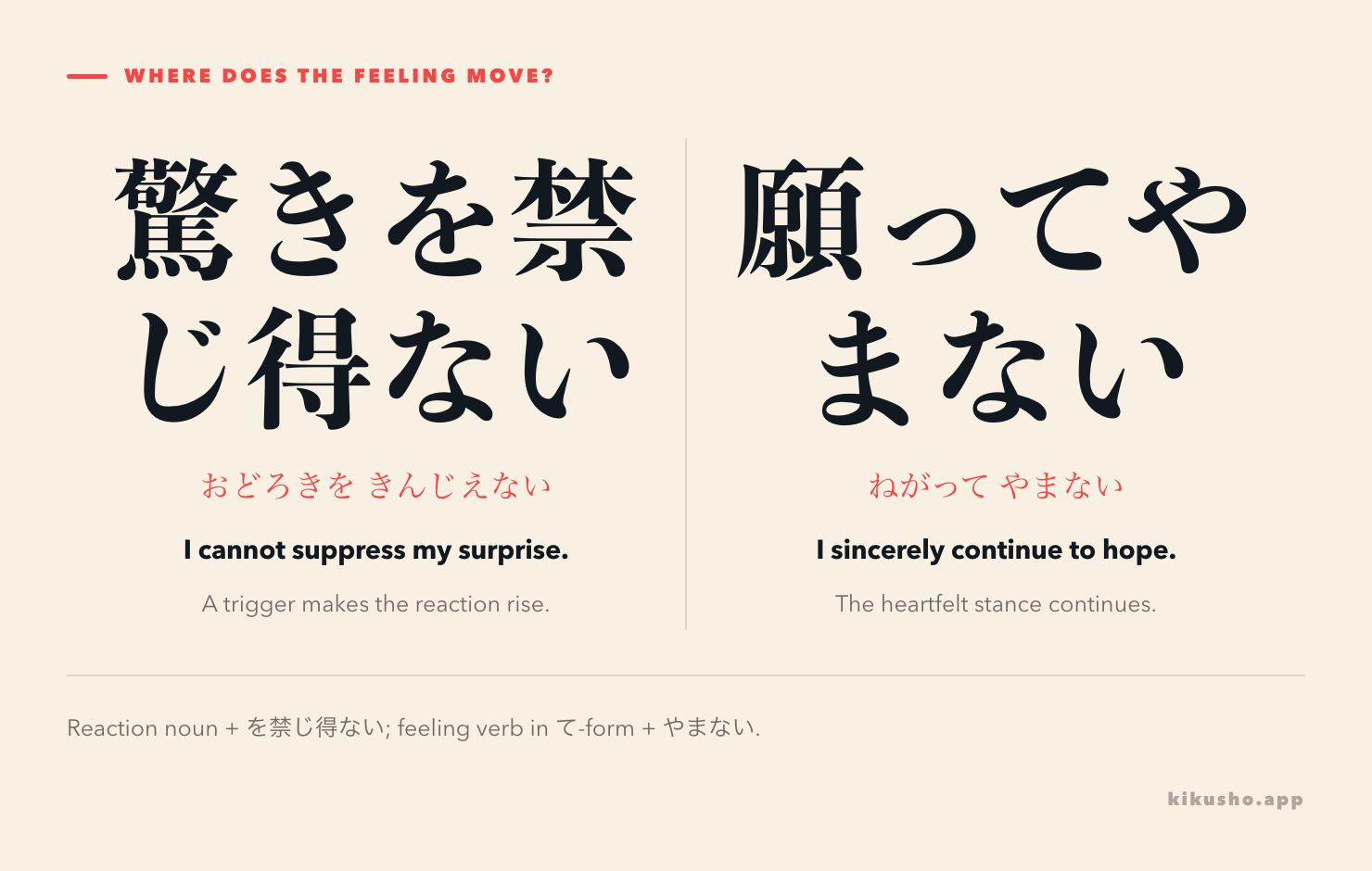
The English phrase “cannot help” can describe either scene, so translation alone is a poor guide. Attachment resolves the choice quickly: を禁じ得ない needs a noun, while てやまない needs the て-form of a suitable verb.
を禁じ得ない names the feeling that escapes restraint
Attach を禁じ得ない to a noun that names an emotion or its visible reaction.
| Emotion noun | Complete form | Natural sense |
|---|---|---|
| 驚き, surprise | 驚きを禁じ得ない | cannot help feeling surprised |
| 怒り, anger | 怒りを禁じ得ない | cannot suppress one's anger |
| 同情, sympathy | 同情を禁じ得ない | cannot help feeling sympathy |
| 笑い, laughter | 笑いを禁じ得ない | cannot hold back laughter |
| 涙, tears | 涙を禁じ得ない | cannot hold back tears |
| 違和感, unease | 違和感を禁じ得ない | cannot avoid a sense that something is wrong |
説明を聞いても、会社の対応には違和感を禁じ得なかった。
せつめいをきいても、かいしゃのたいおうにはいわかんをきんじえなかった。
Even after hearing the explanation, I could not shake my unease about the company's response.
最後まで責任を押しつけ合う姿には、怒りを禁じ得ない。
さいごまでせきにんをおしつけあうすがたには、いかりをきんじえない。
I cannot suppress my anger at the sight of them shifting responsibility to the end.
The particle に often marks the trigger: 結果に驚きを禁じ得ない, 対応に怒りを禁じ得ない. The emotion noun then takes を as the object of 禁じ得ない, literally something like “cannot manage to restrain.” Despite the word 禁じる, the construction does not mean that an authority has failed to prohibit the emotion.
This is careful written language. It suits criticism, commentary, reports and solemn accounts. In ordinary conversation, びっくりした, 腹が立った, 笑いをこらえられなかった or another direct phrase will usually sound more natural.
The final predicate carries tense and politeness: 禁じ得なかった places the reaction in the past, while 禁じ得ません makes the formal statement polite. The reading of 得 here is え: きんじえない.
てやまない keeps a sentiment alive
Attach やまない to the て-form of a verb that can express an enduring feeling, wish, belief or attitude.
| Dictionary form | て-form | Complete expression |
|---|---|---|
| 願う, wish | 願って | 願ってやまない |
| 祈る, pray | 祈って | 祈ってやまない |
| 愛する, love | 愛して | 愛してやまない |
| 尊敬する, respect | 尊敬して | 尊敬してやまない |
| 信じる, believe | 信じて | 信じてやまない |
| 感謝する, feel grateful | 感謝して | 感謝してやまない |
この町に穏やかな日常が戻ることを祈ってやみません。
このまちにおだやかなにちじょうがもどることをいのってやみません。
I sincerely pray that peaceful daily life will return to this town.
彼は、苦しい時期に支えてくれた友人に感謝してやまない。
かれは、くるしいじきにささえてくれたゆうじんにかんしゃしてやまない。
He remains deeply grateful to the friend who supported him through a difficult period.
The polite form is てやみません, which is common in formal wishes and closing remarks. The construction can also modify a noun:
私が尊敬してやまない研究者が、今日の講演者だ。
わたしがそんけいしてやまないけんきゅうしゃが、きょうのこうえんしゃだ。
The researcher I deeply and enduringly respect is today's speaker.
Here 尊敬してやまない describes the researcher. The feeling is not a sudden reaction to today's lecture; it is an established attitude that continues.
Although やむ means “stop,” this grammar is not a productive way to say that any activity never stops. 雨が降ってやまない can be understood literally as rain that will not cease, but it is not the target expression of heartfelt emotion. The N1 pattern prefers a limited set of verbs such as 願う, 祈る, 愛する, 尊敬する, 信じる, 期待する and 感謝する.
Formality is shared, but the time line is not
Both patterns can appear in speeches or polished writing. Formality therefore cannot choose between them on its own.
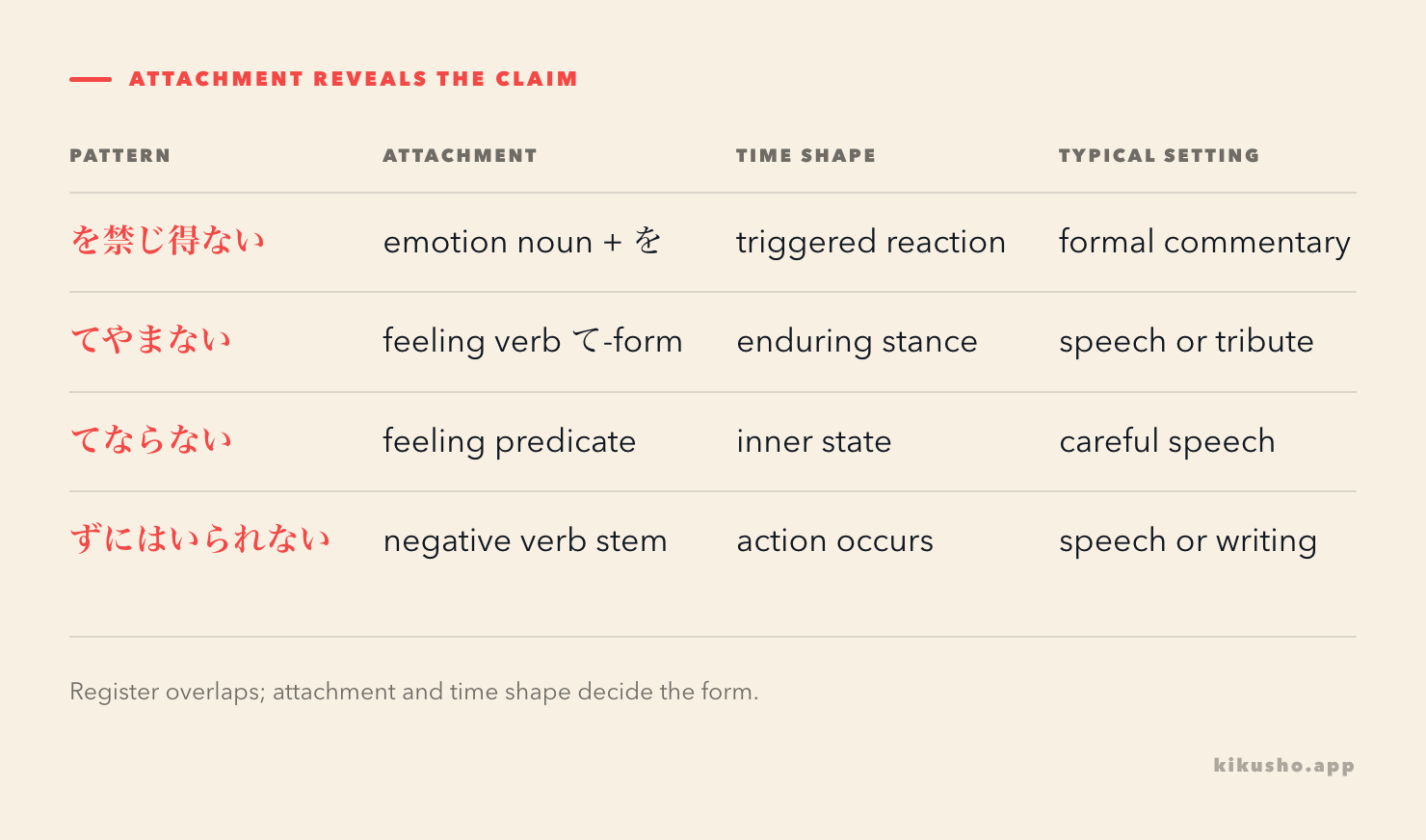
を禁じ得ない often looks back at a finding, decision, scene or act and records the reaction it provokes:
公表された数字には、疑問を禁じ得ない。
こうひょうされたすうじには、ぎもんをきんじえない。
I cannot help having doubts about the published figures.
てやまない presents the speaker's attitude as active across time and often points toward a person, relationship or hoped-for future:
両者の対話が続くことを期待してやまない。
りょうしゃのたいわがつづくことをきたいしてやまない。
I earnestly hope that dialogue between the two sides will continue.
This produces a useful editing test. If you can place “on seeing or learning this” before the sentence and the focus is the reaction, を禁じ得ない is likely. If “from the heart, now and into the future” fits better, てやまない is likely.
Nearby forms move the pressure elsewhere
The two target forms occupy a formal corner of a larger family. Three neighboring patterns make different claims.
てならない keeps the pressure inside a spontaneous feeling or thought:
結果が気になってならない。
けっかがきになってならない。
I cannot stop worrying about the result.
ずにはいられない says the pressure produces an action:
その場面を見ると、涙を流さずにはいられない。
そのばめんをみると、なみだをながさずにはいられない。
When I see that scene, I cannot keep from crying.
The てならない and ないではいられない lesson separates an involuntary inner state from an irresistible action. を禁じ得ない differs again: it packages the reaction as an emotion noun in a markedly formal judgement.
限りだ evaluates the intensity of the speaker's present feeling, as in うれしい限りだ. It does not itself say that the feeling cannot be restrained or will continue. The 限りだ and の極み lesson develops that distinction between personal evaluation and an extreme state.
For a Kikusho card, preserve the trigger or object as well as the fixed expression. 驚きを禁じ得ない becomes easier to misuse when the surprising fact disappears; 願ってやまない needs the hoped-for outcome. Capture the complete clause, check its reading, and let review reconstruct whether the feeling rises suddenly or extends through time.
Practice: locate the feeling in time
Answer all seven items from the attachment and time shape. Open the explanations only after the final composition.
Question 1 — emotion noun. Complete 度重なる説明の変更には、疑問( )。
- ア. を禁じ得ない
- イ. してやまない
- ウ. でやまない
- エ. をやまない
Question 2 — sustained wish. Complete 被災した地域の早い復興を( )。
- ア. 願いを禁じ得ない
- イ. 願ってやまない
- ウ. 願って禁じ得ない
- エ. 願いでやまない
Question 3 — relative clause. Which sentence means “The novelist I deeply and enduringly respect will give a talk”?
- ア. 私が尊敬を禁じ得ない小説家が講演する。
- イ. 私が尊敬してやまない小説家が講演する。
- ウ. 私が尊敬でやまない小説家が講演する。
- エ. 私が尊敬して禁じ得ない小説家が講演する。
Question 4 — reaction or commitment. A report reveals that safety warnings were repeatedly ignored. You are writing formal criticism and want to say that you cannot suppress your anger. Which sentence fits?
- ア. 警告を無視した対応には怒ってやまない。
- イ. 警告を無視した対応には怒りを禁じ得ない。
- ウ. 警告を無視した対応には怒りでやまない。
- エ. 警告を無視した対応には怒りてやまない。
Question 5 — polite closing. Complete a formal message: 皆様の今後のご健康を祈って( )。
- ア. 禁じ得ません
- イ. やみません
- ウ. やめません
- エ. 禁じません
Question 6 — fixed grammar or literal やむ. Which sentence uses the target emotional grammar rather than literal “does not stop”?
- ア. 朝から雨が降ってやまない。
- イ. 彼女は故郷の海を愛してやまない。
- ウ. 工事の音が鳴ってやまない。
- エ. 風が吹いてやまない。
Question 7 — sentence composition. Arrange these pieces to say “I could not suppress my surprise at the unexpected conclusion.”
- 驚きを禁じ得なかった
- 予想外の結論には
- 、
Answers and explanations
The explanations follow the same path as the lesson: attachment first, then the feeling's time shape.
Answer 1. Choose ア, を禁じ得ない. 疑問 is a reaction noun, and the repeated changes are its trigger. てやまない requires the て-form of a suitable feeling verb rather than a bare noun.
Answer 2. イ, 願ってやまない. 願う becomes 願って, and the pattern presents the hope for recovery as heartfelt and continuing. 願いを禁じ得ない would mean that a wish itself cannot be suppressed, a different and unsuitable framing here.
Answer 3. イ, 私が尊敬してやまない小説家が講演する. The て-form 尊敬して attaches to やまない and the whole clause modifies 小説家. を禁じ得ない normally follows an emotion noun, not the verbal act 尊敬する in this shape.
Answer 4. イ, 怒りを禁じ得ない. The ignored warnings provoke an anger that the writer cannot suppress. 怒ってやまない is not the conventional choice for this triggered formal judgement, and ウ and エ have invalid attachments.
Answer 5. イ, やみません. 祈ってやみません is the polite form used for a solemn continuing wish. やめません uses a different verb, やめる, and would mean “will not quit.”
Answer 6. イ, 彼女は故郷の海を愛してやまない. 愛してやまない is the fixed emotional pattern: her love is deep and enduring. The weather and sound sentences use やむ literally for something that does not cease.
Answer 7. 予想外の結論には、驚きを禁じ得なかった. The conclusion is marked as the trigger with には. 驚き is the emotion noun governed by を, and 得なかった places the uncontrollable reaction in the past.
Common questions
What is the difference between を禁じ得ない and てやまない?
を禁じ得ない follows an emotion noun and says a reaction cannot be suppressed. てやまない follows the て-form of a limited set of feeling verbs and presents a heartfelt sentiment as strong and continuing.
What comes before を禁じ得ない?
Use an emotion or reaction noun, such as 驚き, 怒り, 同情, 笑い, 涙 or 違和感: 驚きを禁じ得ない means that one cannot suppress one's surprise.
Which verbs commonly take てやまない?
Common choices include 願う, 祈る, 愛する, 尊敬する, 信じる, 期待する and 感謝する. The pattern is selective and does not freely attach to every action verb.
Are を禁じ得ない and てやまない conversational?
Both are formal. を禁じ得ない often appears in commentary and careful writing; てやまない suits speeches, letters, tributes and other solemn expressions of hope, respect, love or gratitude.