On this page
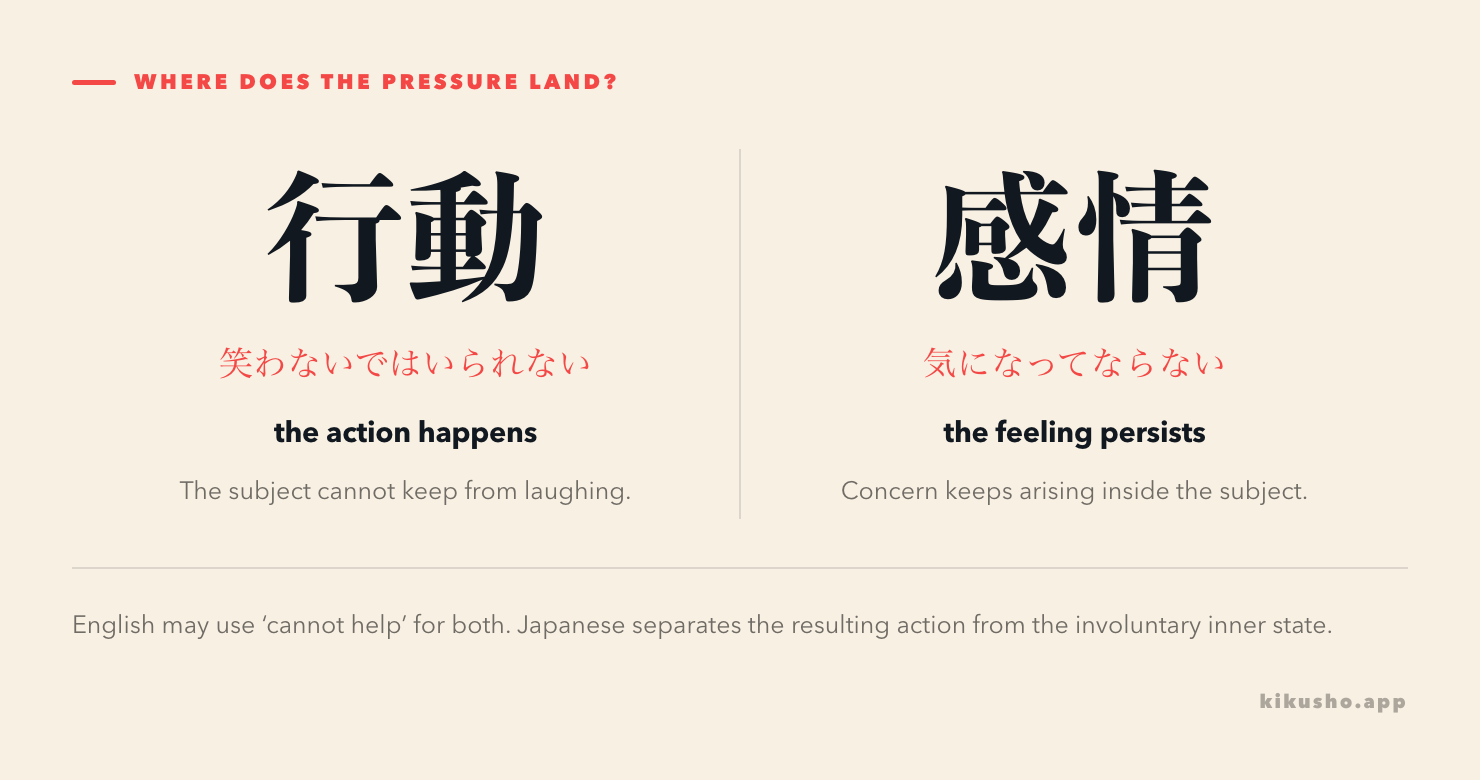
Use Vないではいられない when an inner impulse makes someone perform an action: この写真を見ると、笑わないではいられない, “I cannot help laughing when I see this photo.” Use ~てならない when the uncontrollable part is a feeling, sensation or thought: 試験の結果が気になってならない, “I cannot stop worrying about the exam result.”
The quickest test is to ask what the sentence presents as uncontrollable. If the answer is an action the subject ends up doing, choose ないではいられない. If it is a feeling or impression that keeps arising inside the subject, choose てならない.
This lesson covers inventory item g-a054d107393e, ないではいられない, and g-5e878cb8b8a1, てならない. JLPT Sensei and Bunpro place the first at N2; they also place てならない at N2. These are study classifications rather than an official item list, because the JLPT does not publish an exhaustive grammar syllabus.
The dividing line is action versus inner state
| Pattern | What cannot be controlled | Typical material before it | Result |
|---|---|---|---|
| Vないではいられない | restraint over an action | 笑わない, 確かめない, 応援しない | the action occurs or feels inevitable |
| ~て/~くて/~でならない | a feeling, sensation or impression | 気になって, 悲しくて, 残念で | the state keeps arising or feels overwhelming |
彼の努力を見ると、応援しないではいられない。
かれの どりょくを みると、おうえんしないではいられない。
When I see his effort, I cannot help supporting him.
彼の体調が心配でならない。
かれの たいちょうが しんぱいでならない。
I cannot stop worrying about his health.
The first sentence reaches 応援する, an action. The second stays with 心配だ, an inner state. English can use “cannot help” for both, so translating first and choosing the Japanese form afterward is unreliable.
ないではいられない names the action that escapes restraint
Attach ではいられない to the complete plain negative form. Keep ない in place.
| Dictionary form | Plain negative | Complete pattern |
|---|---|---|
| 笑う | 笑わない | 笑わないではいられない |
| 読む | 読まない | 読まないではいられない |
| 確かめる | 確かめない | 確かめないではいられない |
| する | しない | しないではいられない |
| 来る(くる) | 来ない(こない) | 来ないではいられない(こないではいられない) |
結末が気になって、最後のページを読まないではいられなかった。
けつまつが きになって、さいごの ページを よまないではいられなかった。
My curiosity about the ending drove me to read the last page.
友達が困っていたので、何かしないではいられなかった。
ともだちが こまっていたので、なにか しないではいられなかった。
My friend was in trouble, so I could not help doing something.
The final いられない carries tense and politeness. いられなかった puts the irresistible action in the past, while いられません makes the statement polite. A Japanese teaching reference describes the pattern as being unable to remain without doing something and confirms the Vない + ではいられない attachment.
This is the ordinary-negative counterpart of Vずにはいられない. 笑わないではいられない and 笑わずにはいられない share the same central claim. The former is transparent in conversation; the latter uses the older negative ず and often suits careful prose. The lesson on てしょうがない and ずにはいられない teaches that neighboring form in full.
てならない keeps the sentence inside the feeling
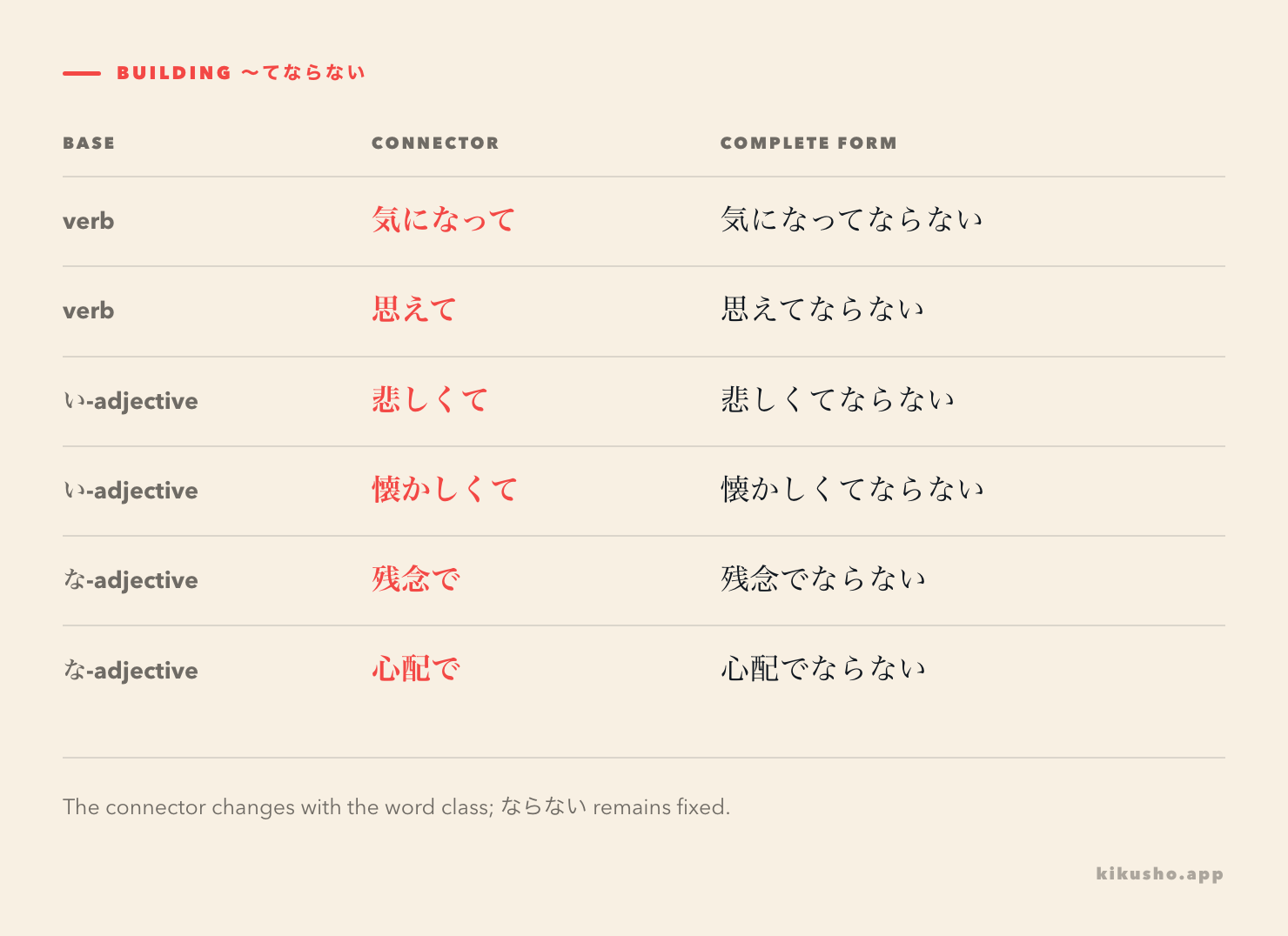
The ending chooses one of three gateways from the predicate before it.
| Source predicate | Gateway before ならない | Resulting N2 form |
|---|---|---|
| 気になる | 気になって | 気になってならない |
| 思える | 思えて | 思えてならない |
| 悲しい | 悲しくて | 悲しくてならない |
| 懐かしい | 懐かしくて | 懐かしくてならない |
| 残念だ | 残念で | 残念でならない |
| 心配だ | 心配で | 心配でならない |
なぜ彼が急に辞めたのか、気になってならない。
なぜ かれが きゅうに やめたのか、きになってならない。
I cannot stop wondering why he suddenly quit.
久しぶりに故郷の写真を見て、懐かしくてならなかった。
ひさしぶりに ふるさとの しゃしんを みて、なつかしくてならなかった。
Seeing photos of my hometown after so long filled me with overwhelming nostalgia.
あの判断は間違いだったように思えてならない。
あの はんだんは まちがいだったように おもえてならない。
I cannot shake the feeling that the decision was wrong.
The verb slot is not open to any deliberate action. It most naturally contains predicates of perception and spontaneous thought, especially 気がする, 思える and 気になる. PassJapanese's N2 explanation likewise limits the pattern to feelings, sensations and thoughts that arise from within; it rejects an uncontrolled external event such as ×雨が降ってならない.
The same trigger can produce two different sentences
Suppose a message has arrived, but you are afraid to open it.
メッセージの内容が気になってならない。
メッセージの ないようが きになってならない。
I cannot stop wondering what the message says.
何度もスマホを確認しないではいられない。
なんども スマホを かくにんしないではいられない。
I cannot keep myself from checking my phone again and again.
The first sentence gives the inner concern. The second gives the behavior that follows from it. They can coexist because they answer different questions.
This also explains why 言いたくてならない and 言わないではいられない are close without being interchangeable. The first describes an overpowering desire to speak. The second says the person cannot refrain from speaking, so the action is presented as the outcome.
Keep four similar forms apart
| Form | Main job | Example |
|---|---|---|
| Vないではいられない | irresistible action | 笑わないではいられない |
| ~てならない | involuntary feeling or thought | 気になってならない |
| ~てしょうがない | overwhelming feeling, desire or physical state | 眠くてしょうがない |
| ~てはならない | formal prohibition | ここに入ってはならない |
~てならない and ~てしょうがない overlap with feelings, but their range and register differ. ~てしょうがない is common in conversation and readily describes physical sensations or desires, such as 眠くてしょうがない and 会いたくてしょうがない. ~てならない is more formal and favors feelings, impressions and thoughts that arise by themselves, such as 残念でならない and 不思議に思えてならない.
Do not let one particle turn the target into a different grammar point. ここに入ってならない is not the normal prohibition. ここに入ってはならない means “You must not enter here.” The は marks the prohibited action and belongs to the formal rule pattern.
External necessity needs another construction too. 予算不足で計画を変更せざるを得ない means circumstances leave no practical alternative. The ざるを得ない lesson explains that pressure. 変更しないではいられない would instead present changing the plan as an inner urge, which is usually the wrong interpretation for a budget decision.
Save the trigger with the grammar
A card containing only 気になってならない preserves the form but loses what provoked the feeling. In Kikusho, save 合格発表が気になってならない so review has to reconstruct both the object of concern and the connector.
For ないではいられない, keep the action and its trigger together: この写真を見ると、笑わないではいられない. That complete sentence makes it clear that the negative form does not negate the final action. It describes the failed attempt to refrain, so laughing is the result.
Practice: locate what cannot be controlled
Work through the full set without consulting the solution panel.
Question 1
The photo always makes you laugh. Which completion fits?
この写真を見ると、笑わ( )。
- ないではいられない
- なくてならない
- ないではならない
- なくてはいられない
Question 2
The speaker cannot stop worrying about a friend's health. Which sentence fits?
- 友達の体調が心配しないではいられない。
- 友達の体調が心配でならない。
- 友達の体調を心配してはならない。
- 友達の体調を心配せざるを得ない。
Question 3
Change 確認する into ないではいられない, then use it in the past tense.
Question 4
Complete both forms for 懐かしい and 残念だ.
- 懐かしい → 懐かし( )ならない
- 残念だ → 残念( )ならない
Question 5
Classify what is uncontrollable in each line, then state how the meanings differ.
- A. 結果が気になってならない。
- B. メールを確認しないではいられない。
Question 6
Select the pair that preserves the movement from an inner feeling to an irresistible action.
合格発表が( ① )。落ち着かず、何度も受験番号を( ② )。
- ①気になってならない/②確認しないではいられない
- ①気にしないではいられない/②確認してならない
- ①気になってはならない/②確認しなくてならない
- ①気にならないではいられない/②確認してはならない
Decide whether blank ① names the internal pressure and blank ② names the resulting behavior before you reveal the key.
Answers and explanations
Answer 1. Choice 1. 笑う → 笑わない → 笑わないではいられない says the viewer cannot refrain from laughing. The action occurs despite restraint. Choice 3 resembles a prohibition but lacks the required ては structure.
Answer 2. Choice 2. 心配だ is a な-adjective, so it connects as 心配でならない. The sentence presents worry as an involuntary inner state. Choice 3 says one must not worry, and choice 4 makes circumstances force the act of worrying.
Answer 3. 確認しないではいられなかった. Keep the full plain negative しない, add ではいられない, then move the final predicate into the past: いられなかった. For example, 結果が気になって、何度も確認しないではいられなかった.
Answer 4. 懐かしくてならない; 残念でならない. An い-adjective changes い to くて. A な-adjective uses で. Both describe a feeling that arises naturally and remains strong.
Answer 5. 結果が気になってならない remains inside the speaker's concern about the result. メールを確認しないではいられない names the action produced by that concern: the speaker repeatedly checks the email. The first is an inner state; the second is behavior that escapes restraint.
Answer 6. Choice 1. 気になってならない expresses the continuing concern. 確認しないではいられない then gives the repeated action that follows from it. The other pairs confuse the target patterns with prohibition or attach てならない to a deliberate checking action.
For jl-334, AI reviewer OpenAI Codex cross-checked both assigned patterns, every attachment, example, translation and distractor with the references named above. This audit does not represent a human or native-speaker endorsement.
Common questions
What is the difference between ないではいられない and てならない?
ないではいられない says that someone cannot refrain from performing an action. てならない describes a feeling, sensation or thought that arises naturally and remains overwhelmingly strong.
How do you form ないではいられない?
Add ではいられない to the complete plain negative form of a verb: 笑わない becomes 笑わないではいられない, and する becomes しないではいられない.
How do you form てならない?
Use a verb's て-form, an い-adjective's くて form, or a な-adjective plus で before ならない: 気になってならない, 悲しくてならない, and 残念でならない.
Is ないではいられない the same as ずにはいられない?
Their core meaning is the same: the subject cannot refrain from acting. ないではいられない keeps the ordinary negative form and often feels more conversational, while ずにはいられない uses the older ず form.