On this page
Use ~てしょうがない/~てしかたがない when a feeling, desire or physical state is so strong that it cannot simply be put aside. Use ~ずにはいられない when the pressure reaches an action: the subject cannot stop themselves from doing it.
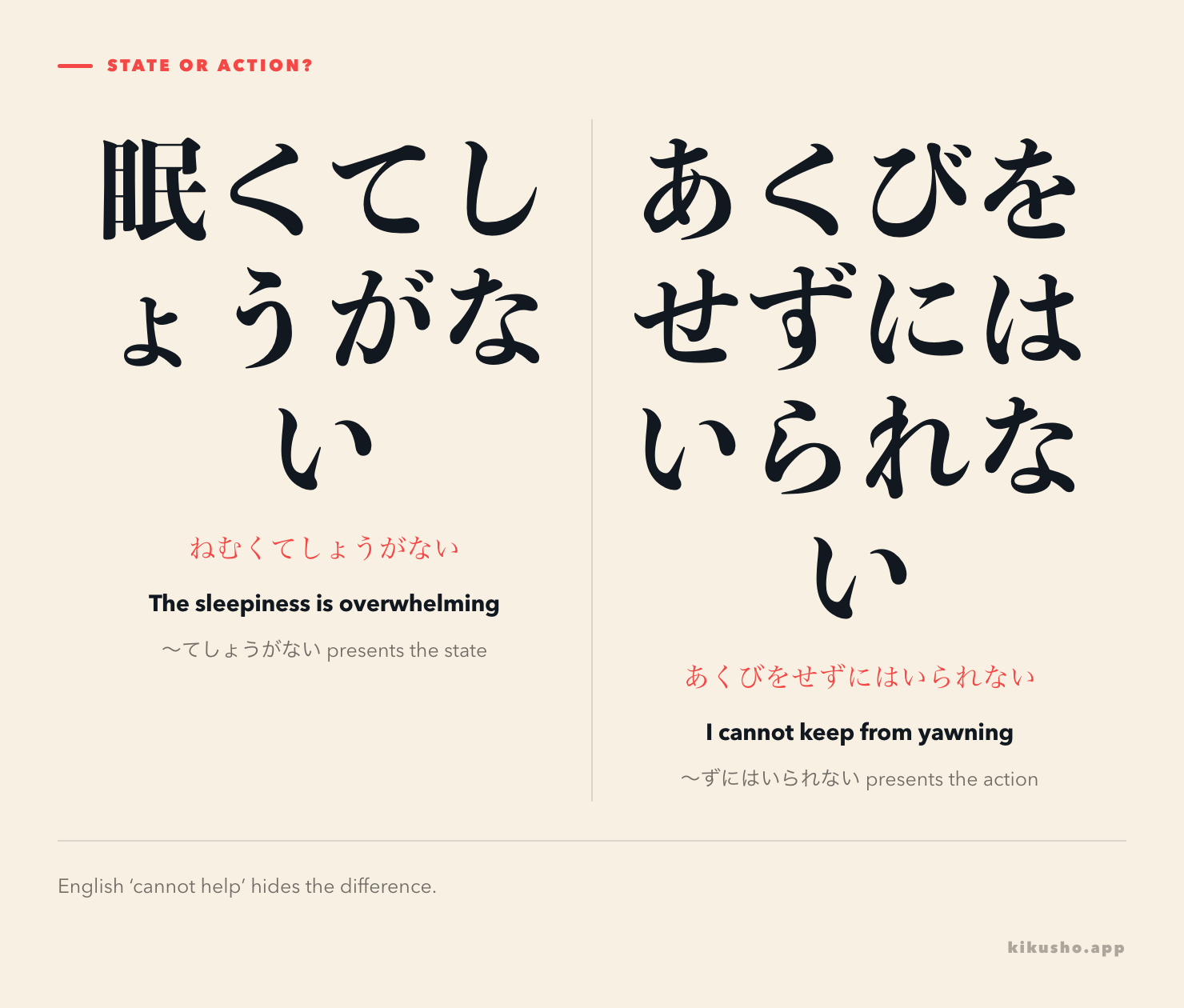
The quickest test is to inspect what comes before the ending. 眠くてしょうがない describes unbearable sleepiness; あくびをせずにはいられない says you cannot keep from yawning. One presents the state. The other presents the action that escapes restraint.
This lesson covers inventory item g-3853fdd73ad5, てしょうがない・てしかたがない, and g-821136ef3e30, ずにはいられない. JLPT Sensei places both forms at N3, while Bunpro places ~てしょうがない at N2 and ~ずにはいられない at N3. These are study placements, not an official item list; the JLPT does not publish an exhaustive grammar syllabus.
The test is state versus action
Both constructions describe something outside calm, deliberate control. They package that lack of control differently.
| Pattern | What it presents | Typical material before it | Core question |
|---|---|---|---|
| ~てしょうがない/~てしかたがない | an intense state, sensation, feeling or desire | 眠くて, 心配で, 会いたくて, 気になって | What feels overwhelmingly strong? |
| ~ずにはいられない | an action the subject cannot refrain from doing | 笑わず, 買わず, 確かめず, せず | What does the subject end up doing? |
明日の結果が心配でしょうがない。
あしたの けっかが しんぱいでしょうがない。
I am terribly worried about tomorrow's result.
この写真を見ると、笑わずにはいられない。
この しゃしんを みると、わらわずにはいられない。
Whenever I see this photo, I cannot help laughing.
The first sentence remains inside the speaker's worry. The second names the action produced by the reaction. English “cannot help” can translate both, so the English gloss is not enough to choose.
~てしょうがない makes the state overwhelming
Build the connection according to the word class.
| Base | Connected form | Complete pattern |
|---|---|---|
| 眠い | 眠くて | 眠くてしょうがない |
| 不安だ | 不安で | 不安でしょうがない |
| 会いたい | 会いたくて | 会いたくてしかたがない |
| 気になる | 気になって | 気になってしょうがない |
The verb examples are usually predicates that already describe an involuntary feeling or continuing concern. 気になってしょうがない works because 気になる means that something weighs on the mind. This construction is not a general way to intensify any deliberate action.
隣の部屋の音が気になってしょうがない。
となりの へやの おとが きになってしょうがない。
I cannot stop being bothered by the sound from the next room.
旅行の日が楽しみでしかたがない。
りょこうの ひが たのしみでしかたがない。
I can hardly wait for the day of the trip.
しょうがない is the more conversational shape; しかたがない can sound a little more measured. In this pattern their central meaning is shared. Nihongo NET's N3 explanation likewise teaches the construction through emotions and sensations.
That boundary matters. 待ってもしょうがない means “there is no point in waiting.” 待ちたくてしょうがない means the desire to wait is overwhelmingly strong, an unusual idea unless the context supplies a reason. The presence or absence of も changes the structure.
~ずにはいられない turns the pressure into an action
Start from the plain negative, remove ない, and add ずにはいられない.
| Dictionary form | Plain negative | Complete pattern |
|---|---|---|
| 笑う | 笑わない | 笑わずにはいられない |
| 読む | 読まない | 読まずにはいられない |
| 確かめる | 確かめない | 確かめずにはいられない |
| する | しない | せずにはいられない |
| 来る(くる) | 来ない(こない) | 来ずにはいられない(こずにはいられない) |
The literal logic is “cannot remain without doing.” The sentence therefore points toward an action that occurs, or that the subject feels unable to avoid.
彼の話を聞くと、応援せずにはいられない。
かれの はなしを きくと、おうえんせずにはいられない。
When I hear his story, I cannot help supporting him.
結末が気になって、最後のページを読まずにはいられなかった。
けつまつが きになって、さいごの ページを よまずにはいられなかった。
I was so curious about the ending that I could not keep myself from reading the last page.
The final いられない carries tense and politeness: いられなかった places the irresistible action in the past, and いられません makes the statement polite. ~ないではいられない has the same core meaning and keeps the ordinary negative: 笑わないではいられない. It is often easier to hear in conversation, while ~ずにはいられない fits both careful speech and writing.
One situation can contain both forms
A feeling may produce an action, but the two clauses still make separate claims.
試験の結果が気になってしょうがなくて、何度もメールを確認せずにはいられなかった。
しけんの けっかが きになってしょうがなくて、なんども メールを かくにんせずにはいられなかった。
I was so worried about the exam result that I could not stop checking my email.
気になってしょうがない names the intense concern. 確認せずにはいられない names the repeated action driven by it. This is also why 本当のことを言いたくてしょうがない and 本当のことを言わずにはいられない are not interchangeable. The first reports an overpowering wish to tell the truth. The second says the subject cannot refrain from telling it, so the action itself is at stake.
The related adverb つい often presents a lapse after restraint fails: ついスマホを見てしまった. The ふと and つい lesson separates that momentary lapse from an unbidden thought. ~ずにはいられない is a full predicate about being unable to refrain, so it can sound stronger and more sustained than a single つい.
External necessity needs another construction
Neither pattern is the default for a rule or an unavoidable practical decision.
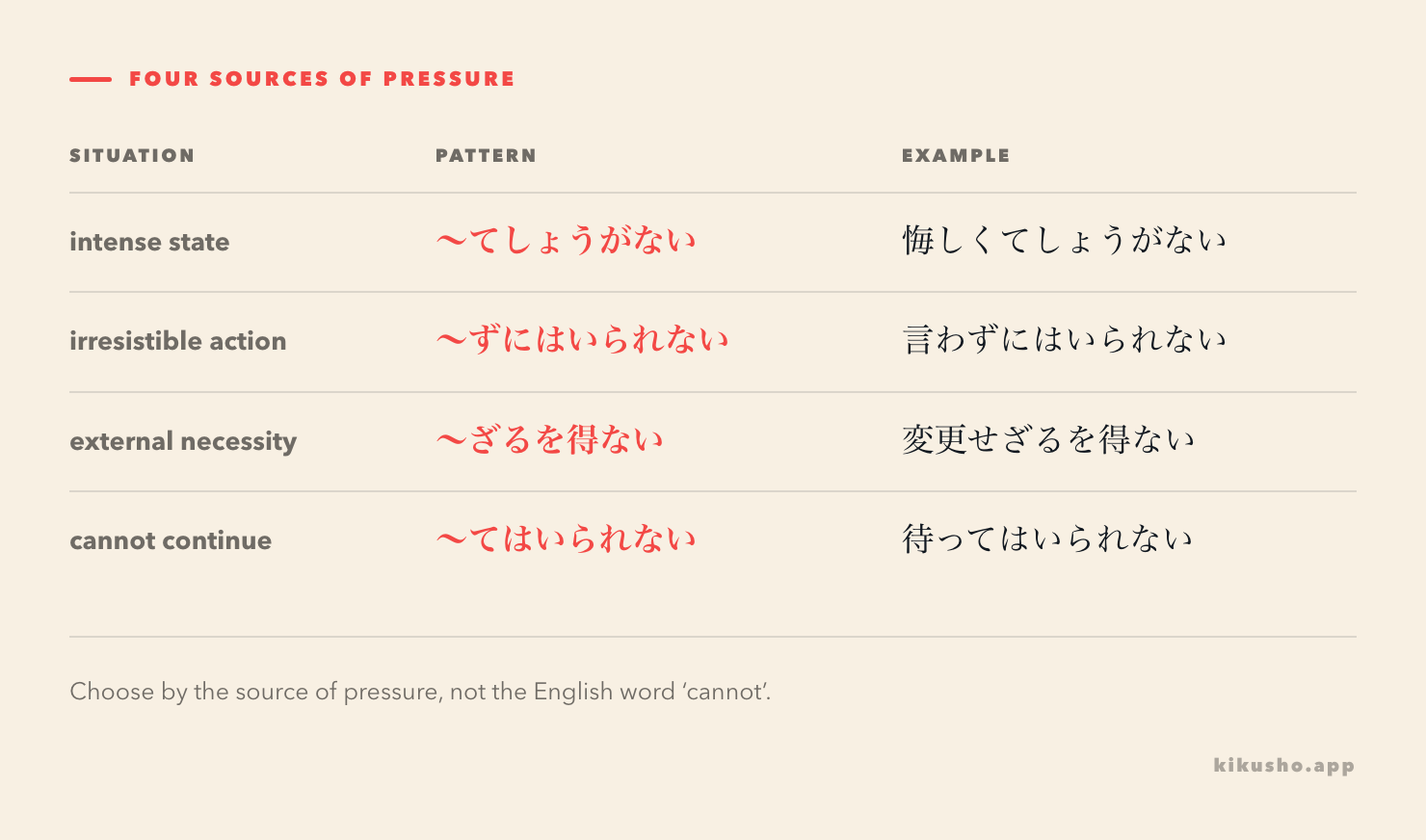
| Situation | Natural form | Example |
|---|---|---|
| an intense feeling or sensation | ~てしょうがない | 悔しくてしょうがない |
| an inner urge leads to action | ~ずにはいられない | 文句を言わずにはいられない |
| circumstances remove every alternative | ~ざるを得ない | 計画を変更せざるを得ない |
| it is impossible to continue the present action | ~てはいられない | もう待ってはいられない |
The company in 予算不足で計画を変更せざるを得ない changes its plan because circumstances leave no alternative. The ~ざるを得ない lesson explains that external pressure. By contrast, 感動して拍手せずにはいられない presents applause as an inner reaction.
Do not confuse ~ずにはいられない with ~てはいられない. 笑わずにはいられない means the person cannot keep from laughing. 笑ってはいられない means the person cannot continue laughing or cannot afford to laugh in the present situation.
Keep the trigger when you save the sentence
An isolated card for 笑わずにはいられない records the form but hides why the action feels inevitable. In Kikusho, capture the trigger as well: この写真を見ると、笑わずにはいられない. The complete line preserves the conditional, the negative base and the action that follows from the reaction.
For ~てしょうがない, keep the object of concern or desire. 結果が気になってしょうがない gives review something concrete to reconstruct, whereas a card containing only しょうがない is liable to recall the separate standalone meaning “it cannot be helped.”
Practice: identify the state before the action
Complete all six questions before consulting the explanation block.
Question 1 — grammar choice. You are extremely sleepy, but no action is named. Complete 今日は眠くて__.
- A. しょうがない
- B. ずにはいられない
- C. ざるを得ない
- D. てはいられない
Question 2 — grammar choice. The photo always makes you laugh. Complete この写真を見ると、笑わ__.
- A. てしょうがない
- B. ずにはいられない
- C. なくてしょうがない
- D. てはいられない
Question 3 — formation. Change 確認する into ~ずにはいられない.
Question 4 — meaning contrast. Explain the difference between these two sentences.
- 本当のことを言いたくてしょうがない。
- 本当のことを言わずにはいられない。
Question 5 — neighbouring form. A broken server leaves the company no practical choice but to delay a release. Which sentence fits?
- A. 発売を延期したくてしょうがない。
- B. 発売を延期せずにはいられない。
- C. 発売を延期せざるを得ない。
- D. 発売を延期してはいられない。
Question 6 — passage completion. Select the pair that completes both blanks.
明日の発表が( )。何度準備しても不安で、資料をもう一度( )。
- A. 心配でしょうがない/確認せずにはいられない
- B. 心配せずにはいられない/確認してしょうがない
- C. 心配してはいられない/確認せざるを得ない
- D. 心配でしかたがない/確認してはいられない
Record both choices before opening the answer section.
Answers and explanations
Answer 1. A, しょうがない. 眠い → 眠くて creates the adjective connection, and the sentence describes an overwhelming physical state. ~ずにはいられない must attach to the negative base of an action verb.
Answer 2. B, ずにはいられない. 笑う → 笑わない → 笑わずにはいられない says the viewer cannot refrain from laughing. A attaches two incompatible pieces, while D would mean that the person cannot continue laughing.
Answer 3. 確認せずにはいられない (かくにんせずにはいられない). A noun + する verb follows the する exception: しない becomes せず, not しず.
Answer 4. 本当のことを言いたくてしょうがない reports an overpowering desire to tell the truth. 本当のことを言わずにはいられない goes further and says the subject cannot refrain from telling it; the action itself is no longer held back.
Answer 5. C, 発売を延期せざるを得ない. The pressure comes from an external technical problem and removes the alternatives, so ~ざるを得ない fits. The sentence does not describe a desire to delay or an emotional urge that drives the company to act.
Answer 6. A, 心配でしょうがない/確認せずにはいられない. The first blank names intense worry about the presentation. The second names the action that the speaker cannot resist performing. D begins naturally but ends with “cannot continue checking,” which reverses the intended meaning.
Where the N3 label becomes uncertain
JLPT Sensei and Nihongo NET place ~てしょうがない/~てしかたがない at N3, while Bunpro places it at N2. JLPT Sensei and Bunpro place ~ずにはいられない at N3; Japanese teacher N1et groups it with N2 material. The disagreement concerns study order, not the attachment or the state-action distinction taught here.
An AI language review by OpenAI Codex checked the final forms, readings, translations, restrictions, all six questions and their distractors against the cited independent references. No human review is claimed.
Common questions
What is the difference between ~てしょうがない and ~ずにはいられない?
~てしょうがない describes a feeling, desire or physical state as intensely present and beyond easy control. ~ずにはいられない says the subject cannot resist performing an action.
How do you form ~てしょうがない?
Use a verb's て-form, an い-adjective's ~くて form, a な-adjective plus で, or a ~たい form changed to ~たくて, then add しょうがない or しかたがない.
How do you form ~ずにはいられない?
Remove ない from the plain negative and add ずにはいられない: 読まない becomes 読まずにはいられない. The main exception is する, which becomes せずにはいられない.
Is ~ないではいられない different from ~ずにはいられない?
The core meaning is the same: the subject cannot refrain from acting. ~ないではいられない uses the ordinary negative and often feels more conversational, while ~ずにはいられない has the older ~ず form.