On this page
Use 折に(おりに) to locate an action at a formal occasion or suitable opportunity. Use 手前(てまえ) when something already said, a role, or another person's gaze limits what the subject can now do.
次に京都へお越しの折には、ぜひご連絡ください。
つぎにきょうとへおこしのおりには、ぜひごれんらくください。
Please contact us when you next come to Kyoto.
私が担当すると言った手前、今さら断るわけにはいかない。
わたしがたんとうするといったてまえ、いまさらことわるわけにはいかない。
Since I said I would take charge, I cannot back out now.
The first sentence offers a time at which contact would be welcome. The second looks backward at a commitment that has narrowed the speaker's choices. English translations such as “when,” “given that” and “in view of” can hide that difference.
This lesson teaches 折に (g-d2b979ad7326) and the constraint use of 手前 (g-85d8168f825b). Kikusho keeps them in its N1 track, but study guides do not agree uniformly: PassJapanese places 折に at N2, and Bunpro places 手前 at N2, while JLPT Sensei and several teacher-written references place them at N1. Those labels are study estimates because the JLPT does not publish an exhaustive current grammar list.
Ask whether A opens a moment or closes off a choice
The two nouns create opposite movements in the sentence.
| What A does | Form | Typical B |
|---|---|---|
| presents a formal occasion or opportunity | A折に(は) | a visit, request, meeting or event at that time |
| creates pressure to remain consistent or save face | A手前 | something one cannot do, must do or hesitates to say |
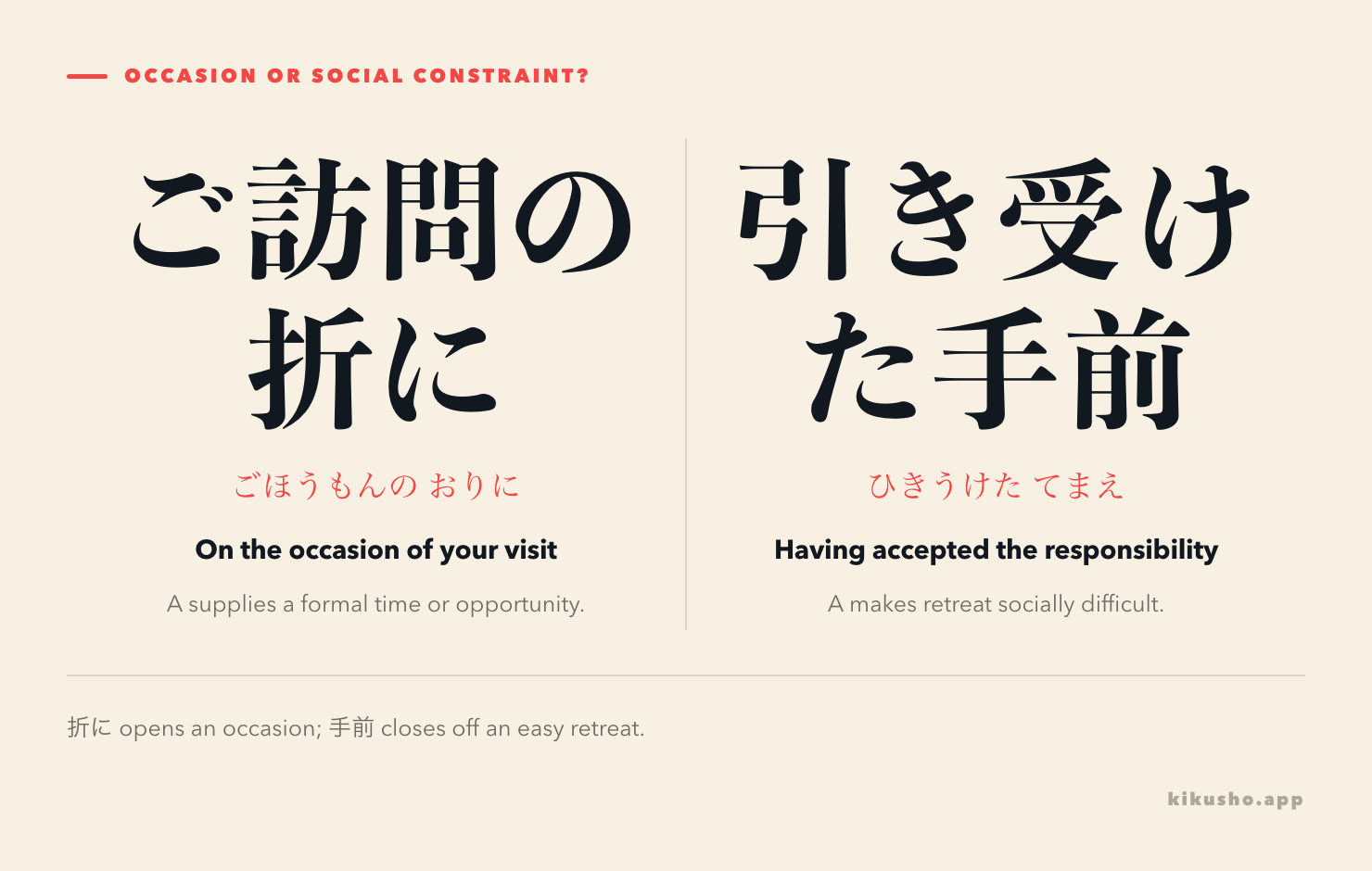
This test is more reliable than translating both clauses with a broad word such as “circumstances.” 折に answers “on what occasion?” 手前 answers “why can the subject no longer act freely?”
折に marks a formal occasion
折 is a noun for an occasion or opportunity. The pattern belongs mainly to careful speech, letters, greetings and formal narrative. Common attachments are:
| Attachment | Example frame | View of the occasion |
|---|---|---|
| V dictionary form + 折に(は) | 訪問する折には | a coming or general occasion |
| V past form + 折に | 訪問した折に | a completed visit used as the time frame |
| N + の + 折に(は) | ご帰国の折には | the occasion named by a noun |
先月、本社を訪れた折に、以前の同僚と再会した。
せんげつ、ほんしゃをおとずれたおりに、いぜんのどうりょうとさいかいした。
When I visited the head office last month, I met a former colleague again.
ご帰国の折には、この書類を窓口にお持ちください。
ごきこくのおりには、このしょるいをまどぐちにおもちください。
When you return to the country, please bring this document to the counter.
The particle は makes the occasion the topic and is especially common in polite invitations or requests: お近くにお越しの折には、お立ち寄りください. It does not automatically mean that the event repeats. It can point to one relevant future opportunity.
Register matters. コンビニに行った折に、牛乳を買った is grammatically interpretable, but it makes an ordinary convenience-store trip sound ceremonious. In daily conversation, コンビニに行ったとき is the natural default.
折に and 際に divide refined and procedural settings
Both forms can mark a formal time. 際に is neutral and businesslike, so it fits rules, instructions and procedures. 折に often sounds more personal, courteous or literary and treats the time as an occasion.
入館の際に、身分証明書をご提示ください。
にゅうかんのさいに、みぶんしょうめいしょをごていじください。
Please show identification when entering the building.
またお会いする折に、続きをお聞かせください。
またおあいするおりに、つづきをおきかせください。
Please tell me the rest when we next meet.
The 際に lesson develops timing, attachment and procedural use. Replace 際に with 折に only when the more refined “occasion” framing suits the relationship and text.
手前 turns a fact into social or personal pressure
In the target grammar, 手前 follows a fact that affects how the subject must now appear or behave. It often follows a promise, claim, accepted responsibility, continuing role or benefit received from someone.
| Attachment | Example frame | Source of pressure |
|---|---|---|
| V dictionary form + 手前 | 人に教える手前 | an action or role one undertakes |
| V past form + 手前 | 引き受けた手前 | a commitment already made |
| Vている + 手前 | 指導している手前 | a continuing role or position |
| N + の + 手前 | 部下の手前 | the people before whom one must maintain an appearance |
この案を自分から提案した手前、失敗したからといって投げ出せない。
このあんをじぶんからていあんしたてまえ、しっぱいしたからといってなげだせない。
Since I proposed this plan myself, I cannot abandon it just because it failed.
部下の手前、不安な表情を見せるわけにはいかない。
ぶかのてまえ、ふあんなひょうじょうをみせるわけにはいかない。
I cannot show anxiety in front of my staff.
The second clause commonly contains わけにはいかない, ないわけにはいかない, なければならない, ざるを得ない or an expression such as 言いにくい. These endings expose the restricted choice. A neutral result with no pressure often misses the point of the pattern.
Keep grammatical 手前 apart from physical 手前
The constraint meaning grows from the ordinary noun's ideas of position, standpoint and being before other people. The noun also has a literal spatial use:
橋の手前に、小さな郵便局がある。
はしのてまえに、ちいさなゆうびんきょくがある。
There is a small post office before the bridge.
This sentence locates a building. It does not say that the bridge creates a moral obligation. The Japanese body-part compounds lesson teaches that near-side sense and the rough second-person reading てめえ as separate vocabulary. In the grammar here, read the form てまえ.
手前 is narrower than からには
Both patterns can make B follow from A, but からには presents a deliberate commitment or natural duty. 手前 highlights consistency, appearance or indebtedness that makes retreat awkward.
引き受けたからには、最後まで責任を持つ。
ひきうけたからには、さいごまでせきにんをもつ。
Now that I have accepted it, I will take responsibility to the end.
引き受けた手前、途中で辞めるとは言いにくい。
ひきうけたてまえ、とちゅうでやめるとはいいにくい。
Having accepted it, I find it hard to say that I will quit halfway through.
The first states resolve. The second reveals the face problem created by backing out. The 以上は, からには and 上は lesson compares three broader premise-to-consequence patterns.
One visit can contain either relationship
The scene alone does not choose the form. The writer chooses what A contributes to B.
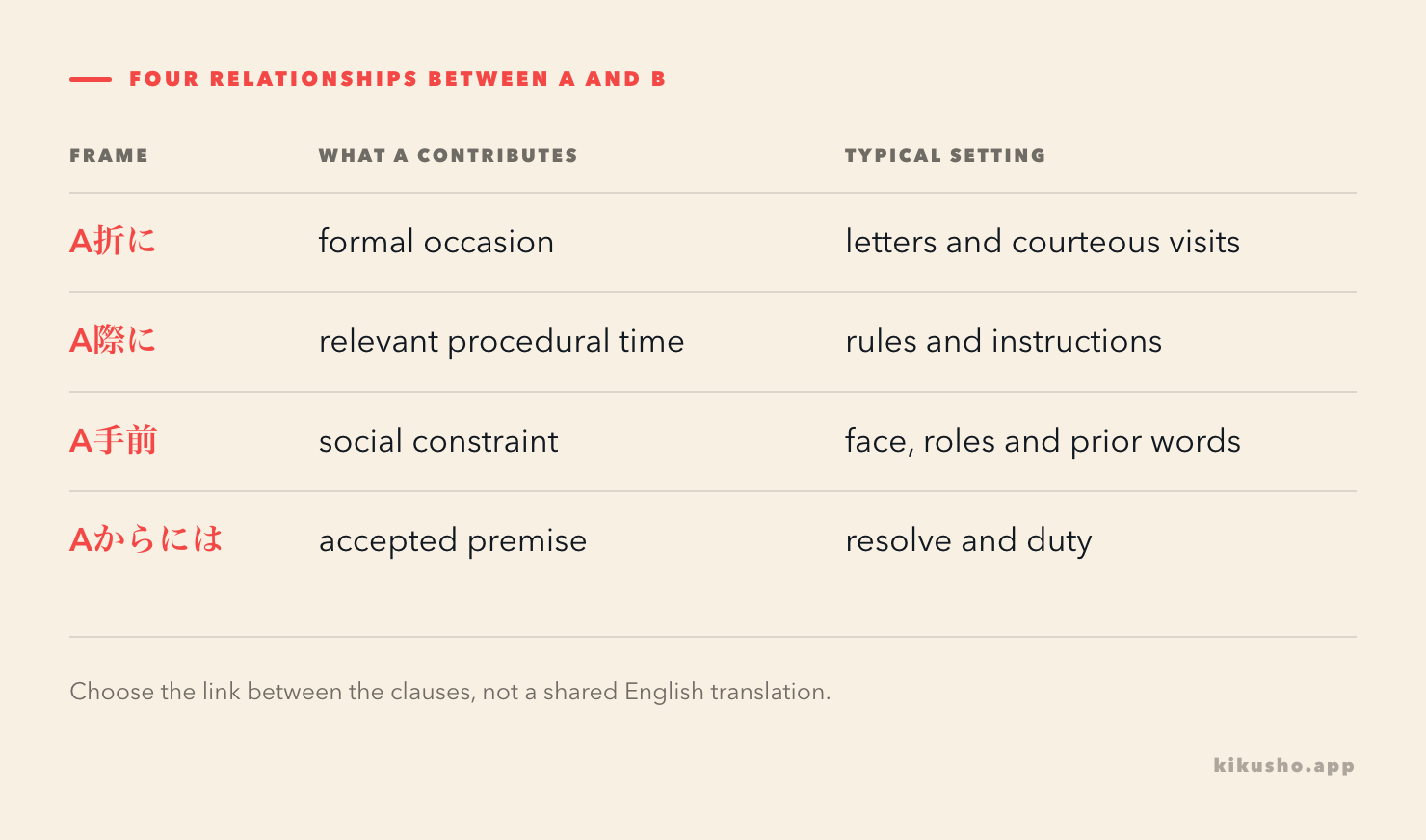
先生の研究室を訪れた折に、新しい資料を見せていただいた。
せんせいのけんきゅうしつをおとずれたおりに、あたらしいしりょうをみせていただいた。
When I visited my professor's office, I was shown new materials.
先生の研究室を訪れると約束した手前、忙しいからといって取り消しにくい。
せんせいのけんきゅうしつをおとずれるとやくそくしたてまえ、いそがしいからといってとりけしにくい。
Since I promised to visit my professor's office, it is hard to cancel merely because I am busy.
For a Kikusho card, keep both halves. A card containing only 訪れた折に loses the event that occurred on that occasion. A card containing only 約束した手前 loses the constrained action that explains the speaker's concern. Capturing the full sentence also lets you edit the reading, register note and relationship before saving it for review.
Practice: identify the relationship between A and B
Answer all seven questions before opening the shared explanation block.
Question 1 — courteous opportunity. Complete 次に大阪へお越しの( )、ぜひ当社にお立ち寄りください。
- ア. 手前は
- イ. 折には
- ウ. からには
- エ. そっちのけで
Question 2 — prior commitment. Complete 自分から引き受けた( )、今さら無理だとは言いにくい。
- ア. 折に
- イ. 際に
- ウ. 手前
- エ. ときまで
Question 3 — completed occasion. Which sentence naturally means “When I visited the branch office, I met the director” in a formal narrative?
- ア. 支社を訪問した折に、支社長にお会いした。
- イ. 支社を訪問した手前、支社長にお会いした。
- ウ. 支社を訪問の折に、支社長にお会いした。
- エ. 支社を訪問したからには、支社長にお会いした。
Question 4 — audience and appearance. Complete 子どもたち( )、先生が約束を破るわけにはいかない。
- ア. の折に
- イ. の手前
- ウ. の際に
- エ. のときから
Question 5 — procedural register. A notice gives a neutral rule: “When entering, show your pass.” Which expression is the best default?
- ア. 入場の手前
- イ. 入場の折に
- ウ. 入場の際に
- エ. 入場したからには
Question 6 — connected text. Read the passage and choose the sentence that best completes it.
田中さんは会議で「この企画は私が責任を持ちます」と言った。しかし、予算の問題が見つかった。( )
- ア. 責任を持つと言った折に、企画から外れた。
- イ. 責任を持つと言った手前、簡単には企画から降りられない。
- ウ. 責任の手前に、予算を見つけた。
- エ. 責任を持つ際に、企画が必ず成功する。
Question 7 — sentence composition. Arrange these pieces to say “Since I promised the client, I cannot change the deadline now.”
- 今さら締め切りを変えるわけにはいかない
- 顧客と約束した手前
- 私は
Answers and explanations
Answer 1. イ, 折には. A future visit becomes a courteous opportunity to stop by. 手前 would require social pressure that restricts the visitor's choices.
Answer 2. ウ, 手前. Volunteering created a commitment, and the following 言いにくい states the resulting difficulty. 折に and 際に would locate an event in time instead.
Answer 3. ア. The past form 訪問した attaches directly to 折に and supplies the occasion for meeting the director. Choice ウ incorrectly places a bare noun-style の after a verb, while 手前 and からには would need a meaningful consequence or commitment.
Answer 4. イ, の手前. The children are the audience before whom the teacher must preserve consistency. The main clause わけにはいかない makes that constraint explicit.
Answer 5. ウ, 入場の際に. A neutral public instruction favors the procedural 際に. 折に would give the routine rule an unnecessarily refined, occasion-like tone, and 手前 does not mark a procedure.
Answer 6. イ. Tanaka's public statement now makes withdrawal difficult. 手前 connects that prior claim to 降りられない without claiming that the plan must succeed.
Answer 7. 顧客と約束した手前、私は今さら締め切りを変えるわけにはいかない。 The completed promise creates the social constraint, 私は identifies the constrained subject, and the final clause states the action now ruled out.
Common questions
What is the difference between 折に and 手前?
折に identifies a formal occasion or suitable opportunity for an action. 手前 gives the prior statement, role or audience that makes the subject feel unable to act freely without losing consistency or face.
What comes before 折に?
Common patterns are a dictionary-form or past-form verb plus 折に, and a noun plus の折に. 折には is frequent when the occasion is presented as a topic, especially in invitations, requests and correspondence.
What comes before 手前 in this grammar pattern?
Use a plain verb, often dictionary, past or ている form, or use a noun plus の. The following clause commonly states something the subject cannot do, must do or would find difficult to say.
Is 手前 always a grammar pattern?
No. 手前 is also an ordinary noun for a position in front of or on the near side of something. Context distinguishes a physical location from the social constraint taught here.