On this page
にもかかわらず acknowledges a real fact or obstacle, then introduces a result contrary to the expectation that fact creates. In 大雨にもかかわらず、試合は予定どおり行われた, the heavy rain is real, yet the match took place as scheduled.
Start with a fact, then overturn the expectation
The basic reading path is:
- accept the first statement as true;
- notice the likely expectation it creates;
- read the following clause as a result that goes against that expectation.
大雨にもかかわらず、試合は予定どおり行われた。
おおあめにも かかわらず、しあいは よていどおり おこなわれた。
Despite the heavy rain, the match took place as scheduled.
Heavy rain normally makes cancellation or delay plausible. The main clause defeats that expectation. にもかかわらず does not itself mean that the result is good or bad; that judgment comes from the situation.
十分に準備したにもかかわらず、説明がうまくできなかった。
じゅうぶんに じゅんびしたにも かかわらず、せつめいが うまく できなかった。
Although I prepared thoroughly, I could not explain it well.
Here the preparation makes a successful explanation likely, so failure feels disappointing. A different sentence can express admiration:
経験が少ないにもかかわらず、彼女の発表は分かりやすかった。
けいけんが すくないにも かかわらず、かのじょの はっぴょうは わかりやすかった。
Despite having little experience, her presentation was easy to understand.
The Japan Foundation's discussion of adversative expressions treats にもかかわらず as especially suited to an objective presentation of conflicting facts. That does not make the expression emotionless. Criticism, surprise, regret or praise can still come from the facts being contrasted.
Attach the complete fact
Use an ordinary plain-form statement before にもかかわらず. Present and past facts can both appear there.
| Material | Connection | Example |
|---|---|---|
| Verb | plain form + にもかかわらず | 知っているにもかかわらず |
| い-adjective | plain form + にもかかわらず | 忙しいにもかかわらず |
| な-adjective | である + にもかかわらず | 静かであるにもかかわらず |
| Noun | noun + にもかかわらず | 大雨にもかかわらず |
| Formal noun statement | noun + であるにもかかわらず | 初心者であるにもかかわらず |
知っていたにもかかわらず、彼は何も言わなかった。
しっていたにも かかわらず、かれは なにも いわなかった。
Although he knew, he said nothing.
忙しいにもかかわらず、手伝ってくれました。
いそがしいにも かかわらず、てつだって くれました。
Despite being busy, she helped me.
この部屋は駅の近くであるにもかかわらず、静かだ。
この へやは えきの ちかくで あるにも かかわらず、しずかだ。
Although this room is near the station, it is quiet.
With nouns, the shorter connection is normal: 雨にもかかわらず, not a forced 雨だにもかかわらず. Formal prose can state the relationship explicitly with Nであるにもかかわらず. For a な-adjective, the dependable formal frame is also であるにもかかわらず.
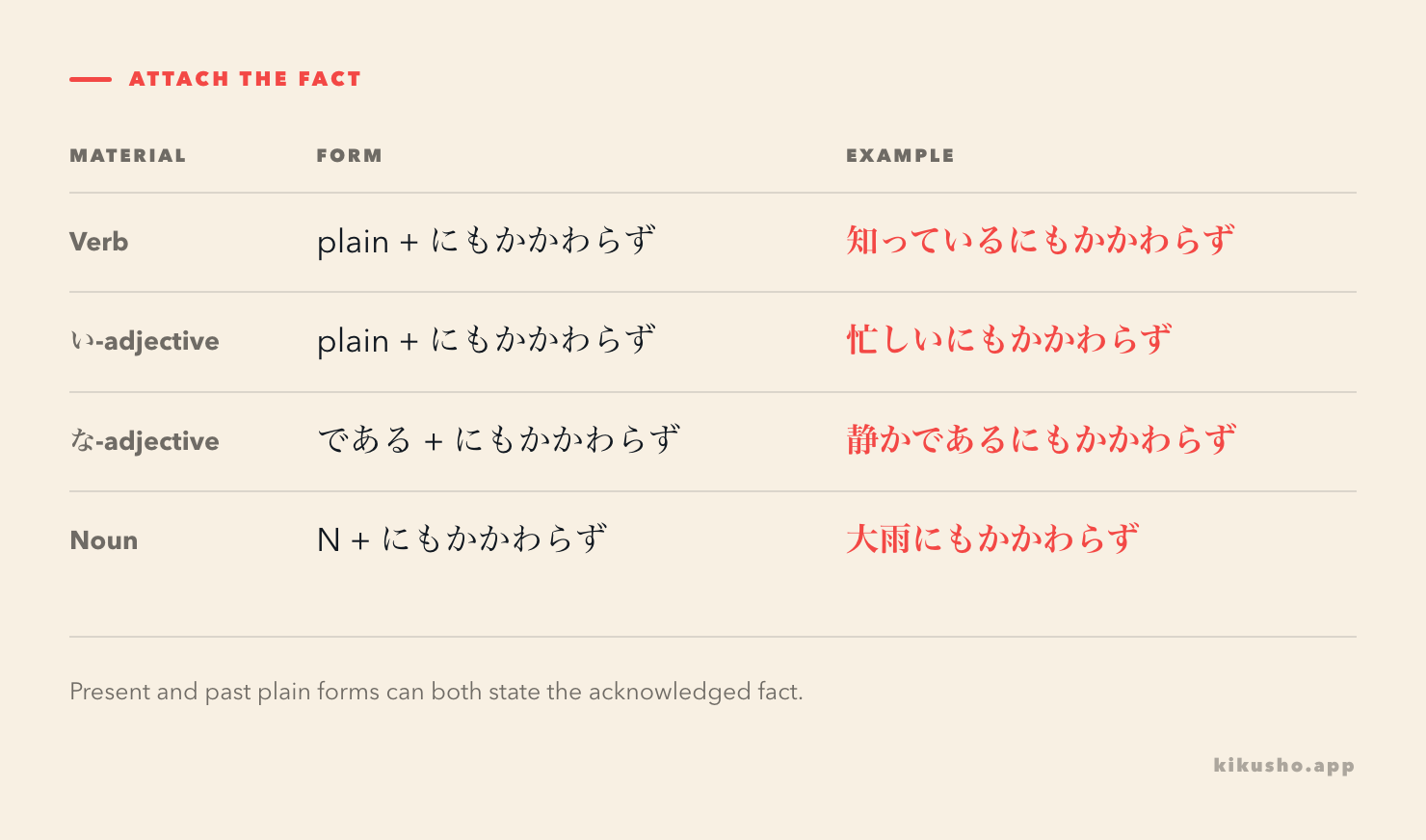
The formation described by 日本語NET and Bunpro agrees on this central pattern. The National Institute for Japanese Language and Linguistics also discusses verb and adjective plain forms, noun connections and the expression's written character. The N2 label is a useful study convention drawn from teaching references, rather than a claim that the test maker has issued a complete public grammar syllabus.
にもかかわらず and にかかわらず answer different questions
The presence of も is decisive here. Compare two weather sentences:
雨にもかかわらず、試合は行われた。
あめにも かかわらず、しあいは おこなわれた。
The match took place despite the rain.
天候にかかわらず、試合は行われます。
てんこうに かかわらず、しあいは おこなわれます。
The match will take place regardless of the weather.
The first sentence reports rain as an actual circumstance. Rain invites an expectation of cancellation, but the match happened. The second can announce a rule across several possible weather conditions. It does not tell us which weather is real today and does not need an unexpected outcome.
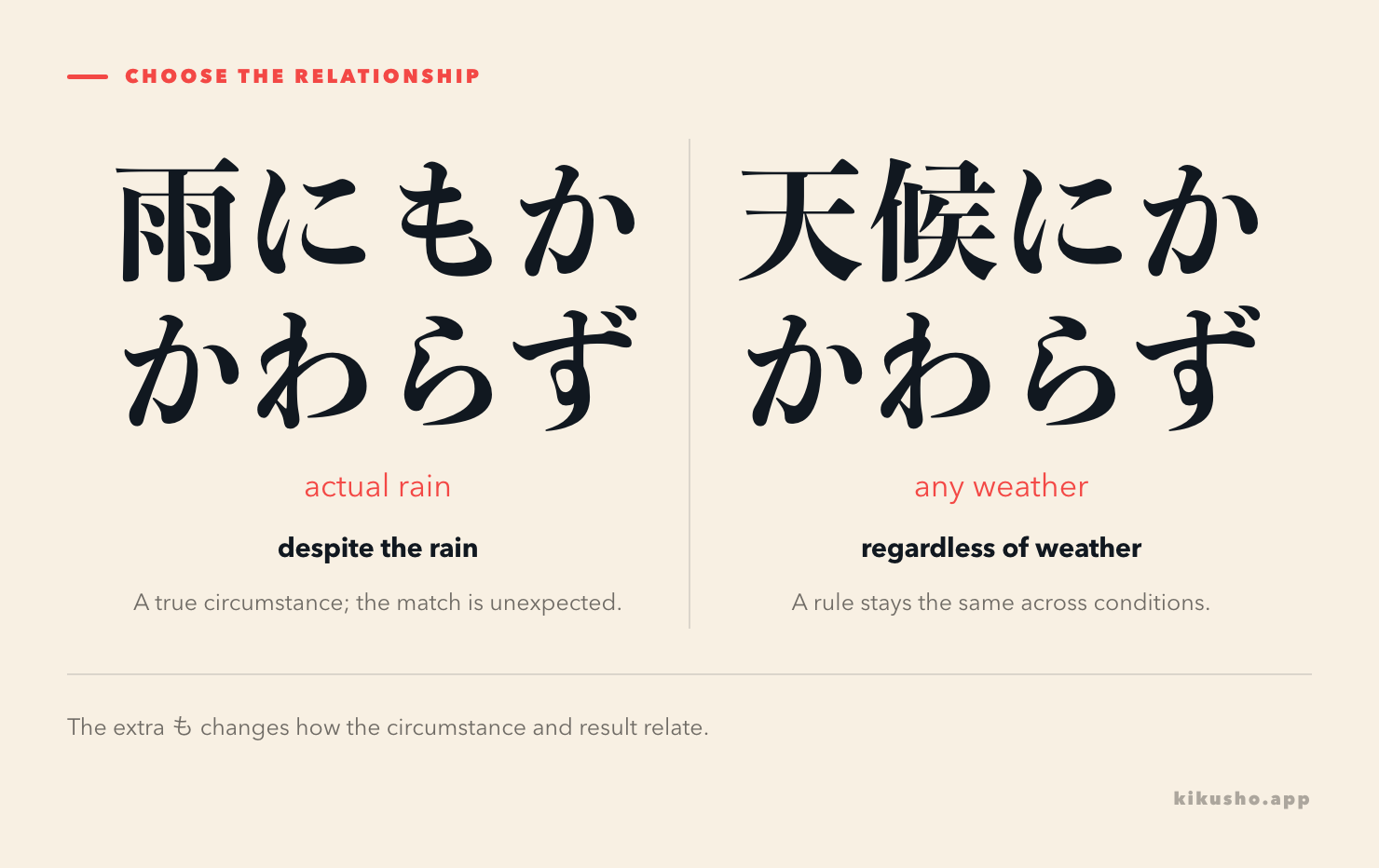
Use this test when both strings look possible:
- Fact → unexpected result: にもかかわらず
- Whatever the condition → same result: にかかわらず
The detailed lesson on にかかわらず and を問わず develops the second relationship. Adding も does not make that connector more polite; it changes what the two clauses mean together.
Compare the formal connector with のに
にもかかわらず and のに can describe the same contrast:
薬を飲んだのに、まだ頭が痛い。
くすりを のんだのに、まだ あたまが いたい。
I took medicine, but my head still hurts.
薬を飲んだにもかかわらず、頭痛は続いた。
くすりを のんだにも かかわらず、ずつうは つづいた。
Despite taking medicine, the headache continued.
The first is natural in everyday conversation and easily carries the speaker's frustration. The second sounds at home in a report, explanation or formal account. The difference is a register tendency, not a ban: にもかかわらず can appear in speech, and it can communicate criticism or disappointment.
The contrast lesson on ても and のに helps with conversational concession. For two other formal ways to grant a point before qualifying it, see ものの and とはいえ.
Use それにもかかわらず between sentences
The connector can also point back to a complete preceding sentence:
締め切りは昨日だった。それにもかかわらず、まだ半分しか提出されていない。
しめきりは きのうだった。それにも かかわらず、まだ はんぶんしか ていしゅつされて いない。
The deadline was yesterday. Nevertheless, only half have been submitted.
それ gathers the previous fact, and にもかかわらず introduces the conflicting result. This structure is useful in essays because the writer can state the evidence first and then mark the contradiction clearly.
Do not use it when the second sentence merely follows in time. If the deadline was yesterday and the results are announced today, there may be no defeated expectation. Choose the connector from the relationship between the facts, not from the English word “but” alone.
When you save にもかかわらず in Kikusho, keep the two sides in the example: the accepted circumstance and the unexpected result. A card containing only 大雨にもかかわらず shows attachment, but it does not train the expectation that makes the grammar useful.
Check that the contrast is real
Three mistakes can make a sentence grammatical in shape but weak in meaning.
First, do not use the expression for a simple cause and result. 雨が降ったので、試合は中止になった says the match was cancelled because it rained. Cancellation follows the normal expectation, so にもかかわらず would reverse the intended logic. To use the target pattern, the match must proceed, move indoors or produce some other result that rain did not predict.
Second, avoid manufacturing surprise from facts that naturally belong together. 日本語を勉強したにもかかわらず、日本語が上手になった sounds as if improvement after study were unexpected. A meaningful contrast would be 長年勉強したにもかかわらず、会話にはまだ自信がない: years of study create the expectation that confidence should be present.
Third, keep the acknowledged fact independent of the speaker's command. 危険であるにもかかわらず、入らないでください is hard to justify because avoiding a dangerous place is exactly what danger predicts. 危険であるにもかかわらず、中に入った人がいた creates the needed conflict: people entered even though the place was dangerous.
A useful editing question is “What would I normally expect after the first part?” If the main clause simply gives that expected result, choose a reason connector such as ので, or state the facts without an adversative connector. If the result resists the expectation, にもかかわらず has a clear job.
Practice
Keep the answer panel closed while you work through the six situations. Each one tests the relationship as well as the visible form.
Question 1: identify the relationship
大雨( )、マラソン大会は予定どおり行われた。
Which expression presents the race as an unexpected result despite actual heavy rain?
A. に応じて
B. にもかかわらず
C. にかかわらず
D. を問わず
Question 2: attach an い-adjective
忙しい( )、先生は一人ずつ質問に答えてくれた。
A. であるにもかかわらず
B. だにもかかわらず
C. にもかかわらず
D. をもかかわらず
Question 3: distinguish the weather rule
晴れでも雨でも、イベントは開催します。天候( )、会場へ来てください。
A. にかかわらず
B. にもかかわらず
C. のおかげで
D. に沿って
Question 4: choose the formal noun form
彼は初心者( )、落ち着いて発表した。
Which completion explicitly states “although he is a beginner” in formal prose?
A. を問わず
B. であるにもかかわらず
C. にかかわらず
D. に応じて
Question 5: connect two sentences
会社は二度注意を受けた。( )、安全対策を変えなかった。
A. そのため
B. したがって
C. それにもかかわらず
D. それに沿って
Question 6: read the full contrast
佐藤さんはこの分野で働いた経験が少ないにもかかわらず、資料を丁寧に調べ、分かりやすい報告書を完成させた。
Which interpretation fits the sentence?
A. Her limited experience creates an expectation, but the careful and clear report goes against it.
B. Anyone may submit a report regardless of experience.
C. The report became less clear because she researched it.
D. She completed the report before gaining any experience at all.
Answers and explanations
1 — B. にもかかわらず. Heavy rain is presented as real, and the scheduled race contradicts the likely expectation of cancellation. にかかわらず would fit a general weather-independent rule instead.
2 — C. にもかかわらず. The い-adjective stays in its plain form: 忙しいにもかかわらず. Do not insert だ or である after 忙しい.
3 — A. にかかわらず. 晴れでも雨でも names alternative conditions under which the event remains unchanged. The sentence states a rule rather than reporting one surprising rainy event.
4 — B. であるにもかかわらず. 初心者である is the complete formal noun statement, followed by the connector. The shorter 初心者にもかかわらず is also possible, but it is not one of the complete alternatives here.
5 — C. それにもかかわらず. The company had already received two warnings, so failing to change its measures contradicts the expected response. そのため and したがって would present a consequence instead.
6 — A. The sentence acknowledges limited experience, then praises a result that defeats the expectation attached to it. It does not announce an eligibility rule, which would favor にかかわらず or を問わず.
Common questions
What does にもかかわらず mean?
It acknowledges a real fact or circumstance and introduces a result that goes against the expectation created by that fact. Depending on the sentence, it can mean despite, although or nevertheless.
What is the difference between にもかかわらず and にかかわらず?
にもかかわらず presents an unexpected result despite an established fact. にかかわらず says that a result or rule does not vary with a condition. The も changes the relationship rather than adding politeness.
Is にもかかわらず the same as のに?
They overlap when a fact and an unexpected result are contrasted. のに is very common in conversation and readily conveys a speaker's feelings; にもかかわらず is especially natural in formal explanations and writing, though context can still give it criticism or regret.
Can にもかかわらず follow a noun?
Yes. Noun plus にもかかわらず is common, as in 大雨にもかかわらず. The fuller noun plus であるにもかかわらず is also available in formal prose.