On this page
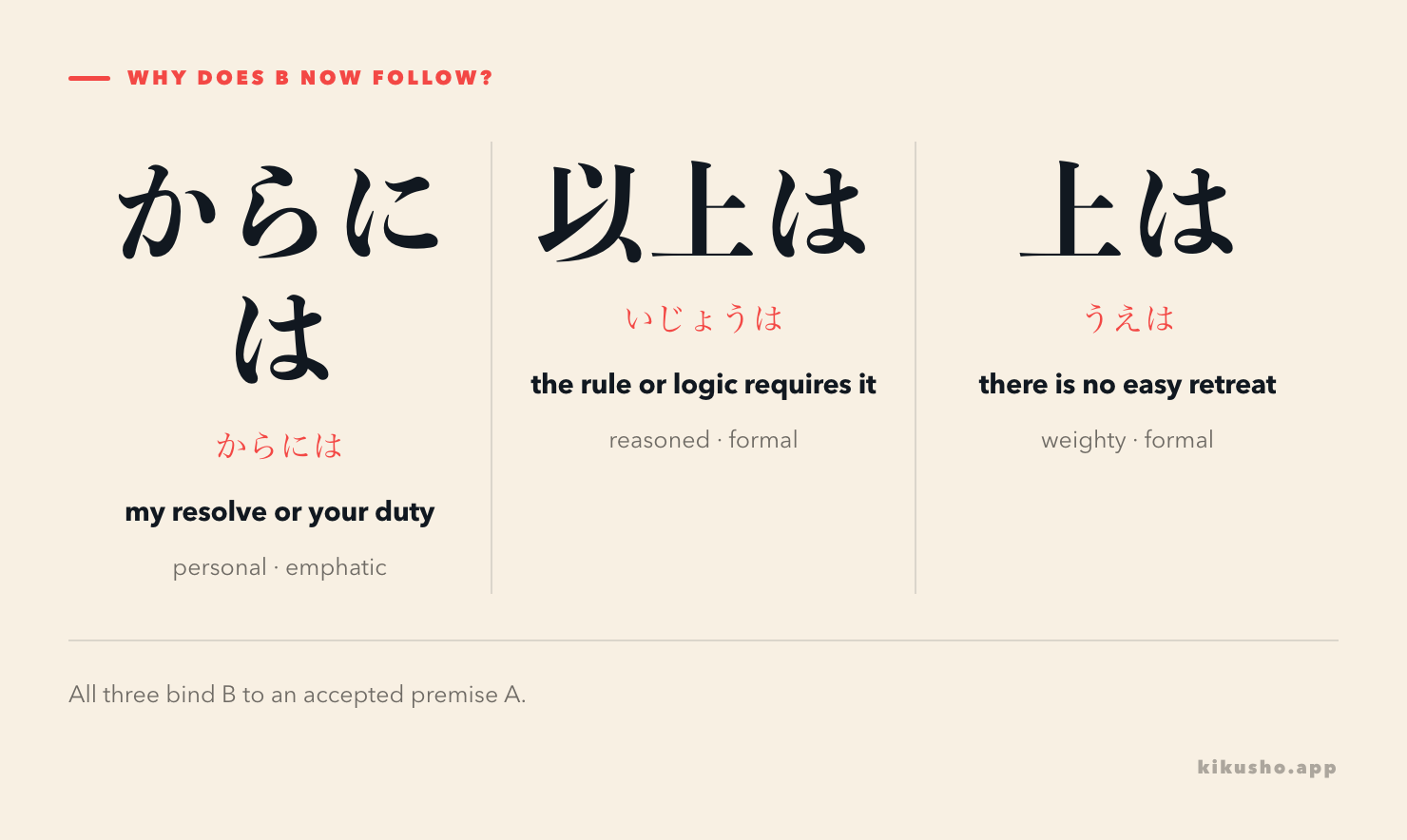
AからにはB, A以上はB and A上はB all mean that once A is accepted, B naturally follows as a commitment, duty or consequence. Choose からには for personal resolve, 以上は for a more logical or rule-like conclusion, and formal 上は when a decision leaves little room to turn back.
引き受けたからには、最後までやり遂げます。
ひきうけたからには、さいごまでやりとげます。
Since I have taken it on, I will see it through to the end.
社員である以上は、会社の規則を守るべきだ。
しゃいんであるいじょうは、かいしゃのきそくをまもるべきだ。
As long as one is an employee, one should follow the company's rules.
ここまで来た上は、計画を実行するしかない。
ここまできたうえは、けいかくをじっこうするしかない。
Now that we have come this far, there is no choice but to carry out the plan.
The three overlap. Their difference is strongest in viewpoint and register, not in a one-word English translation.
The shared mechanism: A makes B binding
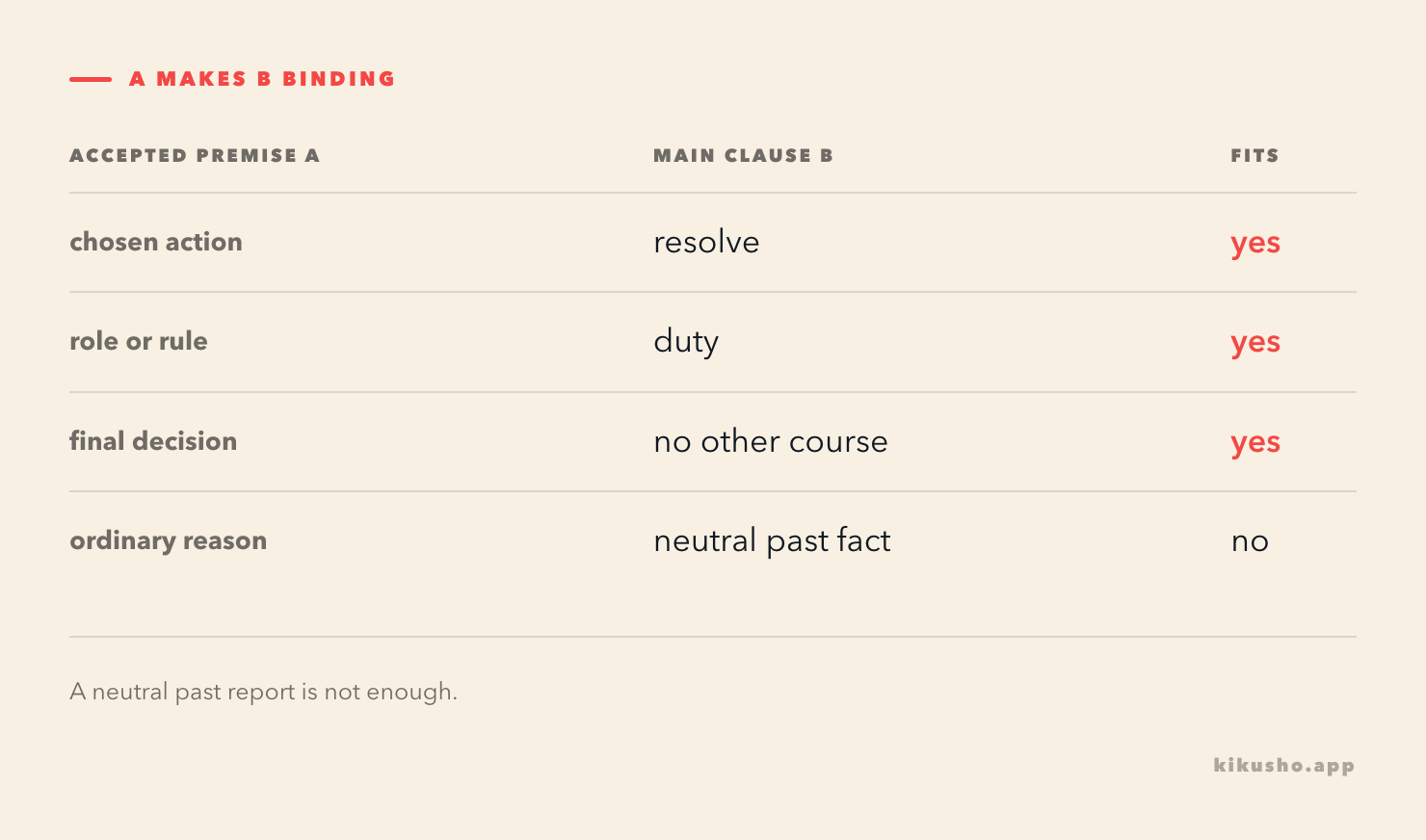
These forms do more than give an ordinary reason. The speaker treats A as settled, then presents B as the appropriate or unavoidable response.
Common main-clause endings include:
| Function of B | Common forms |
|---|---|
| resolve | つもりだ, ~よう, 必ず~する |
| duty or advice | べきだ, なければならない, 必要がある |
| demand or prohibition | ~てください, ~てはいけない |
| unavoidable course | しかない, わけにはいかない |
| confident judgment | はずだ, に違いない |
約束した以上は、守らなければならない。
やくそくしたいじょうは、まもらなければならない。
Since a promise was made, it must be kept.
An ordinary report such as 約束した以上は、昨日電話した sounds mismatched if it merely means “because I promised, I called yesterday.” The pattern makes the second clause sound like a norm, resolve or inevitable conclusion. Simple から or ので is better for a neutral cause.
This premise-to-consequence relation is the foundation. The three forms then position the speaker differently toward it.
からには foregrounds resolve or a demand
からには grows from causal から, but it is more emphatic. A is treated as a real commitment or chosen situation, and B states what the speaker or listener should now do.
大会に出るからには、優勝を目指したい。
たいかいにでるからには、ゆうしょうをめざしたい。
If I am going to enter the tournament, I want to aim for victory.
リーダーを引き受けたからには、途中で投げ出さないでください。
リーダーをひきうけたからには、とちゅうでなげださないでください。
Since you accepted the role of leader, please do not abandon it halfway.
The first sentence declares the speaker's intention. The second presses a responsibility on the listener. This personal and interactive force makes からには natural in conversation.
The Japan Foundation's account of reason expressions characterizes からには as subjective and emphatic, and notes that its following clause often contains resolve or an attempt to influence someone. Unlike からこそ, which highlights A as the special reason, からには puts the communicative weight on what must follow in B.
以上は presents a logical or role-based consequence
以上は(いじょうは) treats A as a firm fact or premise and derives B from it. It readily suits rules, roles, standards and calm argument.
教師である以上は、生徒の個人情報を守る必要がある。
きょうしであるいじょうは、せいとのこじんじょうほうをまもるひつようがある。
As long as one is a teacher, one must protect students' personal information.
この方法を選ぶ以上は、一定のリスクも受け入れるべきだ。
このほうほうをえらぶいじょうは、いっていのリスクもうけいれるべきだ。
If we choose this method, we should also accept a certain level of risk.
The first premise is a continuing status; the second is a decision under discussion. 以上は can support personal resolve too, but it often sounds as if the consequence follows from standards or logic rather than emotion.
A Japanese grammar account based on descriptive grammar defines 以上は as presenting A as certain information from which B necessarily follows. N1et's teacher guide recommends separating the forms pedagogically by using からには for speaker intention and 以上は for rules and other objective consequences, while acknowledging their large overlap.
The は is sometimes omitted: 約束した以上、守るべきだ. The meaning remains the same, though は helps foreground the accepted premise.
上は marks a formal point of no return
上は(うえは) is the most formal and dramatic of the three. It commonly follows a decision, discovery or completed development and presents B as the course that remains now that circumstances have reached this point.
方針を決定した上は、全員で実行に移さなければならない。
ほうしんをけっていしたうえは、ぜんいんでじっこうにうつさなければならない。
Now that the policy has been decided, everyone must put it into action.
真実を知った上は、黙っているわけにはいかない。
しんじつをしったうえは、だまっているわけにはいかない。
Now that I know the truth, I cannot remain silent.
Past-form verbs are especially natural because a boundary has already been crossed. Nonpast forms occur when the decision itself is treated as settled, but Vた上は is the safest core.
A Japanese-teacher comparison of 上は and 以上は notes that 上は is restricted toward severe or pressured situations. That does not mean every sentence must be melodramatic. It means 上は is a poor choice for a routine norm such as returning an ordinary lost wallet; 以上は handles that calm “given A, naturally B” relation better.
Attachment narrows as the register rises
Use the following forms as a dependable production guide:
| Premise A | からには | 以上は | 上は |
|---|---|---|---|
| verb | 行くからには / 行ったからには | 行く以上は / 行った以上は | 行く上は / 行った上は |
| い-adjective | 必要ないからには | 必要ない以上は | uncommon |
| な-adjective | 必要であるからには | 必要である以上は | uncommon |
| noun | 学生であるからには | 学生である以上は | uncommon |
以上は attaches most freely. For nouns and な-adjectives, formal である is the clearest choice with 以上は and からには. 上は is strongly associated with verbs, especially decisions and completed changes.
Do not confuse 上は with 上で:
内容を確認した上で、契約してください。
ないようをかくにんしたうえで、けいやくしてください。
Please sign the contract after checking the contents.
This Vた上で orders actions or makes the first action the basis for the second. 契約した上は、責任を果たさなければならない instead says that once the contract has been signed, responsibility follows.
Match the form to the source of pressure
Use a short decision path:
- Is the speaker declaring resolve or pressing the listener? Start with からには.
- Does a role, rule or accepted fact logically impose B? Start with 以上は.
- Has a serious decision or development removed the option of retreat? Consider formal 上は.
These are centers of gravity, not absolute compartments. 引き受けたからには, 引き受けた以上は and 引き受けた上は can all be grammatical. The first sounds personally committed, the second reasoned and duty-based, and the third weighty and final.
When saving an example in Kikusho, keep both premise and response. からには = now that is too weak for recall. Save 出場するからには、全力を尽くしたい and mark “chosen premise → resolve,” or 社員である以上は、規則を守るべきだ and mark “role → duty.”
Practice: identify what makes the consequence binding
Complete all six questions before opening the explanations below them.
Question 1 — personal resolve. Which completion best foregrounds the speaker's determination?
挑戦する__、最後まで諦めないつもりだ。
- ア. 上で
- イ. 以上に
- ウ. からには
- エ. 上に
Question 2 — rule-like duty. Choose the most neutral, logical form.
医師である__、患者の情報を守るべきだ。
- ア. 上で
- イ. 以上は
- ウ. 上は
- エ. からこそ
Question 3 — point of no return. A formal statement follows a final company decision. Which form best conveys “now that it has been decided, there is no retreat”?
新事業への参入を決めた__、成功させるしかない。
- ア. 上は
- イ. から
- ウ. 以上に
- エ. 上で
Question 4 — main-clause fit. Which sentence mismatches the grammar because B is only a neutral past report?
- ア. 約束したからには、必ず守ります。
- イ. 社員である以上は、規則に従うべきだ。
- ウ. 方針を決めた上は、実行するしかない。
- エ. 約束した以上は、昨日友人に電話した。
Question 5 — sentence composition. Arrange these four chunks into “Since I accepted the role, I intend to fulfil my responsibility.” Use each once.
- 役目を引き受けた
- からには
- 責任を
- 果たすつもりだ
Question 6 — connected text. Choose the two forms that best fit the blanks.
留学すると決めた( )、できる限り準備したい。奨学金を受ける学生である( )、大学の報告義務も守らなければならない。
- ア. 上で/上は
- イ. 以上に/からこそ
- ウ. からには/以上は
- エ. 上に/からには
Answers and explanations
Answer 1. ウ, からには. The speaker has chosen to take on a challenge and states a firm intention for what follows. That subjective commitment is the center of からには.
Answer 2. イ, 以上は. Being a doctor is a role from which confidentiality follows as a professional duty. からには could add personal insistence, but 以上は gives the requested neutral rule-like conclusion.
Answer 3. ア, 上は. A final decision has crossed a boundary and the formal main clause says only one course remains. 上で would mean after deciding or on the basis of the decision, without the same binding force.
Answer 4. エ. “I called a friend yesterday” is merely a past event and is not presented as a commitment, obligation or necessary judgment. Ordinary 約束したので、昨日友人に電話した would express the causal report.
Answer 5. 役目を引き受けたからには、責任を果たすつもりだ. The accepted role is the premise, and つもりだ states the speaker's resulting resolve.
Answer 6. ウ, からには/以上は. A personally chosen study-abroad plan leads to the speaker's intention, so からには fits. Scholarship status creates a rule-based reporting duty, so 以上は is the natural second form.
Level and review note
JLPT Sensei places all three forms at N2. Bunpro independently places からには and 上は at N2, and the other teacher references used here treat 以上は as N2. The inventory records no provider disagreement for these three items.
The labels organize study rather than reproduce an official complete syllabus. The JLPT FAQ states that detailed item lists are not published. What matters in reading is the inference structure: accept A, then identify whether B expresses personal resolve, a rule-like conclusion or a course made unavoidable by the situation.
OpenAI Codex performed the AI review of all three constructions, their examples, translations and six explained answers. No human reviewer participated.
Common questions
What is the difference between からには and 以上は?
Both make B follow naturally from an accepted premise A. からには foregrounds the speaker's resolve or demand, while 以上は readily states a logical, role-based or rule-like obligation and sounds more formal.
When should I use 上は?
Use 上は in formal or forceful language when a decision or completed development has left no easy retreat: now that A has happened, one must accept B.
What follows からには, 以上は and 上は?
The main clause normally carries commitment, obligation, advice, a demand or a natural judgment, using forms such as つもりだ, べきだ, なければならない, しかない, はずだ or に違いない.
Is 上は the same as 上で?
No. 上は links an accepted premise to a binding consequence. Vた上で means after doing something or on the basis of it, and Nの上で can mean in terms of a domain.