On this page
際に(さいに) means “when,” “at the time of,” or “on the occasion of” in formal Japanese. Use it when the occasion matters to an instruction, notice or report; use the ordinary とき for most casual conversation.
際に frames a relevant occasion, not just a time
The noun 際 means an occasion or juncture. In the pattern 際に, the clause before it identifies the occasion, and the main clause tells you what happens then:
予約を変更する際に、予約番号が必要です。 You need your reservation number when changing a booking.
The sentence could use ときに without changing the basic timeline. 際に changes the register and the frame. It sounds like information given by a business, an institution or someone explaining a procedure. That is why you meet it in application instructions, safety notices, customer support pages and formal accounts of past events.
This pattern can describe a future procedure or a past occasion. The occasion need not be ceremonial, but it should be relevant enough to frame what follows. Bunpro describes the register as formal and warns that unchanging daily occurrences often sound unnatural with it. The Japanese teaching site 日本語NET likewise marks it as a stiff expression that is uncommon in everyday conversation.
Attach Vる, Vた or Nの directly to 際
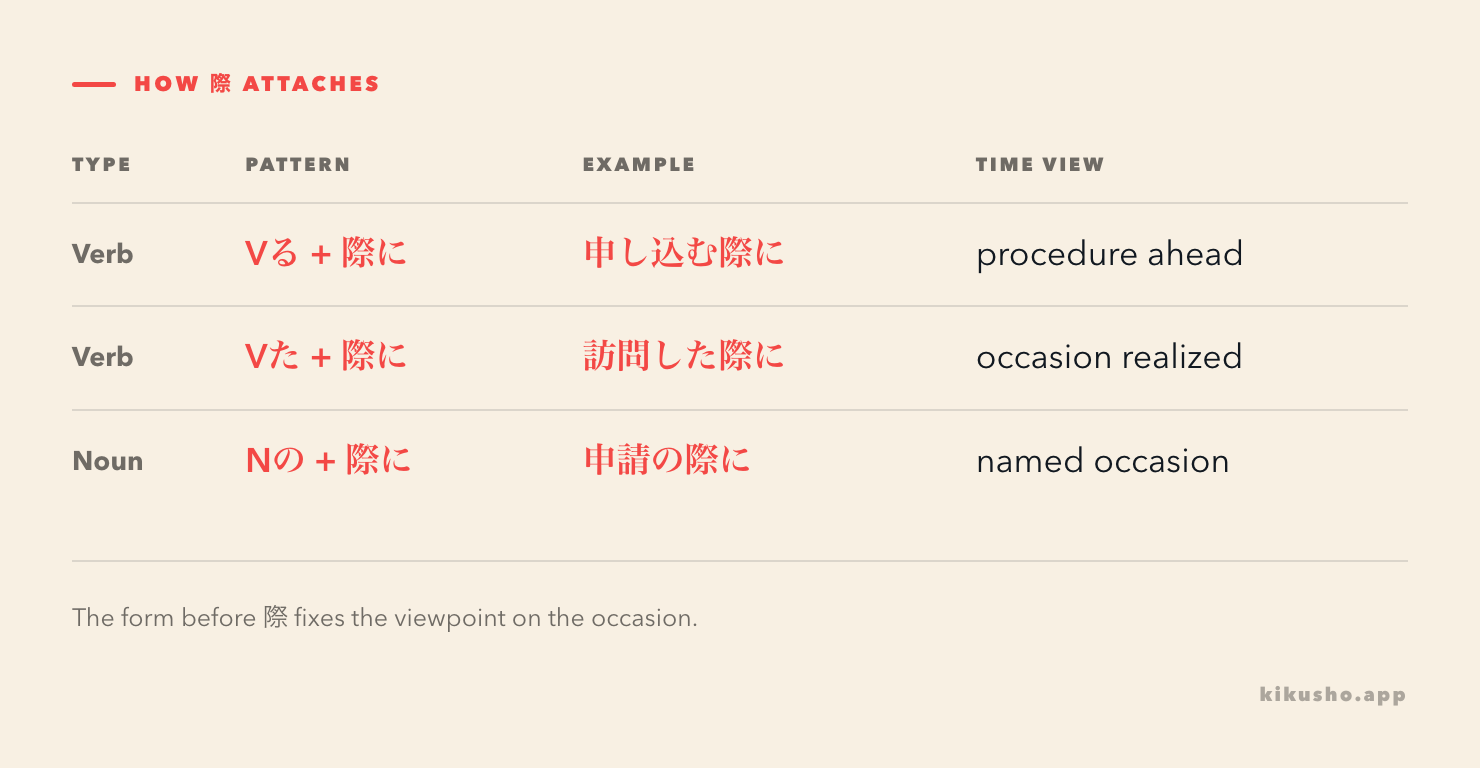
Three attachments cover the uses you need:
| Form | Pattern | Example | What it frames |
|---|---|---|---|
| Verb, dictionary form | Vる + 際(に) | 申し込む際に | when applying |
| Verb, た-form | Vた + 際(に) | 訪問した際に | when I visited |
| Noun | Nの + 際(に) | 申請の際に | at the time of application |
Do not put の after a verb. 申し込むの際に is wrong; 申し込む際に is the complete attachment. A noun needs の, so 申請際に is also wrong.
The に can disappear when 際 functions as the time frame for the main clause:
受付の際、身分証明書をご提示ください。 At reception, please show identification.
受付の際に、身分証明書をご提示ください。 At reception, please show identification.
Both are natural. 日本語教育ナビ lists Vる, Vた and Nの and notes that adding に does not change the basic meaning. The particle becomes more visible when another particle follows it, especially 際には.
Vる looks toward the procedure; Vた looks back at the occasion
The verb form before 際 is chosen from the viewpoint of the occasion, not from the tense of the final verb alone.
Vる際に commonly presents an action as a procedure that is about to happen, expected to happen or considered in general:
この機械を使用する際に、電源を確認してください。 When using this machine, check the power supply.
使用する has not been completed at the point of the instruction. The reader is approaching that action. The main clause tells them what to do as part of the same occasion.
Vた際に places the action before or at the point from which the main clause is reported:
先月、支店を訪問した際に、担当者と話しました。 When I visited the branch last month, I spoke with the person in charge.
訪問した presents the visit as a completed occasion. The whole sentence is in the past, and the conversation belongs to that visit. The た-form does not always translate as “after”; it first tells you that the event before 際 is viewed as realized. Context decides whether the main event occurred during it or just after it.
This relative timing is the same principle that controls ordinary とき clauses. 際に adds a formal, occasion-focused register to that timeline.
際は gives the occasion a rule, while 際の modifies a noun
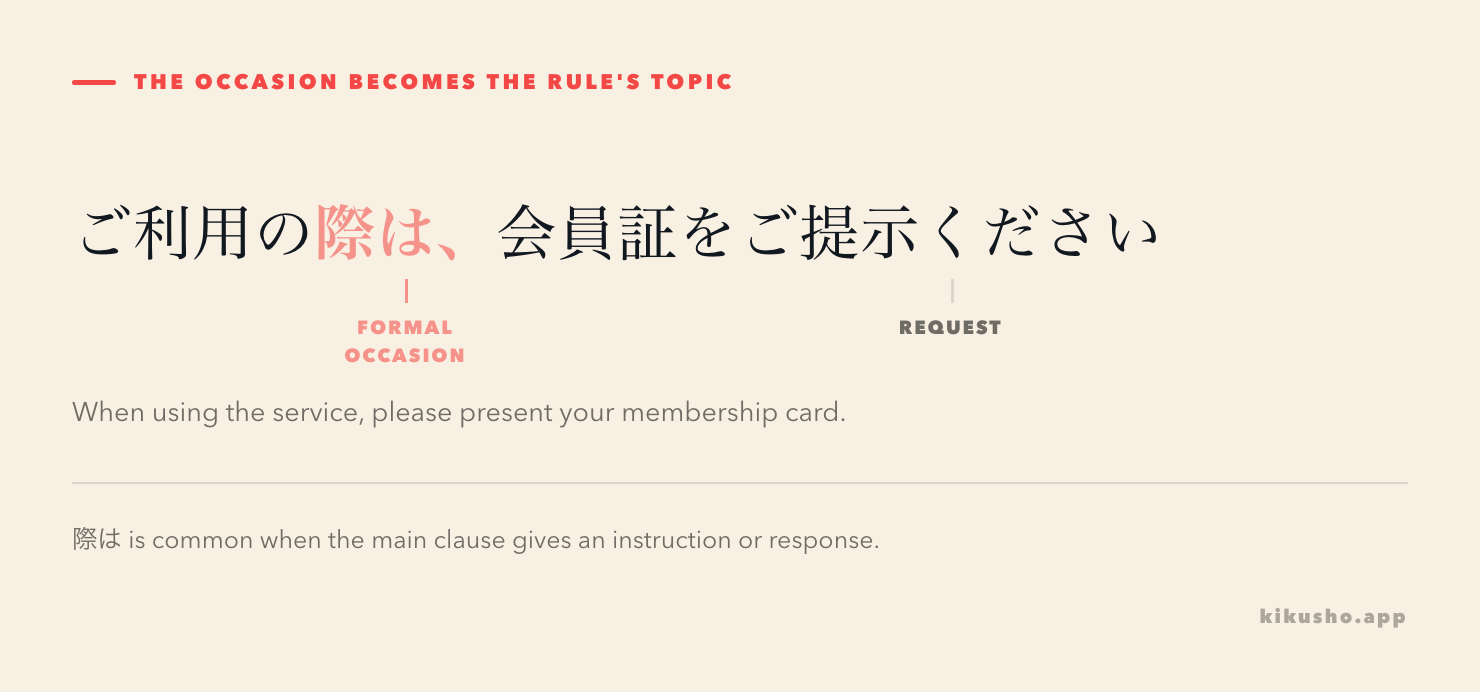
際は makes the occasion the topic. It is especially common when the rest of the sentence gives a standing instruction, request or response:
カードを紛失した際は、すぐにご連絡ください。 If you lose your card, please contact us immediately.
This is why notices so often contain 際は followed by ください. The sentence is not predicting one specific loss. It states what to do whenever that relevant case arises. 際には adds に before the topic particle and can put slightly more focus on the occasion:
ご来館の際には、受付にお立ち寄りください。 When visiting the museum, please stop at reception.
When a noun follows, use 際の:
申請の際の注意事項を確認してください。 Please check the precautions for applying.
Here 申請の際の modifies 注意事項. There is no main action yet inside the 際 phrase; the whole phrase identifies which precautions the reader should check.
とき is the neutral choice for ordinary life
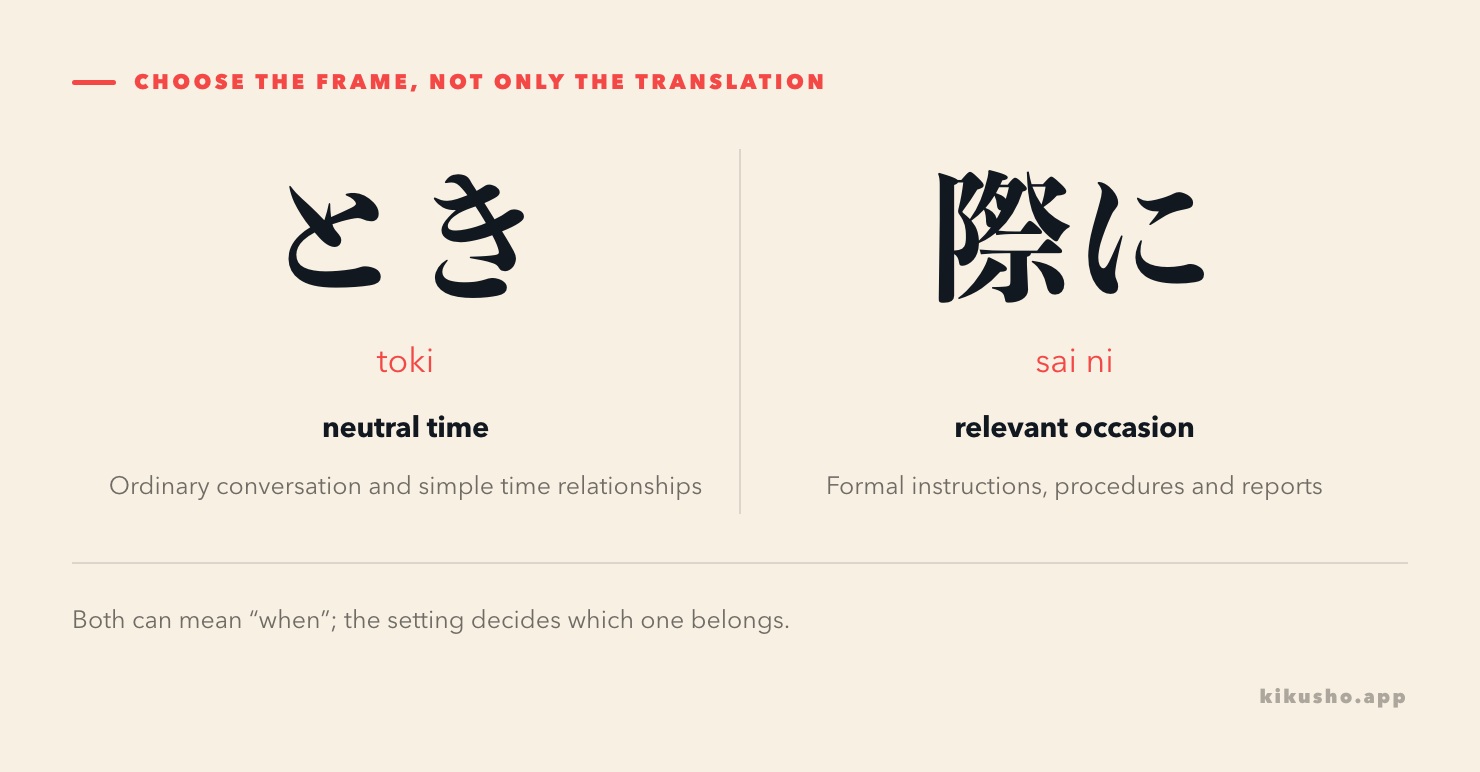
The formal tone is part of the grammar, not decoration. A hotel can write 外出の際は、鍵をフロントにお預けください because it is giving every guest a procedure. Between friends, 外出の際にコンビニに寄った sounds needlessly official. 外出したときにコンビニに寄った is the natural everyday sentence.
Use とき when you are simply locating one event in time:
子どものとき、よく川で遊びました。 When I was a child, I often played by the river.
Use 際に when the event acts as a case, procedure or reportable occasion:
入会の際に、本人確認を行います。 We verify your identity when you join.
This boundary explains why 毎朝コーヒーを飲む際にニュースを読む is grammatical in shape but awkward in an ordinary personal account. Nothing in that routine needs the institutional frame. 毎朝コーヒーを飲むときにニュースを読む fits the scene.
際に is broader and less ceremonial than に際して
際に and に際して can both translate as “on the occasion of,” but they are not interchangeable everywhere. 際に is the formal counterpart of とき and can look backward with Vた:
出張した際に、京都の支店を訪ねました。 When I went on a business trip, I visited the Kyoto branch.
に際して attaches to a noun or a dictionary-form verb and highlights a significant present or future occasion. It does not take Vた in this use. 契約に際して必要な書類 feels more official and eventful than 契約の際に必要な書類.
The dedicated comparison of にあたって and に際して handles the narrower question of preparation before a milestone versus something true at the milestone itself. For this N3 lesson, keep the boundary simple: 際に is the wider formal “when”; に際して is reserved for a significant occasion and a more official register.
N3 and N2 lists disagree because there is no official grammar list
JLPT Sensei classifies 際に as N3, as do 日本語NET and 日本語教育ナビ. Bunpro places the same construction in an N2 lesson. Neither label is an official JLPT ruling: the test publishes level descriptions and sample questions, not an exhaustive grammar syllabus.
The practical answer is to recognize the form at N3 and refine it through N2 reading. At recognition level, identify the three attachments and the formal “when” meaning. For active control, choose Vる or Vた from the time view, know when 際は introduces a rule, and avoid dropping it into casual routine talk.
If you save an example in Kikusho, keep the whole instruction rather than a card that says only 際に = “when.” ご利用の際は、会員証をご提示ください preserves the noun attachment, the formal setting and the request that makes the register visible.
Practice
Question 1. Choose the most natural completion for a museum notice.
館内で写真を撮る___、フラッシュを使用しないでください。
a) 際は b) ときだった c) の際を d) に際した
Question 2. Which sentence has the correct attachment?
a) 申請際に、身分証明書が必要です。 b) 申請の際に、身分証明書が必要です。 c) 申請するの際に、身分証明書が必要です。 d) 申請を際に、身分証明書が必要です。
Question 3. A report describes a completed factory visit last month. Which completion preserves that viewpoint?
先月工場を___、新しい設備を見学しました。
a) 訪問する際に b) 訪問した際に c) 訪問の際を d) 訪問して際に
Question 4. Put these pieces into one natural sentence meaning “When using the service, please read the terms.”
ご利用の際は ・ お読みください ・ 規約を
Question 5. Choose the sentence that sounds natural in casual conversation between friends.
a) 昨日スーパーへ行った際に、パンを買ったよ。 b) 昨日スーパーへ行ったとき、パンを買ったよ。 c) 昨日スーパーへ行く際の、パンを買ったよ。 d) 昨日スーパーへ行ったに際して、パンを買ったよ。
Question 6. A shop posts the notice below. What must a customer bring for a return?
商品を返品する際は、購入時のレシートを商品と一緒にお持ちください。レシートがない場合は、返品を受け付けられません。
a) Bring the product without a receipt. b) Send the receipt before buying the product. c) Bring the receipt together with the product when returning it. d) Ask for a new receipt after the return.
Answers and explanations
Answer 1: a) 際は. The museum is stating a standing rule for the occasion of taking photographs. Vる + 際は is the correct attachment, and the topic particle suits an instruction that applies whenever that case arises.
Answer 2: b) 申請の際に、身分証明書が必要です。 申請 is a noun here, so it needs の before 際. A verb would attach directly as 申請する際に, without の.
Answer 3: b) 訪問した際に. 先月 and 見学しました place the report in the past. 訪問した presents the visit as the completed occasion during which the tour happened.
Answer 4: ご利用の際は、規約をお読みください。 ご利用 is a noun, so の connects it to 際. は turns that occasion into the topic of the request, and 規約を stays with お読みください.
Answer 5: b) 昨日スーパーへ行ったとき、パンを買ったよ。 This is an ordinary errand told casually to a friend, so とき fits. Sentence (a) is possible in a formal report, but its institutional tone clashes with this everyday よ sentence. Sentences (c) and (d) have invalid attachments.
Answer 6: c) Bring the receipt together with the product when returning it. 返品する際は frames the return as the occasion for the instruction. 商品と一緒に connects the receipt and product, while the second sentence explains that a return without the receipt cannot be accepted.
Common questions
What is the difference between 際に and とき?
Both can mean “when,” but とき is the neutral everyday choice. 際に belongs to formal instructions, notices and reports, and frames the event as a relevant occasion rather than an ordinary point in time.
Does 際に take the dictionary form or the た-form?
It takes either. Vる際に usually presents an action that is about to happen or is being considered as a procedure. Vた際に looks back on an occasion that occurred. Nouns take の: 申請の際に.
Is 際に N3 or N2 grammar?
Independent study references disagree. JLPT Sensei and Japanese teaching references place it at N3, while Bunpro teaches it at N2. The JLPT does not publish an exhaustive official grammar list, so treat it as an intermediate formal pattern worth recognizing by N3 and controlling by N2.