On this page
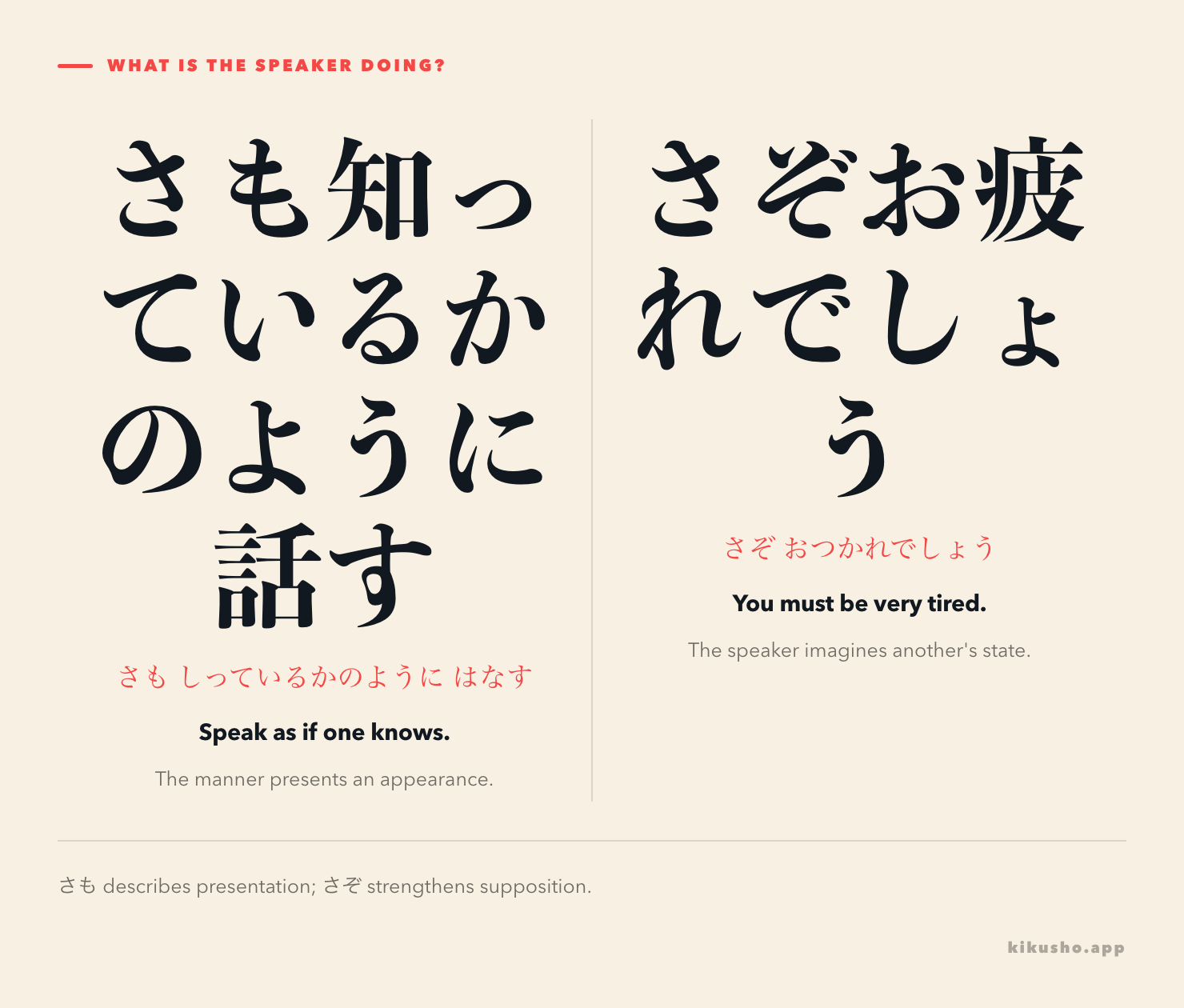
さも makes a manner or appearance seem thoroughly consistent with a description: “as if,” “very much looking” or “in a way that suggests.” さぞ expresses a strong supposition, often an empathetic “you must…” about another person's feelings or circumstances.
彼はさも事情を知っているかのように話した。
かれはさもじじょうをしっているかのようにはなした。
He spoke as if he knew the circumstances.
長い旅で、皆さんさぞお疲れでしょう。
ながいたびで、みなさんさぞおつかれでしょう。
After the long journey, you must all be very tired.
Both words are formal adverbs and both can precede an entire description. Their jobs nevertheless point in different directions. With さも, the speaker observes or portrays how something comes across. With さぞ, the speaker reaches beyond direct knowledge and strongly imagines what a state must be like.
さも presents a convincing appearance
The central sense of さも is “in just such a manner” or “in a way that really looks so.” It commonly prepares a visual or behavioural description.
さも + そう
Use さも before そうに when the following verb describes a manner, or before そうな when the phrase modifies a noun.
子どもたちはケーキをさもおいしそうに食べていた。
こどもたちはケーキをさもおいしそうにたべていた。
The children were eating the cake as though it were utterly delicious.
彼女はさも満足そうな表情を見せた。
かのじょはさもまんぞくそうなひょうじょうをみせた。
She showed a thoroughly satisfied-looking expression.
Here さも strengthens the impression carried by そう. It does not independently decide whether the feeling is sincere. The children may truly enjoy the cake, and the woman's satisfaction may be real.
さも +(かの)よう
Before a fuller proposition, さも often combines with ように/ような or the more emphatic かのように/かのような.
彼はさも自分が責任者であるかのように指示を出した。
かれはさもじぶんがせきにんしゃであるかのようにしじをだした。
He gave orders as if he were the person in charge.
その広告は、さも効果が保証されているような印象を与える。
そのこうこくは、さもこうかがほしょうされているようないんしょうをあたえる。
The advertisement gives the impression that the effect is guaranteed.
The clause supplies the imagined description, and the ending follows its normal syntactic role: ように modifies an action, ような modifies a noun, and ようだ can end a sentence. The かのように lesson gives the full attachment system.
Pretence comes from context, not from さも alone
English translations such as “as if” can suggest that the appearance is false. Japanese does not require that conclusion. Compare these sentences:
祖母は写真を見て、さも懐かしそうにほほえんだ。
そぼはしゃしんをみて、さもなつかしそうにほほえんだ。
My grandmother looked at the photo and smiled with evident nostalgia.
何も準備していないのに、彼はさも計画どおりであるかのように振る舞った。
なにもじゅんびしていないのに、かれはさもけいかくどおりであるかのようにふるまった。
Although he had prepared nothing, he acted as if everything were going according to plan.
The first context supports a genuine feeling. In the second, 何も準備していないのに contradicts the appearance and makes the performance clear. If deliberate deception itself is the point, ふりをする states that choice more directly.
This also separates さも from いかにも. いかにも専門家らしい説明 judges that an explanation strongly matches the recognizable type “expert-like.” さも専門家であるかのように話す foregrounds the way someone presents themself as an expert. Suspicion can arise from that presentation, but the surrounding sentence must support it.
さぞ turns evidence into strong supposition
さぞ does not describe a visible performance. The speaker strongly imagines a state that is not directly available to them. It is especially natural when acknowledging another person's hardship, relief, pride or surprise.
突然の知らせに、さぞ驚かれたことでしょう。
とつぜんのしらせに、さぞおどろかれたことでしょう。
You must have been very surprised by the sudden news.
一人でここまで育てるのは、さぞ大変だったことと思います。
ひとりでここまでそだてるのは、さぞたいへんだったこととおもいます。
I imagine it must have been very difficult to raise them this far alone.
The speaker has reasons for the inference but does not claim direct access to the other person's inner experience. That combination gives さぞ its frequent empathetic tone.
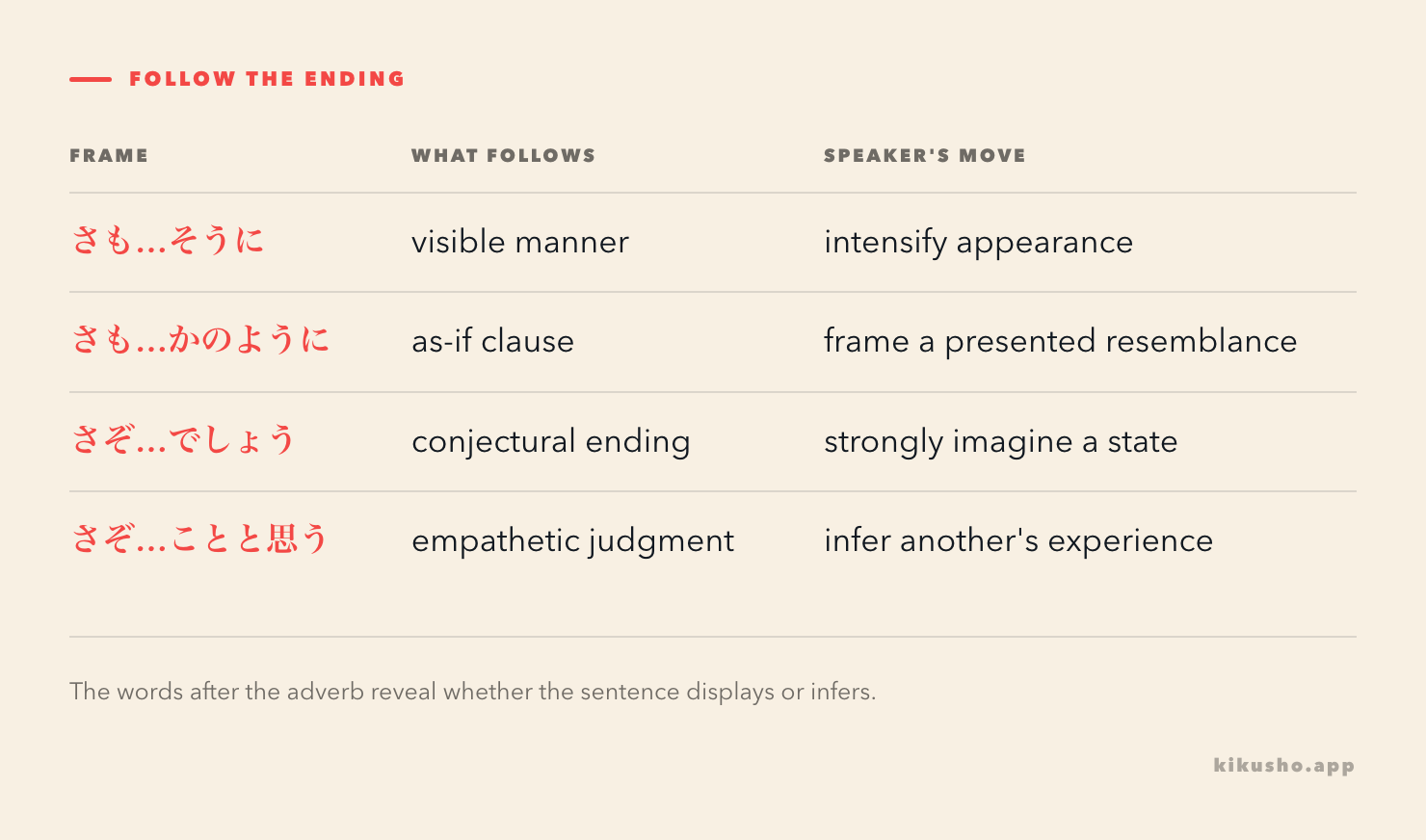
Conjectural or judgment endings make this stance explicit:
| Pattern | Typical effect |
|---|---|
| さぞ…だろう/でしょう | strong “must be / must have been” supposition |
| さぞ…ことだろう/ことでしょう | reflective or formal supposition |
| さぞ…ことと思う/ことと存じます | considerate written or formal acknowledgment |
| さぞ…に違いない | strong conviction based on inference |
さぞ can occur without one of these exact endings when the wider construction already makes the speaker's judgment clear. For learners, retaining the ending is still the safest way to preserve its stance.
さぞかし and さぞや add force
さぞかし reinforces the same supposition and is common in formal or emotionally weighted statements.
合格の知らせを聞いて、ご家族もさぞかしお喜びでしょう。
ごうかくのしらせをきいて、ごかぞくもさぞかしおよろこびでしょう。
On hearing that you passed, your family must be delighted.
さぞや is also emphatic but has a literary or old-fashioned colour in many present-day contexts.
故郷を離れて、さぞや寂しかったことだろう。
ふるさとをはなれて、さぞやさびしかったことだろう。
Having left home, they must have been terribly lonely.
These longer forms do not change the basic grammar. They increase rhetorical force. In ordinary conversation, きっと疲れたでしょう or simply 大変でしたね may sound more natural; さぞ(かし) suits elevated narration, formal correspondence and deliberate empathy.
Follow the ending when the two look interchangeable
A translation can hide the distinction because English “must” sometimes reports appearance and sometimes inference. Ask what the adverb is doing before choosing:
- Is the sentence showing how an action, expression or claim looks? Choose さも, then look for そう or よう.
- Is the speaker strongly imagining an unobserved feeling or situation? Choose さぞ, then look for a conjectural judgment.
彼はさも疲れたような顔をしていた。
かれはさもつかれたようなかおをしていた。
He wore a face that made him look thoroughly tired.
三日間眠れなかったなら、さぞ疲れているだろう。
みっかかんねむれなかったなら、さぞつかれているだろう。
If he has not slept for three days, he must be exhausted.
The first sentence makes the face available as evidence and packages its appearance with ような. The second uses the sleepless nights as a basis for a strong conclusion with だろう.
The Kikusho inventory and the inspected JLPT Sensei and Bunpro materials place these targets at N1, with no recorded level disagreement. Since the exam authority defines tested abilities without issuing a complete grammar syllabus, this placement reflects agreement among study publishers. For a useful Kikusho card, save the adverb together with its ending: さも知っているかのように or さぞお疲れでしょう. That visible frame recalls the speaker's job more reliably than an isolated English gloss.
Practice: appearance or supposition?
Answer all seven questions before opening the explanations. Each answer appears in the single section after Question 7.
Question 1: choose the adverb. Complete the sentence: 彼は__すべてを理解しているかのようにうなずいた。
- ア. さぞ
- イ. さも
- ウ. いかに
- エ. さえ
Question 2: choose the adverb. You are writing politely to someone who cared for a sick parent for years: 長い間、__ご苦労が多かったことと存じます。
- ア. さぞ
- イ. さも
- ウ. まるで
- エ. いかなる
Question 3: choose the ending. Complete the natural description of visible manner: 子どもは新しい靴を__。
- ア. さぞうれしいだろう
- イ. さもうれしそうに見せた
- ウ. さもうれしそうに眺めていた
- エ. さぞうれしいかのように
Question 4: interpret the sentence. What does 彼女はさも偶然会ったかのように驚いてみせた emphasize?
- ア. The speaker strongly imagines her private surprise.
- イ. Her manner presented the meeting as accidental.
- ウ. The meeting was certainly accidental.
- エ. She asked whether the meeting was accidental.
Question 5: judge the inference. Which statement about さも is accurate?
- ア. It always proves that the subject is lying.
- イ. It can intensify a genuine appearance; context establishes pretence.
- ウ. It must end in でしょう.
- エ. It only modifies nouns.
Question 6: choose the best formal sentence. A host sees that guests have arrived after a long, difficult journey and sympathetically infers their fatigue.
- ア. 皆様、さもお疲れそうに旅行しました。
- イ. 皆様、さぞお疲れになったことでしょう。
- ウ. 皆様、さもお疲れに違いありませんでしたように。
- エ. 皆様、さぞお疲れそうな旅でしょう。
Question 7: compare the pair. Which explanation best distinguishes the two sentences?
- 彼はさも困っているような顔をした。\
- 事情を聞けば、彼もさぞ困っているだろう。
- ア. Both directly report the man's confirmed inner feeling.
- イ. Sentence 1 presents a visible appearance; Sentence 2 strongly infers his state.
- ウ. Sentence 1 is a question; Sentence 2 describes deliberate acting.
- エ. Both require evidence that the man is pretending.
Answers and explanations
1. イ: さも. The phrase すべてを理解しているかのように describes how his nodding appeared. さも strengthens that presented resemblance.
2. ア: さぞ. The writer respectfully imagines the other person's long hardship. ことと存じます is a formal judgment frame often used with さぞ.
3. ウ: さもうれしそうに眺めていた. そうに modifies 眺めていた and describes the child's visible manner. The sentence does not need to claim that the pleasure was false.
4. イ: Her manner presented the meeting as accidental. さも…かのように frames the impression created by her displayed surprise. The wording does not prove what actually caused the meeting.
5. イ: It can intensify a genuine appearance; context establishes pretence. さも懐かしそうに笑う, for example, can describe sincere nostalgia. Contradictory facts or explicit acting cues create a deceptive reading.
6. イ: 皆様、さぞお疲れになったことでしょう. The host strongly and politely infers the guests' fatigue. さぞ and ことでしょう form a natural empathetic judgment.
7. イ: Sentence 1 presents a visible appearance; Sentence 2 strongly infers his state. The first uses さも…ような顔 to package an appearance. The second uses さぞ…だろう to draw a strong conclusion from the circumstances.
Common questions
What is the difference between さも and さぞ?
さも intensifies the appearance or manner in which something is presented, often before そう or よう. さぞ marks a strong supposition about an unseen state, especially another person's feelings or experience, and commonly occurs with だろう, でしょう or ことと思う.
Does さも always imply that someone is pretending?
No. さも can describe a perfectly genuine-looking manner, as in さも嬉しそうに笑う. A context, contradiction or verb such as 装う creates a deceptive reading; さも alone only emphasizes how convincingly the appearance fits the description.
What usually follows さぞ?
Conjectural or judgment expressions commonly close the sentence, including だろう, でしょう, ことだろう, ことと思う and に違いない. さぞかし and the more literary さぞや are stronger variants.
Are さも and さぞ JLPT N1 grammar?
The inspected JLPT study references and the Kikusho inventory place both at N1, with no recorded disagreement. This remains a study-list estimate because the exam authority does not provide a complete official grammar syllabus.