On this page
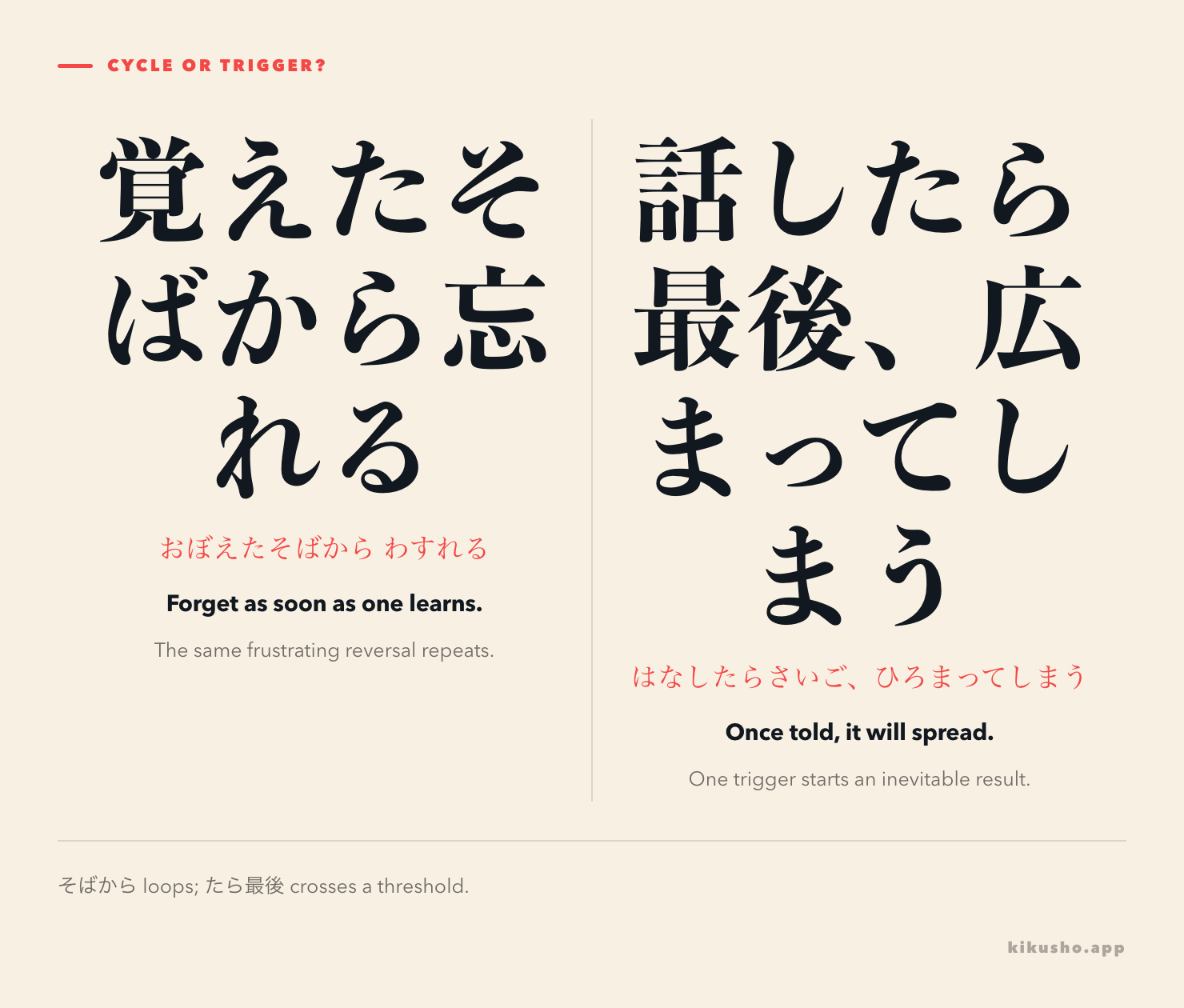
Use そばから when B happens right after A repeatedly, often undoing the effort in A. Use たら最後/たが最後 when A is a decisive trigger and an unwelcome consequence then feels inevitable, irreversible or impossible to stop.
片づけるそばから、子どもたちがおもちゃを広げていく。
かたづけるそばから、こどもたちがおもちゃをひろげていく。
As soon as I tidy things away, the children spread their toys out again.
彼に秘密を話したら最後、翌日には皆が知っているだろう。
かれにひみつをはなしたらさいご、よくじつにはみんながしっているだろう。
Once you tell him a secret, everyone will probably know by the next day.
Both constructions can become “as soon as” or “once” in English. The deciding question is what happens after that moment: does the same frustrating reversal keep recurring, or has one trigger set off a result that cannot readily be escaped?
The test: cycle or point of no return?
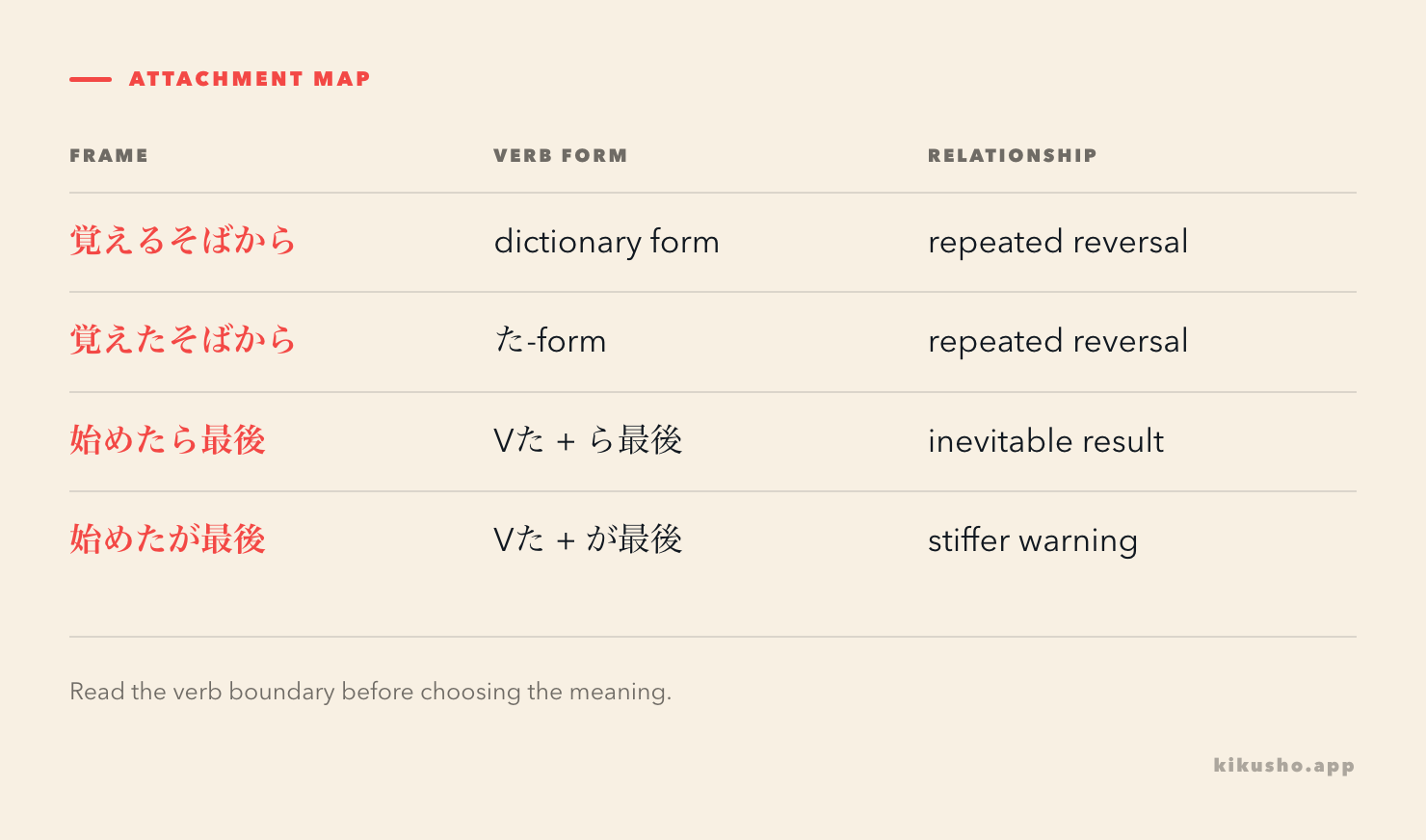
| Construction | Attachment | Relationship between A and B | Typical stance |
|---|---|---|---|
| V dictionary / Vた + そばから | 覚えるそばから / 覚えたそばから | B follows quickly and the same pattern recurs | frustration, resignation, criticism |
| Vた + ら最後 | 始めたら最後 | once A happens, B feels inevitable | warning, strong negative prediction |
| Vた + が最後 | 始めたが最後 | same consequence, in a stiffer form | formal or literary warning |
The visual similarity hides two different designs. そばから can attach to dictionary form or た-form. In たら最後, the sequence たら is the completed conditional form; in たが最後, が follows the verb's た-form.
そばから shows the effort being undone again
そばから places B immediately beside A in time, but proximity alone is not its full job. The same kind of event normally happens more than once, and B often cancels, contradicts or spoils what A just achieved.
新しい単語を覚えたそばから忘れてしまう。
あたらしいたんごをおぼえたそばからわすれてしまう。
I forget new words almost as soon as I learn them.
注意するそばから、彼は同じ間違いを繰り返す。
ちゅういするそばから、かれはおなじまちがいをくりかえす。
As soon as I correct him, he repeats the same mistake.
The first sentence describes a recurring study problem. The second describes a repeated correction-and-error cycle. JapaneseNET's explanation of そばから makes recurrence explicit and notes that the construction often carries dissatisfaction or exasperation.
Both verb forms are available:
| Form | Example | What remains constant |
|---|---|---|
| dictionary form + そばから | 説明するそばから忘れられる | the repeated immediate reversal |
| た-form + そばから | 説明したそばから忘れられる | the repeated immediate reversal |
Bunpro lists both attachments and cautions that the result is ordinarily a pattern, rather than a one-off occurrence. Choosing た-form therefore does not turn the sentence into a single past incident.
That is why the following is awkward without a larger recurring context:
このスマホは買ったそばから壊れた。
このスマホはかったそばからこわれた。
This phone broke right after I bought it.
For one isolated surprise, 買ったとたん、壊れた is the clearer choice. The とたん comparison describes a sudden change after one event without requiring a repeated cycle.
たら最後 makes A the decisive trigger
With たら最後, A opens a chain that the speaker expects will be difficult or impossible to reverse. The result can be literal irreversibility, a serious penalty, or an action that will not stop once begun.
そのファイルを削除したら最後、元には戻せない。
そのファイルをさくじょしたらさいご、もとにはもどせない。
Once you delete that file, you cannot restore it.
彼は話し始めたら最後、誰にも止められない。
かれははなしはじめたらさいご、だれにもとめられない。
Once he starts talking, no one can stop him.
The first consequence is permanent. The second may end eventually, but during that episode the speaker presents it as unstoppable. “Irreversible” is therefore a useful memory cue, not a requirement that B last forever.
Negative expressions frequently make the force visible: もう~ない, 二度と~ない, ~てしまう, 止められない and 免れない. PassJapanese describes the construction as a decisive, normally undesirable trigger rather than a neutral condition.
The negative result can be left unsaid when it is obvious:
この規則違反が見つかったら最後だ。
このきそくいはんがみつかったらさいごだ。
If this rule violation is discovered, that will be the end of it.
Here 最後だ invites the listener to supply the feared consequence. It is not merely saying that discovery happens last in a chronological list.
たが最後 gives the same warning a stiffer shape
Attach が最後 after the verb's た-form:
信頼を失ったが最後、簡単には取り戻せない。
しんらいをうしなったがさいご、かんたんにはとりもどせない。
Once trust is lost, it cannot easily be regained.
The relationship is essentially the same as 信頼を失ったら最後. The difference is register. たら最後 is the more conversational choice; たが最後 sounds firmer and is more characteristic of written or elevated language. JapaneseNET records this difference, while Bunpro's たら最後 entry treats the two as interchangeable in core meaning.
Be careful when segmenting the form:
| Verb | たら最後 | たが最後 |
|---|---|---|
| 言う | 言ったら最後 | 言ったが最後 |
| 始める | 始めたら最後 | 始めたが最後 |
| する | したら最後 | したが最後 |
There is no extra た inserted before が. 言ったが最後 is 言った + が最後. Reading the boundary correctly prevents forms such as 言ったたが最後.
Immediate succession alone does not choose either form
Japanese has several ways to place events close together. The relationship between the events matters more than the English gloss.
ドアを開けるや否や、犬が外へ飛び出した。
ドアをあけるやいなや、いぬがそとへとびだした。
As soon as the door opened, the dog dashed outside.
This reports one vivid sequence. It contains no repeating cycle and no claim that opening the door makes a disastrous outcome inevitable. The や否や, が早いか and なり lesson covers those narrative connectors.
Compare the three relationships:
- 洗っても、子どもが汚すそばからまた洗う: cleaning and dirtying keep recurring.
- この布は洗ったら最後、形が元に戻らない: one wash triggers an irreversible change.
- 洗い終わるや否や、電話が鳴った: one event immediately follows another in a report.
The first invites frustration at repetition. The second warns against crossing a threshold. The third simply compresses the distance between two events.
The result clause reveals the speaker's view
When both constructions describe something that happens every time, frequency alone cannot decide. A person may repeatedly start a game and then become impossible to interrupt. ゲームを始めたら最後、呼んでも返事をしない focuses on the point after which the person is unreachable; it can describe their habitual disposition. 片づけても、遊ぶそばからまた散らかす instead focuses on the cycle that undoes each effort.
Ask two questions:
- Does B cancel A, with the same scene happening again? そばから fits.
- Does A cross a threshold after which B seems unavoidable? たら最後/たが最後 fits.
The Kikusho inventory, JLPT Sensei and Bunpro all place these forms at N1, and no conflicting placement was found for either assigned item. The JLPT describes tested competence without issuing an exhaustive grammar-item list, so N1 here is a study-publisher consensus. Save the full relationship on a Kikusho card: 覚えたそばから忘れる or 話したら最後、広まってしまう. The result clause is where the difference becomes memorable.
Practice: find the relationship after A
Work through Questions 1–7 first; the answer key stays closed until after the last choice.
Question 1: repeated frustration. Choose the best completion: 部屋を掃除する__、犬が泥だらけの足で入ってくる。
- ア. たが最後
- イ. そばから
- ウ. や否や
- エ. 次第で
Question 2: decisive trigger. Complete the warning: この情報が外部に漏れ__、会社の信用は取り戻せない。
- ア. るそばから
- イ. たそばから
- ウ. たら最後
- エ. るが最後
Question 3: formal attachment. Which form correctly completes the sentence? 一度契約に署名し__、条件を変えることはできない。
- ア. たが最後
- イ. るが最後
- ウ. たたが最後
- エ. ますが最後
Question 4: one isolated surprise. A newly bought phone broke once, immediately after purchase. Which sentence avoids implying a recurring pattern?
- ア. スマホを買うそばから、壊れた。
- イ. スマホを買ったそばから、壊れた。
- ウ. スマホを買ったとたん、壊れた。
- エ. スマホを買ったが最後、また買った。
Question 5: interpret the omission. What does 不正が見つかったら最後だ communicate?
- ア. The discovery is the last item in a list.
- イ. Discovery will bring an obvious, serious consequence.
- ウ. The same discovery keeps being forgotten.
- エ. The speaker wants the discovery to happen quickly.
Question 6: compare the register. Which statement is accurate?
- ア. たが最後 has a positive meaning that たら最後 lacks.
- イ. たら最後 takes dictionary form, while たが最後 takes ます-form.
- ウ. The two share a core meaning, while たが最後 is stiffer and more literary.
- エ. Only たが最後 can introduce an omitted result.
Question 7: read the contrast. What changes between these sentences?
- 教えても、彼は聞いたそばから忘れてしまう。\
- 彼に秘密を教えたら最後、すぐ皆に話してしまう。
- ア. Sentence 1 shows recurring loss after each explanation; Sentence 2 presents telling him as a dangerous trigger.
- イ. Sentence 1 describes a single surprise; Sentence 2 promises a desirable result.
- ウ. Both sentences simply report two neutral events in quick succession.
- エ. Both forms mean that the result is permanently irreversible.
Answers and explanations
1. イ: そばから. Cleaning is repeatedly undone when the dog comes back in with muddy paws. The cycle and the speaker's frustration suit そばから.
2. ウ: たら最後. The た-form of 漏れる is 漏れた; adding ら最後 gives 漏れたら最後. The loss of trust is presented as the inevitable consequence.
3. ア: たが最後. The た-form 署名した takes が最後, producing 署名したが最後. The other choices use the wrong verb form or add an extra た.
4. ウ: スマホを買ったとたん、壊れた. とたん can report one sudden event. そばから normally asks for a recurring pattern, while the result paired with たが最後 must express the unavoidable consequence of the trigger.
5. イ: Discovery will bring an obvious, serious consequence. Ending at 最後だ leaves B unspoken because the audience can infer the feared result.
6. ウ: The two share a core meaning, while たが最後 is stiffer and more literary. Both use the verb's た-form and both frame an undesirable consequence as inevitable.
7. ア: Sentence 1 shows recurring loss after each explanation; Sentence 2 presents telling him as a dangerous trigger. そばから focuses on the repeated failure to retain information. たら最後 turns disclosure to this person into the threshold after which the secret will spread.
Common questions
What is the difference between そばから and たら最後?
そばから presents B as happening right after A again and again, often undoing A and frustrating the speaker. たら最後 or たが最後 presents A as a decisive trigger after which an unwelcome B seems inevitable or impossible to stop.
Which verb forms come before そばから?
Both dictionary form and た-form occur: 覚えるそばから and 覚えたそばから. The choice does not remove the construction's usual sense of a repeated pattern rather than a single isolated event.
What is the difference between たら最後 and たが最後?
Their core meaning is the same. Both attach after a verb's た-form; たら最後 is more conversational, while たが最後 is stiffer and more at home in formal or literary writing.
Must the result after たら最後 be negative?
It normally presents an unwelcome, uncontrollable or irreversible result. The event itself may be enjoyable, but the speaker frames the inability to stop or escape its consequence as troublesome.