On this page
Use もう少しで + Vるところだった when an outcome came close but did not happen: もう少しで階段から落ちるところだった, “I nearly fell down the stairs.” もう少しで measures the small distance left; 落ちるところだった names the unrealized outcome.
That division matters because neither piece does exactly the same work alone. もう少しで can lead into other near-event endings, while Vるところだった can also be a literal past-stage description meaning that someone was about to act. Context turns the combination into a clear near miss.
This lesson covers inventory items g-31016ad0aceb, ところだった, and g-0d5b729d45ba, もう少しで. Japanese NET, MLC Japanese Language School, N1et and JLPT Sensei place the relevant patterns at N2. These are teaching labels; the JLPT does not publish an exhaustive grammar syllabus.
The sentence stops on the unrealized side
Imagine a boundary between what actually happened and the result that almost happened:
| Part | Job | Example |
|---|---|---|
| もう少しで | marks a very small remaining distance | もう少しで |
| Vる | names the possible outcome | 転ぶ |
| ところだった | looks back at the point just before it | ところだった |
床がぬれていて、もう少しで転ぶところだった。
ゆかが ぬれていて、もうすこしで ころぶ ところだった。
The floor was wet, and I nearly fell.
The fall did not occur. The past だった belongs to the whole close-call assessment: at that earlier moment, falling was just across the boundary. Do not change 転ぶ to past 転んだ. In this pattern the verb before ところだった is nonpast.
目覚まし時計が鳴らなければ、試験に遅れるところだった。
めざましどけいが ならなければ、しけんに おくれる ところだった。
If the alarm had not rung, I would have been late for the exam.
An explicit counterfactual condition can replace もう少しで. The alarm did ring, and the speaker was not late. The ~なければ clause identifies what prevented the unrealized result.
もう少しで can choose more than one ending
もう少しで is an adverbial phrase meaning that only a little distance, time or change remained. For a past near event, it commonly combines with two shapes:
| Shape | Example | Focus |
|---|---|---|
| もう少しで + Vるところだった | もう少しで財布を忘れるところだった | the unrealized outcome |
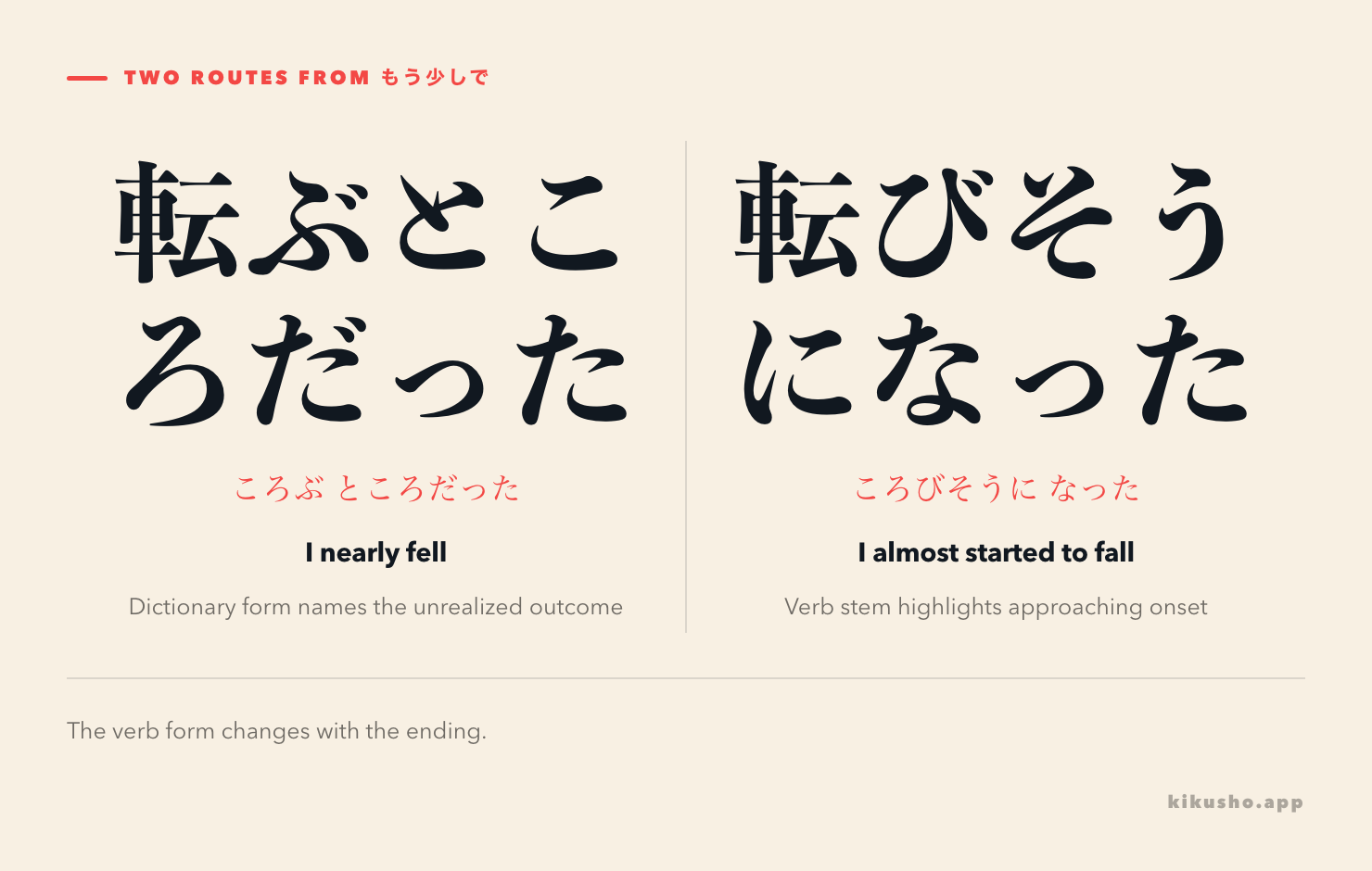
| もう少しで + Vます-stem + そうになった | もう少しで寝そうになった | signs of entering the state |
会議中、もう少しで寝そうになった。
かいぎちゅう、もうすこしで ねそうに なった。
During the meeting, I almost fell asleep.
そうになった describes approaching the onset suggested by visible or felt signs. ところだった frames the situation from the later knowledge that the named outcome did not occur. They overlap in many accidental events, but their construction differs: 寝るところだった, dictionary form; 寝そうになった, ます-stem.
Bad results are common, but not required
Near-miss examples often concern an accident, loss or mistake. That creates a natural feeling of relief.
送信ボタンを押す前に誤字に気づいた。危うく間違った資料を送るところだった。
そうしんボタンを おす まえに ごじに きづいた。あやうく まちがった しりょうを おくる ところだった。
I noticed the typo before pressing Send. I came dangerously close to sending the wrong document.
危うく also signals a narrow escape and tends to suit an undesirable result. もう少しで is neutral about value, so it can introduce a good outcome that was narrowly missed.
あと一問正解していれば、満点を取るところだったのに。
あと いちもん せいかいしていれば、まんてんを とる ところだったのに。
If I had answered one more question correctly, I would have got a perfect score.
The speaker did not get the perfect score. With a missed desirable result, のに often makes the disappointment audible. 絵でわかる日本語 treats this positive-result use separately because learners often memorize only dangerous close calls.
もう少しでパズルが完成するところだったのに、最後の一枚をなくしてしまった。
もうすこしで パズルが かんせいする ところだったのに、さいごの いちまいを なくしてしまった。
The puzzle was almost complete, but I lost the final piece.
The logic stays constant: 完成する did not become true.
The ない-form reverses the unrealized outcome
Japanese NET, N1et and MLC also list Vない + ところだった. The negative proposition is what nearly became reality.
通行人が救急車を呼んでくれなければ、助からないところだった。
つうこうにんが きゅうきゅうしゃを よんでくれなければ、たすからない ところだった。
If a passerby had not called an ambulance, I might not have survived.
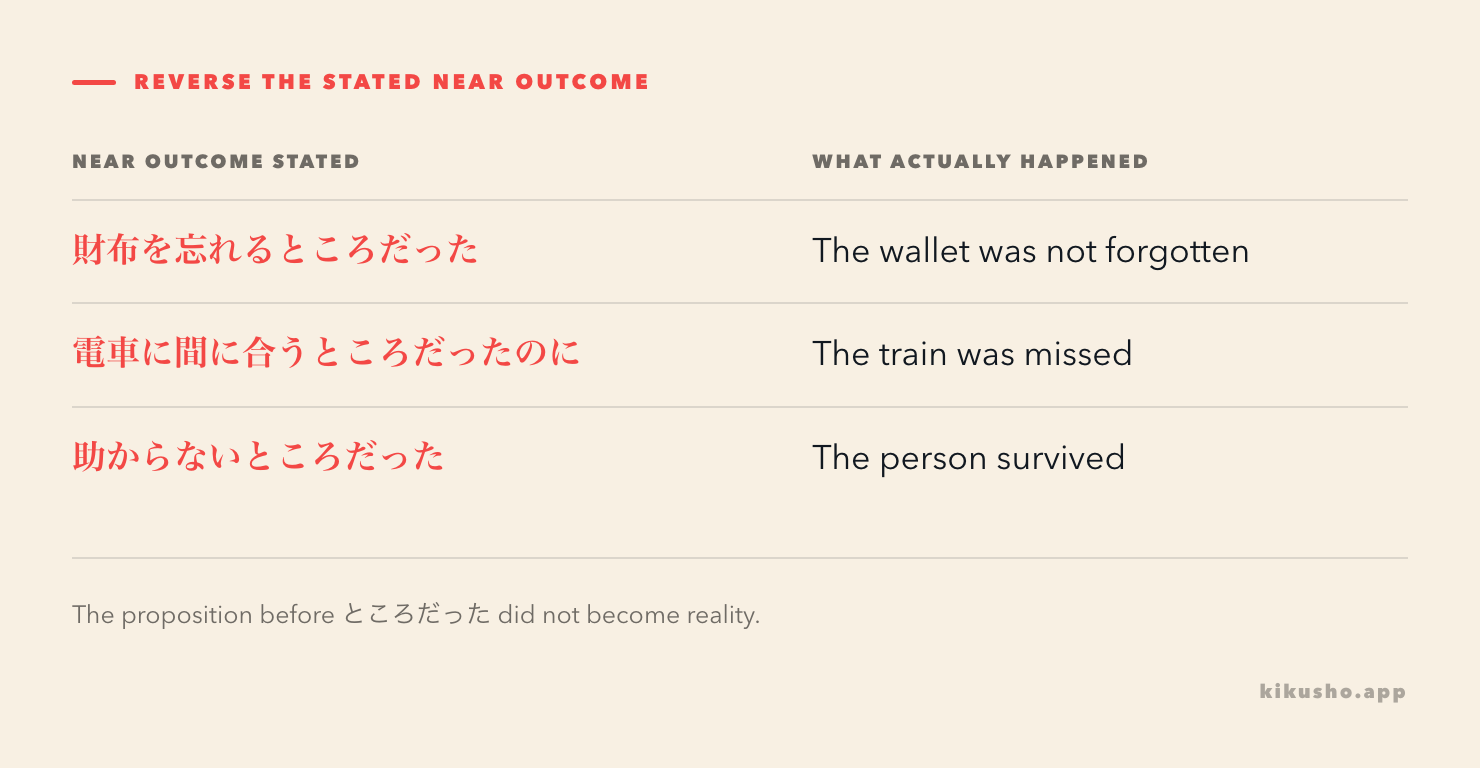
The actual result is the opposite of 助からない: the person survived. First identify the proposition before ところだった, then reverse it to recover reality.
| Near outcome stated | Actual result |
|---|---|
| 財布を忘れるところだった | the wallet was not forgotten |
| 電車に間に合うところだったのに | the train was missed |
| 助からないところだった | the person survived |
するところだった can also mean “was about to do”
Without a near-miss cue, Vるところだった may simply locate a plan at an earlier point.
電話をくれたとき、ちょうど家を出るところだった。
でんわを くれた とき、ちょうど いえを でる ところだった。
When you called, I was just about to leave home.
This sentence says where the plan stood when the call came. It does not by itself say whether the speaker eventually left. By contrast, もう少しで電車に乗り遅れるところだった presents missing the train as the close but unrealized result.
Useful signals for the counterfactual reading include もう少しで, あと少しで, 危うく, a condition such as ~なければ/~たら, and the speaker's reaction 危なかった. A neutral time clause with ちょうど often supports the past-stage reading.
The basic ところ timeline lesson covers Vるところだ, Vているところだ and Vたところだ. The near-miss use builds on that stage image but adds an unrealized result.
したところだった means “had just done”
The form before ところ changes the timeline.
彼が来たとき、私は昼食を食べるところだった。
かれが きた とき、わたしは ちゅうしょくを たべる ところだった。
When he came, I was about to eat lunch.
彼が来たとき、私は昼食を食べたところだった。
かれが きた とき、わたしは ちゅうしょくを たべた ところだった。
When he came, I had just eaten lunch.
食べるところだった looks forward from a past point; 食べたところだった looks back at a completion immediately before that point. The research on もう少しで also supports this tense contrast: a near miss naturally uses the nonpast verb because the named event never became complete.
かける describes a different kind of incompletion
Vます-stem + かける can say an action started but remained incomplete: メールを書きかけた means someone began writing the email. With a sudden event, 落ちかけた can mean “nearly fell,” but its viewpoint is the onset of the change.
落ちるところだった instead looks back at the boundary before the full result and presents falling as unrealized. The かける, 切る and 切れない lesson compares partial processes with verge-of events.
Save the prevention clue with the result
A card containing only 遅れるところだった can be read as either a near miss or a past plan-stage description. Keep the clue: 目覚ましが鳴らなければ、遅れるところだった. Ask two questions during review: “Which outcome is stated?” and “Did it happen?”
For もう少しで, save the whole ending too. もう少しで alone only says that a boundary was near. ところだった, そうになった, or another predicate tells the reader which boundary.
Practice
1. Complete the close call
床がぬれていて、もう少しで__。
ア. 転んだところだった
イ. 転ぶところだった
ウ. 転ぶところだ
2. Choose the verb form before ところだった
あと五秒遅かったら、電車に__ところだった。
ア. 乗り遅れた
イ. 乗り遅れる
ウ. 乗り遅れている
3. Recover the actual result
同僚が確認してくれなければ、古い資料を送るところだった。
Which result occurred?
ア. The old file was sent.
イ. The old file was not sent.
ウ. The colleague sent the old file.
4. Identify the missed good outcome
Which sentence says the speaker narrowly missed completing the work?
ア. もう少しで作業が終わるところだったのに、停電した。
イ. もう少しで作業が終わったところだった。
ウ. ちょうど作業を始めるところだった。
5. Build the negative near outcome
Put all four pieces in order.
ア. 助からない イ. 医者が来なければ ウ. ところだった エ. 彼は
6. Choose the onset-focused ending
会議中、眠気が強くなり、もう少しで__。
ア. 寝そうになった
イ. 寝たところだった
ウ. 寝るところだ
7. Interpret the station announcement scene
ホームへの階段を上っている途中で発車ベルが鳴った。私は走り、ドアが閉まる直前に乗った。「危なかった。もう少しで終電に乗り遅れるところだった」と息をついた。
Which statement is supported?
ア. The speaker missed the last train.
イ. The speaker boarded the last train just in time.
ウ. The speaker had just left the last train.
Answers and explanations
- イ. 転ぶところだった. The near-miss frame requires the nonpast verb 転ぶ before ところだった. ア uses 転んだところだった, “had just fallen,” while ウ does not look back on the close call.
- イ. 乗り遅れる. The named outcome did not occur, so it appears in nonpast form even though the whole assessment is past. ア would create the just-completed 乗り遅れたところだった.
- イ. The old file was not sent. The colleague's check prevented the stated outcome 古い資料を送る. The conditional counterfactual tells us that the actual result was its opposite.
- ア. もう少しで作業が終わるところだったのに、停電した. The work did not reach completion, and のに expresses disappointment at the missed good result. イ clashes with the near-miss use because 終わったところだった means it had just ended. ウ gives a past point just before starting.
- イ–エ–ア–ウ: 医者が来なければ、彼は助からないところだった. The negative proposition 助からない was nearly true; because the doctor came, the man survived.
- ア. 寝そうになった. 寝 is the ます-stem and そうになった highlights approaching the onset of sleep. イ means “had just slept,” and ウ means “is about to sleep.”
- イ. The speaker boarded the last train just in time. The text explicitly says the speaker entered before the doors closed. 乗り遅れるところだった names the outcome that almost happened but did not.
The exact query often presents もう少しで~ところだった as one translation unit. Reading becomes more reliable when you divide the work: the adverb marks proximity, the verb names the possible result, and ところだった makes that result unrealized in the near-miss context.
This lesson was reviewed for both inventory items, dictionary- and ない-form attachment, bad outcomes avoided, good outcomes missed, のに, conditional prevention clauses, and the distinctions from literal past-stage Vるところだった, just-completed Vたところだった, そうになった and かける. The final language pass checked the timeline encoded by every example and confirmed that each exercise has one intended answer.
Common questions
What does もう少しで~ところだった mean?
It means that an outcome came close to happening but did not happen. もう少しで marks how near the boundary was, and the dictionary-form verb plus ところだった presents the unrealized outcome.
What verb form comes before ところだった in the near-miss pattern?
Use a dictionary-form or ない-form verb: 落ちるところだった means “nearly fell,” while 助からないところだった means “would not have survived.” The event is viewed as unrealized even though だった is past.
Is ところだった only used for bad outcomes?
Bad outcomes narrowly avoided are common, but the pattern can also describe a good outcome that was narrowly missed. A missed positive result often appears with のに, as in もう少しで完成するところだったのに.
What is the difference between するところだった and したところだった?
In the near-miss reading, するところだった means the event was close but did not happen. したところだった places a completed event immediately before a past reference point, so it means “had just done.”