On this page
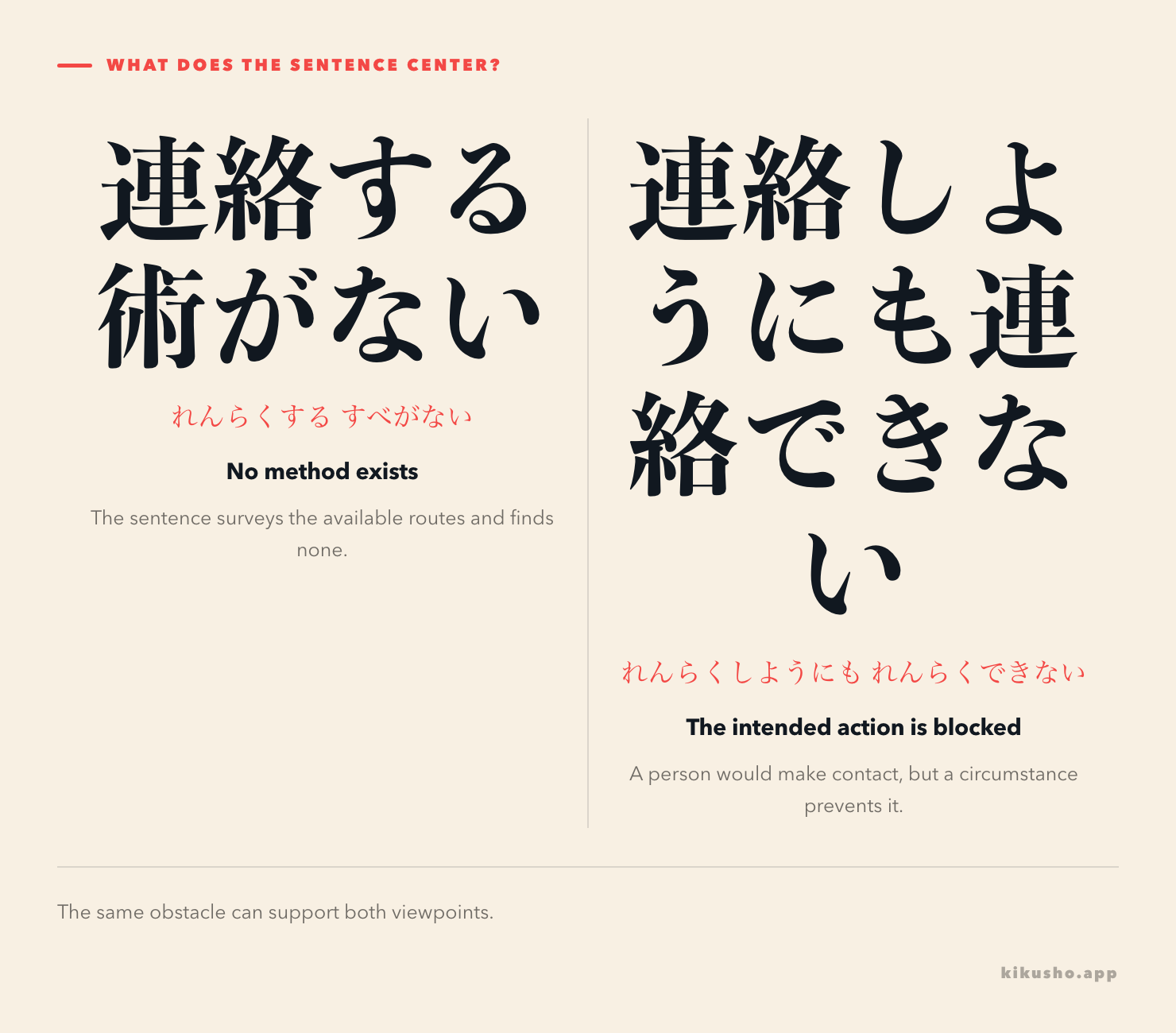
連絡する術がない says that no method of contact exists. 連絡しようにも連絡できない puts a person at the point of trying to make contact, then shows the obstacle that stops them. The outcome may be the same, but the sentence chooses either the missing means or the blocked intention as its centre.
電話番号も住所も知らないので、連絡する術がない。
でんわばんごうもじゅうしょもしらないので、れんらくするすべがない。
I know neither the phone number nor the address, so there is no way to make contact.
携帯電話が壊れていて、連絡しようにも連絡できない。
けいたいでんわがこわれていて、れんらくしようにもれんらくできない。
My phone is broken, so even though I want to make contact, I cannot.
The first sentence inventories the available routes and finds none. The second makes the frustrated action visible: intention, obstacle, inability.
The deciding question is whether you need a method or an attempted action
| Construction | Formation | What it foregrounds | Typical translation |
|---|---|---|---|
| V dictionary + 術がない | 連絡する術がない | no means or method exists | there is no way to contact |
| V volitional + にも + V potential negative | 連絡しようにも連絡できない | a contemplated action is blocked | even if I wanted to contact them, I could not |
Both can follow a reason such as a broken phone, missing information or stopped transport. That shared cause does not erase the difference in presentation. 術がない treats a way or means as absent. ようにも~ない brings the person's attempted or desired action into the grammar itself.
術がない attaches to the dictionary form
Place 術がない after a verb in dictionary form:
| Verb | Correct form | Meaning |
|---|---|---|
| 連絡する | 連絡する術がない | no way to make contact |
| 確かめる | 確かめる術がない | no way to verify |
| 逃げる | 逃げる術がない | no means of escape |
| 知る | 知る術がない | no way to know |
The reading is すべがない. Here 術(すべ) is a noun meaning a means, method or way of attaining an objective. Daijisen's dictionary entry records that reading and sense, while Kanjipedia independently gives “method” and “means.”
記録がすべて失われたため、当時の状況を確かめる術がない。
きろくがすべてうしなわれたため、とうじのじょうきょうをたしかめるすべがない。
All the records were lost, so there is no way to verify what the situation was then.
The construction can also appear without a new verb when the missing course of action is already clear:
必要な道具がなく、ほかに術はなかった。
ひつようなどうぐがなく、ほかにすべはなかった。
We lacked the necessary tools, and there was no other means.
The familiar fixed phrase なす術がない means that there is nothing one can do. なす is written 為す or 成す in some contexts, but the phrase is often left in hiragana. JapaneseNET and the Japanese-teacher reference at Marutoku both give V dictionary + 術がない and なす術がない as the central forms.
ようにも~ない begins with the volitional
The dependable form is:
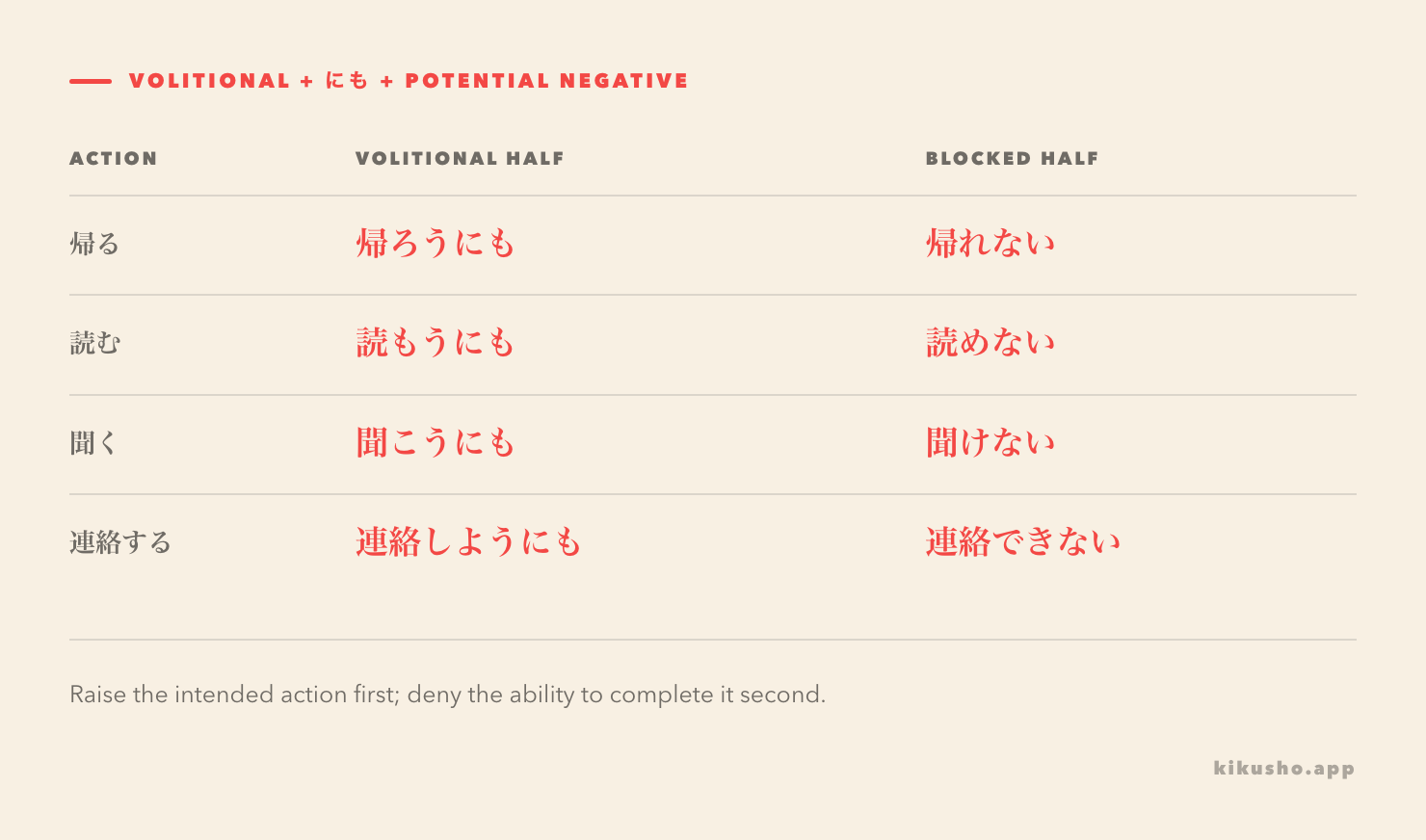
V volitional + にも + the same action in a potential negative form
| Dictionary form | Volitional half | Blocked half | Complete pattern |
|---|---|---|---|
| 帰る | 帰ろうにも | 帰れない | 帰ろうにも帰れない |
| 読む | 読もうにも | 読めない | 読もうにも読めない |
| 聞く | 聞こうにも | 聞けない | 聞こうにも聞けない |
| 連絡する | 連絡しようにも | 連絡できない | 連絡しようにも連絡できない |
The first verb must be an intentional action that can be contemplated. The second half denies the ability to carry it out. For a する verb, use しようにもできない or repeat the action noun before できない.
駅への道を聞こうにも、日本語が話せず聞けなかった。
えきへのみちをきこうにも、にほんごがはなせずきけなかった。
I wanted to ask the way to the station, but I could not because I could not speak Japanese.
大雪で電車が止まり、帰ろうにも帰れない。
おおゆきででんしゃがとまり、かえろうにもかえれない。
Heavy snow stopped the trains, so I could not get home even though I wanted to.
Tanosuke's teaching analysis gives the volitional-plus-potential-negative formation and describes an action wanted but blocked by circumstances. N1et confirms the same standard frame and notes that an intervening reason may separate the two verb forms.
The obstacle can occupy the second half
Textbook drills often present the compact repetition 帰ろうにも帰れない. Natural sentences can name the reason directly after にも:
新しいパソコンを買おうにも、お金が足りない。
あたらしいパソコンをかおうにも、おかねがたりない。
Even if I wanted to buy a new computer, I do not have enough money.
The explicit ending 買えない is understood from the shortage. N1et documents this kind of omitted final ability clause, and JLPT Sensei likewise includes a reason directly after the volitional half.
For controlled production and exam questions, first master the repeated frame. It exposes the construction clearly and prevents a different ように pattern from being mistaken for it. Once the full relation is secure, you can recognize sentences where the obstacle carries the negative result implicitly.
ようがない looks similar but starts from another base
Three expressions can translate as “there is no way,” but their shapes are different:
| Form | Base before the highlighted ending | Example |
|---|---|---|
| 術がない | dictionary form | 調べる術がない |
| ようがない | ます-stem | 調べようがない |
| ようにも~ない | volitional form | 調べようにも調べられない |
In 調べようがない, 調べよう is 調べ + よう, where よう means a way or manner. It only happens to look like the volitional of an ichidan verb. The difference becomes obvious with a godan verb:
- 行きようがない: 行き is the ます-stem; there is no way to go.
- 行こうにも行けない: 行こう is the volitional; one would go, but cannot.
The earlier しかない and ようがない lesson develops that stem-based form. Do not attach にも to the stem-based よう and then improvise the rest.
Register and limits
術がない is more literary or formal than plain 方法がない and できない, especially in expressions such as なす術がない. It can describe an impersonal conclusion about knowledge, evidence or available measures. ようにも~ない is more visibly tied to a person or agent confronting a circumstance, and it can sound frustrated or explanatory.
That difference is not a ban on using both for the same situation:
通信手段がなく、救助を求める術がない。
つうしんしゅだんがなく、きゅうじょをもとめるすべがない。
With no means of communication, there is no way to request rescue.
通信手段がなく、救助を求めようにも求められない。
つうしんしゅだんがなく、きゅうじょをもとめようにももとめられない。
With no means of communication, we cannot request rescue even though we want to.
The first surveys means. The second places people against the barrier. Choose the viewpoint the passage needs.
The Kikusho inventory and JLPT Sensei place both assigned constructions at N1. JapaneseNET independently places 術がない at N1, while Tanosuke and N1et do the same for ようにも~ない. The references consulted agree on that placement. Treat N1 here as a teaching convention: the exam authority does not publish a complete list of tested grammar items.
When you capture either expression in Kikusho, keep the sentence's obstacle. 確かめる術がない needs the lost records; 帰ろうにも帰れない needs the stopped trains. A card that preserves only “cannot” removes the reasoning that lets you choose the form later.
Practice: choose the viewpoint and the form
Record all seven answers before expanding the explanation block.
Question 1: reading and meaning. How is 術 read in 連絡する術がない, and what does it mean here?
- ア. じゅつ; professional skill
- イ. すべ; a means or method
- ウ. わざ; a performance technique
- エ. すべ; a legal duty
Question 2: attach 術がない. Complete: 証拠が消えてしまい、事実を__。
- ア. 確かめる術がない
- イ. 確かめ術がない
- ウ. 確かめようにもない
- エ. 確かめます術がない
Question 3: build ようにも~ない. Which form correctly reports a desired return blocked by stopped trains?
- ア. 帰りようにも帰らない
- イ. 帰るにも帰れない
- ウ. 帰ろうにも帰れない
- エ. 帰りますにも帰れない
Question 4: する verb. Complete: 携帯が壊れていて、家族に連絡__。
- ア. しようにも連絡できない
- イ. するにも連絡しない
- ウ. しにも連絡できない
- エ. しようにも連絡しようがないですか
Question 5: separate ようがない. Which sentence uses the ます-stem construction meaning that no method exists?
- ア. 道が閉鎖され、行こうにも行けない。
- イ. 道が閉鎖され、行きようがない。
- ウ. 道が閉鎖され、行く術を知っている。
- エ. 道が閉鎖され、行こうと思う。
Question 6: interpret the omission. What is understood in 買おうにも、お金が足りない?
- ア. The speaker bought it despite the price.
- イ. The speaker cannot buy it because money is insufficient.
- ウ. The speaker has no opinion about buying it.
- エ. The money itself wants to buy something.
Question 7: compare the viewpoint. Which statement best distinguishes the pair?
- 記録がなく、確かめる術がない。\
- 記録がなく、確かめようにも確かめられない。
- ア. Sentence 1 denies that verification is necessary; Sentence 2 orders it.
- イ. Sentence 1 presents the absence of a method; Sentence 2 presents a contemplated verification blocked by the missing records.
- ウ. Sentence 1 is past tense; Sentence 2 is affirmative.
- エ. The sentences must describe different real-world situations.
Answers and explanations
1. イ: すべ; a means or method. The reading じゅつ belongs to other uses and compounds of 術. In this construction, すべ names the means for carrying out the preceding action.
2. ア: 確かめる術がない. 術がない follows the dictionary form 確かめる. The other choices use a stem, polite form or incomplete mixture.
3. ウ: 帰ろうにも帰れない. 帰ろう is the volitional form and 帰れない is the potential negative. The stopped trains supply the external obstacle.
4. ア: しようにも連絡できない. A する action uses しよう in the first half and commonly できない in the blocked half. The action noun 連絡 makes the relationship explicit.
5. イ: 道が閉鎖され、行きようがない. 行き is the ます-stem of 行く, followed by the noun-like よう and がない. ア instead uses the target volitional-potential frame; C and D do not deny a method.
6. イ: The speaker cannot buy it because money is insufficient. The reason clause occupies the second half and lets the final 買えない remain understood.
7. イ: Sentence 1 presents the absence of a method; Sentence 2 presents a contemplated verification blocked by the missing records. They can describe the same facts while choosing different viewpoints. Neither sentence orders verification or changes the time reference by itself.
Common questions
What is the difference between 術がない and ようにも~ない?
V dictionary form + 術がない says that no method or means exists for an action. V volitional + にも + potential negative stages an action that a person would attempt or wants to perform, then shows that a circumstance prevents it.
How do you read 術 in 術がない?
It is read すべ, not じゅつ. In this construction, 術 means a means, method or way to reach an objective. The common fixed expression なす術がない means that nothing can be done.
Must ようにも~ない repeat the same verb?
The standard exam-ready form repeats the verb: 帰ろうにも帰れない and 読もうにも読めない. With する verbs, the second half is often できない, as in 連絡しようにも連絡できない. Actual sentences may state the blocking circumstance instead and leave the final inability understood.
Is ようにも~ない the same as ようがない?
No. 行きようがない uses the ます-stem 行き plus ようがない and focuses on the absence of a workable method. 行こうにも行けない uses the volitional 行こう and potential negative 行けない to present a contemplated action blocked by circumstances.