On this page
To say “can read,” Japanese can change 読む into 読める or keep the dictionary form and say 読むことができる. The first is a potential verb; the second turns “reading” into a noun phrase and says that action is possible. These two N4 grammar constructions can describe a person's skill or what the circumstances allow. They differ in how they are built, and that difference decides which が or を belongs where.
Potential verbs change the verb itself
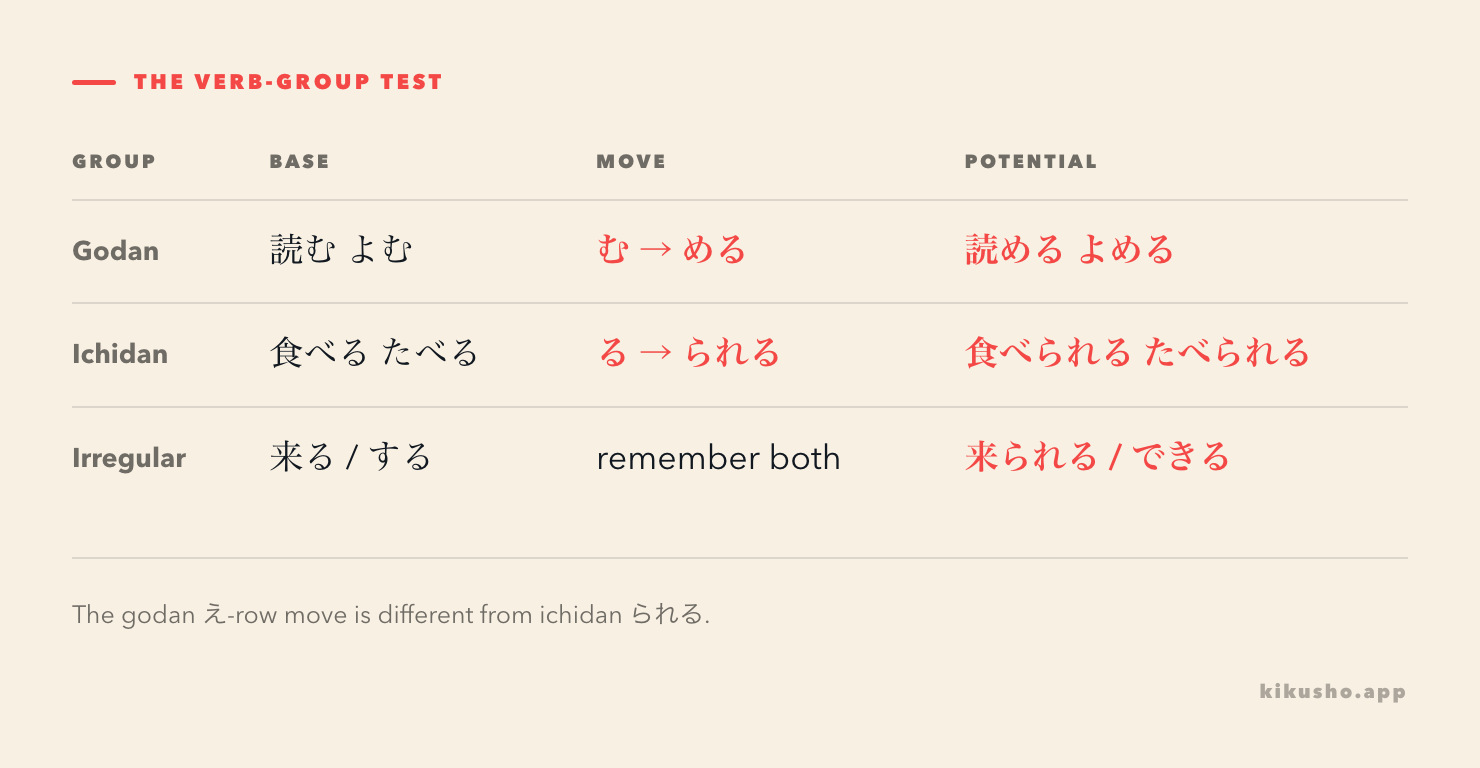
A potential verb is a new verb form, not できます pasted after another conjugation. Start from the dictionary form and follow its verb group. If you need to identify the groups first, the N5 verb-group lesson gives the split before ます.
| Base verb | Group | Potential verb | Meaning |
|---|---|---|---|
| 話す(はなす) | godan | 話せる(はなせる) | can speak |
| 読む(よむ) | godan | 読める(よめる) | can read |
| 書く(かく) | godan | 書ける(かける) | can write |
| 行く(いく) | godan | 行ける(いける) | can go |
| 食べる(たべる) | ichidan | 食べられる(たべられる) | can eat |
| 見る(みる) | ichidan | 見られる(みられる) | can see |
| 来る(くる) | irregular | 来られる(こられる) | can come |
| する | irregular | できる | can do |
| 勉強する | する compound | 勉強できる | can study |
Godan verbs move the final kana to the え row
話す becomes 話せる; 読む becomes 読める. The godan pattern changes the final う-row sound to its え-row partner and adds る. That is why 行く gives 行ける, not 行くられる. The University of Texas potential-conjugation reference and Tofugu's verb-form guide cross-check these groups.
Ichidan verbs add 〜られる
Remove final る from an ichidan verb and add られる: 食べる → 食べられる, 見る → 見られる. This is the standard full form. Casual speech often has 食べれる and 見れる, called ら抜き, but learn the full form for writing and N4 exercises. 来る has the irregular potential 来られる(こられる); する uses the separate verb できる as its “can do” counterpart. A する compound keeps its noun: 勉強する → 勉強できる. Mango Languages' potential-form lesson verifies these spellings, including the colloquial variants.
Plain verb + ことができる keeps the action intact
The other assigned N4 construction is dictionary-form verb + ことができる. こと names the action as a thing, が marks that nominalized action, and できる says it is possible. Use 話すことができます, not 話せることができます, when you want the longer expression. The polite ending is on できる: できます; the negative is できません.
| Short potential | Longer expression | Both say |
|---|---|---|
| 読めます | 読むことができます | can read |
| 食べられません | 食べることができません | cannot eat |
| 書けました | 書くことができました | could write / was able to write |
The short verb usually fits conversation more lightly. ことができる is useful when you want an explicit, somewhat more formal account of the action, or when a full 〜られる form could be mistaken for passive or honorific meaning. Bunpro's N4 ことができる entry gives the plain verb + こと + が + できる structure and contrasts it with the shorter potential.
が and を move differently in the two constructions
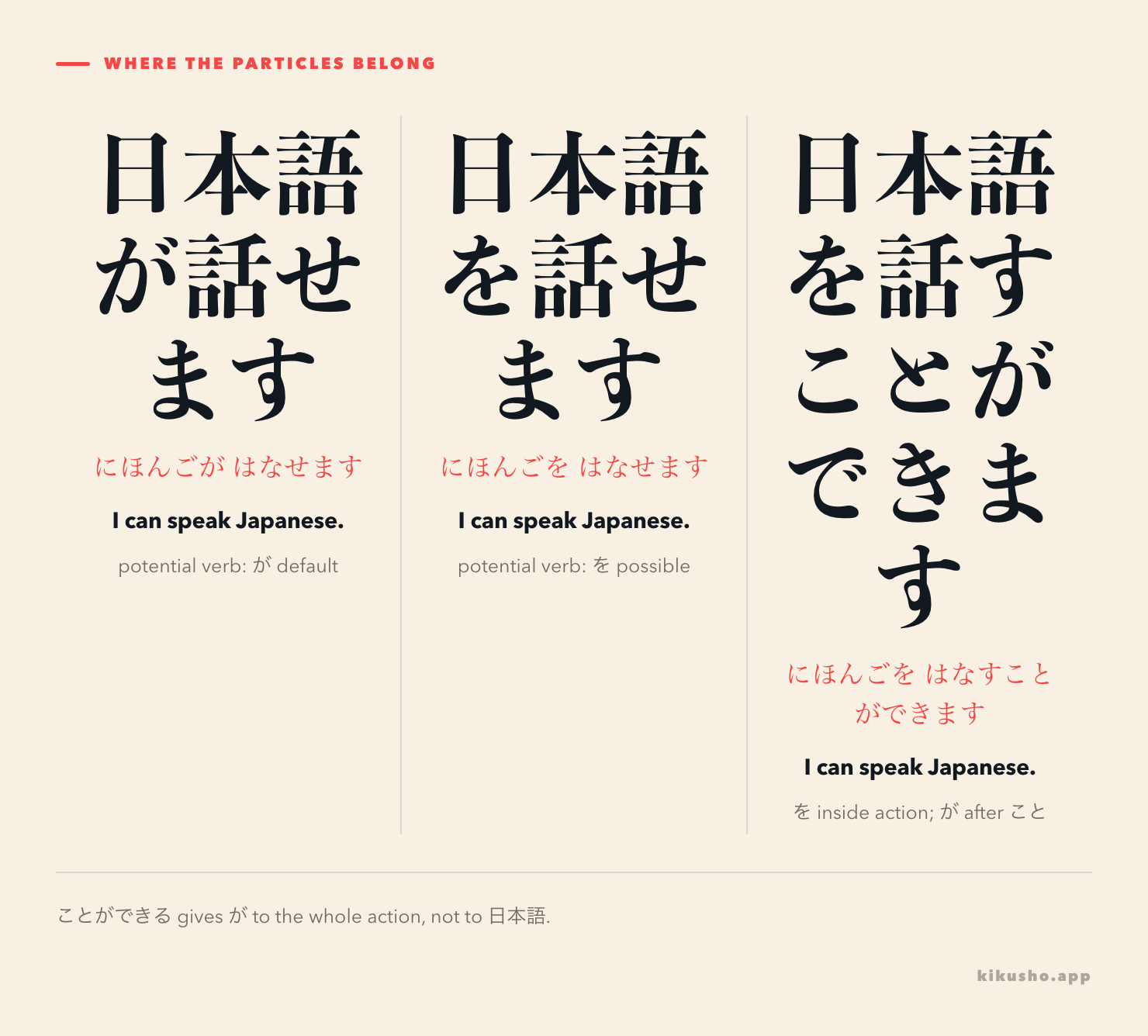
For a plain action, 日本語を話します says “I speak Japanese”: 日本語 is what is spoken and takes を. With the potential verb, 日本語が話せます is a natural first pattern for “I can speak Japanese.” 日本語を話せます is also possible. A potential verb does not erase the action or make Japanese the person speaking; it allows different case marking for the thing acted on. The choice is contextual, and が is a safe learner default, not a ban on を.
The longer form has a different boundary: 日本語を話すことができます. The を still belongs to 話す inside “speaking Japanese.” The が after こと belongs to the whole action. Do not turn this into 日本語が話すことができます to mean “I can speak Japanese”; that changes who is doing the speaking within the verb phrase. An Ohio State linguistics study documents が/を alternation for many potential verbs and explicitly distinguishes the separate ことができる construction. Mango Languages' examples show both 日本語が話せます and 日本語を話せます; its report-writing example also shows why context can favour を. The alternation is not a free swap in every sentence.
A skill and an available opportunity use the same form
姉は漢字が読めます says that my older sister can read kanji: a skill. この図書館では古い新聞が読めます says that old newspapers can be read at this library: the place makes that action available. The verb form is the same; the setting tells you whether “can” comes from the person or the circumstances. Tofugu's examples distinguish skill from situational possibility.
A negative can identify what blocks the action: 足が痛いので、今日は走れません means “I cannot run today because my leg hurts.” It does not say whether the person normally knows how to run. The N5 body and health word lesson teaches 足が痛い as a whole phrase before you use it to explain a limit. For a goal built around becoming able to do something, ように in the purpose lesson follows a potential verb such as 話せる; that later pattern uses the ability state as its target.
〜られる needs context, and English “can” reaches further
食べられる can be potential (“can eat”), passive (“is eaten”), or honorific. A short isolated form may be ambiguous; a sentence about the eater and the thing available usually settles it. If you need to specify ability without that overlap, 食べることができます names the action plainly. Mango Languages' explanation compares these readings of a full 〜られる form.
English “Can I go?” might request permission. 行けますか asks whether going is possible or physically achievable, not automatically whether someone permits it. Likewise, “mistakes can happen” does not usually call for a potential form of 間違える; potential verbs describe someone being able to perform the action. Tofugu's limits section separates ability from permission and accidental possibility. Keep those limits in mind before translating every English can with a potential verb.
When you see この図書館では古い新聞が読めます on a notice, save the sentence, not just 読める. The place explains why reading is possible, and the が shows what is available to read. Kikusho can make a card from a photo or pasted line, with the reading, example and native audio for later review. That captured sentence gives the potential form a setting instead of leaving it as an ending to memorise.
Check yourself
Question 1: grammar choice. Which standard potential form of 食べる means “can eat”?
- A. 食べれる
- B. 食べられる
- C. 食べます
- D. 食べさせる
Question 2: sentence composition. Write “I can read Japanese” with the short potential of 読む. Use 日本語 and the beginner default particle.
Question 3: grammar in a message. Complete both particle blanks in this notice: この図書館では、古い新聞( X )読むこと( Y )できます。 Make it mean “You can read old newspapers at this library.” Write X and Y.
Question 4: construction choice. Rewrite 漢字が書けます using ことができます. Keep the meaning “I can write kanji,” and put the object particle inside the plain-verb phrase.
Answers and explanations
Answer 1. B, 食べられる. Ichidan 食べる drops る and adds the full られる. A is a common ら抜き spoken variant but is not the standard form asked for; C simply says “eat”; D is causative, “make/let someone eat.”
Answer 2. 日本語が読めます。 読む is godan, so む moves to め and adds る, then the form takes polite ます. が marks what can be read in the beginner pattern. 日本語を読めます may also occur in context, but the prompt asked for the beginner default.
Answer 3. X is を and Y is が: 古い新聞を読むことができます. を marks the newspapers as the object of 読む inside the nominalized action. が follows こと. Reversing them would make newspapers the reader and fail to mark the nominalized action as what is possible.
Answer 4. 漢字を書くことができます。 書く stays in dictionary form before こと; を marks the kanji being written inside that verb phrase. The が after こと says writing it is possible. 漢字が書く would instead make kanji the writer.
Notice the boundary before こと in the longer answer: the action still has its own object, while the whole action becomes what できる is about. That boundary is why the two “can” patterns can describe the same task without carrying the same particles in the same positions.
Common questions
Is 食べれる the same as 食べられる?
食べれる is a common spoken ら抜き form of the potential 食べられる. The full 食べられる is the standard form to learn for written Japanese and a test answer. The same full ending can also express passive or honorific meaning, so context matters.
Can a potential verb use を instead of が?
Often yes: 日本語が話せます and 日本語を話せます can both say that you can speak Japanese. が is a useful beginner default, but を remains possible with many potential verbs. The choice varies with sentence structure and context, so do not replace every を mechanically.
Does ことができる attach to a potential verb?
Attach it to the plain dictionary form: 話すことができます. In 日本語を話すことができます, を marks what is spoken inside the verb phrase; が follows こと, the nominalized action.