On this page
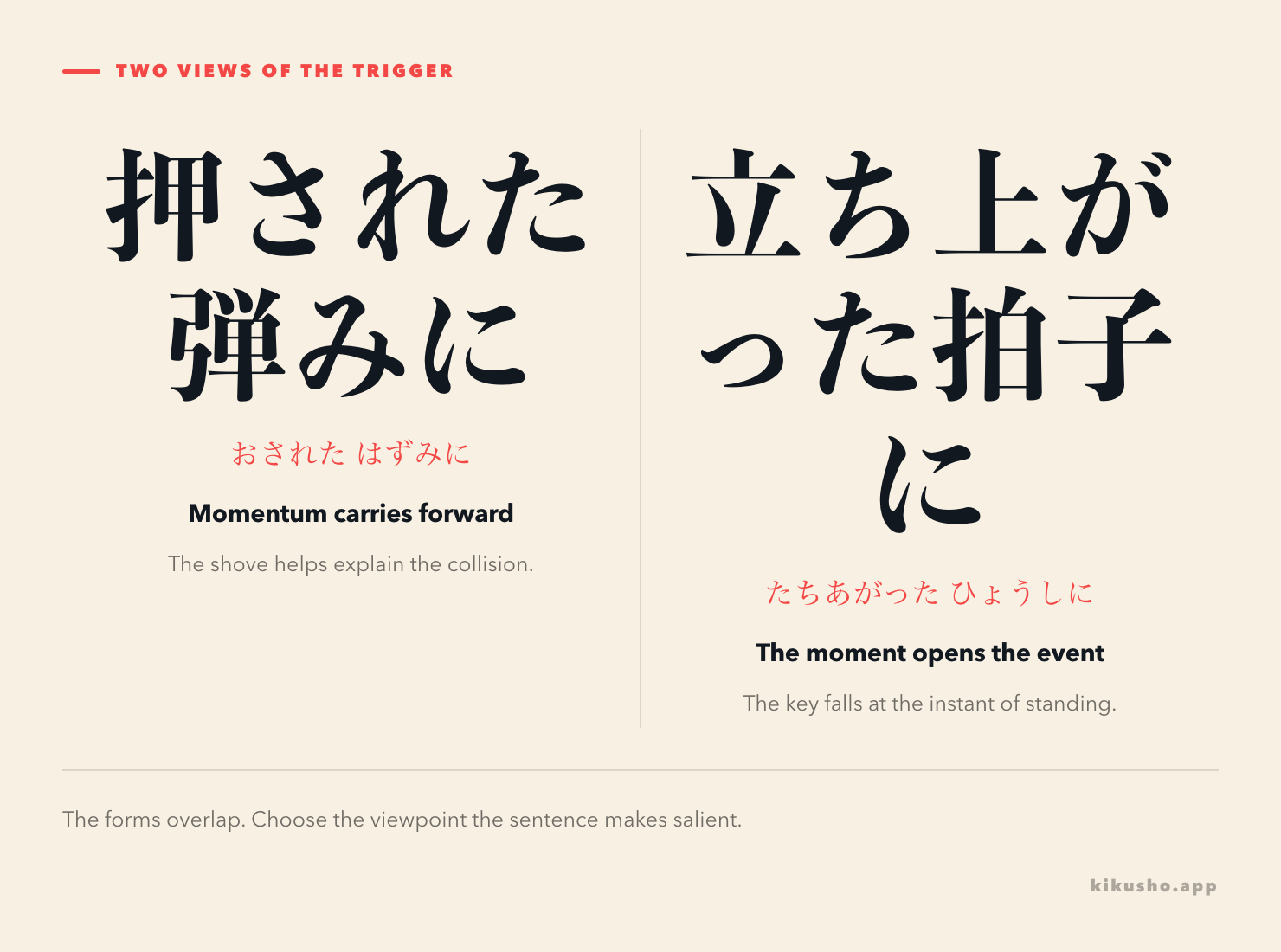
Both Vた + 弾みに and Vた + 拍子に connect one event to an unintended result. Use 弾みに when the first event's momentum, impact or impulse helps explain the result; use 拍子に when you mainly frame the exact moment that set it off. The two readings overlap, so this is a choice of viewpoint rather than a mechanical ban on substitution.
バスが急停車した弾みに、かばんが座席から落ちた。
バスがきゅうていしゃしたはずみに、かばんがざせきからおちた。
The bus stopped suddenly, and the jolt sent my bag off the seat.
椅子から立ち上がった拍子に、ポケットから鍵が落ちた。
いすからたちあがったひょうしに、ポケットからかぎがおちた。
As I stood up from the chair, my key fell out of my pocket.
The first translation makes the physical jolt explicit. The second keeps the camera on the instant of standing. Either noun can occur in many physical scenes, but each selects a slightly different part of the causal picture.
The shared pattern is a trigger followed by an accidental result
| Construction | Core formation | View of the first event | Typical second event |
|---|---|---|---|
| Vた + 弾みに | 押された弾みに | momentum, impact or a developing impulse | fall, drop, injure, blurt out |
| Vた + 拍子に | 立ち上がった拍子に | the instant that acts as a trigger | drop, notice, remember, feel dizzy |
Both constructions usually carry three pieces: event A happens, A provides the occasion or cause, and event B follows without being deliberately planned. JapaneseNET describes the pair as a trigger followed by something done or caused inadvertently. This is why a scheduled action makes a poor continuation.
ドアを閉めた拍子に、棚の写真立てが倒れた。
ドアをしめたひょうしに、たなのしゃしんたてがたおれた。
When I closed the door, the photo frame on the shelf fell over.
The speaker did close the door intentionally. The falling frame is the unplanned result. Do not reduce the rule to “both actions are accidental”; it is the outcome after the construction that normally escapes intention.
Attach both forms to the plain た-form
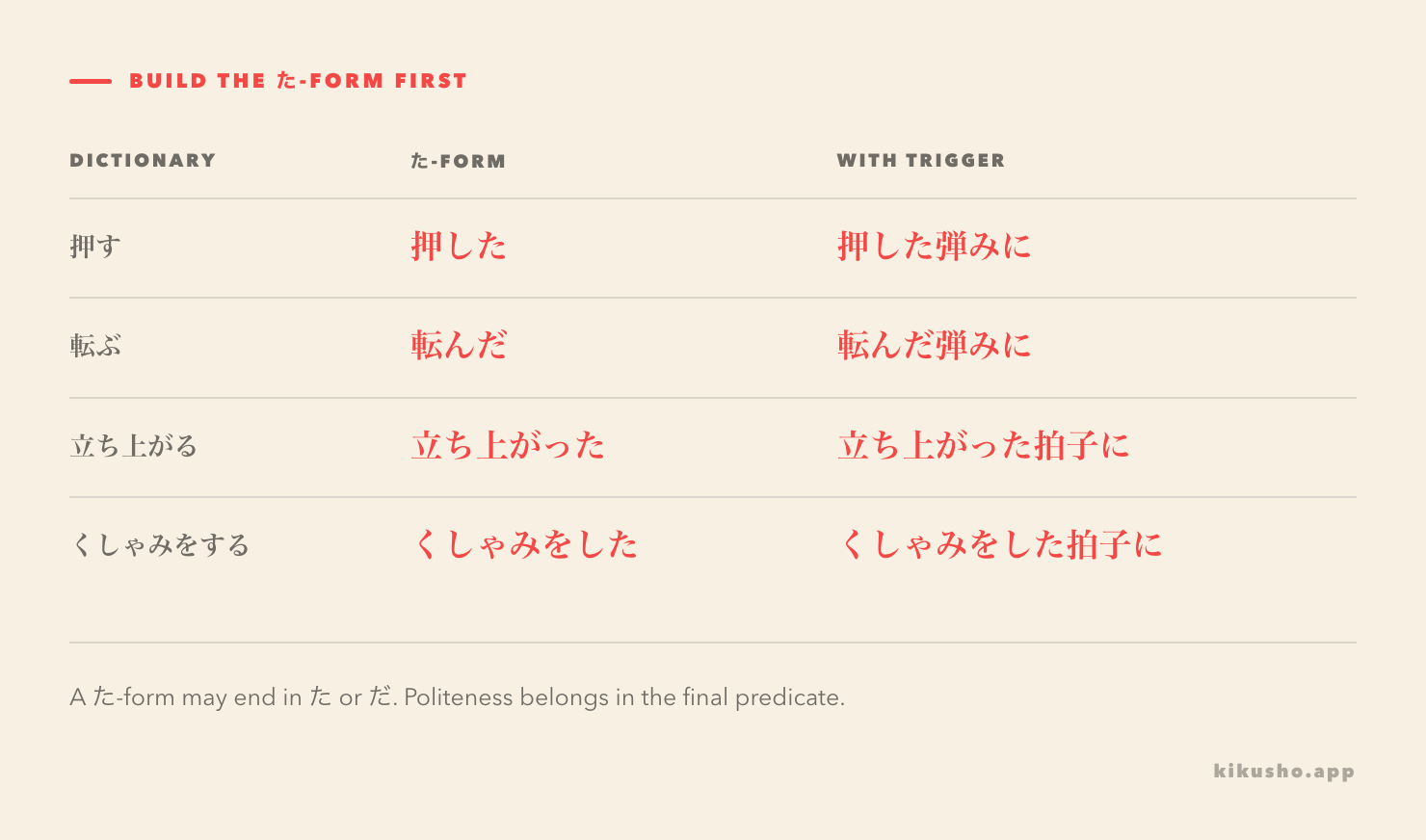
The form before either expression is the ordinary affirmative plain た-form:
| Dictionary form | た-form | Complete attachment |
|---|---|---|
| 押す | 押した | 押した弾みに |
| 転ぶ | 転んだ | 転んだ弾みに |
| 立ち上がる | 立ち上がった | 立ち上がった拍子に |
| くしゃみをする | くしゃみをした | くしゃみをした拍子に |
The label Vた includes past forms ending in だ. 転ぶ becomes 転んだ弾みに, not 転んた弾みに. Politeness belongs at the end of the report, so 立ち上がった拍子に、めまいがしました is standard even though the final predicate is polite.
You can also place 弾みに after an attempted action whose final verb is already in the た-form:
重い箱を持ち上げようとした弾みに、腰を痛めた。
おもいはこをもちあげようとしたはずみに、こしをいためた。
I hurt my lower back in the attempt to lift a heavy box.
Here the immediate base is 持ち上げようとした. The sentence does not claim that the box was successfully lifted; the attempt itself supplied the exertion that led to the injury.
弾みに follows momentum, impact or a chain reaction
弾み(はずみ) can mean bounce, momentum, an impulse, or the turn of events that sets something else in motion. Digital Daijisen's entry at Kotobank includes both an unexpected force and the moment or occasion on which something happens. In this construction, its physical history remains available as a nuance.
後ろから押された弾みに、前の人にぶつかった。
うしろからおされたはずみに、まえのひとにぶつかった。
Someone pushed me from behind, and the momentum made me collide with the person ahead.
手を伸ばした弾みに、机の上のコップを落としてしまった。
てをのばしたはずみに、つくえのうえのコップをおとしてしまった。
As I reached out, I accidentally knocked the cup off the desk.
The connection need not be a literal collision. An emotional or social impulse can also carry a person into an unintended act:
酒に酔った弾みで、秘密を話してしまった。
さけによったはずみで、ひみつをはなしてしまった。
In the heat of being drunk, I ended up revealing the secret.
This example uses the common variant Vた + 弾みで. Tanosuke records both に and で after a verbal clause. A University of Tsukuba analysis finds a useful structural difference beyond that basic alternation: 弾みで retains more noun-like freedom and is strongly preferred after a noun, as in 事故の弾みで. The fixed phrase ものの弾みで likewise means “on an impulse” or “in the heat of the moment.” Keep Vた + 弾みに as the target form, but recognize these neighbours when reading.
拍子に frames the exact instant that becomes the trigger
拍子(ひょうし) has familiar musical meanings, but Digital Daijisen's relevant sense is “the exact time when something was done.” This makes 拍子に natural when the sentence notices what happened at that instant.
くしゃみをした拍子に、眼鏡がずれた。
くしゃみをしたひょうしに、めがねがずれた。
When I sneezed, my glasses slipped out of place.
振り向いた拍子に、昔の店が目に入った。
ふりむいたひょうしに、むかしのみせがめにはいった。
As I turned around, an old shop caught my eye.
The sneeze has physical movement, so 弾みに would also be plausible if you wanted to evoke the jolt. The second example instead makes a chance perception available at the turn. This is the kind of result for which the moment-focused 拍子に often feels more natural.
You will also meet noun phrases that do not name a specific preceding verb:
何かの拍子に、その人の名前を思い出した。
なにかのひょうしに、そのひとのなまえをおもいだした。
Something prompted me to remember that person's name.
何かの拍子に and ふとした拍子に leave the precise trigger vague. They still present the recollection as arising by chance, not as a planned effort to remember.
The contrast is a preference, not two sealed categories
Some explanations offer a clean rule: force for 弾み, exact timing for 拍子. It is a useful first choice, but natural usage has a wide middle where both are possible.
| Scene | Likely choice | Why |
|---|---|---|
| A shove sends you into someone | 押された弾みに | the transferred force matters |
| Standing makes a key fall from a pocket | 立ち上がった拍子に | the result is framed at that instant |
| A collision knocks a phone away | either | impact and timing are both salient |
| A name suddenly returns to mind | 何かの拍子に | a chance trigger matters more than force |
| A secret is revealed on impulse | 酔った弾みで | an impulse develops into the act |
Tanosuke explicitly notes that the two target expressions can replace each other. The dictionary definitions also overlap: Kotobank defines one sense of 弾み through 拍子, while its 拍子 entry lists はずみ as a synonym for the relevant sense. Treat the force-versus-moment distinction as a way to read the writer's emphasis. Do not mark a sentence wrong solely because a different writer could have selected the neighbouring noun.
たとたん states immediacy more directly
Vた + とたん(に) also introduces a sudden development at an action's boundary. Its main job is to mark the immediate timing. 弾みに and 拍子に more readily ask you to see A as the occasion or trigger for B.
窓を開けたとたんに、電話が鳴った。
まどをあけたとたんに、でんわがなった。
The phone rang the moment I opened the window.
The opening and the ringing can simply coincide. Now compare a result tied to the movement:
窓を勢いよく開けた拍子に、机の紙が飛んだ。
まどをいきおいよくあけたひょうしに、つくえのかみがとんだ。
When I flung the window open, the papers on the desk blew away.
The second report invites a trigger reading: the opening lets in the gust that moves the papers. The earlier 最中に and たとたん lesson develops the boundary and sudden-development constraints of とたん. Use that distinction when an exam item contrasts simple immediacy with an accidental causal chain.
N1 is a publisher placement, and the forms also live outside tests
The Kikusho reference inventory and JLPT Sensei place the combined item at N1. JapaneseNET and Tanosuke independently label these forms N1, and no reviewed teaching reference assigned this exact pair to another level. As with other grammar labels, that agreement describes publisher sequencing; the JLPT authority does not publish an exhaustive grammar list.
The constructions are useful because they compress a small story into one link. The first clause gives the movement or moment, and the second preserves what unexpectedly followed. When you capture such a sentence in Kikusho, keep both clauses. A card containing only 弾み or 拍子 loses the causal relationship that distinguishes this sense from bounce, momentum, rhythm and musical metre.
Practice: identify the trigger and its viewpoint
Record all seven answers before opening the explanation block.
Question 1: readings. How are the two target nouns read in 転んだ弾みに and 立ち上がった拍子に?
- ア. はずみ and ひょうし
- イ. だんみ and びょうし
- ウ. はじみ and はくし
- エ. いきおい and ちょうし
Question 2: build the form. Complete: 階段で__弾みに、足首をひねった。
- ア. 転ぶ
- イ. 転びます
- ウ. 転んだ
- エ. 転んで
Question 3: choose the force-focused view. Someone is pushed from behind and collides with a door. Which sentence foregrounds the transferred momentum?
- ア. 後ろから押された弾みに、ドアにぶつかった。
- イ. 後ろから押す拍子です、ドアにぶつかった。
- ウ. 後ろから押される弾みに、ドアにぶつかった。
- エ. 後ろから押されました拍子に、ドアにぶつかった。
Question 4: choose the moment-focused view. Which sentence naturally presents a chance recollection at an unspecified trigger?
- ア. 何かの拍子に、昔の住所を思い出した。
- イ. 何かを拍子して、昔の住所を思い出した。
- ウ. 何かの弾むに、昔の住所を思い出した。
- エ. 何かの拍子だ、昔の住所を思い出した。
Question 5: compare with とたん. Which statement is accurate?
- ア. とたん always proves that the first event physically caused the second.
- イ. 拍子に can present A as a chance trigger, while とたん focuses more directly on immediate timing.
- ウ. 弾みに is used only for deliberate outcomes.
- エ. All three forms introduce an ordinary scheduled next action.
Question 6: judge the overlap. A collision knocks a phone from someone's hand. Which assessment is best?
- ア. Only 弾みに can ever be grammatical because a collision has force.
- イ. Only 拍子に can ever be grammatical because the phone falls at a moment.
- ウ. Either can work; 弾みに can emphasize the jolt, while 拍子に can frame the instant.
- エ. Neither can work because the result is accidental.
Question 7: assemble the sentence. Arrange every piece once to say “When I stood up, the key fell from my pocket.” Which piece occupies ★?
__ __ ★ __ 落ちた。
- ア. ポケットから
- イ. 立ち上がった
- ウ. 鍵が
- エ. 拍子に
Answers and explanations
1. ア: はずみ and ひょうし. These readings belong to the target expressions. 弾 can be read だん and 拍 can be read はく elsewhere, but those readings do not build these two forms.
2. ウ: 転んだ. Both constructions attach to the plain た-form. 転ぶ has the た-form 転んだ, whose ending is んだ rather than a separately added た.
3. ア: 後ろから押された弾みに、ドアにぶつかった. 押された is the required plain た-form, and 弾みに highlights the motion transferred by the shove. The other options use a dictionary, polite or invented attachment.
4. ア: 何かの拍子に、昔の住所を思い出した. 何かの拍子に is an established way to leave the accidental trigger unspecified. 拍子 is a noun here, not a する verb, and the other endings do not form the target expression.
5. イ. 拍子に readily presents the first event as the occasion for the chance result. とたん foregrounds the second event's immediacy and does not always assert a physical causal link. None of the forms is a neutral connector for a planned schedule.
6. ウ. The physical scene supports both viewpoints. 弾みに can make the collision's force vivid; 拍子に can locate the falling phone at that instant. The preference does not create an absolute grammatical boundary.
7. イ → エ → ア → ウ; ★ is ア. The complete sentence is 立ち上がった拍子に、ポケットから鍵が落ちた。 The た-form clause ends with 拍子に, followed by the source ポケットから and subject 鍵が before the fixed predicate.
Common questions
What do た弾みに and た拍子に mean?
Both attach to a verb in its plain た-form and connect that event to a second, usually accidental or unexpected result. 弾みに often makes the first event's momentum or impulse vivid, while 拍子に tends to frame the exact moment that triggered the result.
Are た弾みに and た拍子に interchangeable?
They overlap greatly, especially with collisions, falls and sudden body movements. The distinction is a tendency rather than a strict rule: 弾みに leans toward force or a chain reaction, and 拍子に toward timing.
Can 弾みに use で instead of に?
Yes. Verb た-form + 弾みで is common, and noun phrases such as 事故の弾みで particularly favour で. 弾みで also appears in ものの弾みで, meaning on an impulse or in the heat of the moment.
How are た拍子に and たとたん different?
Both can place a development at an action's boundary. た拍子に presents the first event as the occasion or trigger for the accidental result; たとたん focuses more directly on the immediacy of the second event.