On this page
The road may narrow to one usable route, or it may end completely. 歩くしかない means walking is the only route left and you can take it. 帰りようがない means no available method will get you home. That difference between one option and no means decides which N3 pattern fits.
First check whether the target action can happen
Suppose the last train has gone. A hotel is within walking distance:
終電が出たので、ホテルまで歩くしかない。
しゅうでんが でたので、ホテルまで あるくしかない。
With the train gone, walking is my only way to reach the hotel.
Walking is inconvenient, but possible. The speaker has compared the alternatives and retained one.
Now change the destination. It is on an island, the last ferry has left, and nobody has a boat:
船がもうないので、今夜は島へ渡りようがない。
ふねが もう ないので、こんやは しまへ わたりようがない。
There is no boat now, so there is no way to cross to the island tonight.
The intended crossing has no usable method. The sentence does not choose crossing as an obligation; it says crossing cannot be carried out.
| Pattern | Status of the action | Speaker's conclusion |
|---|---|---|
| V dictionary form+しかない | Possible | This is the only option left |
| V stem+ようがない | Impossible under the stated conditions | There is no way or method to do it |
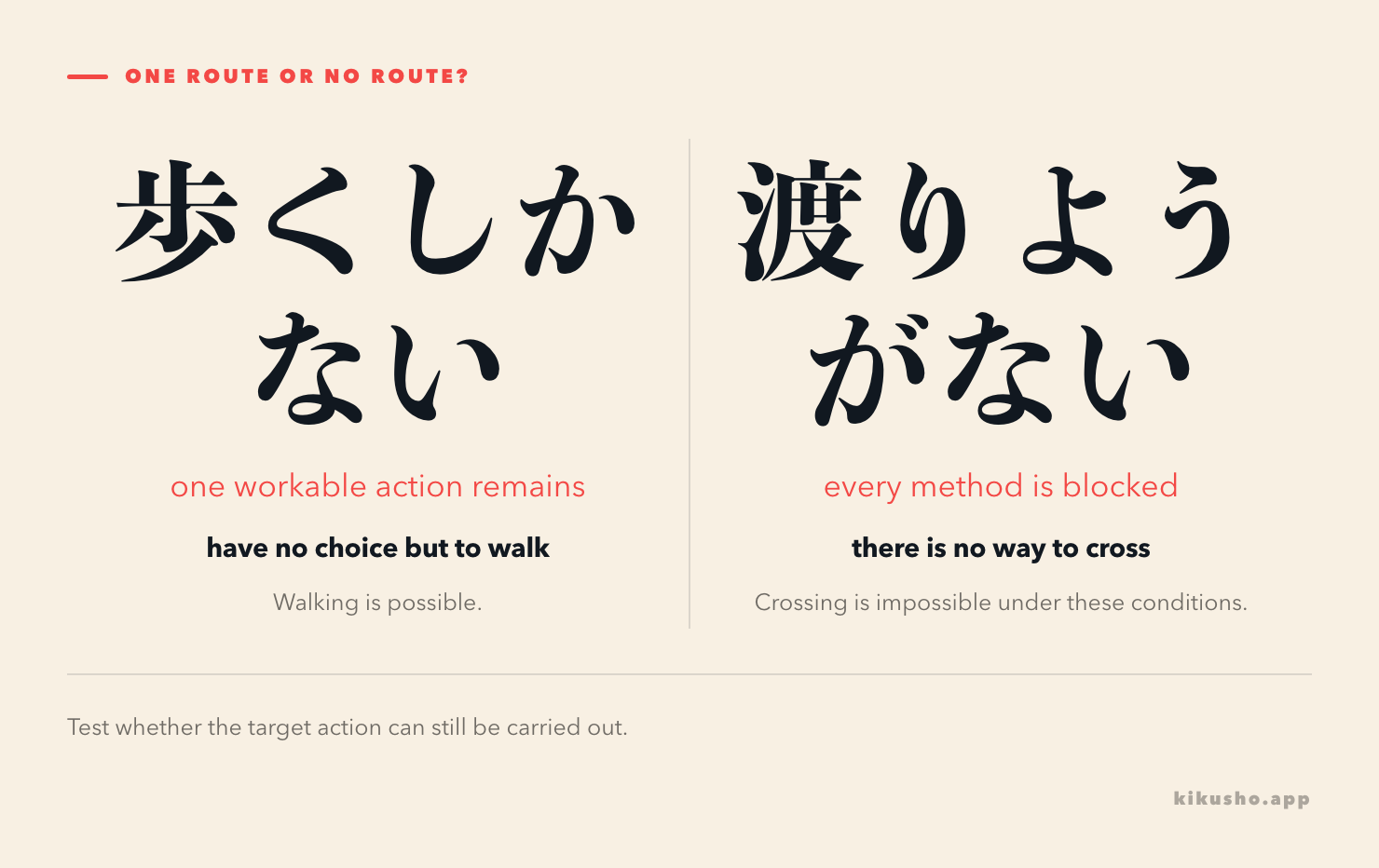
A useful test is to continue the sentence. After 歩くしかない, the person can start walking. After 渡りようがない, the person cannot start crossing until the conditions change.
しかない selects the sole remaining action
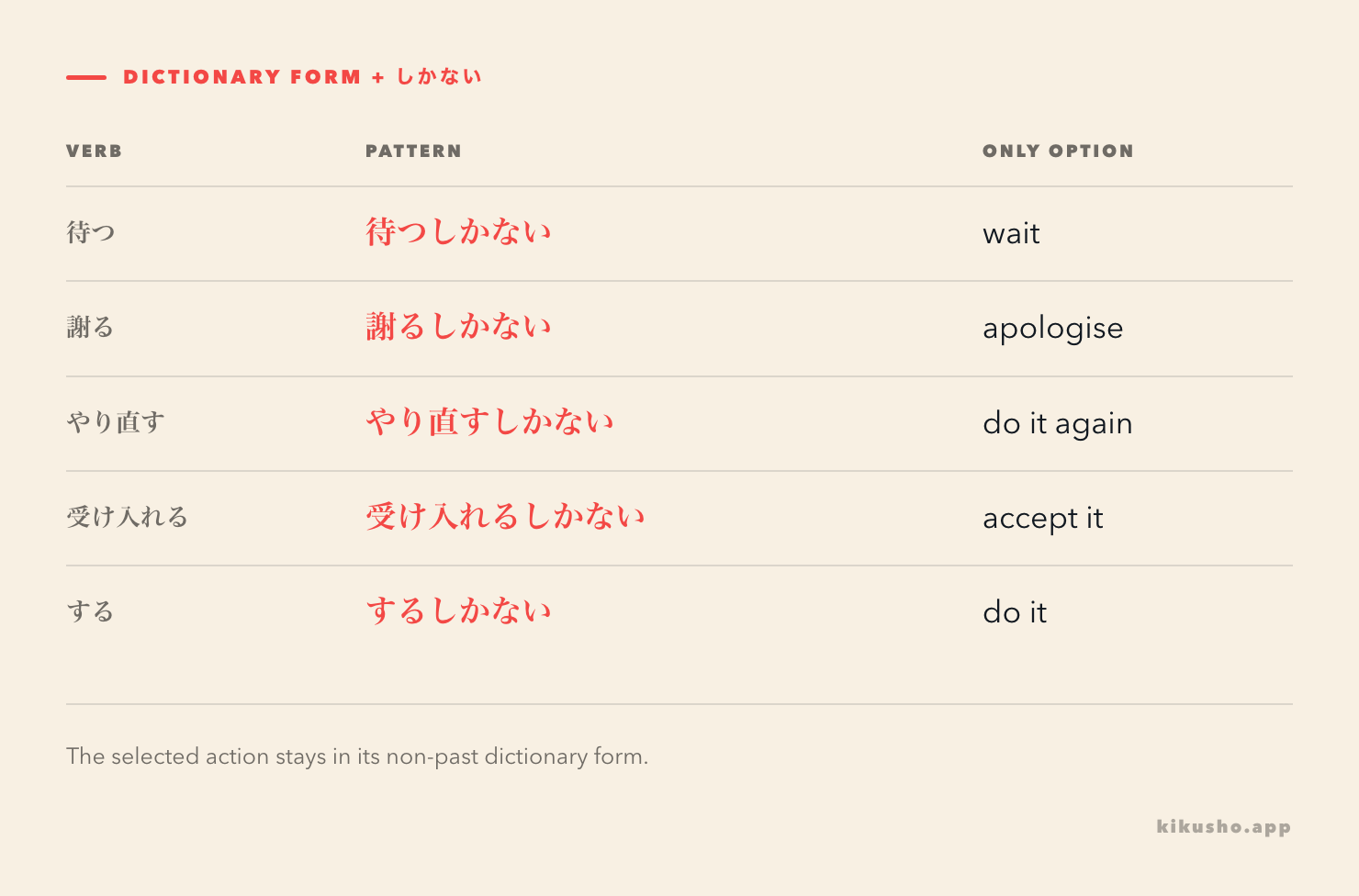
Attach しかない directly to the non-past dictionary form of a verb:
| Verb | Pattern | Meaning |
|---|---|---|
| 待つ | 待つしかない | have no choice but to wait |
| 謝る | 謝るしかない | have no choice but to apologise |
| やり直す | やり直すしかない | have no choice but to do it again |
| 受け入れる | 受け入れるしかない | have no choice but to accept it |
| する | するしかない | have no choice but to do it |
Bunpro's しかない reference gives the same dictionary-form attachment and describes the selected action as the only possibility. The negative-looking ending belongs to the fixed construction; it does not negate the selected verb.
データが消えたので、最初から入力し直すしかありません。
データが きえたので、さいしょから にゅうりょくしなおすしか ありません。
The data disappeared, so we have no choice but to enter it again from the beginning.
The polite form is しかありません. The action before it remains in dictionary form. Do not change it to a polite verb: 入力し直しますしかありません is not the pattern.
This verb construction is related to the broader particle pattern N+しか+negative predicate, as in 水しかない, “there is only water.” The present lesson focuses on a complete action as the only route. The quantity lesson on しか and も covers how a limited amount can carry the speaker's evaluation.
The only option is not always unwelcome
Circumstances often produce a reluctant choice:
締め切りが明日だから、今夜仕上げるしかない。
しめきりが あしただから、こんや しあげるしかない。
The deadline is tomorrow, so I have no choice but to finish it tonight.
Yet しかない can also present one choice as so obviously good that alternatives need no consideration:
京都まで来たなら、この庭を見るしかないよ。
きょうとまで きたなら、この にわを みるしかないよ。
If you have come all the way to Kyoto, you simply have to see this garden.
The Japan Foundation's Marugoto teaching notes explicitly distinguish the reluctant “no other choice” reading from this positive, emphatic recommendation. Context and intonation tell you whether the remaining route feels burdensome or irresistible.
Because the construction selects an action, it is close to expressions of obligation. The lesson on ざるを得ない compares a more formal response to unavoidable circumstances with ordinary しかない. For this N3 choice, keep the concrete alternatives in view: all but one have fallen away.
ようがない says the required means are absent
For ようがない, begin with the polite form, remove ます, and add ようがない:
| Dictionary form | ます form | Stem+ようがない |
|---|---|---|
| 行く | 行きます | 行きようがない |
| 調べる | 調べます | 調べようがない |
| 確かめる | 確かめます | 確かめようがない |
| 書く | 書きます | 書きようがない |
| する | します | しようがない |
The よう here expresses a way or manner of performing the verb. It is not the volitional ending in 行こう. Compare 行きようがない, built from 行きます, with 行こうと思う, “I think I will go.”
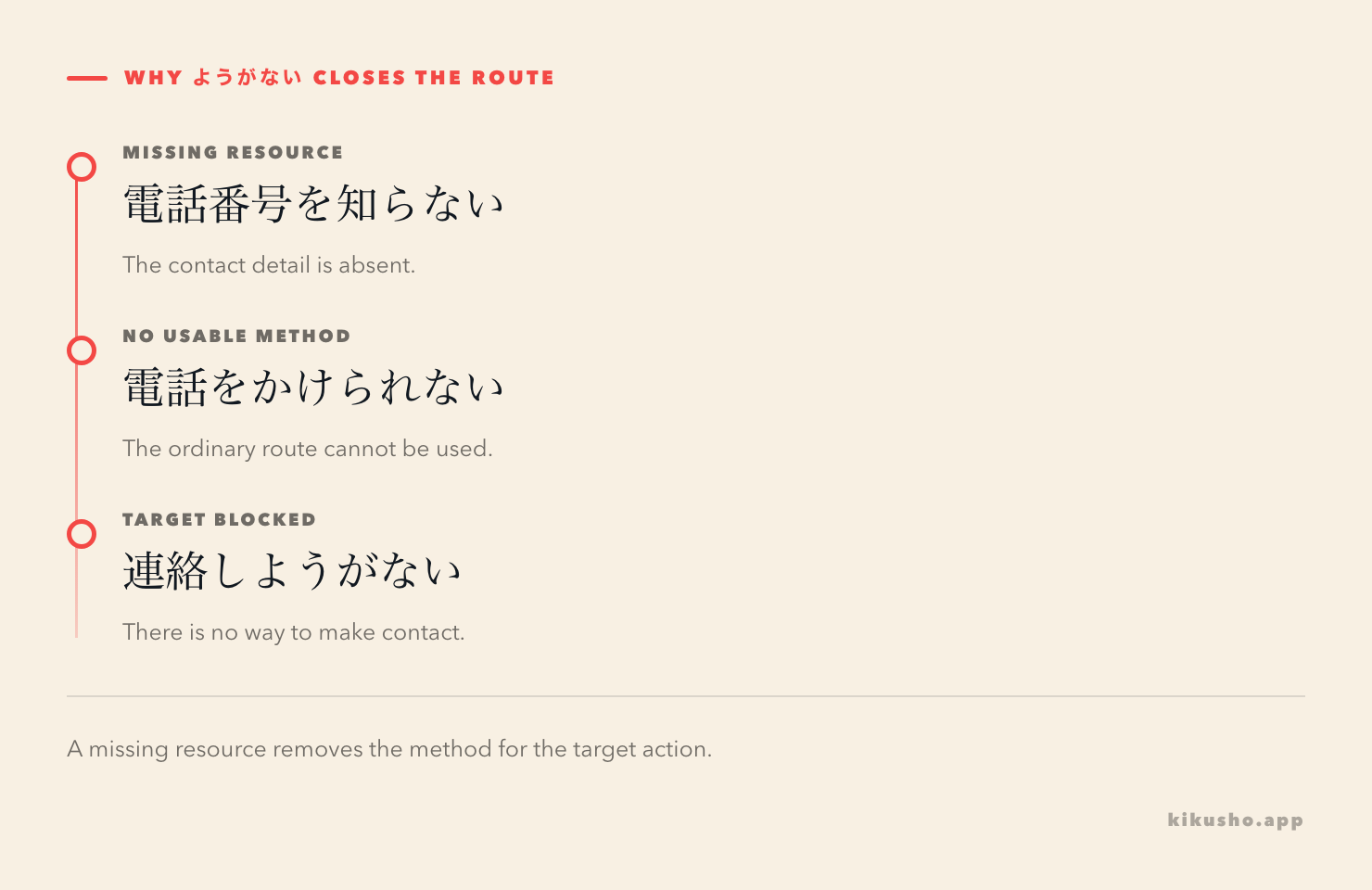
住所も電話番号も知らないので、彼に連絡しようがない。
じゅうしょも でんわばんごうも しらないので、かれに れんらくしようがない。
I know neither his address nor his phone number, so there is no way to contact him.
Contacting him is the target, but every normal channel is missing. JLPT Sensei's ようがない entry records the stem attachment, the variant ようもない, and examples built around absent transport, contact details and information. Nihongo Net independently describes the form as inability caused by missing means or conditions.
The cause is often stated before the pattern:
証拠が残っていないので、事実かどうか確かめようがない。
しょうこが のこっていないので、じじつか どうか たしかめようがない。
No evidence remains, so there is no way to verify whether it is true.
字が完全に消えていて、この名前は読みようがない。
じが かんぜんに きえていて、この なまえは よみようがない。
The writing has completely disappeared, so there is no way to read this name.
You will also meet noun-like combinations with a する action: 説明のしようがない means there is no way to explain it, and 判断のしようがない means there is no basis or way to judge. The particle の connects the noun to しようがない. These are not the same as attaching よう directly to any noun.
Impossibility must come from the means, not disbelief
ようがない is narrower than the English “there is no way.” English can express disbelief with that phrase: “There is no way he finished already.” Japanese normally uses わけがない for that logical rejection:
一人で一時間で終えられるわけがない。
There is no way one person could finish it in an hour.
資料がないので、正確に計算しようがない。
There are no materials, so there is no way to calculate it accurately.
The first speaker rejects the proposition as implausible. The second identifies a missing resource that blocks a method. The わけ forms lesson handles that logical conclusion and its two negative relatives.
Potential form alone also differs. 連絡できない states inability. 連絡しようがない makes the missing route itself salient. A nearby sentence should normally explain what prevents the action, or the situation should make it obvious.
Put both patterns into one decision
Imagine a broken laptop containing tomorrow's presentation. A repair shop is still open:
自分では直せないから、修理店に持っていくしかない。
I cannot repair it myself, so my only option is to take it to a repair shop.
The repair shop provides a possible next action. If the laptop has been lost and there is no backup, the target changes:
データもコピーもないので、元の資料を復元しようがない。
There is neither data nor a copy, so there is no way to restore the original material.
This pair exposes a common mistake. Difficulty, reluctance or inconvenience does not justify ようがない when one workable route remains. Conversely, しかない cannot select an action that the sentence has already made impossible.
When saving either pattern in Kikusho, include the failed alternatives. 持っていくしかない becomes memorable beside the broken laptop and open shop. 復元しようがない needs the missing backup. The constraint is part of the grammar, so it belongs on the card with the expression.
JLPT Sensei places both verb patterns at N3, and Bunpro places the only-action しかない entry at N3. Broader しか+negative records appear at N4 in Bunpro, the Japan Foundation material and some comparison lists, while other inventories place related forms elsewhere. The labels describe different scopes as well as editorial sequencing. The JLPT does not publish an exhaustive official grammar list, so this lesson states the exact two constructions it verifies.
Test whether a usable route remains
Complete all six questions before consulting the answer block.
Question 1: grammar choice. The buses have stopped, but the station is close enough to reach on foot. Complete: バスがないので、駅まで__。
- ア. 歩くしかない
- イ. 歩きようがない
- ウ. 歩こうがない
- エ. 歩きしかない
Question 2. Which sentence says that missing contact details make contact impossible?
- ア. 電話番号がないので、連絡するしかない。
- イ. 電話番号がないので、連絡しようがない。
- ウ. 電話番号がないので、連絡ししかない。
- エ. 電話番号がないので、連絡するようがない。
Question 3. Choose the correct formation from 調べます.
- ア. 調べるようがない
- イ. 調べないしかない
- ウ. 調べようがない
- エ. 調べますしかない
Question 4: sentence composition. Arrange the pieces to say “We have no choice but to wait for the result”: しかありません / 結果を / 待つ.
Question 5. A friend visiting Kyoto says ここまで来たら、紅葉を見るしかないね with enthusiasm. What does しかない convey here?
- ア. Seeing the leaves is physically impossible.
- イ. The leaves are the only thing that exist in Kyoto.
- ウ. Seeing the leaves is the one obvious, strongly recommended choice.
- エ. The friend has already seen the leaves.
Question 6: text grammar. Choose the pair that matches each constraint in this short account.
パソコンが壊れましたが、修理店はまだ開いています。自分では直せないので、店に持っていく__。しかし、パスワードを忘れたため、中のファイルを今確認し__。
- ア. ようがない / しかない
- イ. しかない / ようがない
- ウ. しかない / しかない
- エ. ようがない / ようがない
Answers and explanations
Answer 1. ア, 歩くしかない. Walking remains possible and is the only available route. 歩きようがない would say no method of walking exists, contradicting the stated proximity. ウ and エ use the wrong verb form.
Answer 2. イ, 連絡しようがない. The missing number blocks a means of contact. ア selects contacting as the only option even though the sentence supplies no way to do it. ウ and エ do not form either target construction.
Answer 3. ウ, 調べようがない. Remove ます from 調べます to obtain 調べ, then add ようがない. ア wrongly uses the dictionary form before ようがない, while エ wrongly leaves the polite ending before しかない.
Answer 4. 結果を待つしかありません。 待つ stays in dictionary form, followed by the polite しかありません. The result is the object marked by を.
Answer 5. ウ. In this enthusiastic context, しかない elevates one choice as the obvious thing to do. It need not express reluctant resignation. The sentence neither makes viewing impossible nor reports a completed visit.
Answer 6. イ, しかない / ようがない. The open repair shop leaves one workable action, so the laptop can be taken there. The forgotten password blocks access to the files, so the speaker cannot currently verify them. The other pairs either declare the available trip impossible or select an unavailable check as a feasible option.
The final passage contains both patterns because possibility changes with the target action. Repair still has a route; immediate file access does not. Name the action first, then ask whether one path survives or every method has disappeared.
Common questions
What is the difference between しかない and ようがない?
Verb dictionary form plus しかない says one action remains as the only option. Verb stem plus ようがない says the means or method needed to perform an action do not exist.
How does ようがない attach to a verb?
Remove ます from the polite form and add ようがない: 行きます becomes 行きようがない, 調べます becomes 調べようがない, and します becomes しようがない. ようもない is a variant.
Does しかない always express reluctant resignation?
No. It often sounds resigned when circumstances leave an unwanted option, but it can also strongly recommend the one action that makes sense, as in saying that a visitor simply has to see a famous place.
Are しかない and ようがない N3 grammar?
Several teaching resources place the verb patterns at N3, while broader しか plus negative patterns appear at other levels. These are publisher estimates because the JLPT does not publish an exhaustive grammar list.