On this page
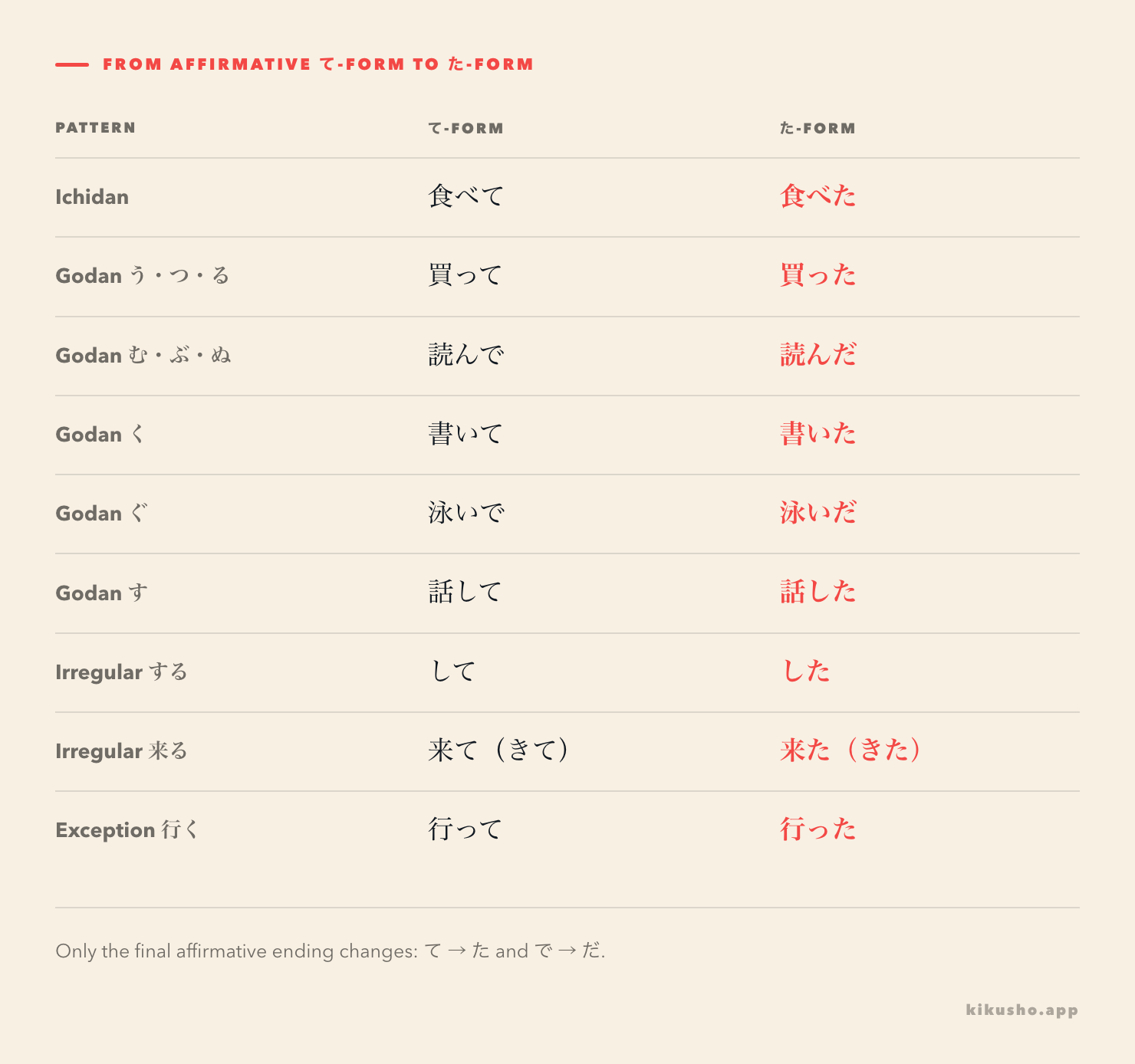
帰る becomes 帰った, while 食べる becomes 食べた: the Japanese plain affirmative past is the た-form, which includes verbs ending in だ. If you already know a verb's affirmative て-form, change its final て → た or で → だ and keep the earlier sounds intact.
The resemblance saves you a second set of sound changes. 帰って → 帰った keeps っ, and 読んで → 読んだ keeps ん and the voiced ending. The new form can close a plain past statement; the て-form usually connects to something that follows.
This N5 grammar lesson teaches the past forms of ichidan and godan verbs, including the common irregular forms needed alongside them, and compares plain past with polite ました. Bunpro's る-verb past unit and う-verb past unit place these foundations at N5. That is a teaching estimate: the JLPT does not publish an exhaustive grammar syllabus. Know your verb groups and ます forms; the て-form chart supplies the conjugation you will reuse.
Ichidan verbs replace final る with た
Remove the dictionary form's final る, then add た. 食べる(たべる)→ 食べた, eat → ate; 見る(みる)→ 見た, see/watch → saw/watched; 起きる(おきる)→ 起きた, get up → got up. The stem remains unchanged.
An ichidan verb does not need the small っ used by some godan verbs. 食べった is the wrong shape. The matching て-form is 食べて, which makes the final-vowel relationship visible without changing the stem.
Do not apply that deletion to every verb ending in る. 帰る(かえる), go home, is godan and becomes 帰った(かえった). Its class decides the sound change. TUFS's plain-form reference gives both class paradigms; Tofugu's past-form guide independently checks them.
Godan verbs keep the て-form's sound families
From the dictionary form, replace the last kana according to its family. From a known て-form, change only the final て or で. These are two ways to reach the same result.
| Godan ending | Plain past ending | Dictionary forms and readings | Result |
|---|---|---|---|
| う・つ・る | った | 買う(かう)・待つ(まつ)・帰る(かえる) | 買った・待った・帰った |
| む・ぶ・ぬ | んだ | 読む(よむ)・遊ぶ(あそぶ)・死ぬ(しぬ) | 読んだ・遊んだ・死んだ |
| く | いた | 書く(かく) | 書いた |
| ぐ | いだ | 泳ぐ(およぐ) | 泳いだ |
| す | した | 話す(はなす) | 話した |
The verbs mean buy, wait, go home; read, play, die; write; swim; and speak, respectively. Read 買った as かった, 読んだ as よんだ, 書いた as かいた, and 泳いだ as およいだ. Keep the small っ where the table gives it; it is part of the conjugation.
だ in 読んだ is the voiced partner of this past ending. It is not the だ used after a noun. Do not build the form by adding noun-predicate だ to 読む. 読むだ and 読みだ do not mean “read” in the past. Bunpro's godan unit explicitly distinguishes the two.
The table is the ordinary beginner pattern, with exceptions worth checking rather than guessing. Less common written verbs 問う(とう), ask/question, and 請う(こう), request, retain う: 問うた/請うた, paired with 問うて/請うて. Bunpro lists them, and Reverso's specific entries for 問う and 請う confirm those forms. Their mention is a limit on the chart, not a claim that the headwords belong to N5 vocabulary.
行く, する and 来る keep their special forms
行く(いく), go, takes 行った(いった), rather than the く-row guess 行いた. You already meet the exception in 行って, so converting that to the past preserves it. Other common く-verbs keep the regular pattern: 書いて → 書いた, for example.
| Dictionary form | Affirmative て-form | Plain past | Past reading |
|---|---|---|---|
| 行く | 行って | 行った | いった |
| する | して | した | した |
| 来る | 来て | 来た | きた |
する, do, becomes した. 来る(くる), come, becomes 来た(きた). The kanji 来 stays, but the reading changes from く to き. 来た is neither くた nor こた; こ belongs to other forms such as 来ない.
The existence verbs need no special past exception: ある → あった follows godan, and いる → いた follows ichidan. Use the ある/いる lesson to decide which kind of existence the sentence describes. TUFS and Tofugu confirm the past formations separately from the choice of verb.
ました grows from the ます form
For the ordinary polite past, replace ます with ました. Keep the base that stood before ます, even if the plain past used a different sound.
| Dictionary form | Plain past | Polite affirmative | Polite past |
|---|---|---|---|
| 見る | 見た | 見ます | 見ました |
| 書く | 書いた | 書きます | 書きました |
| 待つ | 待った | 待ちます | 待ちました |
| 行く | 行った | 行きます | 行きました |
| 来る | 来た(きた) | 来ます(きます) | 来ました(きました) |
| する | した | します | しました |
メモを書いた and メモを書きました both report “I wrote a note.” The latter uses polite ます style. The distinction is the register of the report, not how long ago the writing happened. TUFS's ました lesson gives the direct ます→ました change.
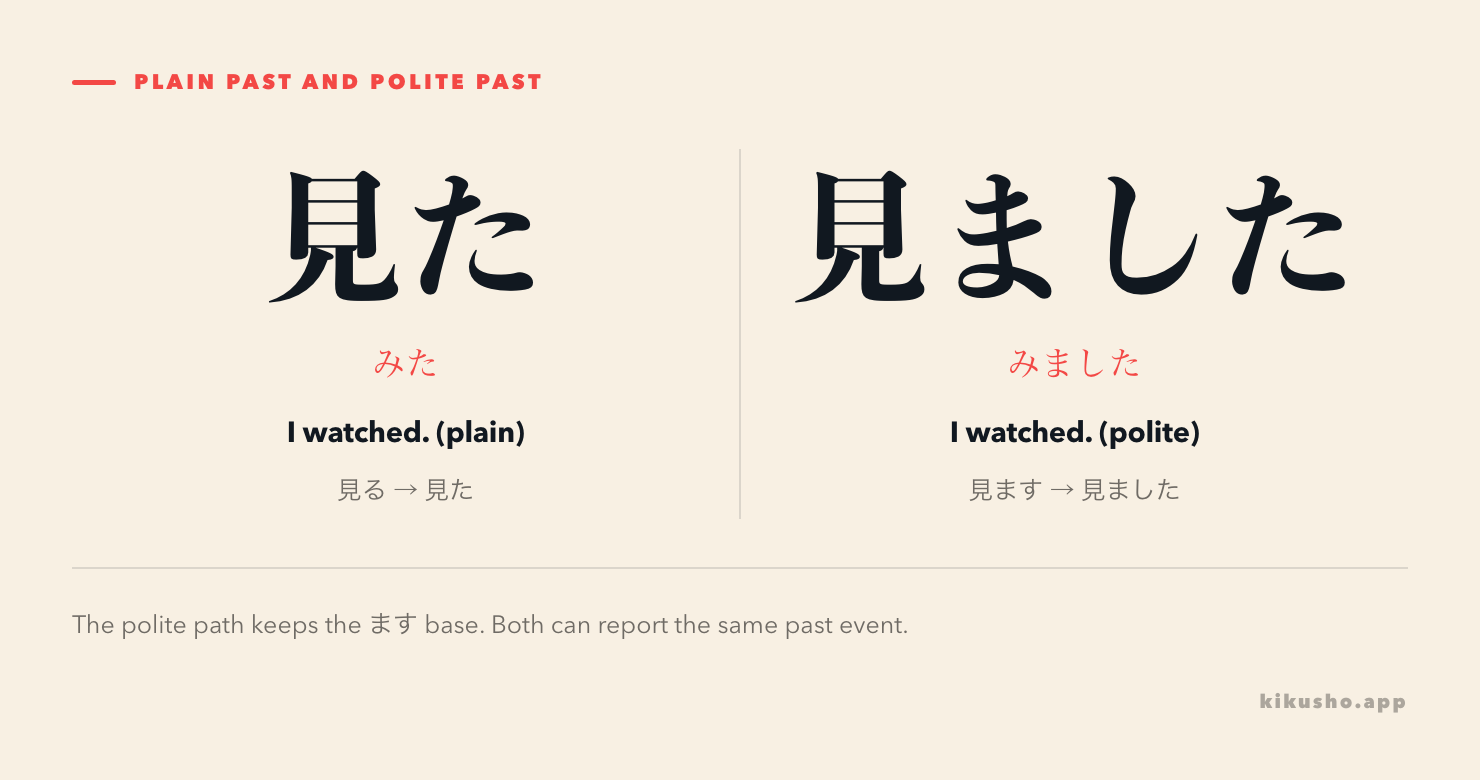
To make that ordinary report polite, do not just attach です to the finished verb: 書いたです is not the standard ます-style past. Use 書きました. Japanese can put other material after a plain past verb, but that makes a further construction; it is not a general permission to append です.
The plain past can also occur inside a sentence whose final predicate is polite. A grammar pattern may require the plain form before it while the ending addresses the listener politely. Tofugu illustrates this distinction. Learn the verb's plain past as a usable form, rather than treating it as something that only belongs in casual sentence endings.
Context decides whether the action is a past event or already finished
昨日、メモを書いた means “I wrote a note yesterday.” 昨日(きのう)anchors the writing in a past day. もう宿題をした, in reply to a question about homework, can mean “I've already done my homework.” 宿題 is しゅくだい and もう means already. The second report makes the action's completion relevant now.
You do not need a separate affirmative verb ending corresponding to English have done. Hiroki Fukushima's guide for Mango Languages explains why context and time expressions distinguish these translations; TUFS's polite-past lesson also gives completion as a use of ました.
Keep the claim bounded. Saying someone bought a book does not by itself prove that they still own it. Context can make a continuing result relevant; the ending reports the action without telling you where the book is now.
Nor does every larger pattern containing a た-form locate its event before the present. ~たら can introduce a future condition. The と/たら comparison teaches that construction; seeing a た-form within it is not enough to translate the whole clause as an event that has already happened.
For Kikusho, a short account of yesterday gives the captured verb a reason to be past. If you dictate a line containing メモを書いた, check that its editable example keeps 書いた and the original time context. A generated dictionary-form example would test a different task. When you later meet 書きました in a message, keep its polite setting too; the two cards need different endings for different listeners.
The affirmative verb chart does not build every past predicate
An い-adjective takes a different route: 高い(たかい)→ 高かった, expensive → was expensive. A noun statement needs a past copula, such as 学生だ → 学生だった, is a student → was a student; 学生 is がくせい. Neither uses the godan final-kana families above. The adjective lesson and copula lesson teach those routes.
For “did not,” build a negative first. 見る → 見ない → 見なかった is the plain route; 見ませんでした is polite. 見たない does not give the past negative. The negative-form lesson handles that formation and the difference between a completed past non-event and an action still pending now.
The shortcut here is specifically a conversion between a verb's affirmative て-form and affirmative た-form. It is not a rule for replacing every て or で inside an entire sentence, and it does not choose the tense or meaning of the construction that follows.
Practice
These seven questions are newly written for this lesson. Finish the complete set before scrolling to the numbered explanations.
Question 1. Choose the plain past of 呼ぶ(よぶ), “call.”
- ア. 呼びた
- イ. 呼んた
- ウ. 呼んだ
- エ. 呼った
Question 2. 起きる(おきる), “get up,” is ichidan. Write its plain past without adding any extra stem sound.
Question 3. Arrange all four pieces into “I went to school yesterday,” keeping polite ます style: 学校へ / 私は / 昨日 / 行きました. Use topic → time → destination → verb order. 学校(がっこう)means school.
Question 4. Choose the reading of 来た, the plain past of 来る.
- ア. こた
- イ. きた
- ウ. くた
- エ. きった
Question 5. Complete the account while keeping polite ます style and the time of each event.
昨日、友達の家に行きました。友達と音楽を___。今日は家で音楽を聞きます。
友達(ともだち)means friend, 家(いえ)means home, 音楽(おんがく)means music, and 聞く(きく)means listen/hear. The listening with the friend belongs to yesterday's visit.
- ア. 聞きます
- イ. 聞いた
- ウ. 聞きた
- エ. 聞きました
Question 6. A learner writes パンを買ったです to report “I bought bread” in standard polite ます style. Correct the verb ending while keeping the past event. パン means bread.
Question 7. Join 公園で遊ぶ and 家に帰る to say “I played in the park and then went home.” Connect the first action with its て-form and end the sequence in plain past. 公園(こうえん)means park and 遊ぶ(あそぶ)means play.
Answers and explanations
Answer 1. ウ. 呼んだ. Godan ぶ belongs to the む・ぶ・ぬ family, which takes んだ. 呼び is the ます base, so ア uses the wrong base; イ loses the voiced ending; エ borrows った from the う・つ・る family.
Answer 2. 起きた(おきた). Remove final る and add た to the ichidan stem 起き. 起きった would apply an extra godan sound change. The matching て-form 起きて changes its final vowel to give the same 起きた.
Answer 3. 私は昨日、学校へ行きました。 私は gives the topic, 昨日 the time, 学校へ the destination and 行きました the final polite past. The polite form grows from 行きます. Its plain counterpart is 行った, with the exception retained.
Answer 4. イ. きた. 来る uses き in 来た and 来て. こ is the base in 来ない, while く is the dictionary reading. No small っ is added in this past form.
Answer 5. エ. 聞きました. The listening belongs to the completed visit introduced by 昨日, and the exercise keeps polite ます style. ア is non-past; ウ incorrectly adds た to the ます base. イ, 聞いた, is a grammatical plain past but changes the requested style. 今日 introduces the separate non-past activity at home.
Answer 6. パンを買いました。 Start from 買います and change ます to ました. 買った is the plain past and does not become standard ます style by taking です. 買いました preserves both the event and the requested politeness.
Answer 7. One answer is 公園で遊んで、家に帰った。 遊ぶ takes んで for the connected first action; godan 帰る takes った for the final past. The order follows the two events. 公園で遊んだ。家に帰った。 also reports both events in plain past, but uses two separate statements instead of the requested connected sequence.
Common questions
How do I make the Japanese た-form?
If you know the affirmative verb て-form, change its final て to た or で to だ. 食べて becomes 食べた, and 読んで becomes 読んだ. From the dictionary form, ichidan verbs drop る and add た; godan verbs use their ending's sound pattern. 行く becomes 行った, する becomes した, and 来る becomes 来た, read きた.
What is the difference between た and ました?
At the end of an ordinary statement, the た-form is plain and ました is polite. Both can report the same past event. Build ました from the ます form, rather than adding です to the plain past: 書きます becomes 書きました, while the plain past is 書いた.
Why do some Japanese past verbs end in だ?
Godan verbs ending in む, ぶ or ぬ take んだ, and those ending in ぐ take いだ. This だ is the voiced past ending, not the noun-predicate copula. 読む becomes 読んだ and 泳ぐ becomes 泳いだ; both belong to the た-form paradigm.