On this page
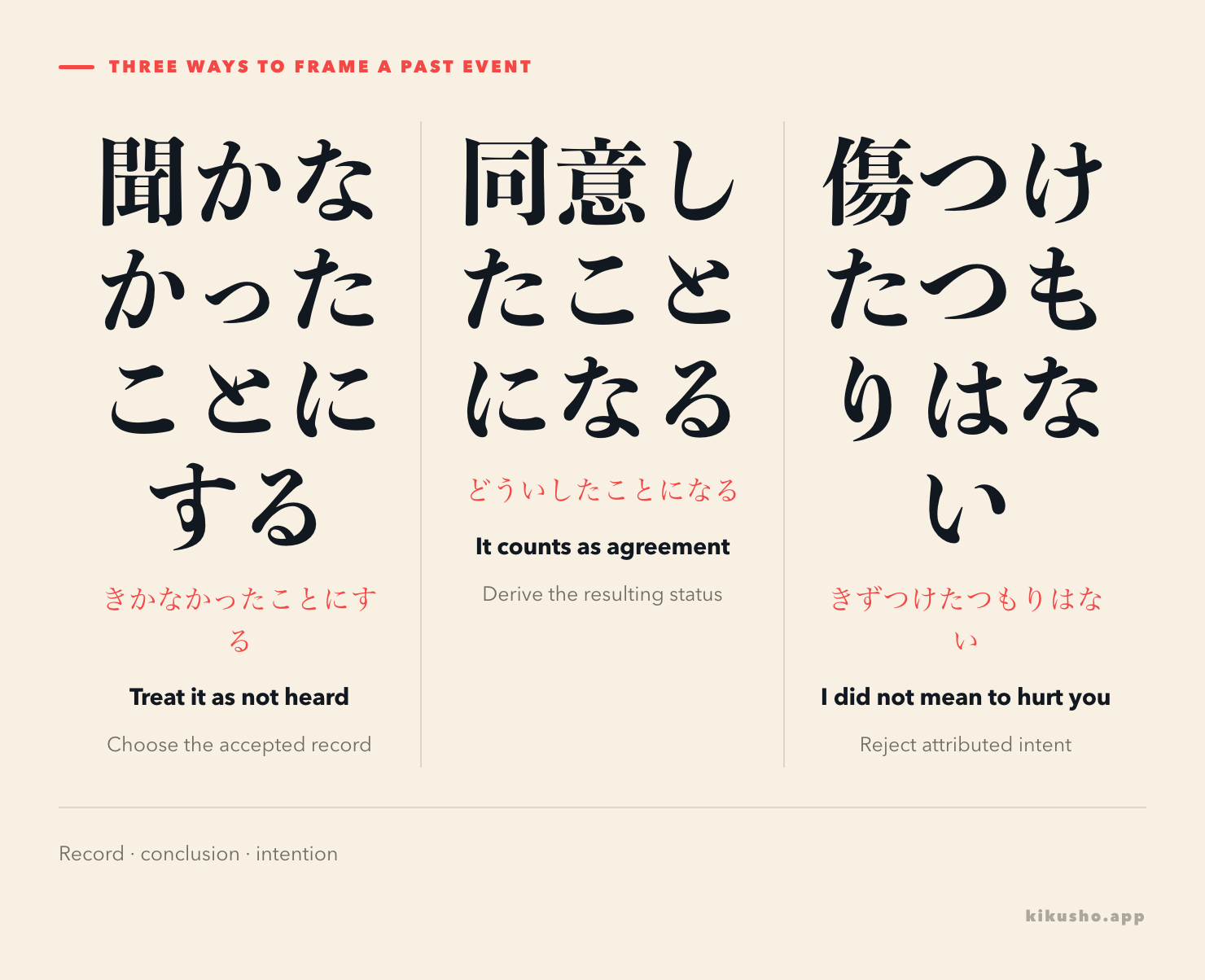
Vた + ことにする chooses the version of a past event that people will treat as true; Vた + ことになる presents a past status that follows from a rule or conclusion; Vた + つもりはない rejects the intention someone reads into what you did. All three look backward, but they change a different part of the message: the accepted record, the resulting classification, or the actor's intention.
This is not the basic pattern for deciding what to do next. That use appears in ことにする and ことになる for decisions and arrangements. Here the verb before こと is already past: したことにする, not することにした.
Three constructions, three questions
Imagine that you heard confidential information, signed a form, and later made a comment that offended a colleague. Each event raises a different question.
| Construction | Question it answers | Core effect |
|---|---|---|
| Vた / Vなかった + ことにする | Which version will we adopt? | Deliberately treats a past event as true or untrue |
| Vた / Vなかった + ことになる | What past status follows? | Derives how an event counts under a rule or conclusion |
| Vた + つもりはない | What intention did I have? | Rejects an intention or interpretation attributed to the speaker |
JLPT Sensei's N1 lesson on たことにする and たことになる groups the first two as ways to regard something as having happened. The Japan Foundation's grammar note gives a more precise account of つもりはない: the speaker corrects the intention another person may infer. These descriptions meet at “past event,” but they do not make the expressions interchangeable.
たことにする deliberately adopts a version
Use the past affirmative or past negative before ことにする:
| Form | Example | Practical meaning |
|---|---|---|
| Vた + ことにする | 読んだことにする | Treat it as having been read |
| Vなかった + ことにする | 読まなかったことにする | Treat it as not having been read |
| Vた + ことにした | 読んだことにした | Decided to treat it as having been read |
| Vた + ことにしている | 読んだことにしている | Maintain the convention that it was read |
The final する carries tense and politeness. The event inside the clause is already in the past.
この話は聞かなかったことにします。
このはなしはきかなかったことにします。
I will act as though I did not hear this.
The speaker did hear the story. 聞かなかったことにする chooses the version that will guide later behaviour. It may be a harmless convention, a face-saving fiction, or dishonest concealment; context decides. The grammar itself says that the speaker intentionally adopts the version.
間違いに気づいたが、最初から正しく答えたことにした。
まちがいにきづいたが、さいしょからただしくこたえたことにした。
I noticed the mistake, but pretended I had answered correctly from the start.
Here the surrounding facts make the counterfactual reading clear. In other contexts, the adopted version can be a reasonable simplification rather than a lie: a teacher may count a close answer as correct, or a committee may agree to record a late submission as received on time.
Zousan Law's N1 comparison also presents ことにする as an intentional way of treating an event as though it happened. “Pretend” is therefore useful in many examples, but it is too narrow as a universal translation. “Treat as,” “count as,” and “agree that” often fit better.
たことになる presents the resulting status
With たことになる, the speaker does not foreground choosing the version. A rule, calculation, piece of evidence or interpretation produces the conclusion.
この欄に署名すれば、規約に同意したことになります。
このらんにしょめいすれば、きやくにどういしたことになります。
If you sign this field, that will count as having agreed to the terms.
The agreement becomes the legal or procedural status attached to signing. The sentence need not imply that anybody is pretending. It explains what the action counts as.
今年で日本に十年住んだことになる。
ことしでにほんにじゅうねんすんだことになる。
This year, it comes to ten years that I have lived in Japan.
The calendar produces the conclusion. The residence is real; ことになる packages the result of the calculation. This is why translating every example as “pretend that” gives the wrong impression.
Compare the pair:
出席したことにした。
しゅっせきしたことにした。
We chose to count it as attendance.
この研修を受ければ、会議に出席したことになる。
このけんしゅうをうければ、かいぎにしゅっせきしたことになる。
Taking this training counts as having attended the meeting.
The first foregrounds an agent's choice. The second states the consequence of a system or rule. Passive English translations can hide that difference, so ask where the classification comes from.
たつもりはない denies the intention, not necessarily the act
Attach つもりはない, つもりではない or past つもりはなかった to a past-form verb when you need to reject an intention attributed to a completed action.
傷つけたつもりはありません。
きずつけたつもりはありません。
I did not mean to hurt you.
The sentence does not prove that nobody was hurt. It can leave the actual effect intact while denying that harm was the speaker's aim. That makes the pattern useful for clarification, but also potentially defensive.
失礼なことを言ったつもりはない。
しつれいなことをいったつもりはない。
I did not intend to say anything rude.
The Japan Foundation note contrasts this with 言わなかったつもりだ, where the speaker believes that they did not say it. Its examples show つもりはない/ではない as a reply when someone else assigns an intention to the speaker. JLPT Sensei's たつもりはない lesson similarly glosses it as not meaning or intending to do something.
In a tense conversation, そんなつもりはなかった can sound like self-defence. If the result matters, add acknowledgement rather than using the pattern as a complete answer:
責めたつもりはなかったけれど、そう聞こえたならごめんなさい。
せめたつもりはなかったけれど、そうきこえたならごめんなさい。
I did not mean to blame you, but I am sorry if it sounded that way.
The apology responds to the effect; つもりはなかった clarifies the intention.
Keep the scope of negation visible
Small changes around つもり produce very different claims.
| Sentence | What the speaker claims |
|---|---|
| 言ったつもりはない | The act may have occurred; I reject the attributed intention |
| 言わなかったつもりだ | I believe I did not say it |
| 言ったつもりだった | I believed I had said it |
| 言うつもりはない | I have no intention of saying it |
| 言わなかったことにする | I will treat it as though I did not say it |
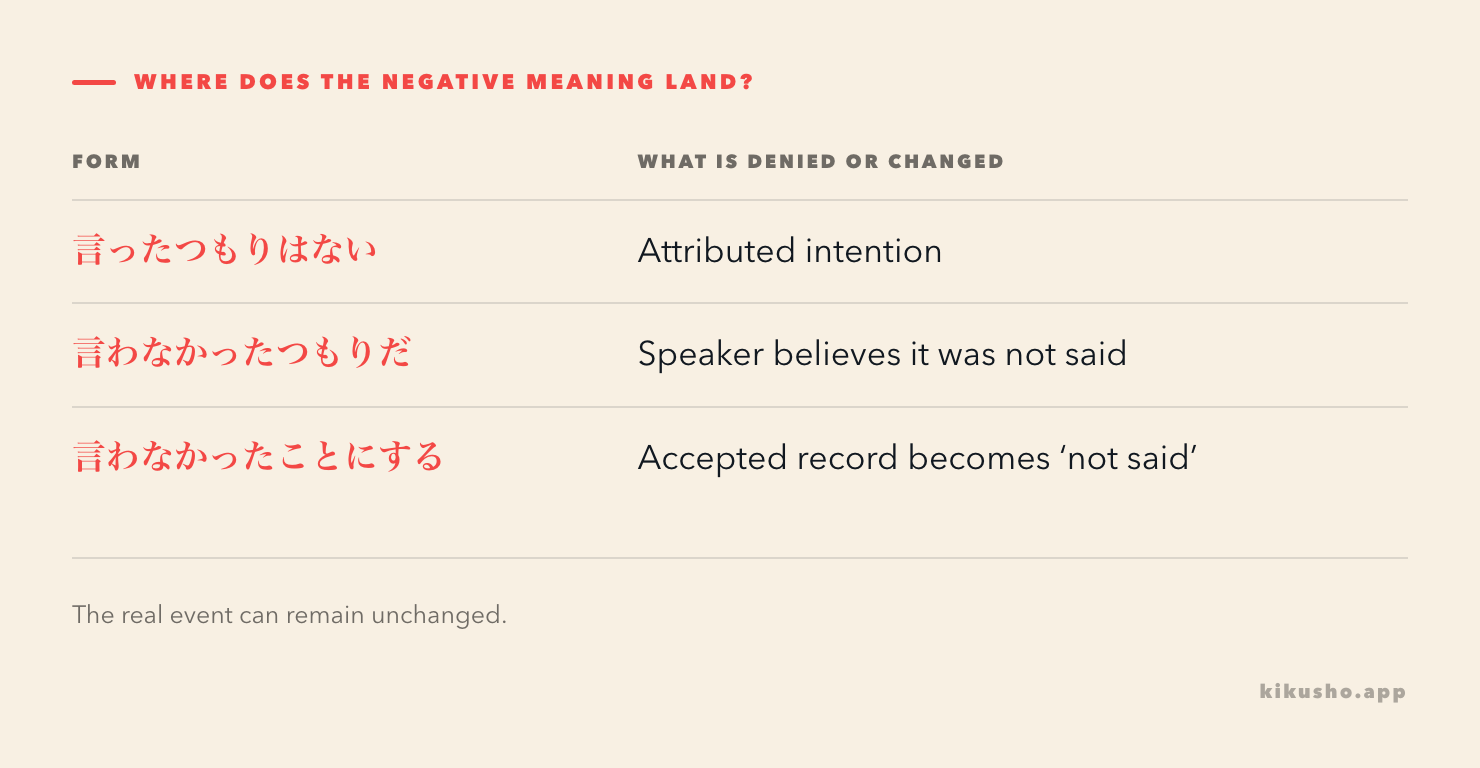
The past-event belief use receives a fuller comparison in たもの and つもりだった for past habits and intentions. つもりで creates an imagined premise for how you act now; see つもりで for an intended or imagined role. Neither is a substitute for denying an attributed intention after an action.
Choose by the disputed layer
When two people disagree about the past, identify what is disputed:
- If they are choosing the version to use from now on, choose たことにする.
- If a rule or chain of reasoning determines what the event counts as, choose たことになる.
- If the action occurred but the speaker rejects its alleged purpose, choose たつもりはない.
One conversation can contain more than one layer:
冗談で言ったつもりはなかった。でも、この話は聞かなかったことにしてほしい。
じょうだんでいったつもりはなかった。でも、このはなしはきかなかったことにしてほしい。
I did not mean it as a joke. But I want you to act as though you did not hear this.
The first sentence corrects an interpretation of the speaker's intention. The second asks the listener to adopt a convention about the record. Similar English phrases such as “I didn't mean that” and “let's say that didn't happen” can obscure the structural difference.
These patterns are commonly taught as N1 by JLPT Sensei, while publisher classifications vary and the JLPT does not provide an exhaustive official grammar syllabus. Treat the level as a study guide. The important exam skill is tracking who controls the framing and what exactly is being negated.
Practice
First test which layer each sentence changes. Open the explanations only after you have committed to all seven responses.
Question 1
You heard confidential information. Your manager says, “Please act as though you did not hear that.” Which ending turns the line into that request?
その話は聞かなかった( )ください。
A. つもりはなくて
B. ことになって
C. ことにして
D. つもりで
Question 2
Signing a document counts as having accepted its terms. Select the line that states this rule.
A. 署名すれば、規約に同意したことになります。
B. 署名すれば、規約に同意したつもりはありません。
C. 署名すれば、規約に同意することにしました。
D. 署名すれば、規約に同意しなかったつもりです。
Question 3
Your remark upset a colleague. You want to say that causing hurt was not your intention without denying the effect. Which ending keeps both facts compatible?
傷つけた( )。
A. ことにした
B. つもりはなかった
C. ことになった
D. つもりだった
Question 4
Find the line whose speaker claims, “I believe I did not say it,” rather than “I did not mean it that way.”
A. 言ったつもりはない。
B. 言わなかったことになる。
C. 言わなかったつもりだ。
D. 言ったことにする。
Question 5
Read the situation. A committee deliberately decides to record a late submission as on time. Which sentence foregrounds that choice?
A. 締め切りまでに提出したことにした。
B. 締め切りまでに提出したことになった。
C. 締め切りまでに提出するつもりはない。
D. 締め切りまでに提出したつもりだった。
締め切り(しめきり)means deadline; 提出する(ていしゅつする)means to submit.
Question 6
Which response best acknowledges both intention and effect?
A: あの言い方は責められているように感じました。
B: ( )
A. 責めたつもりはありません。だから問題はありません。
B. 責めなかったことにします。
C. 責めたことになります。
D. 責めたつもりはありませんでしたが、そう聞こえたならすみません。
Question 7
Put the chunks in order to say, “If you complete this training, it will count as having attended the meeting.” The ★ marks the third chunk.
ア. 出席した
イ. この研修を修了すれば
ウ. ことになります
エ. 会議に
Answers and explanations
Answer 1
C: ことにして. The complete request is その話は聞かなかったことにしてください, “Please act as though you did not hear that.” The past negative 聞かなかった gives the version to adopt; してください turns ことにする into a request. B would present a resulting state, not ask the listener to choose one.
Answer 2
A: 署名すれば、規約に同意したことになります。 Read しょめいすれば、きやくにどういしたことになります. A rule connects signing with the status of prior agreement. Nothing in the sentence requires a false pretence. B denies intention, C describes a decision to agree, and D says the signer believes they did not agree.
Answer 3
B: 傷つけたつもりはなかった. Read きずつけたつもりはなかった. The past action may have caused hurt, but the speaker denies having that intention. A deliberately adopts the record that hurt occurred. C presents hurt as a resulting classification. D says the speaker believed or intended that they had hurt the person.
Answer 4
C: 言わなかったつもりだ. The negative is inside the action: the speaker believes “I did not say it.” In A, 言った remains affirmative and はない rejects the attributed intention. D chooses to treat the act of saying as having occurred.
Answer 5
A: 締め切りまでに提出したことにした. The committee deliberately adopts “submitted by the deadline” as the official version. B can describe the status that resulted, but it does not foreground the committee's choice as requested. C concerns a present intention; D describes the person's belief that they submitted it.
Answer 6
D. 責めたつもりはありませんでした rejects the intention to blame; そう聞こえたならすみません acknowledges how the words sounded. A uses the same target construction but dismisses the listener's reaction. B attempts to rewrite the record, and C merely classifies the act as blame.
Answer 7
イ → エ → ア → ウ; ★ is ア. The sentence is この研修を修了すれば、会議に出席したことになります. Read このけんしゅうをしゅうりょうすれば、かいぎにしゅっせきしたことになります. Completing the training triggers a rule under which the person counts as having attended the meeting.
Save the event and its frame together
A card containing only したことにする = pretend will fail when the event is officially counted rather than fictional. Save the construction with its frame: “choose an accepted version,” “derive what counts,” or “reject attributed intent.”
In Kikusho, keep one complete example on the front and the disputed layer in the explanation. During review, ask what the sentence leaves intact. 傷つけたつもりはない can leave the hurt intact; 聞かなかったことにする can leave the real hearing intact; 同意したことになる can state a real consequence of the rule.
Common questions
What does たことにする mean when it follows a past verb?
It means deliberately treating an event as having happened, or not happened, for the purpose of the conversation, record or plan. 聞かなかったことにする means “I will act as though I did not hear that.” It does not erase the real event.
How is たことになる different from たことにする?
たことにする presents a deliberate choice of version. たことになる presents the conclusion or status that follows from a rule, calculation or interpretation. Signing a form, for example, may count as having accepted its terms.
Does 傷つけたつもりはない deny that someone was hurt?
No. It rejects the intention attributed to the speaker: “I did not mean to hurt you.” The hurt may still be real, so the expression does not by itself remove responsibility or replace an apology.
Are these constructions officially N1 grammar?
JLPT Sensei labels both target lessons N1, while other publishers organise grammar differently. The JLPT does not publish an exhaustive official grammar list, so level labels are teaching conventions rather than official guarantees.