On this page
たら/ば/なら~ところだ presents a result that would be true under a condition that is not true. In あの会社に採用されていたら、今頃大阪で働いているところだ, the speaker was not hired and is not working in Osaka; 大阪で働いている is the unrealized scene.
あの会社に採用されていたら、今頃大阪で働いているところだ。
あの かいしゃに さいようされていたら、いまごろ おおさかで はたらいている ところだ。
If I had been hired by that company, I would be working in Osaka now.
The construction does more than attach ところ to any sentence ending in たら. First establish a premise contrary to reality; then use the clause before ところだ to show the situation that would have resulted.
Build a contrary premise and its unrealized result
The conditional form can vary because たら, ば and なら do not become one identical particle in this construction. Each introduces a premise in its ordinary way, while the context marks that premise as unreal.
| Premise | Result frame | Original example |
|---|---|---|
| Vたら | plain clause + ところだ/だった | 採用されていたら、今頃働いているところだ |
| Vば | plain clause + ところだ/だった | 雨が降らなければ、試合をしていたところだ |
| N・ナAなら | plain clause + ところだ/だった | 私が責任者なら、その提案を断るところだ |
The result clause may itself contain a dictionary form, a negative form, ている, or another plain predicate. Choose the form that depicts the imagined scene.
雨で試合が中止にならなければ、今頃は決勝を見ているところだ。
あめで しあいが ちゅうしに ならなければ、いまごろは けっしょうを みている ところだ。
If the match had not been cancelled because of the rain, we would be watching the final now.
もし私が責任者なら、その提案を断るところだ。だが、決めるのは部長だ。
もし わたしが せきにんしゃなら、その ていあんを ことわる ところだ。だが、きめるのは ぶちょうだ。
If I were in charge, I would reject that proposal. But the department head makes the decision.
The second sentence makes the reality explicit: the speaker is not in charge. Without that context, なら may introduce an open assumption rather than a counterfactual one. The grammar shape alone does not prove that the condition is false.
JLPT Sensei's assigned reference lists たら, ば and なら as possible condition markers. A Japanese grammar-pattern index from Kurosio Publishers independently classifies たら…ところだ and ば…ところだ(った) as counterfactual condition patterns.
Read the sentence on two timelines
To interpret the pattern, write down two versions of events. The stated condition and result belong to the imagined line; their opposites normally describe reality.
| Reality | Contrary premise | Unrealized result |
|---|---|---|
| 採用されなかった | 採用されていたら | 今頃大阪で働いているところだ |
| 試合は中止になった | 中止にならなければ | 今頃決勝を見ているところだ |
| 私は責任者ではない | 私が責任者なら | その提案を断るところだ |
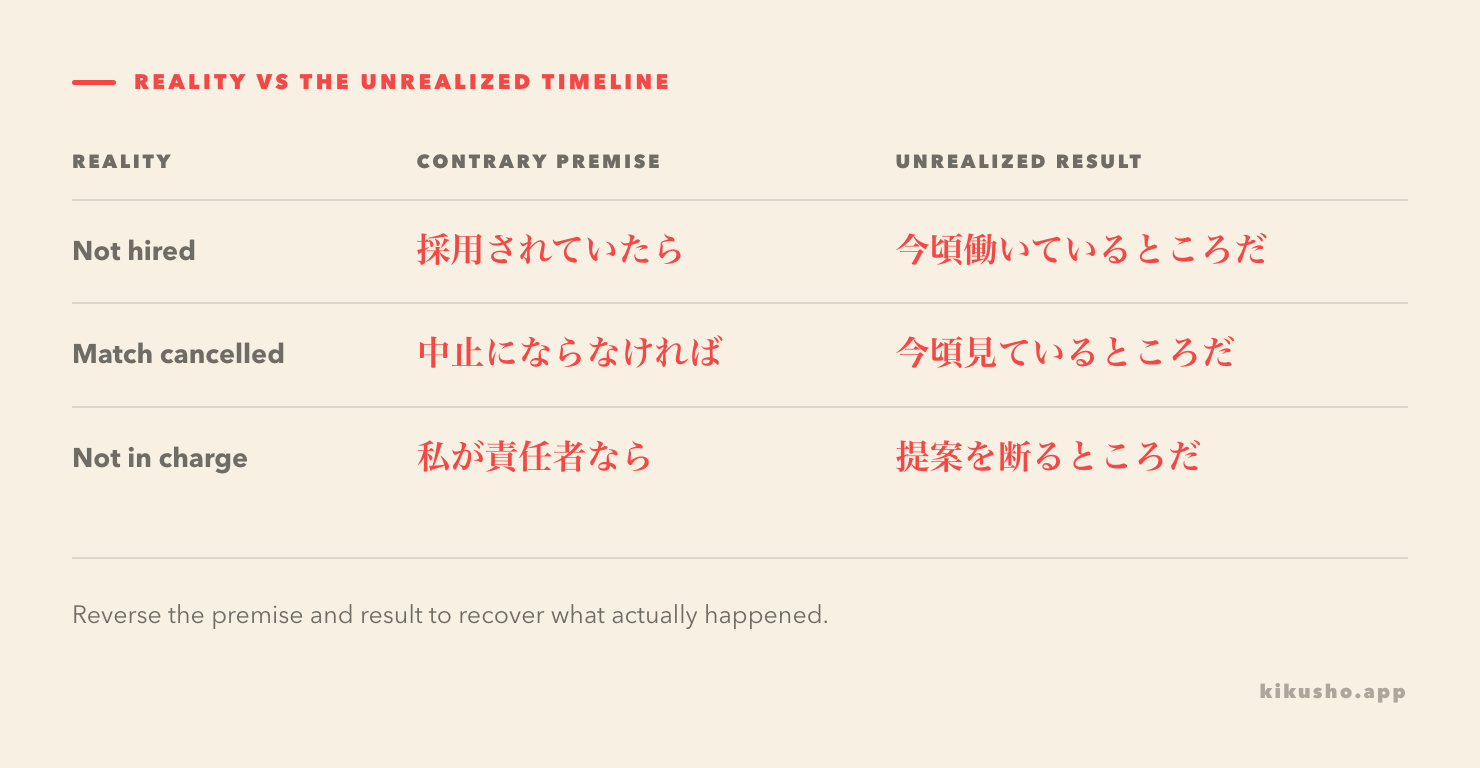
This reversal is a useful reading test. In 採用されていたら, the passive past does not report a real hiring. The full sentence says the hiring failed to happen. Likewise, 見ているところだ describes where the speakers would be in the imagined timeline, not what they are doing now.
The time adverb 今頃 often makes the intended reading easy. It points to the scene that would be unfolding around now if an earlier fact had been different. It is common, but it is not part of the fixed grammar and is not required.
The National Institute for Japanese Language and Linguistics includes an authentic example with しなかったら今頃は…向っていたところでした, placing the speaker inside a present result that did not become real. The example and analysis appear in NINJAL's study of ところだ.
Use ところだ for the imagined reference point
With ところだ, the speaker commonly presents the result as the scene that would hold at the current reference point.
予定どおり出発できていれば、今頃は京都を観光しているところだ。
よていどおり しゅっぱつできていれば、いまごろは きょうとを かんこうしている ところだ。
If we had been able to leave as planned, we would be sightseeing in Kyoto now.
The actual facts are that the departure did not go as planned and the speakers are not sightseeing in Kyoto. 観光している is progressive because it depicts an activity that would be underway.
The result does not have to be progressive:
彼がここにいれば、すぐ相談するところだが、今日は出張中だ。
かれが ここに いれば、すぐ そうだんする ところだが、きょうは しゅっちょうちゅうだ。
If he were here, I would consult him immediately, but he is away on business today.
Here 相談する names the action the speaker would take. The following が and the fact that he is away make the contrary situation explicit.
Use ところだった to look back at an avoided result
When the speaker looks back at a past point, ところだった commonly presents the result that would have occurred. This often produces a close-call reading.
係員が止めてくれなかったら、立入禁止区域に入るところだった。
かかりいんが とめてくれなかったら、たちいりきんしくいきに はいる ところだった。
If the attendant had not stopped me, I would have entered the restricted area.
The attendant did stop the speaker, so the speaker did not enter. The dictionary form 入る names the outcome that remained unrealized; the past だった locates the whole assessment at the earlier danger point.
地図を確認していなかったら、反対方向の電車に乗っているところだった。
ちずを かくにんしていなかったら、はんたいほうこうの でんしゃに のっている ところだった。
If I had not checked the map, I would have been on a train going the opposite way.
The ている inside the result depicts the state that would have held at the relevant past moment. This makes the internal form and the final だった do different jobs: 乗っている chooses the imagined scene; だった places the counterfactual assessment in a past frame.
This use overlaps with the close-call Vるところだった taught in the near-miss lesson. The difference is one of scope. もう少しで転ぶところだった says that falling nearly happened. 足元を見ていなかったら、転ぶところだった supplies the unreal condition that would have led to the fall. Both put the named outcome on the unrealized side.
Do not turn the tendency into an absolute tense rule. A narrative can shift its reference point, and ところだった can also mean “was just about to” without asserting a counterfactual. Time expressions, the condition, and the real-world contrast determine the reading together.
Ordinary ところ describes an actual action stage
Basic temporal ところ places an action just before, during or just after its actual occurrence:
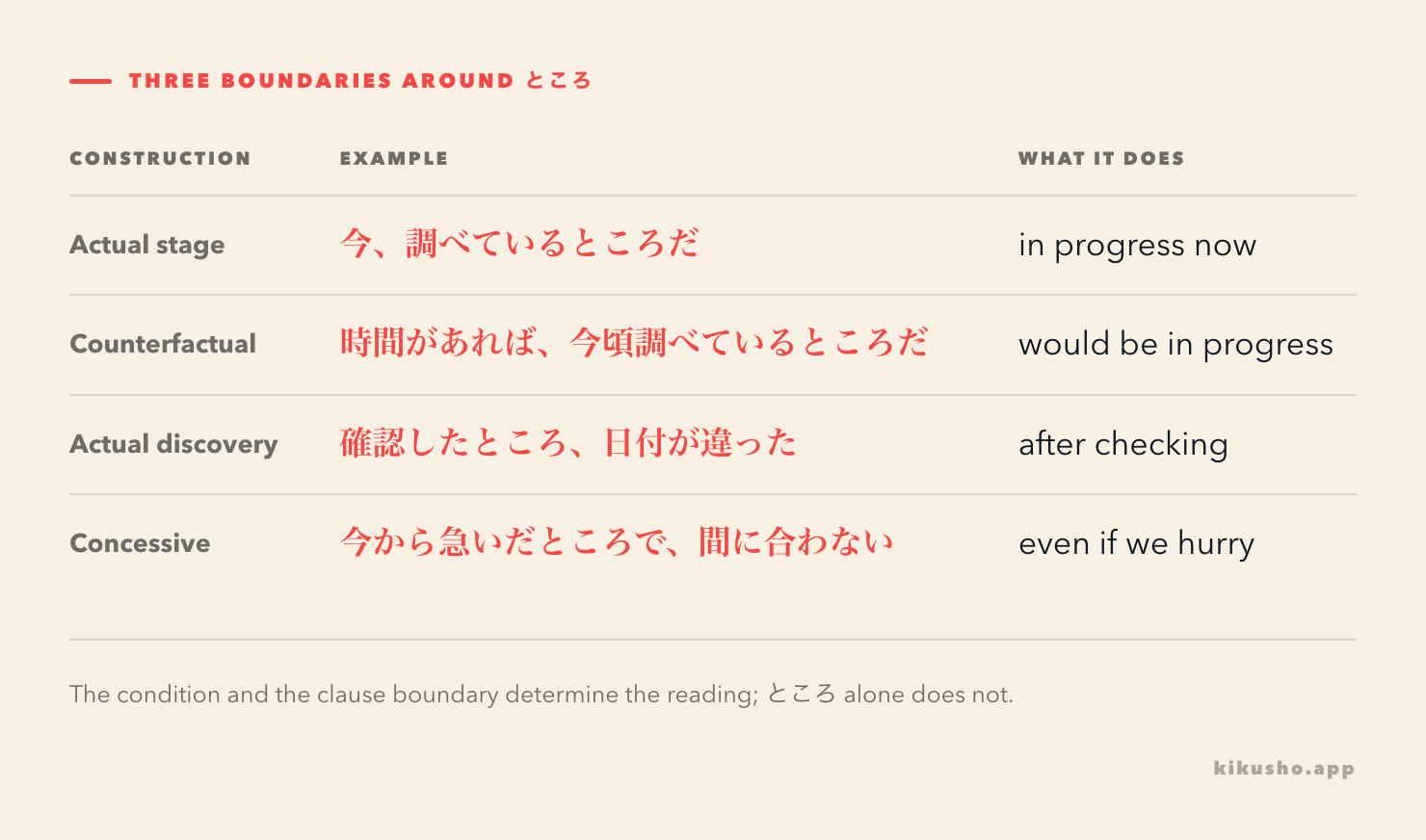
| Form | Ordinary temporal meaning | Example |
|---|---|---|
| Vるところだ | about to do | 今から出るところだ |
| Vているところだ | in the middle of doing | 今、調べているところだ |
| Vたところだ | have just done | たった今、着いたところだ |
These sentences do not contain a contrary premise. 今、調べているところだ reports real research underway. By contrast, 時間があれば、今頃調べているところだ can present research that is not underway because the speaker does not have time.
The full ところ timeline guide covers the actual before, during and after stages. The counterfactual construction borrows that scene-setting ability, then places the scene on an imagined timeline.
Vたところ and Vたところで are different constructions
Vたところ can report what happened or what someone discovered after performing an action.
日付を確認したところ、申込期間はもう終わっていた。
ひづけを かくにんした ところ、もうしこみきかんは もう おわっていた。
When I checked the date, I found that the application period had already ended.
The checking happened, and the following clause reports its result. This is not an unreal conditional.
Vたところで is concessive: even if the action were performed, it would not change the conclusion.
今から急いだところで、終電には間に合わない。
いまから いそいだ ところで、しゅうでんには まにあわない。
Hurrying now would still leave us too late for the last train.
The point is the ineffectiveness of hurrying. Japanese NET's たところで guide confirms that the following clause commonly gives a negative or limited result. Compare that with もっと早く出ていたら、今頃は終電に乗っているところだ, which imagines a different result under a contrary past premise.
Keep the boundary visible when reading:
- [condition たら/ば/なら] + [result ところだ]: the result would hold, but reality differs.
- [Vた] + ところ: doing V led to an actual discovery or result.
- [Vたところで] + conclusion: even doing V would not improve the conclusion.
An ordinary conditional may still be open
Not every sentence with たら describes a false condition.
明日雨が降ったら、家で勉強する。
あした あめが ふったら、いえで べんきょうする。
If it rains tomorrow, I will study at home.
Tomorrow's weather is unresolved. This is an ordinary future condition, so adding ところだ merely because the English translation contains would would distort the sentence.
昨日雨が降らなかったら、外で練習していたところだ。
きのう あめが ふらなかったら、そとで れんしゅうしていた ところだ。
If it had not rained yesterday, we would have been practising outside.
This sentence tells us that it did rain and the outdoor practice did not occur. The distinction is semantic: is the premise still open, or does the speaker know reality went the other way? The broader たら, ば, と and なら comparison helps choose the conditional itself; the present lesson explains what happens when that conditional introduces an unreal premise before ところだ.
You can often express a similar counterfactual with ~ていただろう. ところだ is especially vivid because it locates the speaker inside the situation that would be holding at the reference point. This is a tendency in viewpoint, not a rule that makes one version correct and the other wrong.
The N1 label is a study placement
JLPT Sensei and JSMORI place たら~ところだ at N1. NINJAL's Japanese-learner corpus workshop volume also lists ば~ところだ(った) and たら~ところだ among advanced condition patterns. The pieces themselves are familiar earlier: conditionals, plain verb forms and temporal ところ. The advanced task is recovering the unspoken actual world and keeping several similar ところ constructions apart.
The JLPT does not publish an exhaustive official grammar list, so N1 should be read as the assigned study-list placement rather than a claim that the expression is formal or confined to the exam. It appears in ordinary explanation and reflection whenever a speaker compares reality with the scene that could have followed.
For review, save both sides of the contrast. A card containing only 働いているところだ invites the ordinary “in the middle of working” reading. 採用されていたら、今頃大阪で働いているところだ preserves the false premise and makes the counterfactual interpretation retrievable.
Practice: recover the world that did not happen
Question 1 · identify the counterfactual
Which sentence says the speaker is not sightseeing in Kyoto now?
- A. 今、京都を観光しているところだ。
- B. 予定どおり出発できていれば、今頃は京都を観光しているところだ。
- C. 京都を観光したところ、雨が降ってきた。
- D. 京都を観光したところで、全部は見られない。
Question 2 · recover reality
Read: 雨で試合が中止にならなければ、今頃は決勝を見ているところだ。 What happened on the real timeline?
- A. The match was cancelled, and the speaker is not watching the final.
- B. The match was not cancelled, and the speaker is watching the final.
- C. The speaker has just finished watching the final.
- D. The speaker does not know whether the match was cancelled.
Question 3 · choose the past near-miss frame
Complete: 係員が止めてくれなかったら、立入禁止区域に__。
- A. 入ったところだ
- B. 入るところだった
- C. 入ったところで
- D. 入っているところだ
Question 4 · find the actual discovery
Which sentence means “When I checked the date, I found that the deadline had passed”?
- A. 日付を確認したら、今頃申し込んでいるところだ。
- B. 日付を確認すれば、申し込むところだった。
- C. 日付を確認したところ、締め切りが過ぎていた。
- D. 日付を確認したところで、締め切りは変わらない。
Question 5 · find the ineffective concession
Which sentence says that hurrying now still cannot get us onto the last train?
- A. 今から急いだところで、終電には間に合わない。
- B. 今から急いでいるところだ。
- C. もっと早く出たら、終電に間に合っているところだ。
- D. 急いだところ、終電が来た。
Question 6 · choose now or past
You are describing the job you would be doing now if you had been hired. Complete: 採用されていたら、今頃大阪で__。
- A. 働いているところだ
- B. 働いたところだ
- C. 働くところだった
- D. 働いたところで
Question 7 · build the unrealized present scene
Arrange all four chunks to say “If we had left as planned, we would be sightseeing in Kyoto now.”
京都を観光している / 予定どおり / ところだ / 出発できていれば、今頃は
Answers and explanations
Reveal the reasoning only after you have committed to all seven choices.
Answer 1
B. The failed departure is the contrary premise, and 今頃は京都を観光しているところだ is the unrealized current scene. A reports real sightseeing in progress. C reports an actual sequence, and D is concessive.
Answer 2
A. Reverse the contrary premise and its result: the match was cancelled, so the speaker is not watching the final. 今頃 locates the imagined viewing around now.
Answer 3
B. 入るところだった. The attendant did stop the speaker, so entering remained an unrealized past result. A says someone had just entered, C begins a concessive pattern, and D presents a current action without the past assessment.
Answer 4
C. 日付を確認したところ、締め切りが過ぎていた. Vたところ reports what was discovered after the real act of checking. D means that checking would not change the deadline.
Answer 5
A. 急いだところで means “even if we hurry” and the negative conclusion says the effort will not improve the outcome. B is an actual action in progress; C tries to state a different counterfactual result; D reports a sequence.
Answer 6
A. 働いているところだ. 今頃 and ている depict the job that would be underway now. The hiring did not happen, so the work is not in progress.
Answer 7
予定どおり出発できていれば、今頃は京都を観光しているところだ。 The ば-condition gives the unreal earlier premise; 今頃は anchors the result at now, and 観光しているところだ depicts the activity that would be underway.
Let reality decide which ところ you are reading
When ところ appears, do not classify it from the last few characters alone. Find the premise, ask whether it is true, and locate the result in time. A false premise followed by the scene that would hold gives the counterfactual たら/ば/なら~ところだ; an actual action stage, a discovered result and a concessive たところで each build a different timeline.
Common questions
What does たら~ところだ mean?
It presents the result that would hold under a condition contrary to fact. In 採用されていたら、今頃大阪で働いているところだ, the speaker was not hired and is not working in Osaka; that job is the unrealized result.
Can ば and なら replace たら before ところだ?
Yes. The counterfactual premise may use たら, ば or なら when that conditional fits the intended relationship. The main clause with ところだ presents the imagined situation that does not match reality.
What is the difference between ところだ and ところだった here?
ところだ commonly places the imagined result at now or another current reference point, often with 今頃. ところだった looks back at an unrealized result or near miss. Context and reference time decide the choice.
Is たら~ところだ the same as たところで?
No. たら~ところだ gives the result that would follow from a contrary-to-fact condition. Vたところで means “even if one did V” and usually says that doing it would not improve the result.