On this page
~てみせる belongs to the person who acts: they demonstrate something or promise to prove themselves by doing it. ~てしかるべきだ belongs to the person judging the situation: they say that an action, treatment or result is only proper and ought to occur. The first projects agency; the second applies a standard.
The deciding question is who owns the force
Both constructions follow a て-form, and both can sound stronger than a plain statement. Their force points in different directions.
| Ask this | ~てみせる | ~てしかるべきだ |
|---|---|---|
| Who supplies the force? | the person performing the action | the speaker or writer evaluating the situation |
| What is asserted? | “I will do it,” “I will prove it,” or “here is how” | “this is proper,” “this deserves to happen” |
| Typical register | conversation, narrative, dramatic resolve | formal speech, commentary, argument |
| Common shape | Vて + みせる | Vて + しかるべきだ |
| Example | 今度こそ勝ってみせる | 努力は評価されてしかるべきだ |
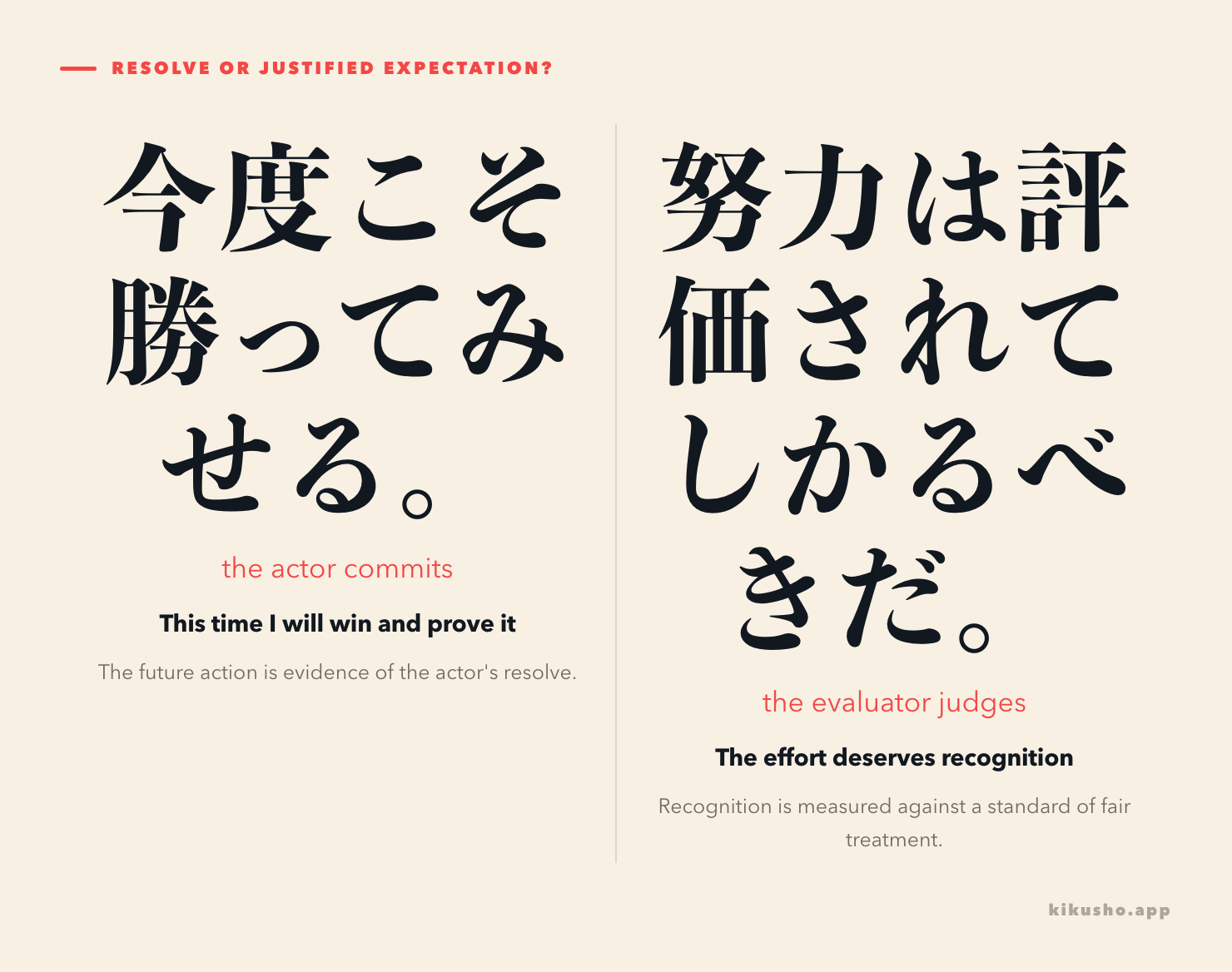
If the subject can say “watch me do it,” choose ~てみせる. If the speaker can say “by any reasonable standard, this ought to happen,” choose ~てしかるべきだ. English “should” sometimes appears in both translations, so follow the owner of the stance rather than the English word.
~てみせる demonstrates an action or turns success into proof
Attach みせる to the verb's て-form:
- 書く → 書いてみせる
- 説明する → 説明してみせる
- 勝つ → 勝ってみせる
- 合格する → 合格してみせる
The concrete use still carries the ordinary idea of showing. 先生は手順を書いてみせた means “The teacher wrote out the steps to demonstrate.” The performed action itself becomes the example. The past form is common because the narrator reports what the other person visibly did.
The resolve use makes the result the proof. 今度こそ合格してみせる is not a neutral prediction that the speaker will pass. It is a declaration: “This time I will pass, just watch.” Words such as 必ず, 絶対に and 今度こそ often make that determination explicit.
The two uses form a continuum rather than two unrelated idioms. A Tokyo University of Foreign Studies corpus study separates visible presentation of an action from presentation of a result and the actor's psychological stance. A later Japanese Language Society study likewise traces a progression from an observable performance to an achieved result in which the visual meaning of 見せる has faded.
Do not collapse ~てみせる into ~てみる. この問題を解いてみる means “I will try solving this problem.” この問題を解いてみせる means “I will solve this problem and prove that I can.” The first explores an outcome; the second stakes the actor's ability or resolve on it.
~てしかるべきだ judges what is fitting
Attach the whole expression to the て-form:
- 認める → 認められてしかるべきだ
- 謝る → 謝ってしかるべきだ
- ある → あってしかるべきだ
- 説明する → 説明してしかるべきだ
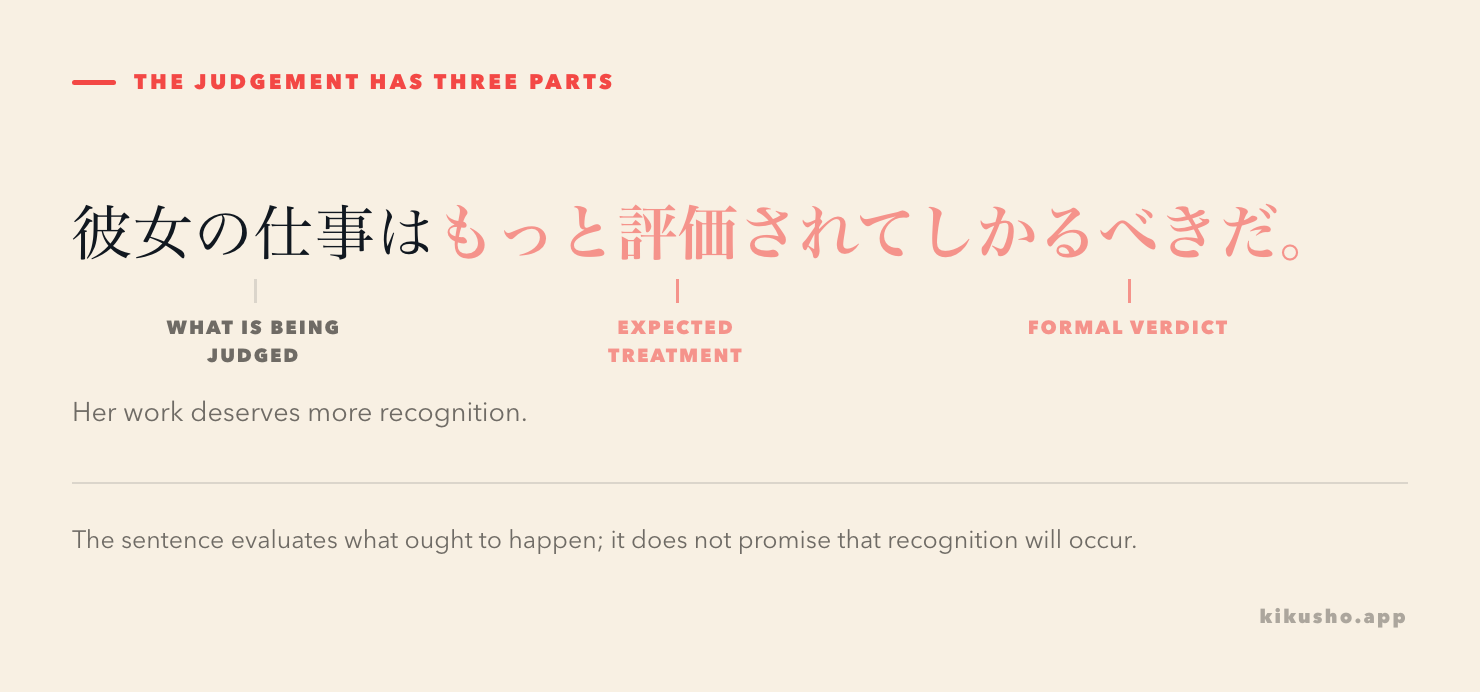
長年の努力はもっと評価されてしかるべきだ means “Years of effort deserve greater recognition.” The sentence does not promise that anyone will recognize the effort. It judges recognition to be the proper response. Passive verbs are frequent because the object of judgement is often how a person, achievement or problem should be treated.
The expression is formal and often appears when reality falls short. この制度には十分な説明があってしかるべきだ says that a system of this kind ought naturally to come with an adequate explanation. 十分な説明があってしかるべきだった moves the judgement into the past: there should have been an explanation. Neither sentence confirms that the explanation exists.
The しかる here is usually written in kana and is unrelated to 叱る, “to scold.” The historical expression 然るべし meant that something was suitable or fitting; Digital Daijisen's entry records that core. In modern attributive use, しかるべき対応 means an appropriate response. The teaching reference 例文で学ぶ日本語文法 confirms that しかるべき marks what is naturally appropriate or suited to the situation.
The same event changes when actor and evaluator exchange places
Consider a researcher whose work has been dismissed:
研究者は「結果を出してみせる」と言った。 The researcher said, “I will produce results and prove it.”
この研究はもっと正当に評価されてしかるべきだ。 This research deserves a fairer evaluation.
The first sentence quotes the researcher's commitment. The second could be written by a colleague, reviewer or editorial board. It does not commit the researcher to any new act; it criticizes the standard applied by other people.
That difference also limits the verbs each form naturally attracts. Resolve with ~てみせる favors controllable achievements such as winning, completing, persuading or proving. Normative ~てしかるべきだ readily takes recognition, explanation, compensation, responsibility and other outcomes society can judge as fair. A sentence may be grammatically buildable yet pragmatically strange if nobody can control the promised result or no shared standard supports the judgement.
Replacing one form changes the sentence's speaker
必ず勝ってしかるべきだ no longer sounds like the competitor's vow. It sounds like an observer asserting that victory is the fitting outcome, perhaps because the team is stronger. Conversely, 努力は評価されてみせる tries to make the effort itself announce resolve. A person might vow 努力を認めさせてみせる, “I will make them acknowledge my effort,” because that sentence restores an agent who intends to cause the result.
The nearest prerequisite is ordinary べきだ. The はず and べき comparison separates prediction from obligation. ~てしかるべきだ stays on the judgement side, but its formal tone presents the outcome as the naturally fitting response to circumstances. It often sounds less like direct advice to “you” and more like a public assessment of what institutions, communities or responsible people ought to provide.
The resolve side has its own neighbors. どうしても成功したい describes a desire that will not yield, while 成功してみせる performs the commitment in speech. The どうしても and なるべく lesson develops fixed desire against flexible effort.
The level label changes, but the contrast does not
The curriculum source places both patterns at N1. ~てしかるべきだ is consistently treated as advanced because its formal register and normative stance are concentrated in editorials, formal argument and demanding reading. JLPT Sensei's lesson labels it N1 and gives the verb て-form attachment.
~てみせる has a genuine placement disagreement. JLPT Sensei lists it at N1, JapaneseNET at N2 and Tanosuke at N3. Those sources agree on the two central uses and the same attachment. No public JLPT specification settles every grammar point's level, so treat the label as study order rather than a change in meaning.
When either form appears in a long passage, the decisive evidence may sit one sentence earlier: who is speaking, what result is missing, and whether someone is making a promise or applying a standard. A Kikusho card can retain that sentence around the target form. Keep the quoted speaker with ~てみせる or the reason for the judgement with ~てしかるべきだ; a bare English gloss erases the distinction the passage was testing.
Practice the owner of the stance
Question 1 · a vow
An athlete declares, “Next time I will definitely win.” Which ending fits?
今度こそ必ず勝っ___。
- A. てみせる
- B. てしかるべきだ
- C. てみるべきだ
- D. ているはずだ
Question 2 · a public judgement
Complete the formal comment: 長年の功績はもっと評価され___。
- A. てみせる
- B. てみる
- C. てしかるべきだ
- D. るはずがない
Question 3 · try or demonstrate
A teacher performs the procedure so the class can copy it. Which sentence expresses that demonstration?
- A. 先生は手順をやってみた。
- B. 先生は手順をやってみせた。
- C. 先生は手順をやってしかるべきだった。
- D. 先生は手順をやるはずがない。
Question 4 · read two stances
Read the passage:
候補者は「最後までやり抜いてみせる」と語った。しかし、市民には政策について十分な説明があってしかるべきだ。
Who expresses resolve, and who supplies the judgement in the second sentence?
Question 5 · build the form
Change 説明する into the form meaning “I will explain it and prove that I can.”
Question 6 · the kanji trap
Which sentence contains the verb 叱る, “to scold,” rather than the fixed expression てしかるべきだ?
- A. 努力は認められてしかるべきだ。
- B. 先生は学生を叱るべきだ。
- C. 説明があってしかるべきだ。
- D. 責任を取ってしかるべきだ。
Question 7 · compose a formal judgement
Use もっと, 評価する in the passive, and てしかるべきだ to say: “Her work deserves more recognition.”
Question 8 · explain the shift
What changes if 必ず成功してみせる is replaced with 成功してしかるべきだ?
Answers and explanations
Solution 1
A. てみせる. The athlete commits to an achievement and presents the future victory as proof of resolve. てしかるべきだ would judge victory to be the fitting outcome from an observer's position.
Solution 2
C. てしかるべきだ. Recognition is presented as the proper response to years of achievement. The passive 評価されて leads into the formal normative judgement.
Solution 3
B. 先生は手順をやってみせた. The teacher performs the action as a visible model. A says the teacher tried the procedure; C judges that doing it was proper; D denies an expectation.
Solution 4
The candidate expresses resolve through やり抜いてみせる. The speaker or writer of the passage supplies the second judgement, saying that citizens should properly receive an adequate explanation. The citizens are beneficiaries of the expected explanation, not the people making the vow.
Solution 5
説明してみせる. Change する to its て-form して, then add みせる. The result makes explanation the act through which the speaker will demonstrate ability or determination.
Solution 6
B. 先生は学生を叱るべきだ. Here 叱る is an independent dictionary-form verb followed by ordinary べきだ. In the other three sentences, hiragana しかる belongs to てしかるべきだ and carries the “fitting or naturally expected” meaning.
Solution 7
彼女の仕事はもっと評価されてしかるべきだ。 The work is the topic, 評価されて gives the expected treatment in the passive, and the final expression evaluates that treatment as proper.
Solution 8
必ず成功してみせる is the actor's declaration: success will prove resolve or ability. 成功してしかるべきだ is an evaluator's claim that success is the naturally fitting outcome. The replacement changes both the owner of the stance and the kind of claim.
The shared て-form is only the doorway. Beyond it, one sentence faces the actor's next move and the other faces the standard by which everyone else will judge the result.
Common questions
What is the difference between ~てみせる and ~てしかるべきだ?
~てみせる presents an agent's action as a demonstration or proof of resolve. ~てしかるべきだ gives the speaker's formal judgement that an action or state is proper and naturally expected.
How is ~てみせる different from ~てみる?
~てみる means to try an action and see what happens. ~てみせる means to perform it for someone to see, or to achieve it as proof of determination.
Is the しかる in ~てしかるべきだ the verb 叱る?
No. It comes from 然る, meaning to be so or fitting. 先生が学生を叱るべきだ separately contains the verb 叱る, “to scold,” followed by ordinary べきだ.
Is ~てみせる N1 grammar?
Level lists disagree. JLPT Sensei places it at N1, JapaneseNET at N2 and Tanosuke at N3. Its formation and meanings are stable; only the study sequence differs.