On this page
Use Vてもどうにもならない when you want to name a proposed action and say that even doing it will not fix or change the situation. Use どうにも~ない when どうにも directly strengthens a negative predicate: something cannot be understood, repaired, managed or made workable by any means.
今さら言い訳をしてもどうにもならない。
いまさら いいわけを しても どうにもならない。
Making excuses now will not change anything.
この説明だけでは、どうにも理解できない。
この せつめいだけでは、どうにも りかいできない。
I simply cannot understand it from this explanation alone.
The first sentence puts 言い訳をする forward as a possible remedy, then rejects its effect. The second does not evaluate a proposed remedy. Its negative predicate 理解できない states the inability itself.
This lesson covers inventory item g-0b0623169ef2, てもどうにもならない, and g-52f01039d51a, どうにも~ない. JLPT Sensei teaches ~てもどうにもならない as an N1 pattern, while the Dictionary of Advanced Japanese Grammar describes どうにも~ない as an advanced construction. These placements are study guidance rather than an official exam list: the JLPT does not publish an exhaustive grammar syllabus.
The quickest test is remedy or negative result
Ask where the sentence puts its main limit.
| Pattern | Structure | Main judgment | Question it answers |
|---|---|---|---|
| Vてもどうにもならない | attempted action + ても + fixed outcome | doing V will have no useful effect | “Would this remedy change anything?” |
| どうにも + negative predicate | adverb + inability or negative result | the result cannot be achieved or managed | “Can this be done by any means?” |
The structures overlap because どうにもならない is itself どうにも + ならない. The difference is what comes before it. Adding a Vても clause makes a particular action visible and denies that action's usefulness.
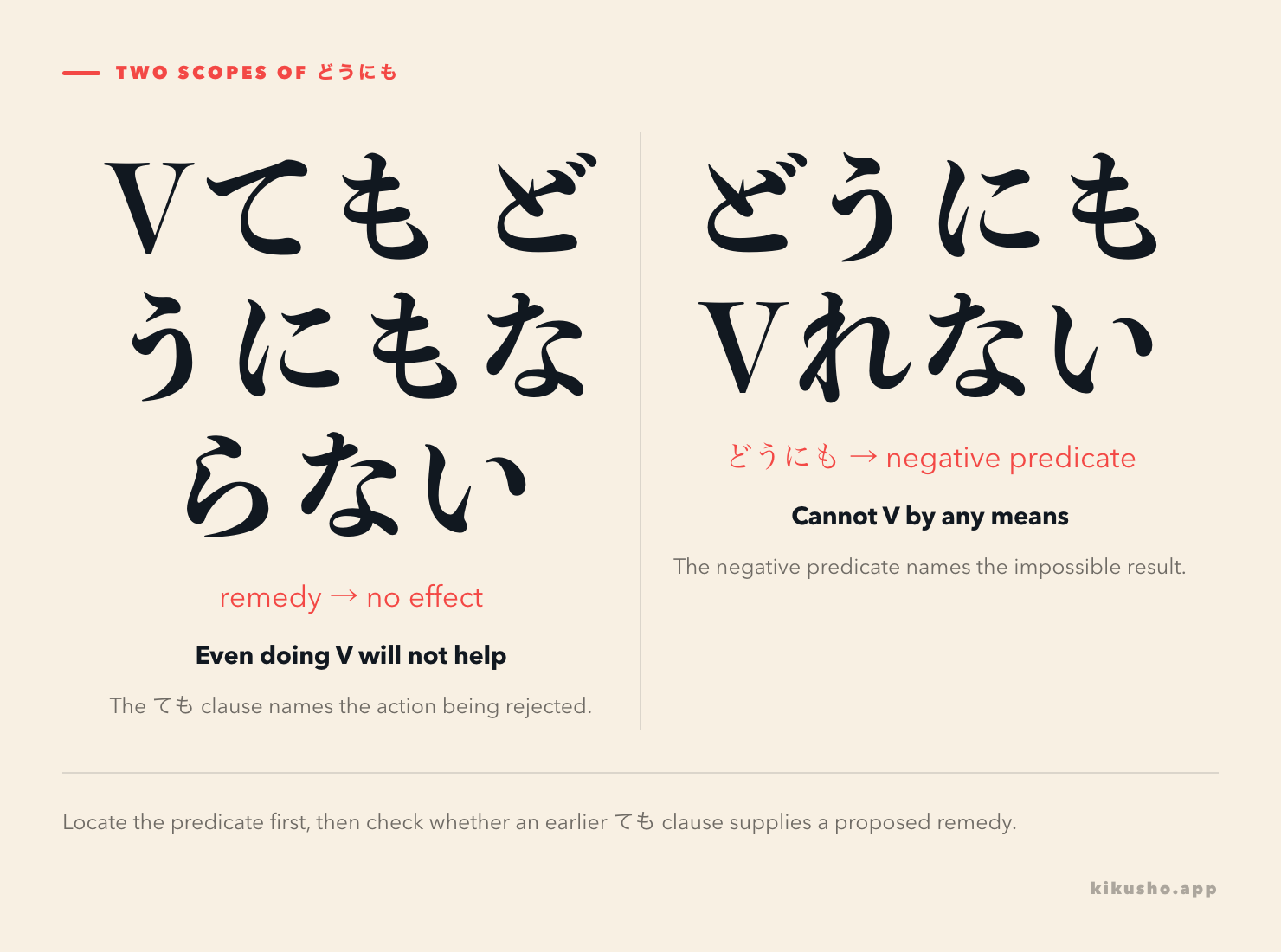
Vてもどうにもならない rejects a proposed remedy
Build the first pattern with the ordinary concessive ~ても form:
| Dictionary form | ~ても form | Complete pattern |
|---|---|---|
| 急ぐ | 急いでも | 急いでもどうにもならない |
| 謝る | 謝っても | 謝ってもどうにもならない |
| 考える | 考えても | 考えてもどうにもならない |
| 後悔する | 後悔しても | 後悔してもどうにもならない |
The action before ても is real or imaginable, but the speaker judges it unable to alter the result. Regret, excuses, panic and last-minute effort occur often because they can consume energy after the decisive moment has passed.
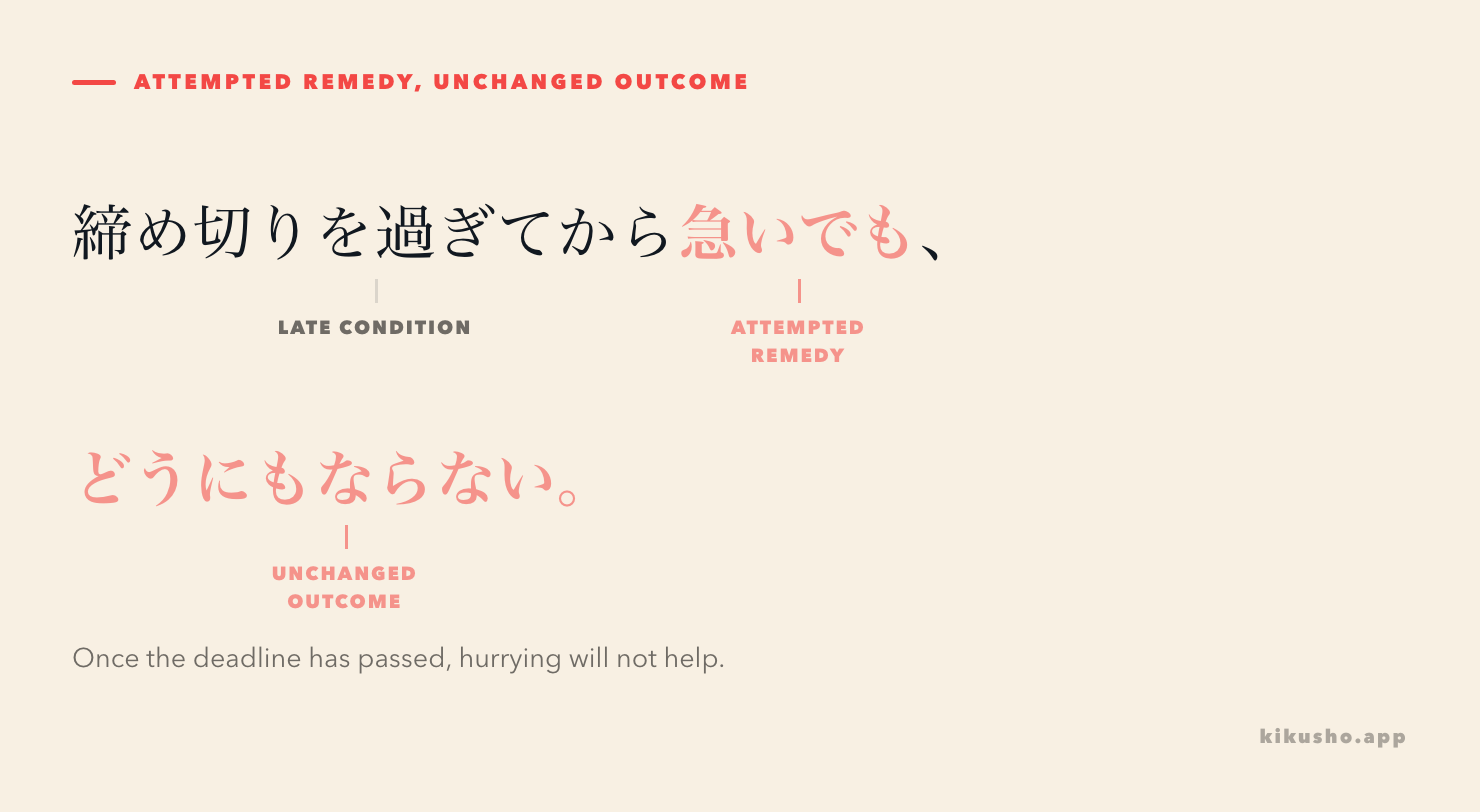
締め切りを過ぎてから急いでも、どうにもならない。
しめきりを すぎてから いそいでも、どうにもならない。
Once the deadline has passed, hurrying will not help.
記録が残っている以上、事実を隠してもどうにもならない。
きろくが のこっている いじょう、じじつを かくしても どうにもならない。
Since a record remains, hiding the facts will not change anything.
In both sentences, the ending does more than predict failure. It closes off an ineffective response and often prepares the listener for a different, practical step.
どうにも~ない belongs to the negative predicate
In the broader pattern, どうにも has the force of “by any means,” “at all” or “simply,” and the rest of the sentence must supply a negative result. A potential negative is especially common.
専門用語が多すぎて、この報告書はどうにも理解できない。
せんもんようごが おおすぎて、この ほうこくしょは どうにも りかいできない。
There is too much technical terminology, so I simply cannot understand this report.
必要な部品がもう作られていないので、どうにも修理できない。
ひつような ぶひんが もう つくられていないので、どうにも しゅうりできない。
The necessary parts are no longer made, so it cannot be repaired by any means.
The pattern is not restricted to potential verbs. It can also appear with a form that says no method exists, or with a negative result:
| Negative predicate | What remains impossible | Example |
|---|---|---|
| V potential + ない | carrying out the action | どうにも説明できない |
| Vます-stem + ようがない | finding a method | どうにも直しようがない |
| ならない | making the situation workable | この計画はどうにもならない |
| N + にならない | reaching a usable state | 雑音が多くて仕事にならない |
The subject need not be a person. A plan, machine, text or situation can resist every available approach. That makes どうにも~ない useful for objective constraints as well as personal frustration.
予算も人員も足りず、この計画はどうにもならない。
よさんも じんいんも たりず、この けいかくは どうにもならない。
With neither enough budget nor enough staff, this plan cannot be made workable.
どうにもならない is the shared centre
The standalone sentence この状況はどうにもならない fits the broad pattern: どうにも modifies ならない. It says the situation is beyond control or repair.
Put an action before it and the sentence gains a second layer:
会議で反対しても、どうにもならない。
かいぎで はんたいしても、どうにもならない。
Even if we object at the meeting, it will not change anything.
Here 反対しても identifies the rejected remedy. The outcome どうにもならない still says that the situation cannot be made better. For an exam question, first locate the predicate; then check whether an earlier ても clause supplies a specific ineffective action.
Compare ても仕方がない and ても始まらない
All three expressions can dismiss an action as futile, but their centres differ.
| Ending | Central idea |
|---|---|
| Vてもどうにもならない | the action cannot change or repair the situation |
| Vても始まらない | the action will not move matters forward |
| Vても仕方がない | the action is pointless; in another use, an outcome is understandable or unavoidable |
資料をなくしたことを後悔しても、どうにもならない。
しりょうを なくしたことを こうかいしても、どうにもならない。
Regretting that you lost the documents will not change anything.
This focuses on the unchanged loss. 後悔しても始まらない instead tends to push the conversation toward what should happen next. 後悔しても仕方がない judges regret pointless, while 失敗しても仕方がない can also accept failure as understandable. The full ても始まらない and ても仕方がない comparison develops those two readings.
For a different kind of impossibility, 術がない and ようにも~ない separates the absence of a method from an intended action blocked by circumstances. どうにも~ない can describe either practical or mental limits, but it does not by itself stage an intention in the way VようにもVれない does.
Register and conversational variants
Both target forms are standard enough for careful speech and writing. Their tone often carries resignation because the speaker has considered the available options and sees no effective route.
In conversation, Vたって can replace Vても, and ならない may contract to なんない:
今さら謝ったって、どうにもなんないよ。
いまさら あやまったって、どうにも なんないよ。
Apologizing now is not going to change anything.
This is natural casual speech, but the standard 謝ってもどうにもならない is the safer form for writing and JLPT production practice. どうしようもない is another common expression meaning that nothing can be done, yet it is a separate lexical choice. Do not assume that every sentence containing it tests the どうにも~ない pattern.
Build a card around the scope boundary
When you save these forms in Kikusho, keep the whole predicate rather than a single translation. Pair 言い訳をしても → どうにもならない on one card and どうにも → 理解できない on another. The arrow shows what each expression governs: an explicit remedy in the first, a negative result in the second.
The following exercises test that boundary. Complete all eight before opening the answer block.
Practice
Question 1 — a missed deadline. The deadline has passed, and the speaker says that rushing now will not improve the outcome. Complete the line.
締め切りはもう過ぎた。今から急いでも( )。
- A. どうにもならない
- B. どうにも急げない
- C. 急ぎようにもない
- D. 仕方がある
Question 2 — predicate scope. Which sentence has どうにも directly strengthening a negative potential predicate?
- A. 今さら説明してもどうにもならない。
- B. この暗号は複雑で、どうにも解読できない。
- C. どうにもしても説明できる。
- D. 説明するにもどうにもなる。
Question 3 — sentence composition. Put the chunks in a natural order.
どうにもならない/証拠が残っているので/事実を否定しても
Question 4 — grammar choice. A mechanic has tried every available approach. Complete the sentence.
部品が手に入らないため、この機械はどうにも( )。
- A. 修理してもならない
- B. 修理できない
- C. 修理するとならない
- D. 修理している
Question 5 — text grammar. Read the passage and choose the best pair.
発表まであと五分しかない。今から資料の色を変えても( 1 )。それより、内容をもう一度確認したい。しかし、三ページ目の説明は複雑すぎて、私には( 2 )。
- A. どうにもならない/どうにも理解できない
- B. どうにも理解できない/どうにもならない
- C. 仕方がある/理解してもどうにもなる
- D. どうにもならない/どうにも理解する
Question 6 — produce the broader pattern. Say naturally with どうにも~ない that a report cannot be understood because it uses too many specialist terms.
Question 7 — grammar choice. Which sentence most clearly rejects an explicit action as an ineffective remedy?
- A. この問題はどうにも難しい。
- B. この問題はどうにも解けない。
- C. 答えを推測してもどうにもならない。
- D. 答えはどうにも正しい。
Question 8 — text grammar. A manager says: 今さら責任者を責めてもどうにもならない。まず復旧方法を考えよう。 What role does the first sentence play?
- A. It says blaming the person will not change the situation and redirects attention to a useful step.
- B. It says there is no physical method available for blaming the person.
- C. It accepts the person's mistake as understandable.
- D. It reports that the manager is unable to identify the responsible person.
Reveal the eight explanations
1 · The missed deadline
A, どうにもならない. The 急いでも clause names the proposed remedy, and the ending denies that hurrying can alter the missed deadline. B would mean “cannot hurry by any means” and would require a context about inability rather than futility.
2 · Predicate scope
B. どうにも modifies the negative potential 解読できない, so the code cannot be deciphered by any available means. A contains the other target structure: 説明しても names an ineffective action before どうにもならない.
3 · Evidence remains
証拠が残っているので、事実を否定してもどうにもならない。 (しょうこが のこっているので、じじつを ひていしても どうにもならない). The reason comes first, 否定しても supplies the rejected remedy, and どうにもならない gives the unchanged outcome.
4 · The unavailable part
B, 修理できない. どうにも naturally strengthens the negative potential: the machine cannot be repaired by any means. A mixes the concessive しても with an incomplete use of ならない.
5 · Two limits in context
A, どうにもならない/どうにも理解できない. Changing colours is an explicit last-minute action that will not improve the situation. In the second blank, どうにも directly strengthens 理解できない and expresses the speaker's inability to understand the explanation.
6 · A model report sentence
One natural answer is 専門用語が多すぎて、この報告書はどうにも理解できない。 (せんもんようごが おおすぎて、この ほうこくしょは どうにも りかいできない). The negative potential 理解できない identifies the result that cannot be achieved.
7 · An ineffective remedy
C. 答えを推測しても explicitly presents guessing as a possible action, while どうにもならない denies that it will help. B states the broader inability to solve the problem and does not name a rejected remedy.
8 · Blame versus recovery
A. The manager closes off blame because it cannot repair the present situation. まず復旧方法を考えよう then supplies the productive replacement action. The sentence does not accept the mistake or claim that identifying the person is impossible.
The central distinction is scope. Vてもどうにもならない looks left to an action and says that action will not help; どうにも~ない looks right to a negative predicate and says the result cannot be achieved by any means.
This version received an AI language and practice check by OpenAI Codex. The check covered the Japanese forms, readings, translations and eight exercises against the cited references; no human reviewer was involved.
Common questions
What is the difference between ~てもどうにもならない and どうにも~ない?
Vてもどうにもならない names an action and says that even doing it will not improve or solve the situation. どうにも~ない is broader: どうにも strengthens a negative predicate such as 理解できない, 修理できない or 仕事にならない and means that the result cannot be achieved by any means.
How does ~てもどうにもならない attach to a verb?
Put the verb in its て-form and add も, then どうにもならない: 急ぐ becomes 急いでもどうにもならない, and 後悔する becomes 後悔してもどうにもならない.
What kinds of predicates follow どうにも?
It commonly appears with a negative potential such as 理解できない, a no-method form such as 直しようがない, or a negative result such as 仕事にならない. The predicate names what cannot be done or what cannot become workable.
Is どうにもならない itself an example of どうにも~ない?
Yes. どうにもならない is the frequent case in which なる is the negative predicate. Vてもどうにもならない places a concessive action before that outcome and explicitly rejects the action as an effective remedy.