On this page
Use ~ても差し支えない to give formal permission or judge an option acceptable because it creates no hindrance. Use Vずとも to say that a result remains possible or true even without doing V; the form marks unnecessary action, but does not grant permission on its own.
申請書は電子メールで提出しても差し支えありません。
しんせいしょは でんしメールで ていしゅつしても さしつかえありません。
You may submit the application form by email.
窓口へ行かずとも、オンラインで申請できます。
まどぐちへ いかずとも、オンラインで しんせいできます。
You can apply online without going to the service counter.
The first sentence evaluates email submission and says it will cause no problem. The second makes a concession: even if the person does not go to the counter, the main-clause result 申請できます still holds.
This lesson covers inventory item g-bef5a6d99a72, ても差し支えない, and g-6760f4bb6de1, ずとも. JLPT Sensei lists both ~ても差し支えない and ~ずとも at N1. This is study guidance because the JLPT does not publish an exhaustive grammar syllabus.
The decision is acceptability or an omitted action
| Pattern | What it evaluates | What follows | Central reading |
|---|---|---|---|
| Xても差し支えない | X as an action, state or option | the fixed judgment 差し支えない | X is acceptable; X will cause no problem |
| Vずとも + main clause | not doing V | a result that still holds | even without doing V; there is no need to V |
The English translations can meet at “you do not have to.” Japanese reaches that result by two routes. 記入しなくても差し支えない explicitly judges omission harmless. 記入せずとも提出できる makes the omitted action a concessive condition and states the surviving result, “submission is possible.”
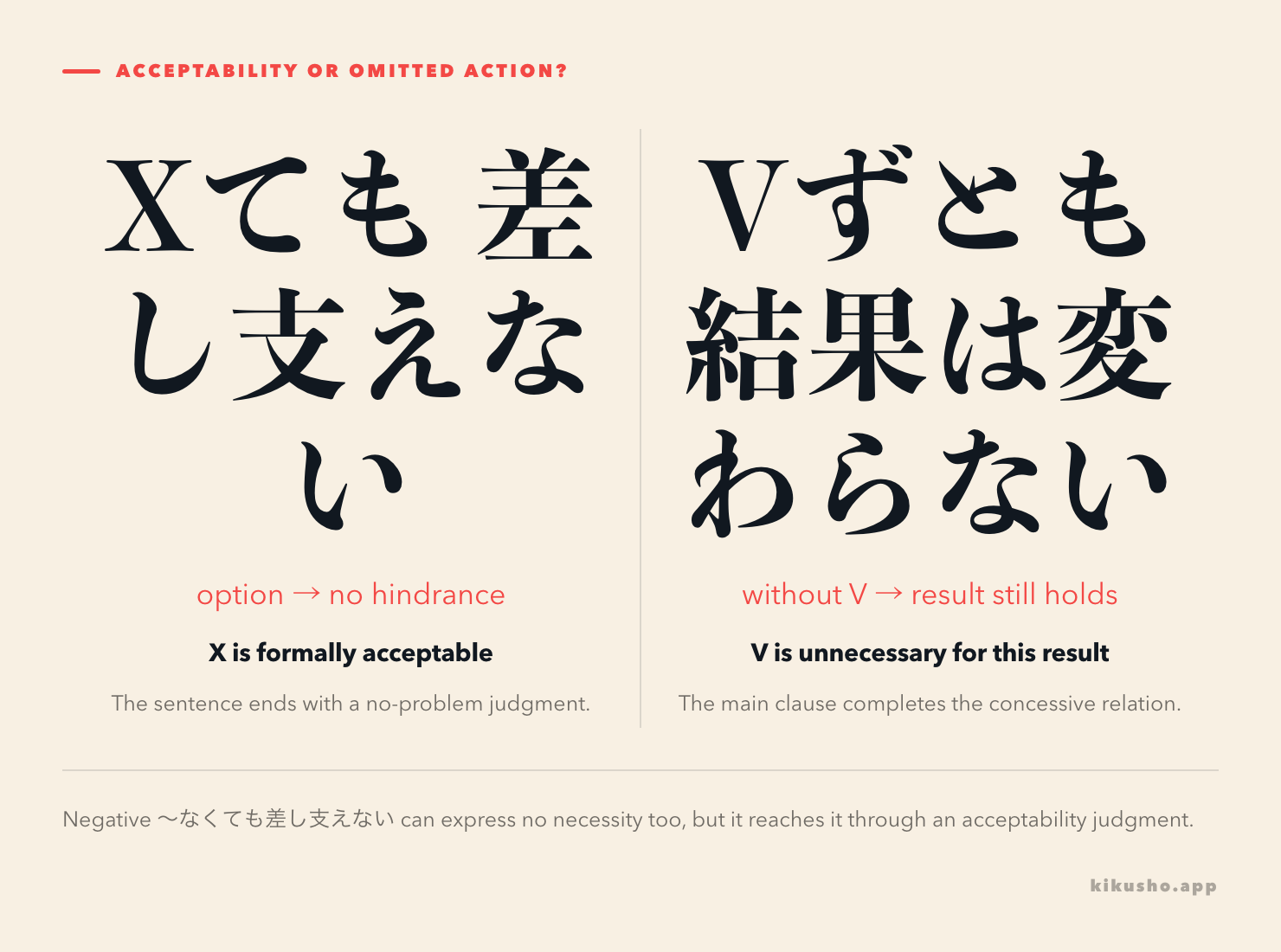
~ても差し支えない gives a formal no-problem judgment
差し支え means an obstacle, inconvenience or hindrance. The negative 差し支えない therefore says that the condition before it does not interfere. As a grammar pattern, this often functions as measured permission or institutional acceptance.
返信は明日になっても差し支えありません。
へんしんは あしたに なっても さしつかえありません。
It is fine if your reply comes tomorrow.
会議には代理人が出席しても差し支えない。
かいぎには だいりにんが しゅっせきしても さしつかえない。
A representative may attend the meeting.
The speaker is not merely describing what is physically possible. They judge the proposed timing or participant acceptable under the relevant rules and circumstances.
The connection follows the ordinary concessive forms:
| Word class | Connection | Example |
|---|---|---|
| verb | Vて + も | 提出しても差し支えない |
| negative verb | Vなくて + も | 出席しなくても差し支えない |
| い-adjective | ~くて + も | 少し遅くても差し支えない |
| な-adjective | ~で + も | 簡単でも差し支えない |
| noun | N + でも | コピーでも差し支えない |
The negative connection changes the direction of what is accepted:
この欄は記入しなくても差し支えありません。
この らんは きにゅうしなくても さしつかえありません。
You do not have to fill in this field.
Not filling in the field is acceptable, so filling it in is unnecessary. This does not prohibit the action. The beginner pattern ~なくてもいい makes the same logical distinction from prohibition in everyday language.
Vずとも makes non-performance concessive
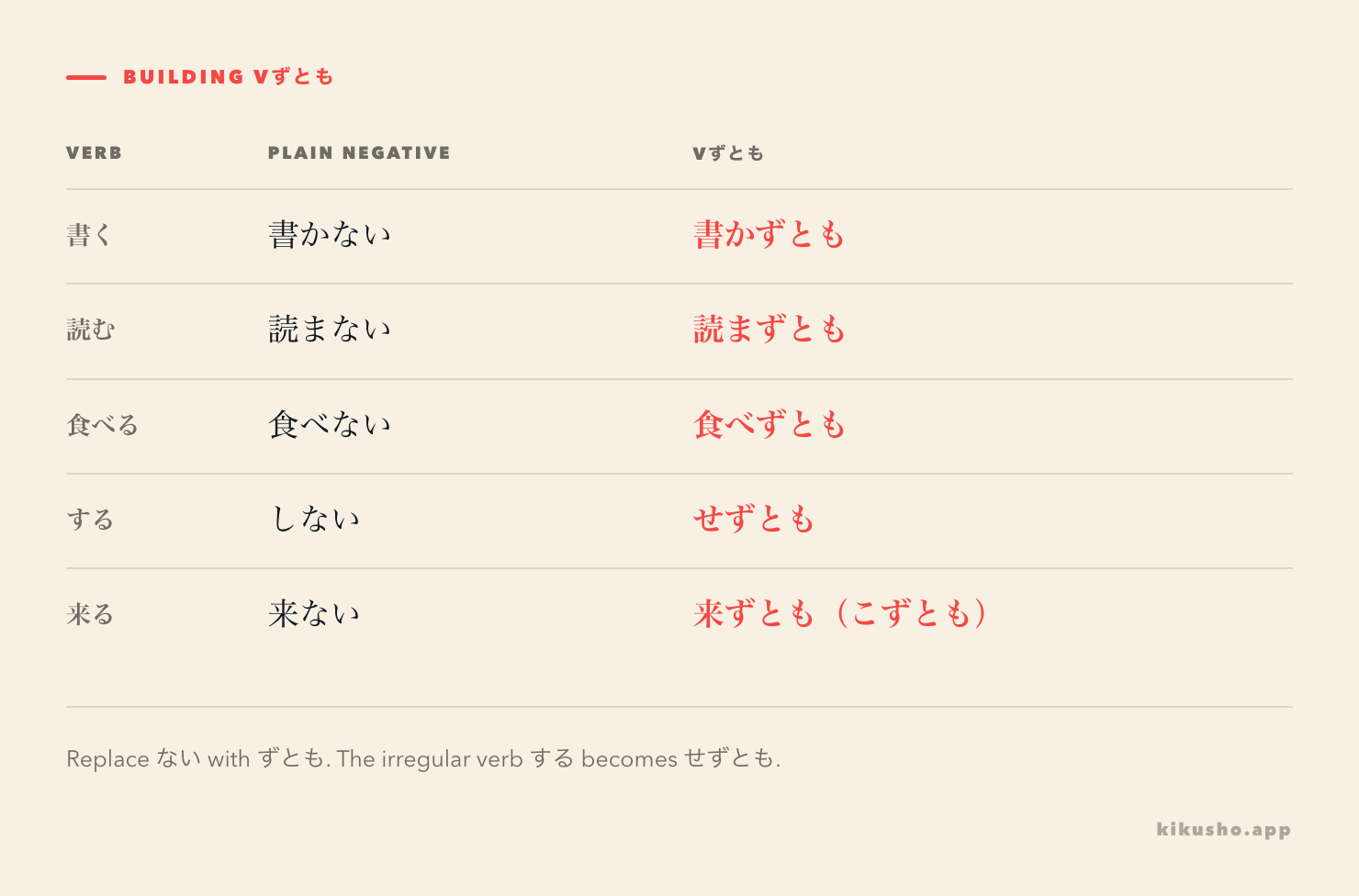
ず is a literary negative form and とも marks concession. Together, Vずとも introduces “even without doing V” and hands the sentence to a main clause that remains valid.
| Dictionary form | Plain negative | Vずとも |
|---|---|---|
| 書く | 書かない | 書かずとも |
| 読む | 読まない | 読まずとも |
| 食べる | 食べない | 食べずとも |
| する | しない | せずとも |
| 来る | 来ない | 来ずとも(こずとも) |
The special する → せずとも deserves deliberate practice. Forms such as しずとも and しないずとも are incorrect.
専門家に相談せずとも、この手順書を読めば設定できる。
せんもんかに そうだんせずとも、この てじゅんしょを よめば せっていできる。
You can configure it by reading this manual, even without consulting a specialist.
すべての例を読まずとも、要点は理解できる。
すべての れいを よまずとも、ようてんは りかいできる。
You can understand the main point without reading every example.
The main clause matters. 相談せずとも alone only supplies a subordinate condition. It does not tell the reader what is possible without the consultation. Add 設定できる, 問題ない, 分かる or another result to complete the thought.
The overlap appears in negative permission
Compare three sentences about the same document:
原本を提出しなくても差し支えありません。
You do not have to submit the original; omitting it poses no problem.
原本を提出せずとも、コピーがあれば申請できます。
Even without submitting the original, you can apply if you have a copy.
原本を提出しなくても、コピーがあれば申請できます。
Even if you do not submit the original, you can apply if you have a copy.
The first is a formal acceptance judgment. The second and third have the same broad concessive logic, but ずとも is more literary and compressed than なくても. In ordinary conversation, なくても is usually the natural choice.
Do not replace affirmative permission with ずとも. ここに座っても差し支えありません says sitting here is permitted. ここに座らずとも… begins “even without sitting here…” and still needs a result. It cannot answer “May I sit here?” by itself.
Register decides which form sounds at home
Both forms belong more readily to careful prose and formal settings than to relaxed conversation. A BCCWJ-based study of permission expressions found ~ても差し支えない more often in Diet proceedings than in the casual question-and-answer material it compared. A Japanese-teacher reference likewise describes ~ても差し支えない as relatively formal and more measured than ~ても構わない.
| Formal or written | Everyday alternative |
|---|---|
| 使用しても差し支えありません | 使ってもいいです |
| 参加しなくても差し支えありません | 参加しなくてもいいです |
| 参加せずとも内容は分かります | 参加しなくても内容は分かります |
The ordinary ~てもいい permission pattern works across far more conversational situations. 差し支えありません suits notices, procedures, professional replies and careful assessments. ずとも suits formal explanation, argument and compact written prose.
Two related shapes are useful but should not be mistaken for the target pattern. 差し支えはない adds the topic particle は without changing the core no-hindrance judgment. 差し支えなければ means “if it is not inconvenient” and commonly introduces a request; it is not the same attachment as Xても差し支えない.
Save the entire relation in Kikusho
For 差し支えない, keep the accepted option with the judgment: コピーでも → 差し支えありません. For ずとも, keep both clauses: 窓口へ行かずとも → オンラインで申請できる. A card containing only ずとも = without hides the feature an N1 question is likely to test: which action is omitted and which result survives.
Work through all eight prompts before revealing the explanations.
Practice
Question 1 — formal permission. An office accepts email submission. Complete the sentence.
申請書はメールで提出しても( )。
- A. 差し支えありません
- B. ずともありません
- C. 差し支えませんず
- D. 提出せずとも
Question 2 — unnecessary consultation. Choose the sentence meaning “You can solve this without asking your supervisor.”
- A. 上司に聞いても差し支えない。
- B. 上司に聞かずとも、この問題は解決できる。
- C. 上司に聞いてずとも、解決してもいい。
- D. 上司に聞かなく差し支えない。
Question 3 — build ずとも. Put these chunks in a natural order.
内容は理解できる/辞書を使わずとも/この文章なら
Question 4 — connection. Choose the correct formal no-necessity sentence.
- A. 参加せずても差し支えありません。
- B. 参加しないでもずともいいです。
- C. 参加しなくても差し支えありません。
- D. 参加せず差し支えてありません。
Question 5 — the する exception. Supply the literary negative of する that fits the blank.
特別な準備を( )、この説明を読めば始められます。
- A. しずとも
- B. せずとも
- C. しないずとも
- D. しなくずとも
Question 6 — two judgments in a notice. Read the notice and select the two forms that preserve its logic.
説明会には代理人が出席しても( 1 )。また、説明会に参加( 2 )、資料は後日ウェブサイトで確認できます。
- A. 差し支えありません/せずとも
- B. ずとも/しなく差し支えない
- C. 差し支えずとも/してもいい
- D. 構いませんず/しないとも
Question 7 — compose formal acceptability. Write a natural sentence saying that a copy, rather than the original, is acceptable.
Question 8 — explain the contrast. Why can ここに座っても差し支えありません answer a permission question, while ここに座らずとも cannot stand as the same answer?
Open the answer notes
1 · Email submission
A, 差し支えありません. 提出しても presents email submission as the option being evaluated, and the polite negative says it creates no problem. D would leave 提出せずとも without a main-clause result.
2 · Solving it independently
B. 聞かずとも is the correct negative concessive of 聞く, and 解決できる states what remains possible without asking. A permits asking the supervisor, which reverses the intended direction.
3 · A text without a dictionary
この文章なら、辞書を使わずとも内容は理解できる。 (この ぶんしょうなら、じしょを つかわずとも ないようは りかいできる). The omitted action comes before ずとも; the surviving result 理解できる completes the relation.
4 · Optional attendance
C. Make 参加する negative as 参加しない, then replace ない with なくても before 差し支えありません. A wrongly combines ず with ても.
5 · The する exception
B, せずとも. The literary negative of する is せず, so the complete concessive form is せずとも. None of the other options is a Japanese conjugation.
6 · A notice with both patterns
A, 差し支えありません/せずとも. The first clause formally accepts a representative's attendance. The second says the materials remain available even without participating in the briefing.
7 · A copy is acceptable
One natural answer is 原本ではなく、コピーでも差し支えありません。 (げんぽんではなく、コピーでも さしつかえありません). The noun connection is Nでも, and the sentence gives a formal no-problem judgment about the copy.
8 · Permission needs the judgment
座っても差し支えありません evaluates sitting and declares it acceptable, so it can grant permission. 座らずとも only means “even without sitting”; it creates a subordinate condition and still needs a result such as 手続きはできます. It neither evaluates sitting as allowed nor completes the sentence by itself.
The reliable split is grammatical as well as semantic. ~ても差し支えない ends the judgment by declaring an option harmless; Vずとも opens a formal concessive condition and relies on the main clause to show what remains true.
OpenAI Codex performed an AI language and exercise review of this version against the cited references. No human reviewer was involved.
Common questions
What is the difference between ~ても差し支えない and Vずとも?
~ても差し支えない formally judges an action, state or option acceptable because it causes no hindrance. Vずとも means even without doing V and introduces a condition under which the result in the main clause still holds; it does not grant permission by itself.
How does ~ても差し支えない attach?
Use the ordinary ~ても/~でも forms: verb て-form + も, い-adjective ~くても, な-adjective or noun + でも. A negative verb uses ~なくても差し支えない and says that omitting the action poses no problem.
How do you form Vずとも?
Start from the verb's ない-form, replace ない with ずとも, and remember that する becomes せずとも. Thus 書かない becomes 書かずとも, 食べない becomes 食べずとも and 来ない becomes 来ずとも, read こずとも.
Is Vずとも the same as Vなくても?
Their core concessive meaning can overlap, but Vずとも is markedly formal and written. Vなくても is the ordinary modern choice in conversation. Both need a main clause that states what remains possible, true or sufficient without the action.