On this page
Use Vても知らない when a speaker warns about an unwanted outcome and distances themself from responsibility if it happens. Use さもないと after an instruction or necessary condition to mean “otherwise” and introduce the consequence of not following it.
もう出発しないと、電車に遅れても知らないよ。
もう しゅっぱつしないと、でんしゃに おくれても しらないよ。
If you do not leave now, do not blame me if you miss the train.
もう出発してください。さもないと、電車に遅れます。
もう しゅっぱつしてください。さもないと、でんしゃに おくれます。
Please leave now. Otherwise, you will miss the train.
Both utterances warn about the same risk. The first adds a relationship between speaker and listener: “I warned you; I am not responsible.” The second connects the instruction to its if-not consequence without necessarily saying anything about the speaker's future help.
This lesson covers inventory item g-12b90f7a2ef0, ても知らない, and g-89aad3dc956b, さもないと. JLPT Sensei places both ~ても知らない and さもないと at N1. An independent teacher-written account instead labels ~ても知らない outside its JLPT list, while still confirming the same conversational warning use. These labels are study estimates because the JLPT does not publish an exhaustive grammar syllabus.
Look for stance or logical connection
| Form | Grammatical job | What the warning adds | Typical home |
|---|---|---|---|
| Vても知らない | sentence ending after an unwanted outcome | the speaker disclaims responsibility or help | direct conversation |
| さもないと + consequence | connector meaning “if that is not so” | the consequence of ignoring the preceding step | speech, instructions and prose |
The forms are not interchangeable slots. 遅れても知らない can end the sentence. さもないと points backward to the condition before it and forward to a consequence after it.
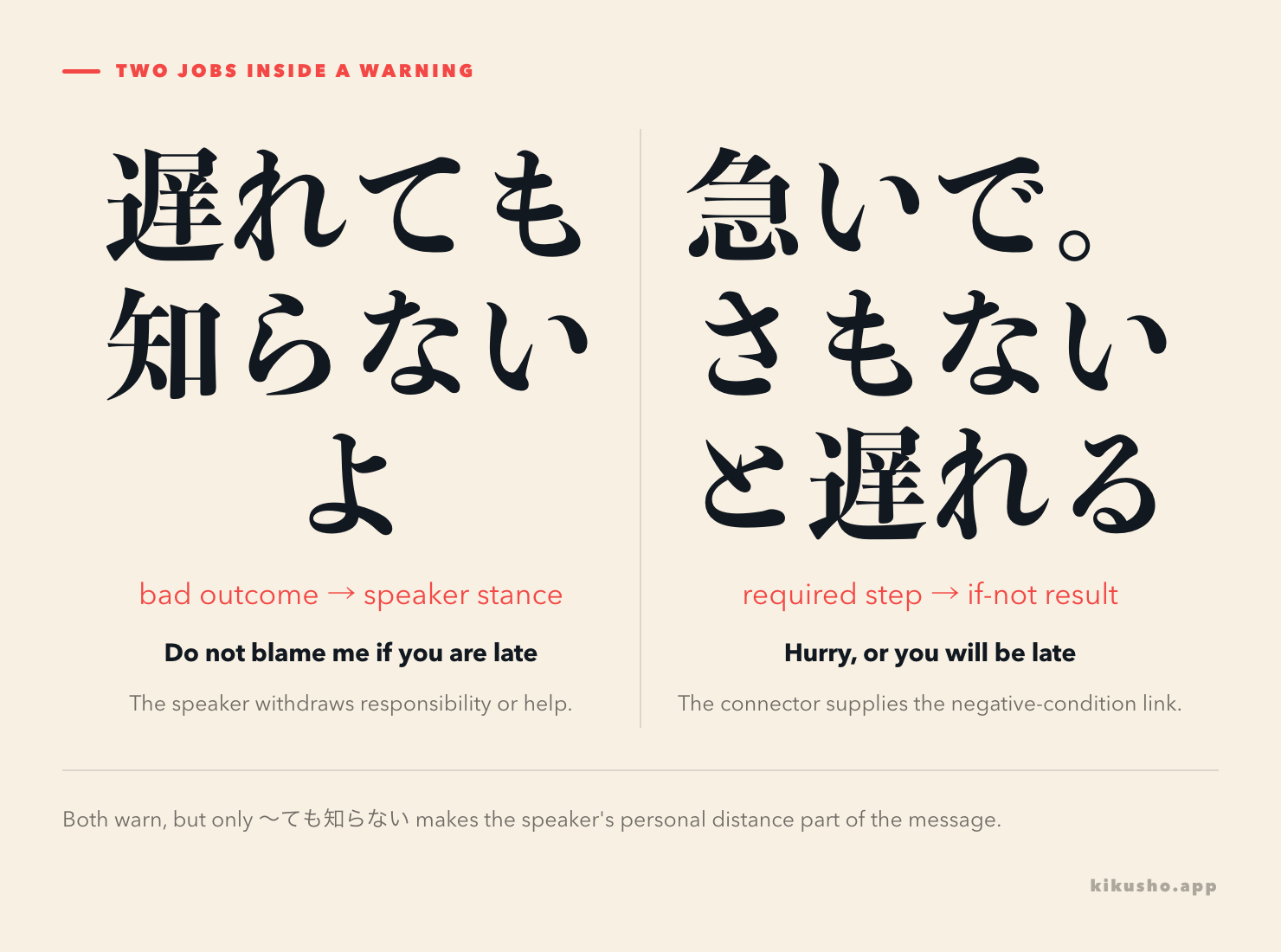
~ても知らない makes the speaker's distance audible
Build the form with the outcome verb's ordinary て-form plus も知らない:
| Dictionary form | て-form | Warning ending |
|---|---|---|
| 遅れる | 遅れて | 遅れても知らない |
| 忘れる | 忘れて | 忘れても知らない |
| 壊す | 壊して | 壊しても知らない |
| 風邪をひく | 風邪をひいて | 風邪をひいても知らない |
The verb normally names the trouble the listener may bring about. The speaker has seen the risk, issues a warning, and says in effect that the listener cannot later demand sympathy, rescue or responsibility.
そんなに夜更かしして、明日寝坊しても知らないよ。
そんなに よふかしして、あした ねぼうしても しらないよ。
If you stay up that late and oversleep tomorrow, do not say I did not warn you.
大事なファイルを確認せずに消しても知らないからね。
だいじな ファイルを かくにんせずに けしても しらないからね。
If you delete an important file without checking it, do not expect me to take responsibility.
Endings such as よ, からね and わよ often make the interpersonal force clearer. They do not change the attachment. The expression can sound caring, exasperated or scolding depending on the relationship, but it is rarely a neutral institutional warning.
The ordinary meaning of 知らない is still visible, yet this is not a factual report about knowledge. 結果を知らない means “I do not know the result.” 失敗しても知らないよ uses the whole construction to warn: failure may occur, and the listener has been put on notice.
さもないと builds an if-not chain
さもないと is a connector. The first unit states what must be done or what must be true; the second states what follows if that condition is not satisfied.
必ずバックアップを取ってください。さもないと、データを失うおそれがあります。
かならず バックアップを とってください。さもないと、データを うしなう おそれが あります。
Be sure to make a backup. Otherwise, there is a risk of losing your data.
締め切りまでに申請してください。さもないと、審査を受けられません。
しめきりまでに しんせいしてください。さもないと、しんさを うけられません。
Apply by the deadline. Otherwise, you cannot be considered.
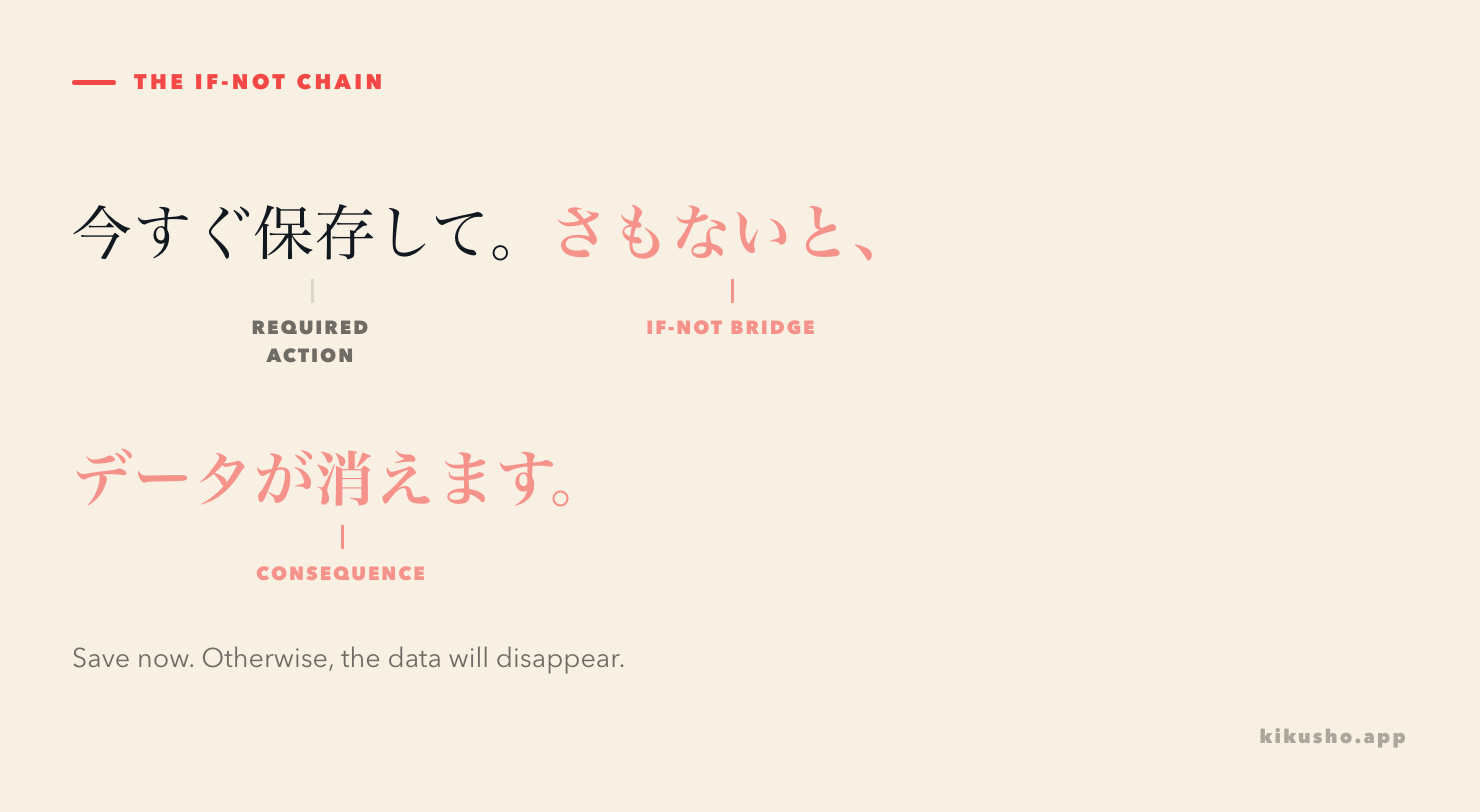
The consequence is often unwanted because warnings motivate action through risk. It need not be a threat from the speaker. A manual can describe equipment failure, a notice can describe lost eligibility, and an explanation can state a logical problem.
The variant さもなければ also means “otherwise” and fits formal prose. Academic work on advanced connectors classifies さもないと, さもなければ and そうしないと as negative-condition expressions. そうしないと is the transparent everyday alternative: “if you do not do that.”
The missing condition belongs to the previous sentence
The internal logic of さもないと is close to “if it is not so,” so it cannot introduce an unrelated bad event.
パスワードを変更してください。さもないと、アカウントが危険にさらされます。
Please change your password. Otherwise, the account will be exposed to risk.
The account risk follows from not changing the password. If the second clause merely says 明日は雨です, the connector would wrongly imply that changing the password affects tomorrow's weather.
This also separates さもないと from a general sequence marker such as その後. その後 means “after that” and does not negate the preceding action. さもないと specifically constructs the alternative in which the preceding requirement is not met.
The two warnings can occur together
A speaker can state the logical risk and then add their own stance:
今すぐ作業を保存して。さもないと、全部消えても知らないよ。
いますぐ さぎょうを ほぞんして。さもないと、ぜんぶ きえても しらないよ。
Save your work now. Otherwise, if it all disappears, do not blame me.
The structure is layered:
- 今すぐ作業を保存して gives the required action.
- さもないと opens the alternative where the listener does not save.
- 全部消えても知らないよ names the bad outcome and withdraws responsibility.
Their ability to coexist proves that they do different jobs. Replacing either one would remove either the if-not link or the speaker's stance.
Register changes the warning's social effect
~ても知らない belongs naturally to direct conversation between people who can speak personally. An adult may warn a child, or a friend may warn another friend. Used toward a customer or superior, it can sound dismissive because it foregrounds refusal of responsibility.
さもないと is serious but not inherently rude. JapaneseTest4You records both さもないと and さもなければ between a prior condition and its result. In a formal notice, the politeness of the instruction and the factual wording of the consequence can keep the warning professional.
For nearby risk language, ~かねない says that an unwanted result could occur without building the two-sentence “do this, otherwise…” chain. The conditional ~ては warning lesson instead places a troublesome condition inside one sentence.
Capture the full warning in Kikusho
Save 遅れても知らないよ with the relationship note “speaker disclaims responsibility,” not the bare gloss “do not know.” For さもないと, keep both sides: 期限までに申請する → さもないと → 審査を受けられない. The consequence is what gives the connector its logic.
Answer all eight prompts before opening the explanation block.
Practice
Question 1 — speaker stance. A friend has repeatedly warned Ken to back up his work. Which ending adds “do not blame me if it disappears”?
- A. 消えても知らないよ
- B. 消えるさもないと
- C. 消えても知っているよ
- D. 消えずとも知らないよ
Question 2 — the connector. Complete the notice.
午後五時までに申請してください。( )、今回の審査を受けられません。
- A. それなのに
- B. さもないと
- C. その後
- D. ても知らない
Question 3 — build the warning. Put the chunks in a natural order.
風邪をひいても知らないよ/薄着のまま外に出たら
Question 4 — logical fit. Which pair has a real if-not relationship?
- A. 窓を閉めてください。さもないと、雨が部屋に入ります。
- B. 窓を閉めてください。さもないと、富士山は高いです。
- C. 窓を閉めても知らない。雨が部屋に入りません。
- D. 窓を閉めずとも知らない。今日は火曜日です。
Question 5 — conversation or notice. A parent tells a child that they have already warned them about oversleeping. Choose the most natural ending.
そんなに遅くまで起きて、明日寝坊しても( )。
- A. 知らないよ
- B. さもないと
- C. そうした後
- D. 知られている
Question 6 — two layers. Choose the pair that supplies both the negative-condition bridge and the speaker's disclaimer.
今すぐ保存して。( 1 )、データが全部消えても( 2 )。
- A. さもないと/知らないよ
- B. ても知らない/さもないと
- C. その後/知っているよ
- D. さもなければならない/知られている
Question 7 — write a formal warning. Use さもないと to tell applicants to attach the required document or their application cannot be accepted.
Question 8 — explain the distinction. In 急いで。さもないと、遅れても知らないよ, what separate job does each target expression perform?
Reveal the warning analysis
1 · Responsibility for lost work
A, 消えても知らないよ. The unwanted outcome comes before ても知らない, and the speaker distances themself from responsibility after repeated advice. C promises awareness rather than issuing this warning.
2 · A missed review window
B, さもないと. The connector refers back to applying by five and introduces the consequence of not doing so. その後 would only order the events and would not create the negative condition.
3 · Going out underdressed
薄着のまま外に出たら、風邪をひいても知らないよ。 (うすぎのまま そとに でたら、かぜを ひいても しらないよ). The たら clause supplies the risky behaviour; 風邪をひいても知らない names the feared result and the speaker's stance.
4 · A consequence that follows
A. Leaving the window open can allow rain into the room, so the second sentence is a genuine consequence of ignoring the request. The other choices connect unrelated facts or misuse the target forms.
5 · A parent's warning
A, 知らないよ. The sentence already contains 寝坊しても, and the parent speaks personally after warning the child. さもないと would need to connect the prior instruction to a following consequence instead.
6 · Connector plus stance
A, さもないと/知らないよ. さもないと creates the alternative where the listener fails to save. 消えても知らないよ then names the loss and adds the speaker's refusal of responsibility.
7 · Required attachment
One natural answer is 必要書類を添付してください。さもないと、申請を受理できません。 (ひつようしょるいを てんぷしてください。さもないと、しんせいを じゅりできません). The first sentence states the requirement and the second gives the institutional consequence of omitting it.
8 · Two jobs in one warning
さもないと means “if you do not hurry” and links the command to the risk of being late. 遅れても知らないよ adds the speaker's stance: the listener has been warned and should not expect the speaker to accept responsibility for the lateness.
The most reliable clue is the warning's grammar. Vても知らない closes the utterance with a personal disclaimer; さもないと sits between a necessary step and the consequence of not taking it.
This lesson's Japanese, translations and eight exercises received an AI review by OpenAI Codex using the references above. It has not received a human language review.
Common questions
What is the difference between ~ても知らない and さもないと?
~ても知らない presents an unwanted outcome and warns that the speaker will not take responsibility or help if it occurs. さもないと means otherwise and connects a required action or condition with the consequence that follows if it is not met.
How does ~ても知らない attach?
Put the outcome verb in its て-form and add も知らない: 遅れる becomes 遅れても知らない, and 忘れる becomes 忘れても知らない. In this warning use, the verb normally names the trouble the listener risks.
Where does さもないと appear in a sentence?
It usually follows a complete instruction, recommendation or necessary condition and introduces a new clause: 今すぐ保存してください。さもないと、データが消えます. The variant さもなければ has the same otherwise relation.
Is ~ても知らない literally about lacking knowledge?
The words retain the image of saying I do not know, but the construction is pragmatic: the speaker has warned the listener and distances themself from responsibility for the possible result. A neutral statement of ignorance needs a different sentence.