On this page
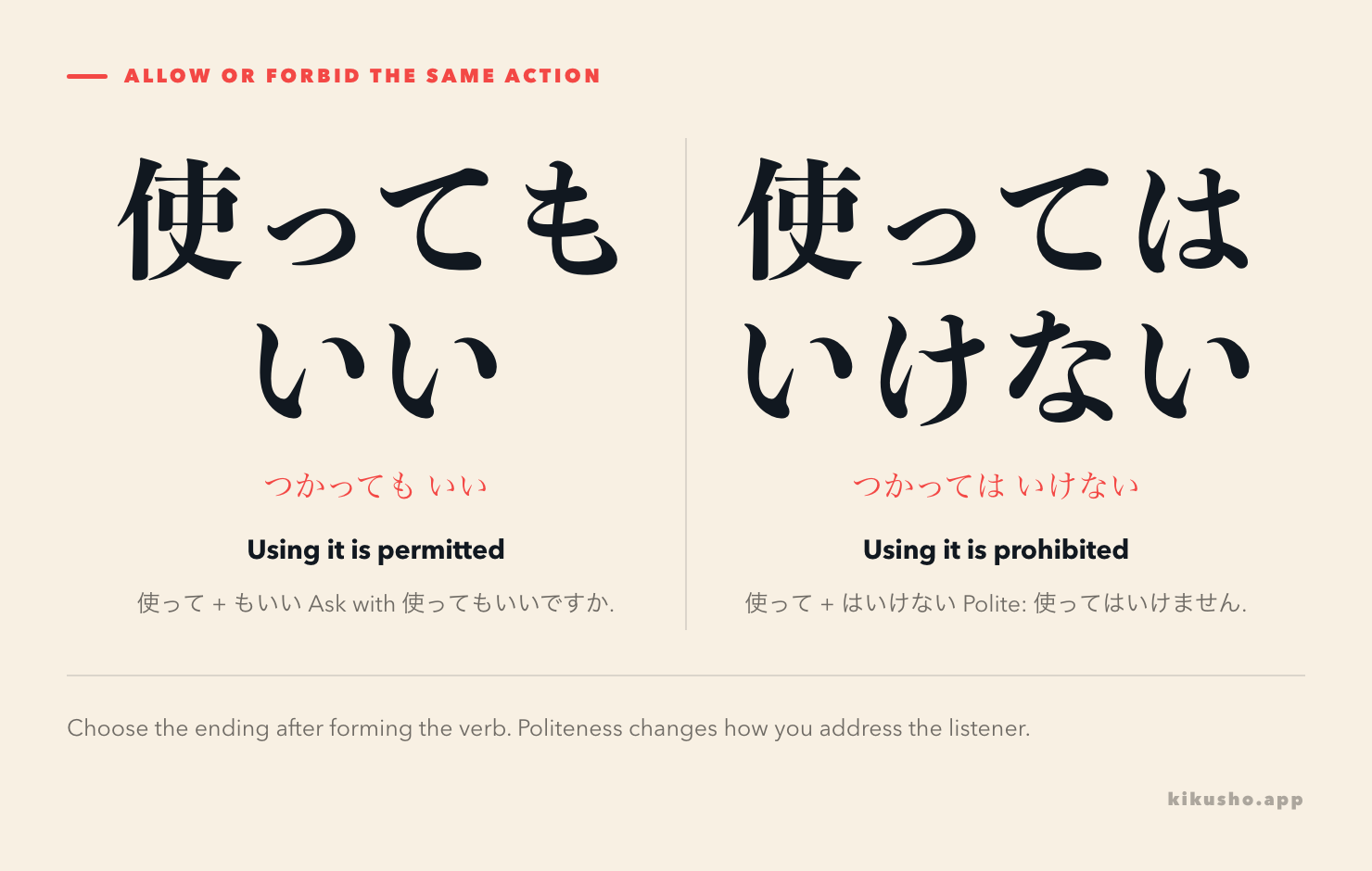
At a library counter, パソコンを使ってもいいですか asks whether you may use a computer. パソコンを使ってはいけません gives the opposite rule: you must not use it. The action stays the same; もいい accepts it, while はいけない rules it out.
Ask whether the action is acceptable, then choose the ending
Verb て-form + もいい expresses permission or acceptance. Verb て-form + はいけない expresses prohibition. Add ですか to the permission pattern when you are asking rather than granting it. Make the prohibition polite by changing いけない to いけません; its force remains “must not.”
This N5 grammar comparison teaches three assigned constructions: てもいいです, てはいけない, and the spoken ちゃいけない・じゃいけない forms. The specific JLPT Sensei entries classify permission and spoken prohibition as N5. Bunpro's てはいけない entry also says N5, while PassJapanese's permission page says N4. Those labels guide study order; they do not establish an exhaustive official exam syllabus.
Make the verb's て-form before adding either pattern
The endings attach to 使って, not dictionary-form 使う or polite 使います. When 読む becomes 読んで, the ending begins immediately after で: 読んでもいい or 読んではいけない.
| Dictionary verb | Linking form | Permission | Prohibition |
|---|---|---|---|
| 書く(かく) | 書いて | 書いてもいい | 書いてはいけない |
| 使う(つかう) | 使って | 使ってもいい | 使ってはいけない |
| 読む(よむ) | 読んで | 読んでもいい | 読んではいけない |
| 泳ぐ(およぐ) | 泳いで | 泳いでもいい | 泳いではいけない |
| 食べる(たべる) | 食べて | 食べてもいい | 食べてはいけない |
| する | して | してもいい | してはいけない |
These forms assume you can already build the verb て-form. That lesson supplies the sound changes; the choice here comes afterward. Do not append another て to 読んで, or use 読むもいい for permission. Tofugu's permission reference checks that the verb supplies its whole linking form, including a final で.
~てもいいですか asks; ~てもいいです gives the go-ahead
Imagine you want to borrow something from a colleague's desk:
このペンを借りてもいいですか。
この ペンを かりても いいですか。
“May I borrow this pen?”
You are asking whether your borrowing is acceptable. A clear affirmative reply can repeat the same action:
はい、借りてもいいですよ。
はい、かりても いいですよ。
“Yes, you may borrow it.”
The listener grants permission. はい、どうぞ (“Yes, go ahead”) is another natural reply in this situation. The University of Texas JOSHU reference distinguishes asking with ですか from granting with です. Mayumi Ito's Mango Languages permission guide explains when a go-ahead reply fits someone seeking personal approval.
Compare このペンを借りてください, “Please borrow this pen.” That てください request asks the listener to perform the action. 借りてもいいですか instead seeks approval for the speaker's intended action. The difference is who will borrow the pen, not merely which expression has more syllables.
In familiar conversation you can ask 借りてもいい?; intonation carries the question without ですか. 借りていい? is also possible for this ordinary permission request. Dropping も here makes it shorter and more direct. Do not treat that as a rule for every expression containing てもいい: its other uses can depend on も.
Acceptance can concern a condition rather than an action
The same もいい can accept a state. With an い-adjective, use くて + もいい; with a な-adjective or noun, use で + もいい.
| Accepted condition | Example | Meaning |
|---|---|---|
| An い-adjective | 答えは短くてもいいです。 | It's fine if the answer is short. |
| A な-adjective | 説明は簡単でもいいです。 | It's fine if the explanation is simple. |
| A noun | 昼ご飯はパンでもいいです。 | Bread is fine for lunch. |
Read 答え(こたえ), 短い(みじかい), 説明(せつめい), 簡単(かんたん), and 昼ご飯(ひるごはん). These are accepted conditions, rather than permission for a named person to act. The JLPT Sensei attachment table gives these word-class patterns. Keep the verb-action comparison as your starting point for asking what you may do.
~てはいけない forbids doing it
ここでは電話で話してはいけません。
ここでは でんわで はなしては いけません。
“You must not talk on the phone here.”
The notice prohibits the action. It does not say that speaking is physically impossible, or that you simply need not do it. ここでは sets the place where the rule applies. The later は belongs to 話してはいけません; both particles can occur in one sentence because they have different jobs.
The plain ending is 話してはいけない. The polite ending 話してはいけません is appropriate when stating a rule to a visitor, but it still asserts a prohibition. JLPT Sensei's prohibition page supplies both endings; Mango's independently authored prohibition guide discusses rules and the strength of directly forbidding something.
For this pattern, retain は after the linking form. Permission uses もいい, and prohibition uses はいけない. Replacing only いい with いけない does not build the prohibition taught here. Nor does adding ません to the earlier action verb produce this construction: keep 話して intact and make the final いけない polite.
Spoken ちゃ and じゃ preserve the prohibition
ちゃいけない・じゃいけない are conversational contractions of the full pattern. Recover ては from ちゃ, and では from じゃ. The verb's linking form decides which route you take.
| Full expression | Spoken expression | Reading of the spoken form |
|---|---|---|
| 書いてはいけない | 書いちゃいけない | かいちゃ いけない |
| 使ってはいけない | 使っちゃいけない | つかっちゃ いけない |
| 読んではいけない | 読んじゃいけない | よんじゃ いけない |
| 泳いではいけない | 泳いじゃいけない | およいじゃ いけない |
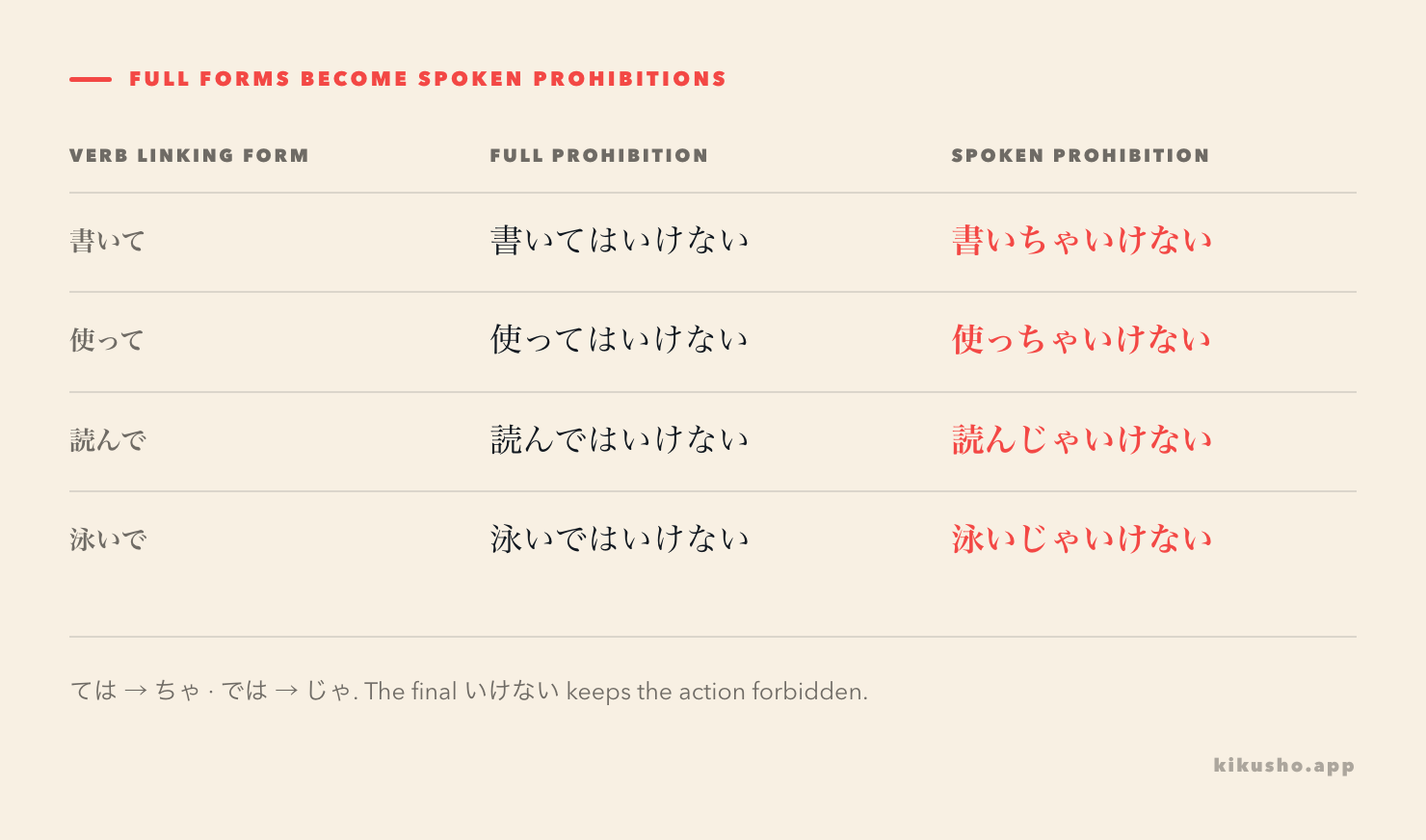
Do not replace 読む directly with 読むじゃいけない, or choose ちゃ just because it looks familiar. Start from 読む → 読んで → 読んでは → 読んじゃ. For the contracted forms, the JLPT Sensei lesson also shows a spoken だめ ending. 書いちゃだめ (かいちゃ だめ) and 読んじゃだめ (よんじゃ だめ) still forbid writing and reading. Shortening does not make those actions permissible.
You may also hear ちゃいけません or じゃいけません: a spoken contraction with a polite ending. The contraction and the level of politeness are separate choices. They need not move together.
A polite ending does not give you authority over the listener
Permission language has a social setting. An owner can allow you to borrow a pen; a staff member can explain a library rule. Telling a senior colleague what they are “allowed” to do may sound as though you are deciding for them. Ask about your own proposed action when that is what you mean.
Likewise, てはいけません states a rule or a firm boundary. It is not automatically a tactful substitute for every personal “please don't.” Check whether you are reporting a rule, protecting a boundary or issuing an instruction. Mango's prohibition guide discusses the strength of forbidding an action. Politeness alone does not settle it.
English “can” can mean either permission or ability. If your question concerns whether a person has the skill or opportunity to do something, continue with Japanese potential forms. “Must not” also differs from “do not have to”: the former forbids, while the latter leaves an action optional. The obligation lesson handles the separate route to “must.”
Finally, a phrase containing ては does not always end in a prohibition. The later ては・では warning lesson covers conditional consequences and recurring actions. Here, いけない is what makes the full expression a prohibition.
If you hear 読んじゃいけない, a vocabulary card for 読む alone loses the instruction. Kikusho's voice capture can retain an example and a register note on an editable card. Check that its saved meaning preserves “must not” and the situation where you heard it; the shorter sound needs the same boundary as the full sentence.
Practice: try all six before opening the solutions
Use the given setting and the requested level of politeness.
Question 1: complete a statement. A librarian explains that reading books is permitted in this room. Complete この部屋では、本を__。
- A. 読んではいけません
- B. 読んでもいいです
- C. 読むもいいです
- D. 読んでもいいですか
Question 2: ask about your action. You want to borrow an eraser. Choose the standard polite permission question: 消しゴムを__。
- A. 借りてはいけません
- B. 借りるもいいですか
- C. 借りてもいいですか
- D. 借りてください
Question 3: assemble a rule. Arrange these chunks to say “You must not speak here,” using the polite form. Write the complete sentence and identify the chunk that occupies ★: (1) (2) ★ (4)。
- A. いけません
- B. ここで
- C. は
- D. 話して
Question 4: rewrite the message. Change その水を飲んじゃいけない。 into an uncontracted polite prohibition. Keep その水を unchanged.
Question 5: follow the notice. Read this library instruction:
ここではパソコンを使ってもいいです。でも、音を出してはいけません。音は消してください。
Which account preserves both rules?
- A. Computers may be used with their sound on.
- B. Every visitor must use a computer.
- C. Computers may be used, but their sound must be off.
- D. Computers may not be used at all.
Question 6: interpret the spoken ending. Someone says その箱を開けちゃいけない。 What instruction does this give?
- A. You may open that box.
- B. Opening that box is physically impossible.
- C. You need not open that box, but you may.
- D. You must not open that box.
Record six selections or sentences before moving to the numbered explanations.
Answers and explanations
Answer 1: B. 読んでもいいです states that reading is allowed. A forbids it, C skips the required 読んで linking form, and D turns the statement into a question. Read 部屋 as へや and 本 as ほん.
Answer 2: C. 消しゴムを借りてもいいですか。 (けしゴムを かりても いいですか) asks permission for your borrowing. A forbids borrowing, B attaches to dictionary-form 借りる, and D asks the listener to borrow it. The subject of the intended action changes in D.
Answer 3: B → D → C → A; ★ is C. ここで話してはいけません。 (ここで はなしては いけません) keeps the location first and builds 話して + は + いけません. The star checks the internal order, not merely recognition of the word いけません.
Answer 4: その水を飲んではいけません。 (その みずを のんでは いけません) expands じゃ to では, because 飲む has the linking form 飲んで. Then いけない becomes polite いけません. 飲んでもいいです would grant permission and reverse the warning.
Answer 5: C. Computer use is permitted by 使ってもいいです; producing sound is forbidden by 音を出してはいけません. The final request reinforces the sound restriction. 音を消す(おとをけす) means turn the sound off here. A ignores the prohibition, B invents an obligation, and D erases the permission.
Answer 6: D. 開けちゃいけない (あけちゃ いけない) expands to 開けてはいけない. The speaker forbids opening the box. A reverses the decision, B describes inability rather than this rule, and C confuses a prohibition with an optional action. 箱 is はこ; the relevant question is whether opening is permitted, regardless of whether the lid is easy to lift.
Common questions
How do I ask permission with ~てもいい?
Put the action verb in its て-form and add もいいですか. For example, 借りてもいいですか asks whether you may borrow something. Without か, 借りてもいいです states that borrowing is acceptable or permitted.
Does ~てはいけません mean do not have to?
No. It forbids doing the action: 読んではいけません means you must not read it. Do not have to removes an obligation and leaves the action optional; that is a different construction.
Where do ちゃ and じゃ come from in prohibitions?
Conversational ては becomes ちゃ, while では becomes じゃ. Thus 書いてはいけない becomes 書いちゃいけない, and 読んではいけない becomes 読んじゃいけない. The following いけない or だめ keeps the phrase a prohibition.
Are these forms N5 or N4 grammar?
This curriculum teaches them at N5, following the specific JLPT Sensei entries; Bunpro also places てはいけない at N5. Other teaching lists, including PassJapanese for てもいい, use N4. These are study estimates, not an exhaustive official JLPT syllabus.